Reviewing the best fly fishing rod racks starts with a practical truth: expensive rods fail early when storage is an afterthought. In my own gear room, the biggest jump in rod longevity did not come from a new tube or better case; it came from using the right rack for the way I actually fish, travel, and dry equipment. A fly fishing rod rack is any storage system designed to hold assembled rods, broken-down sections, or rod-and-reel combinations safely and accessibly. Good racks prevent bent tips, crushed guides, reel damage, and the small knocks that slowly turn premium tackle into unreliable tackle.
This matters because fly fishing equipment is unusually vulnerable. Graphite blanks are light and strong under load, yet susceptible to impact damage. Guides can deform, cork can collect moisture, and reels exposed to accidental bumps or floor grit wear faster than many anglers realize. Most modern fly rods also represent a meaningful investment. A quality trout setup often costs several hundred dollars, while saltwater and spey outfits can push well beyond a thousand. Storing them on garage hooks, leaning them in a corner, or stacking them in a truck bed is a costly mistake.
The best fly fishing rod racks solve three problems at once: protection, organization, and convenience. Protection means secure spacing, soft contact points, and stable support. Organization means you can separate freshwater, saltwater, and travel setups, identify line weights quickly, and avoid tangles. Convenience means grabbing the right rod before dawn without digging through tubes. For anglers building a serious equipment system, rod racks also support maintenance habits. When rods and reels are visible, they are more likely to be rinsed, dried, inspected, and repaired before the next trip.
As a hub for equipment reviews, this guide covers the main rack types, key buying criteria, leading product styles, and the tradeoffs that matter in real use. Whether you store two trout rods in an apartment, ten guide rods in a drift boat garage, or a mixed collection of spey, surf, and travel rods, choosing the right rack improves both gear protection and fishing readiness.
What Makes a Fly Fishing Rod Rack Worth Buying
The best fly fishing rod racks are built around fit, stability, and material quality. Fit sounds obvious, but many rod racks marketed for general fishing are designed for heavier conventional rods with larger butt diameters and less concern for delicate guide alignment. Fly rods need support that does not pinch thin blanks or force rods into awkward angles. The ideal rack supports rods vertically or horizontally with enough spacing to prevent reel handles, stripping guides, and line loops from catching one another.
Stability is the second requirement. A freestanding rack that tips when one rod is removed is not a bargain. Wall-mounted systems must anchor securely into studs or use appropriate masonry hardware. In testing and setup work, I have found that the safest systems spread load across multiple mounting points and use lower cradles deep enough to keep rods from bouncing free when a door slams or a dog brushes past. If a rack is for a boat, truck, or trailer, vibration resistance matters even more.
Material quality determines how the rack behaves over years, not weeks. Wood racks, especially those made from oak, maple, or marine-grade teak, look excellent and are structurally solid, but finish quality matters in humid basements and coastal climates. Powder-coated steel offers strength and a clean utility-room appearance, though bare contact points should always be padded. Molded polymer and high-density foam systems resist moisture well and are often the most practical for garages or skiffs. Cheap felt or low-grade EVA compresses over time, exposing blanks to harder surfaces.
A useful buying checklist includes capacity, assembled-versus-broken-down storage, reel clearance, mounting footprint, corrosion resistance, and ease of cleaning. Capacity should include future growth. Most anglers outgrow small racks quickly, especially once euro nymph, streamer, dry fly, and backup setups accumulate. Reel clearance is often overlooked; large arbor reels and fighting butts need more room than product photos suggest. Cleaning also matters. Salt crystals, dust, and garage debris collect on lower supports, so smooth, wipeable surfaces are preferable to deep carpeted recesses.
Types of Rod Racks and Where Each Works Best
Wall-mounted racks are the most efficient choice for home storage. They keep rods off the floor, use vertical space well, and make it easy to organize by species or line weight. In a dedicated gear room, a two-piece horizontal wall rack is often the cleanest solution for fully assembled rods. The top section supports tips while the lower section cradles butts or reels. This layout reduces vertical ceiling requirements and keeps rods visible. For anglers with standard eight- to nine-foot trout rods, horizontal wall storage is usually the best balance of safety and accessibility.
Vertical floor racks work well in garages, cabins, and retail-style gear corners. They are simple to install because they need no wall drilling, and they can hold many outfits in a small footprint. Their weakness is mobility and exposure. If the rack sits near a walkway, rod tips are vulnerable. Vertical systems also place the highest guides and tips near overhead hazards such as garage door tracks, shelves, or hanging tools. They are best when placed in protected corners and used for assembled rods that are regularly rotated.
Ceiling racks are useful in space-constrained garages and workshops. They can store broken-down rods in tubes or assembled rods overhead, but they are less convenient for daily access. I recommend ceiling storage mainly for backup outfits, seasonal saltwater rods, or long spey rods that otherwise dominate wall space. The key is clearance: if rods sit above vehicle roofs, ladders, or fluorescent fixtures, retrieval becomes awkward and risky.
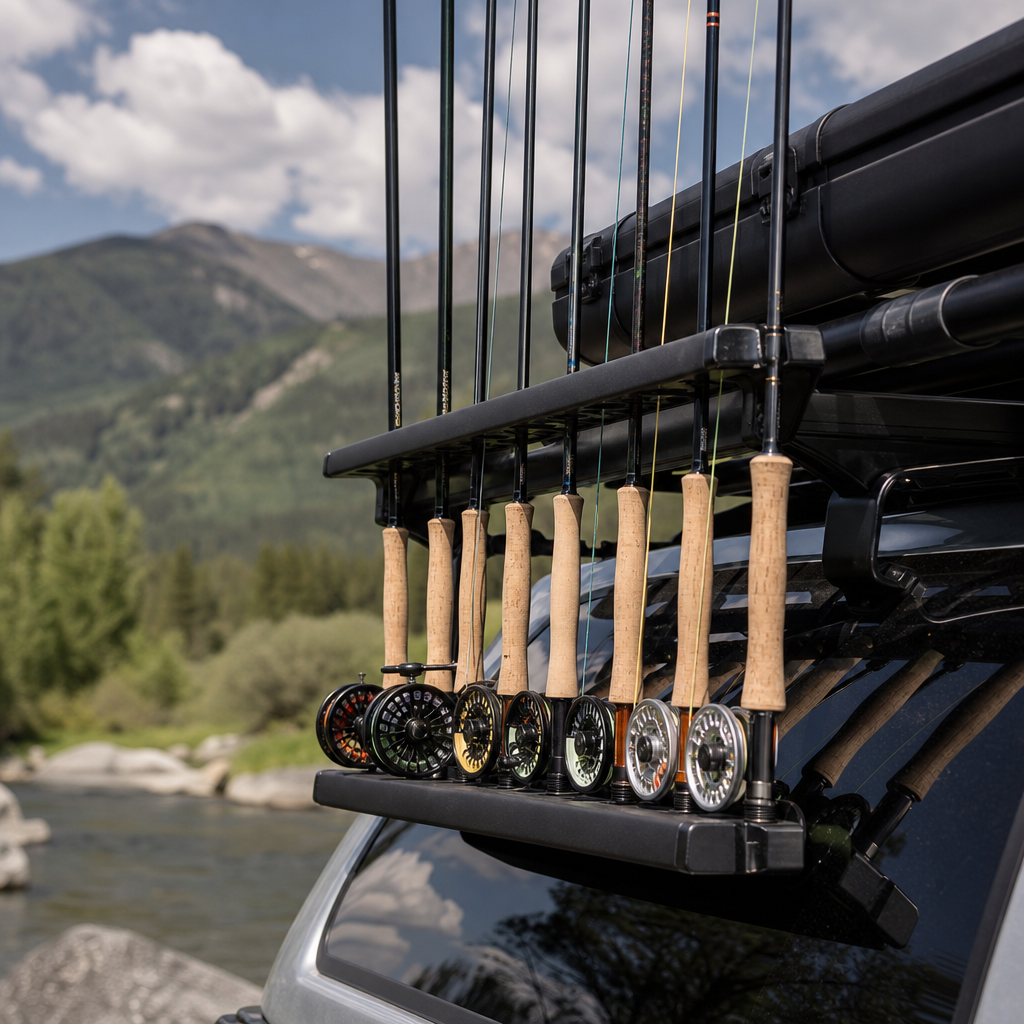
Vehicle and boat racks are a distinct category. Their job is not long-term storage but protected transport between spots. Truck interior racks, raft frames, drift boat holders, and skiff gunwale systems must account for vibration, sun exposure, and sudden impacts. For fly gear, foam-lined clips and secure reel positioning are essential. Many general-purpose vehicle racks work poorly with fly reels because handles snag and frames get knocked during loading. In transport systems, retention strength is more important than display value.
| Rack Type | Best Use | Main Advantage | Main Limitation |
|---|---|---|---|
| Wall-mounted horizontal | Home gear rooms, offices, cabins | Excellent visibility and protection for assembled rods | Requires wall space and proper mounting |
| Vertical floor rack | Garages, lodges, guide operations | High capacity in a small footprint | Tips remain exposed to traffic and overhead hazards |
| Ceiling rack | Seasonal or backup storage | Uses unused overhead space | Least convenient for frequent access |
| Vehicle or boat rack | Transport between fishing locations | Prevents tangles and impact during travel | Not ideal for long-term indoor storage |
Best Fly Fishing Rod Rack Designs for Different Anglers
For most freshwater anglers, the best fly fishing rod rack design is a horizontal wall system with padded slots and wide reel spacing. This format works because trout, bass, and light salmon outfits are often stored assembled between trips. Brands and custom builders commonly use routed wood faces with EVA or felt inserts, and the best versions hold the blank securely without scraping wraps. A six-rod capacity is the practical minimum for anglers who fish multiple techniques. Four rods sounds adequate until one backup, one guest rod, and one experimental setup appear.
Guides and frequent travelers often benefit more from modular racks than fixed decorative ones. Modular systems let you add sections as a guide fleet grows, separate client rods from personal equipment, and dedicate one area to drying recently used outfits. In guide garages, I prefer moisture-resistant polymer or sealed hardwood over unfinished pine. After a wet day, drips from leaders, lines, and reel spools will expose any weak finish quickly. If the system includes labels or line-weight markers, turnaround before the next launch becomes much faster.
Saltwater anglers need corrosion resistance above all. The best rack for a flats skiff owner may not be the prettiest; it will be the one that shrugs off spray, rinse water, and heat. Powder-coated aluminum, stainless fasteners, closed-cell foam, and UV-stable polymers matter more here than furniture-grade looks. Eight- to twelve-weight rods with larger reels also need deeper lower cradles and more spacing between stations. A rack built around trout rods can feel cramped immediately once a fighting butt and larger frame reel enter the picture.
Apartment anglers and those with multipurpose spaces should look at compact racks that combine display and storage. A slim wall rack behind a door, above a workbench, or along a closet wall keeps rods ready without turning a room into a tackle shop. In these settings, aesthetics count. Clean joinery, rounded edges, and neutral finishes make it easier to integrate fly gear into a living space. The best product is not always the heaviest-duty option; sometimes the right answer is the rack a spouse or roommate will happily tolerate in a shared room.
Build Quality, Mounting, and Long-Term Durability
Durability begins at the contact points. Every place the rack touches the rod should be smooth, padded, and shaped to distribute pressure. Thin cutouts with hard edges can concentrate force on one section of graphite, especially if the rod is stored under side load. Closed-cell foam is usually better than open-cell padding because it resists water absorption and holds shape longer. Felt looks classic, but in damp environments it can trap moisture and grit. Once embedded with dust or sand, felt becomes mildly abrasive.
Mounting hardware separates trustworthy racks from decorative disappointments. A quality wall rack should include screws appropriate for studs, and the manufacturer should state weight capacity or at least expected load. If that information is missing, caution is warranted. Rods are light, but reels are not, and a six-rod rack loaded with large arbor reels, spare spools, and fighting butts creates leverage. For drywall-only installations, toggle bolts can work, but stud mounting is still the benchmark for assembled rod storage.
Wood construction deserves close inspection. Hardwood species such as oak and maple resist denting better than soft pine, while bamboo and reclaimed woods offer strong visual appeal but inconsistent dimensional stability unless properly treated. Look for sealed edges, even stain application, and a finish that covers routed slot interiors as well as visible faces. In humid rooms, unfinished internal cuts are often where swelling starts. For metal racks, inspect welds, coating consistency, and the presence of nylon, rubber, or foam isolators where rods rest.
Long-term durability also depends on how the rack fits your maintenance routine. The best fly fishing rod rack is one you can clean in under five minutes. Saltwater anglers should be able to wipe it down after every trip. Drift boat owners should be able to hose out grit without trapping moisture in hidden corners. Replaceable foam pads, stainless hardware, and simple geometry extend service life. Fancy contours and deep recesses may look refined in photos, but they collect debris and complicate inspection over time.
How to Choose the Right Rack for Your Equipment Review Shortlist
If you are comparing products for a purchase, start by listing rod lengths, line weights, and whether you store them assembled. That single step eliminates many unsuitable options. A rack that works beautifully for 9-foot 5-weights may be awkward for 11-foot switch rods or 7-foot small-stream glass rods. Next, measure the actual storage area, including door swing, ceiling height, and nearby obstructions. Many returns happen because buyers estimate space instead of measuring it. A reel-heavy setup also needs more lower clearance than most product renderings imply.
Then match rack style to use frequency. Daily-use rods deserve the easiest-access positions. Backup rods can live higher, farther away, or in tube storage. If children, pets, or heavy garage traffic are factors, elevate gear and avoid floor racks near pathways. For shared spaces, choose a system that keeps points and hooks controlled, with room for line management. Some anglers add line keeper straps before storage to prevent loose leaders from wrapping around adjacent outfits. That small habit reduces frustration more than any premium finish.
Finally, evaluate the maker. Strong product pages include exact dimensions, mounting guidance, material details, and close-up images of contact surfaces. Reputable brands also explain whether a rack is intended for fly, spinning, or mixed rod types. If reviews mention rods slipping, foam peeling, or screws stripping, believe the pattern. For this equipment reviews hub, use those same criteria across related categories: compare function first, construction second, appearance third. A rack is successful when it protects equipment reliably and makes every trip easier to prepare for.
The best fly fishing rod racks combine protection, organization, and access in one simple system. They keep delicate graphite blanks straight, shield guides and reels from accidental impact, and make it far easier to maintain a ready-to-fish gear lineup. For most anglers, a well-made horizontal wall rack offers the strongest overall value because it stores assembled outfits safely, uses space efficiently, and encourages better care habits. For guides, saltwater anglers, and travelers, modular, corrosion-resistant, or transport-focused designs may be the smarter choice.
The key lesson is to buy for your actual fishing life, not for a catalog photo. Measure your space, count your rods honestly, account for reel size, and choose materials suited to humidity, spray, and daily handling. If you build your equipment reviews shortlist around fit, mounting strength, padding quality, and long-term durability, weak options drop away quickly. A good rack is not a luxury accessory; it is basic protection for gear that costs real money and supports time on the water.
Use this hub as your starting point for deeper equipment reviews, then narrow your decision by storage location, rod count, and target species. Choose the rack that protects your rods today and still works when your collection grows tomorrow.
Frequently Asked Questions
What should I look for when choosing the best fly fishing rod rack?
The best fly fishing rod rack is the one that matches how you actually store, transport, and use your gear. Start by deciding whether you need to hold fully assembled rods, broken-down rod sections, or complete rod-and-reel setups. Some anglers want a wall-mounted rack for a gear room, while others need a freestanding model for a garage, boat area, or cabin. Capacity matters, but protection matters more. A good rack should support the rod without creating pressure points near the tip, guides, or ferrules, and it should keep reels from banging into one another.
Material is another major factor. Wood racks often look great and work well in home storage spaces, but they need a dry environment and solid construction. Powder-coated metal and high-density polymer racks are often better choices for damp garages, boats, and high-use areas because they resist moisture and are easier to clean. Padding or soft inserts are also worth paying attention to, especially if you store premium rods with delicate finishes. The goal is not just organization; it is reducing stress, impact, and accidental damage over time.
You should also think about access. If a rack is difficult to use, you are less likely to use it consistently. Wide slot spacing, secure reel cradles, and a layout that keeps rods separated make a big difference in day-to-day convenience. In practical terms, the best racks make it easy to put rods away wet, retrieve them quickly, and avoid tangles. That combination of protection, fit, and usability is what really separates a great fly fishing rod rack from one that only looks good in photos.
Are wall-mounted or freestanding fly fishing rod racks better?
Neither style is universally better; it depends on your space and storage habits. Wall-mounted rod racks are excellent for dedicated gear rooms, workshops, and finished garages because they keep rods off the floor and out of the way. They are especially useful if you want to store assembled fly rods horizontally or vertically without risking accidental kicks, drops, or tip damage. A properly installed wall rack can create a clean, efficient setup that makes your collection easy to inspect and rotate. For anglers with several outfits rigged for different waters or species, wall-mounted storage is often the most organized option.
Freestanding rod racks, on the other hand, offer flexibility. They are easier to reposition, usually require no drilling, and can work well in cabins, rental spaces, or multi-purpose rooms. If your storage area changes seasonally or you like to move gear between the garage and the mudroom, a freestanding rack may be more practical. Some also hold rods and reels in a compact footprint, which is helpful when floor space is limited. The tradeoff is that lower-quality freestanding racks can be easier to bump, tip, or overload.
From a performance standpoint, the better choice is the one that stays stable, keeps rods separated, and fits your routine. If you have a permanent storage area and want maximum security, wall-mounted is usually the stronger answer. If you value portability and adaptability, freestanding can be the better buy. In either case, build quality, spacing, and support design matter more than the category itself.
Can a fly fishing rod rack help rods last longer?
Yes, and in many cases the improvement is significant. Rods do not usually fail because they were simply used; they fail because they were stored carelessly, leaned in corners, stepped on, crushed under other gear, or left with hidden stress points for long periods. A well-designed fly fishing rod rack reduces those risks by giving each rod a stable, consistent place to rest. That means fewer bent tips, fewer damaged guides, less pressure on ferrules, and fewer reel impacts. For anglers who invest in high-end fly rods, proper rack storage is one of the simplest ways to protect that investment.
Racks are especially helpful after fishing when equipment is wet and people are tired. That is when rods often get propped against a wall or tossed into a pile with nets, waders, and boots. A dedicated rack encourages better habits by making storage fast and obvious. If the rack also allows airflow around the rod and reel, it can help gear dry more evenly, which is beneficial for reel seats, cork grips, and metal hardware. While a rack does not replace cleaning and maintenance, it supports both by keeping equipment visible and accessible.
The key is using the right type of rack correctly. A poor rack that forces rods into tight slots or lets reels knock together can create new problems. But a quality rack that supports rods naturally, avoids sharp contact points, and fits your rod lengths and reel sizes can absolutely extend usable life. In real-world terms, good storage often prevents the kind of small, cumulative damage that leads to expensive repairs or premature replacement.
Is it better to store fly rods assembled or broken down in a rod rack?
Both methods can work well, but the better choice depends on how often you fish and where the rods are stored. If you fish frequently and rotate between a few go-to setups, storing rods assembled in a rack can be convenient and perfectly safe, provided the rack supports them properly. This setup makes sense for anglers who want quick access before or after trips and who have a controlled environment such as a gear room or dry garage. The main advantage is speed and readiness. The main concern is making sure long rods are not exposed to accidental bumps, sagging support, or traffic-heavy storage areas.
Broken-down storage is often the safer long-term option for seasonal gear, travel rods, or collections that are not used every week. Separating sections reduces the overall footprint and can lower the chances of tip breakage or accidental knocks. It can also make climate-controlled closet storage easier. However, if you break rods down while still damp and then put them into a tight enclosed space, you may trap moisture where it should not stay. That is why many anglers use a rack as part of a drying and staging system before moving rods into tubes or sleeves.
The best answer for many people is a mixed approach. Store actively used rods assembled in a rack for easy access, but break down backup or off-season rods for compact long-term storage. No matter which method you choose, avoid forcing sections into tight holders, stacking heavy gear against rods, or storing them in places with heat, humidity, or constant direct sun. A rack works best when it supports your actual fishing routine rather than an idealized one.
What common mistakes should I avoid when using a fly fishing rod rack?
One of the biggest mistakes is choosing a rack based only on appearance or capacity while ignoring fit. A rack may claim to hold many rods, but if the spacing is too tight for fly reels, fighting butts, or larger guide trains, your gear can rub, tangle, and suffer impact damage. Another common problem is poor installation. Wall-mounted racks that are not anchored securely into studs or proper hardware can shift over time or fail under load. Freestanding racks can also become unstable if placed on uneven floors or overloaded on one side.
Moisture management is another overlooked issue. Even the best fly fishing rod rack cannot compensate for consistently storing wet gear in a damp, closed environment. Before long-term storage, let rods and reels dry properly, especially after fishing in rain, mud, or saltwater conditions. Salt residue, trapped moisture, and dirt around guides and reel seats can do more damage than most anglers realize. A rack should support drying and organization, not become a place where neglected gear simply sits.
Finally, avoid treating the rack as a dumping station for everything else. Nets, bags, waders, boots, and tools can crowd rods, snag line, and turn organized storage into a hazard zone. Keep the rack dedicated to rod protection first. Check it periodically for worn padding, loose hardware, and any slot edges that could scuff blanks or wraps. The best results come from pairing a good rack with consistent habits: clean gear, thoughtful placement, and enough space for each setup to rest without contact or stress.