Conservation tips for fly fishing guides matter because guides occupy a rare position between fisheries science, on-the-water decision-making, and public education. A guide influences how clients handle trout, where boats anchor, which access points absorb pressure, and whether a river day leaves behind stewardship or damage. In my own seasons guiding tailwaters, spring creeks, and freestone rivers, I learned that conservation efforts are not an abstract side issue. They shape fish survival, angler satisfaction, permitting relationships, and the long-term viability of a guide business.
Within fly fishing, conservation means protecting fish populations, aquatic habitat, water quality, riparian corridors, and public access through deliberate practices. Ethics overlaps with conservation, but it is broader: ethics addresses fair chase, courtesy, and restraint even when the law allows more. Conservation efforts are the practical actions that reduce harm and improve resilience. For guides, those actions include fish handling protocols, seasonal closures, invasive species prevention, river-use planning, client instruction, and participation in local watershed projects.
This topic matters more now because many fisheries face cumulative pressure from drought, warming water, fragmented habitat, whirling disease concerns, didymo spread, bank erosion, and rapidly growing angler traffic. Agencies can set regulations, yet guides determine what happens during thousands of daily micro-decisions. A guide who rotates beats, uses temperature cutoffs, pinches barbs, and teaches clients efficient landing techniques protects more fish than signage alone ever will. A guide who ignores these basics can undo expensive habitat restoration in a single busy season.
As a hub page under conservation and ethics, this article covers the core conservation efforts every fly fishing guide should understand and implement. It defines the operating standards that support healthy fisheries, outlines how to manage clients responsibly, and explains where guides can contribute beyond the boat ramp. The goal is simple: help guides fish effectively while leaving rivers healthier, fish less stressed, and anglers better informed than when the trip began.
Protect Fish Through Low-Impact Guiding Practices
The first conservation duty of a fly fishing guide is reducing stress and mortality during the catch-and-release process. Catch and release is not automatically harmless. Survival rates depend on water temperature, fight duration, hook location, handling time, and fish species. Trout and salmonids become especially vulnerable as water warms because dissolved oxygen drops while metabolic demand rises. Many guides use a hard stop around 68 degrees Fahrenheit for trout, and some fisheries managers recommend ending effort even earlier on heavily pressured rivers. Carrying a calibrated stream thermometer is therefore not optional; it is a basic conservation tool.
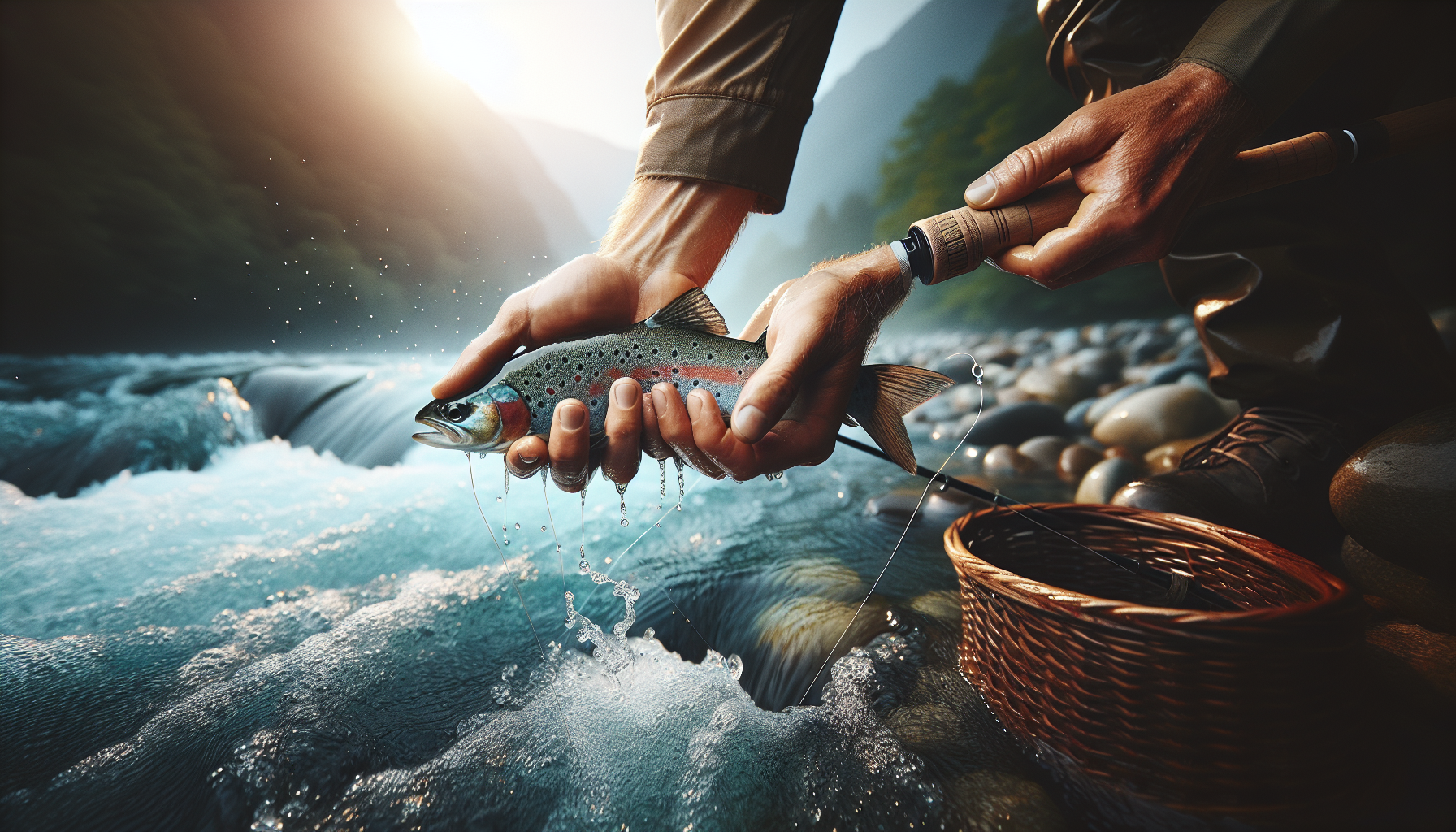
Fight time matters because exhausted fish accumulate lactate and struggle to recover. Guides should match tippet strength to fish size and current speed rather than defaulting to ultralight presentations that prolong the battle. Barbless hooks, or at minimum pinched barbs, shorten release time and reduce tissue damage. Rubber landing nets are preferable to knotted nylon because they protect slime and lower fin abrasion. Once netted, fish should remain in the water as much as possible, with cameras prepared in advance if a client wants a quick photo. A useful standard is “net, unhook, decide, lift briefly, release,” all within seconds.
Guides also need species-specific judgment. Native cutthroat in small headwaters may require stricter handling than stocked rainbows in a robust tailwater. Pre-spawn fish staging in tributary mouths deserve a wide berth even when legal to target. During winter, fish can be injured by freezing air exposure, while in summer they may need immediate revival in moderate current. Explaining these nuances to clients is part of the job. Most anglers cooperate when the guide clearly links a technique to fish survival and future quality fishing.
Manage Habitat, Access, and River Traffic Responsibly
Healthy fisheries depend on habitat, and guides influence habitat condition every day. Repeated foot traffic at the same entry point breaks down banks, widens social trails, and strips riparian vegetation that stabilizes soil and cools water. Boat anchors dragged through spawning gravel can disturb redds. Wading through shallow tailouts in autumn or spring can crush eggs that remain invisible to clients. Effective conservation efforts therefore include route planning, launch etiquette, and habitat awareness at a fine scale.
One of the simplest improvements I made as a guide was rotating access sites and resting high-use runs. This spreads pressure and allows bankside vegetation to recover. In drift boats, beach only on durable surfaces when possible, avoid side channels with juvenile fish, and use established launches rather than creating informal slide paths. On walk-and-wade trips, use existing trails, keep groups compact, and avoid trampling undercut banks where fish shelter. If a client wants to cross a redd area for a better casting angle, the answer should be immediate and firm: no cast is worth damaging a year class.
Guides should also understand flow regimes and river morphology. Tailwater fisheries can change dramatically with dam releases, exposing gravel bars and concentrating fish into thermal refuges. Freestone rivers after runoff may have fragile, newly formed banks. Spring creeks often suffer from bank collapse where anglers repeatedly stand on the edge. Reading water is not only about finding fish; it is also about identifying where your presence causes the least damage. On crowded rivers, spacing boats generously and avoiding repeated laps through the same pod of fish reduces stress and conflict at once.
Prevent the Spread of Invasive Species and Fish Disease
Invasive species prevention is one of the most concrete conservation efforts a guide can control. New Zealand mudsnails, zebra and quagga mussels, didymo, whirling disease spores, and aquatic hitchhikers hidden in boot seams or anchor ropes can move quickly between watersheds. A guide who fishes multiple rivers each week is a potential vector unless equipment cleaning is systematic. The standard is straightforward: clean, drain, dry, and when risk is high, disinfect.
Felt soles deserve special scrutiny because they retain moisture and organisms longer than many rubber alternatives. Several states have restricted or banned felt for that reason. Even where felt remains legal, many guides have switched to rubber soles with studs to reduce transfer risk. Boats, nets, live wells, bilges, trailer bunks, and wading staffs all need inspection. Decontamination methods vary by organism and agency guidance, but hot water treatment, drying times, and approved disinfectants are widely used. Guides should follow state fish and wildlife protocols rather than improvised internet advice.
Client gear presents another challenge. Borrowed boots, old nets, and coolers can introduce contamination, especially on multi-day trips across drainage boundaries. The easiest solution is to provide clean loaner gear and explain why. If clients bring their own equipment, build a pre-trip checklist into confirmation emails: last river fished, drying time, and whether gear has been cleaned. This not only lowers risk but also demonstrates professional standards to landowners, outfitters, and agencies. Conservation is often judged by visible habits, and biosecurity habits are highly visible.
Teach Clients Conservation During Every Trip
Guides are field educators whether they claim that role or not. A six-hour float gives more teaching time than most formal outreach events, and clients tend to remember lessons connected to a fish they just landed. Conservation efforts become durable when guides translate them into simple, repeatable actions. Do not wait until a fish is in the net to explain handling. Give a two-minute briefing before the first cast: fight hard, keep fish wet, wet your hands, no beaching, and photos only if the fish is calm and the camera is ready.
Good instruction also frames why regulations exist. Many clients do not understand seasonal closures, hoot owl restrictions, slot limits, or native fish protections. When a guide explains that an afternoon closure protects trout from lethal water temperatures, compliance feels rational rather than inconvenient. When clients learn to identify redds, they stop seeing gravel patches as empty wading lanes. When they hear how streamside willows shade water, trap sediment, and shelter juvenile fish, they are less likely to break branches for a backcast. Specific reasons change behavior better than generic appeals to “respect nature.”
Education should extend beyond fish. Pack out tippet clippings, pick up monofilament left by others, avoid music on public water, close gates, and respect private property boundaries. These are conservation and ethics issues because social friction can cost access and drive avoidable regulation. A strong guide leaves clients with a better understanding of watershed health, not just better casting mechanics.
Build a Practical Conservation Plan for Your Guide Operation
Conservation efforts work best when they are written into business systems instead of depending on memory. I recommend that every guide service maintain a simple operating plan with thresholds, checklists, and staff expectations. That plan should define water temperature cutoffs, fish handling rules, cleaning procedures, access rotation, and how guides report habitat or poaching concerns. Written standards create consistency across employees and protect the business when clients pressure a guide to keep fishing despite poor conditions.
| Conservation area | Best practice for guides | Why it matters |
|---|---|---|
| Water temperature | Check with a calibrated thermometer; stop trout trips near 68°F or earlier if agency guidance says so | Reduces post-release mortality during warm conditions |
| Fish handling | Use rubber nets, barbless hooks, wet hands, and keep fish submerged | Protects slime coat, fins, and recovery capacity |
| Habitat protection | Rotate access points and avoid wading through redds or fragile banks | Prevents erosion and spawning damage |
| Invasive species | Clean, drain, dry, and disinfect gear between watersheds | Limits spread of harmful organisms and disease |
| Client education | Deliver a pre-trip conservation briefing and model correct behavior all day | Multiplies stewardship beyond a single trip |
Documentation helps. Add conservation policies to your website, waiver packet, and trip confirmation notes. Keep a thermometer log during hot months. Record sections rested due to crowding or habitat concerns. If your region uses permit reporting, note wildlife sightings, bank failures, invasive species observations, and illegal activity. These records improve decision-making and demonstrate professionalism during outfitter reviews or landowner discussions.
Partnerships make plans stronger. Trout Unlimited chapters, watershed councils, state fish and wildlife agencies, and local conservation districts often provide volunteer opportunities, river etiquette materials, and restoration updates. A guide service that joins cleanups, comments on management plans, or helps monitor water conditions becomes part of the solution rather than merely a user group. Clients notice that credibility.
Support Watershed Restoration and Long-Term Fishery Health
Daily low-impact habits are essential, but guides should also engage in broader conservation efforts that improve fisheries over time. Habitat restoration can include riparian planting, culvert replacement, barrier removal, in-stream structure projects, irrigation efficiency upgrades, and meadow or floodplain reconnection. These projects sound technical, yet guides often see the need first because they witness eroding banks, warming side channels, or dewatered reaches across seasons.
Participation can be practical rather than political. Share observations with biologists, volunteer boats for monitoring days, donate guide trips to local conservation fundraisers, and encourage clients to support science-based groups working in the watershed. If a tailwater suffers from repeated thermal spikes, collect consistent temperature notes and pass them to managers. If a tributary has blocked fish passage, document timing and location accurately. Guides spend enough hours outside to function as useful eyes on the resource, provided observations are disciplined and factual.
Long-term fishery health also requires restraint. Some of the best conservation decisions cost short-term revenue: canceling heat-stressed trips, avoiding concentrated spawning fish, limiting repeat drifts on a fragile section, or steering clients to carp or smallmouth when trout conditions deteriorate. In my experience, these decisions build a stronger business, not a weaker one. Clients remember honesty, and serious anglers want guides who protect the places they love. Conservation tips for fly fishing guides ultimately come down to this principle: your reputation should reflect not only how many fish clients catch, but also how well the river fares after you leave. Review your current practices, formalize your standards, and make every trip a model of stewardship.
Frequently Asked Questions
Why do conservation tips matter so much for fly fishing guides specifically?
Conservation matters for fly fishing guides because guides influence far more than a single angler’s catch rate. A guide helps shape how clients handle fish, where they wade, where they anchor or beach a boat, how they move through spawning habitat, and what standards they carry home to their own waters. That makes guiding one of the most practical forms of fisheries stewardship on the river. In day-to-day terms, conservation-minded guiding protects trout from unnecessary stress, reduces damage to streambanks and aquatic vegetation, limits pressure on vulnerable access points, and helps maintain the quality of the fishery that supports the guide’s livelihood.
Guides also sit at the intersection of science and behavior. Fisheries biologists may produce recommendations about water temperature, spawning closures, fish handling, invasive species prevention, and angling pressure, but guides are often the ones applying those recommendations in real time. They decide whether to fish a run or leave it alone, whether conditions are safe for catch-and-release, whether a client should step out of the boat at a particular spot, and whether a fish should be netted quickly or fought longer for a photo. Those choices add up. On heavily used rivers, repeated small decisions by guides and clients can either preserve a resource or steadily wear it down.
There is also an educational responsibility that comes with the profession. Many clients book a trip not just to catch fish, but to learn. When a guide explains why they avoid redds, pinches barbs, rotates pressure between reaches, or ends the day early during high water temperatures, the client sees conservation as part of competent angling rather than a separate lecture. That is one of the strongest long-term benefits of good guiding: it builds better anglers who carry ethical habits to every river they fish.
What are the best fish handling practices fly fishing guides should teach clients?
The best fish handling practices are the ones that minimize fight time, reduce air exposure, protect the fish’s slime coat, and get the trout back into current quickly and in strong condition. Guides should start by setting expectations before the first cast. Clients should understand that landing fish efficiently is better than overplaying them, especially in warm water or strong current. Proper tackle matters here. Rod weight, tippet strength, and drag settings should be chosen to land fish quickly without unnecessary exhaustion. A guide who matches gear to conditions is already practicing conservation.
Once a fish is close, a rubber or knotless landing net is one of the most useful tools a guide can carry. It supports the fish, reduces thrashing, and helps avoid injury compared with dragging a trout onto rocks, boat decks, or dry hands. Fish should remain in the water whenever possible. If a hook can be removed with the fish still submerged, that is ideal. Barbless hooks or pinched barbs make release faster and cleaner, which is especially helpful when clients are new to handling trout.
Guides should also teach clients to wet their hands before touching a fish and to avoid squeezing the body or gripping the gills. Holding a trout horizontally with gentle support is much safer than lifting it vertically by the jaw or midsection. If a quick photo is taken, the guide should organize it in advance so the fish is out of the water for only a moment. A useful standard is simple: net, unhook, one quick photo if conditions allow, then release. The fish should be revived only as much as needed, facing into moderate current until it kicks away under its own power. For exhausted fish, especially during summer, reducing handling time is usually more important than extended display or repeated photo attempts.
Perhaps most importantly, guides need to normalize saying no. If water temperatures are high, if a fish is deeply hooked, or if a client wants prolonged photo sessions, the guide has to make the conservation call. Clients generally respect that when it is explained clearly and confidently. Over time, those standards protect not just individual fish, but the reputation of the fishery and the guide operation itself.
How can fly fishing guides reduce their impact on riverbanks, spawning habitat, and access areas?
Reducing physical impact starts with understanding that river damage often comes from repetition, not a single dramatic mistake. One guide stepping onto a soft bank once may not matter much, but dozens of daily launches, exits, and client approaches in the same place can create erosion, trampled vegetation, widened trails, and sediment delivery into the river. Guides can reduce that impact by using durable access points, rotating put-ins and walk-in entries when regulations allow, and avoiding the temptation to create informal trails or shoreline shortcuts simply for convenience.
Wading choices are equally important. Guides should teach clients to enter and exit the river on gravel, rock, or hardened access zones rather than undercut or vegetated banks. During spawning periods, they need to identify redds and explain what they look like: clean, lighter-colored gravel patches where trout have cleared sediment to lay eggs. Clients often step on redds because they do not know what they are seeing. A good guide turns that into a teaching moment and reroutes the group immediately. Even if fish are visibly holding nearby, protecting spawning habitat should override the urge to fish through those areas.
Boat positioning deserves the same level of care. Anchoring on sensitive gravel beds, dragging boats through shallow spawning zones, or repeatedly beaching on vegetated edges can cause avoidable damage. Guides should anchor only where substrate and current make that practice safe for habitat, and they should be willing to row past a run if stopping there would increase erosion or disturb vulnerable fish. On crowded rivers, spacing out and choosing less obvious stops can also help reduce concentrated wear on the most popular banks and gravel bars.
Trash, line, and incidental waste are another part of access stewardship. Guides should carry a system for collecting tippet clippings, snack wrappers, and any litter found on the water. That may seem basic, but clients notice it. When guides visibly leave places cleaner than they found them, they model stewardship in a direct and credible way. Over a season, these habits help preserve access relationships with landowners, reduce user conflicts, and protect the places that make guided fisheries possible in the first place.
When should a guide change plans or stop fishing altogether for conservation reasons?
A conservation-minded guide knows that the best call is not always to keep fishing. Water temperature is one of the clearest triggers for changing plans, especially on trout rivers during summer. As temperatures rise, dissolved oxygen decreases and fish experience more physiological stress. Even if trout can still be caught, their odds of surviving a release may drop substantially. Guides should monitor temperatures with a reliable thermometer, know local thresholds and agency guidance, and be prepared to shift to early starts, cooler tributaries where legal and appropriate, non-trout options, or a full stop if conditions become unsafe.
Low flows are another important factor. When rivers shrink, trout lose cover, become more concentrated, and face increased pressure from anglers, predators, and warm water. In those conditions, repeatedly targeting the same visible fish or crowding refuge water can have a disproportionate impact. A guide may need to shorten the trip, move to a different water type, focus on casting instruction instead of active fishing, or avoid sensitive reaches entirely. This can be a hard conversation with paying clients, but it is part of professional judgment.
Seasonal spawning periods also require flexibility. If fish are paired on redds, staging in shallow vulnerable areas, or concentrated below barriers and inflows, the ethical and often biological choice is to leave them alone. The same applies after major stress events such as wildfire ash flows, pollution incidents, severe icing, or unusually high and dirty water that compromises safe fish handling and river travel. Conservation is not only about fish mortality; it is also about avoiding habitat damage and preventing risky decisions that affect the broader ecosystem.
The strongest guides communicate these changes early and confidently. They explain that a cancelled or adjusted plan protects the fishery and preserves future opportunity. Most clients appreciate that honesty, especially when the guide offers meaningful alternatives such as casting lessons, entomology discussion, knot work, river reading instruction, or rescheduling. In practice, these days often build trust. Clients remember guides who put the river first, because it signals expertise, integrity, and long-term commitment rather than short-term extraction.
How can fly fishing guides educate clients about conservation without sounding preachy?
The key is to make conservation part of the fishing day rather than a separate speech. Clients are usually most receptive when information is timely, practical, and directly connected to what is happening in front of them. Instead of delivering a long lecture at the truck, a guide can explain each conservation choice in context: why the group is avoiding a side channel, why fish stay in the water for photos, why barbs are pinched, or why the day ends before the hottest part of the afternoon. That style feels helpful and professional rather than moralizing.
Language matters. Guides tend to be effective when they speak in terms of outcomes and shared goals. Saying, “We land fish quickly here because warm water makes recovery harder,” or, “Let’s stay off that gravel because those are spawning beds,” is clear, respectful, and grounded in the fishery. Clients do not need a biology seminar to understand that their actions affect fish survival and habitat quality. Small, confident explanations delivered at the