Handling fish properly for catch and release is one of the most important skills any conservation-minded angler can learn, because the moment a fish is landed often determines whether it truly survives after release. Catch and release means returning a fish to the water alive after capture, while proper fish handling refers to the techniques that reduce physical injury, stress, air exposure, and delayed mortality. In practice, those details matter more than many anglers realize. I have watched strong fish swim away only to roll over minutes later after rough handling, and I have also seen deeply tired fish recover when they were kept wet, supported correctly, and released without unnecessary delay. That difference is the core of ethical angling.
As a hub topic within conservation and ethics, catch and release sits at the intersection of biology, regulation, and personal responsibility. Fisheries agencies use harvest limits, size restrictions, seasonal closures, and gear rules to protect fish populations, but those measures work only when released fish actually survive. Species such as trout, bass, pike, tarpon, redfish, salmon, and muskellunge can all benefit from release, yet each responds differently to stress, temperature, and handling. Water temperature, fight time, hook location, and even whether a fish touches dry carpet or hot boat decking can change the outcome. Proper handling is therefore not a cosmetic best practice; it is a measurable conservation tool that protects spawning stock, maintains age structure, and supports sustainable recreational fisheries.
Good catch and release begins before the cast. It includes selecting tackle that lands fish efficiently, choosing hooks that are easier to remove, carrying the right tools, and knowing when conditions are too risky for release to be responsible. It continues at boatside or shoreline with wet hands, minimal air exposure, firm but gentle support, and fast recovery. It ends only when the fish is upright, ventilating, and capable of swimming away under its own power. For anglers who want to fish ethically, guide responsibly, or teach newcomers the right habits, understanding these steps is essential. This article covers catch and release from preparation through release, explains common mistakes, and provides a practical framework you can apply on the water immediately.
Why Fish Die After Release and What Anglers Can Control
Released fish do not die from one cause alone. Post-release mortality usually results from a chain of stressors: exhaustion from a long fight, lactic acid buildup, loss of equilibrium, tissue damage from hooks, removal of protective slime, internal injury from poor support, and reduced oxygen uptake during air exposure. Warm water intensifies nearly all of these problems because oxygen availability drops as temperatures rise while the fish’s metabolic demand increases. That is why summer trout fishing in marginal temperatures is far riskier than releasing the same fish in cold spring water.
Anglers can control most of the major risk factors. Fight time can be shortened by using tackle heavy enough for the species and conditions. Hooking injury can be reduced with barbless hooks or by pinching down barbs, especially when using artificial lures. Air exposure can be limited by planning every step before lifting a fish. Physical damage can be prevented by avoiding dry hands, abrasive nets, lip-only holds on large fish, and contact with rocks, sand, or hot surfaces. Recovery success improves when fish are released in current or calm water appropriate to the species and are not pushed back and forth aggressively.
The key principle is simple: every second and every touch counts. A fish that is landed quickly, kept in the water, unhooked with proper tools, and supported correctly has a much higher chance of surviving than one fought to exhaustion for a photo session. Ethical release is not about intent alone. It is about reducing avoidable harm at each stage of the encounter.
Prepare Before Hookup: Tackle, Tools, and Fish-Friendly Choices
The best catch and release outcomes start with gear selection. I rig fish handling tools before I make the first cast because searching for pliers while a fish thrashes in the net wastes precious time. At minimum, carry long-nose pliers, hemostats or forceps for small hooks, line cutters, and a knotless rubberized landing net. A rubber net is far superior to old nylon mesh because it reduces fin fray, scale loss, and tangling around gills, hooks, and teeth. For larger species, a cradle or sling can be even better than a standard net.
Rod, reel, and line should match the fish. Ultralight tackle may feel sporting, but for many species it increases fight duration and stress. For salmonids in current, redfish around structure, or largemouth bass in heavy cover, stepping up line strength often results in faster landings and fewer fatal exhaustion events. Circle hooks are widely recommended for bait fishing because they tend to hook fish in the jaw rather than deep in the throat or gut. J-hooks can be effective, but they carry a higher risk of deep hooking when fish swallow bait. For lure anglers, single hooks are generally easier to remove than trebles, and crushing barbs speeds release dramatically.
Conditions matter as much as gear. If water temperatures are dangerously high for trout or steelhead, if dissolved oxygen is low, or if the fishery is experiencing a disease event, the most responsible decision may be to stop targeting that species entirely. Conservation sometimes means choosing not to fish. Responsible anglers also review local regulations before the trip. Some waters prohibit targeting spawning fish, require barbless hooks, or restrict landing methods. Compliance protects both fish populations and the angler.
Landing and Handling Fish Without Causing Unnecessary Injury
Once a fish is hooked, the goal is to bring it to hand firmly and efficiently without panic. Keep steady pressure, use the rod’s power correctly, and avoid extending the fight for sport. When the fish is ready, lead it headfirst into a waiting net rather than stabbing at it. Netting fish tail-first often causes escape attempts and extra trauma. If you are shore fishing without a net, choose a safe landing spot in advance. Sliding fish over dry rocks, concrete, or hot sand removes slime and can injure fins, eyes, and skin.
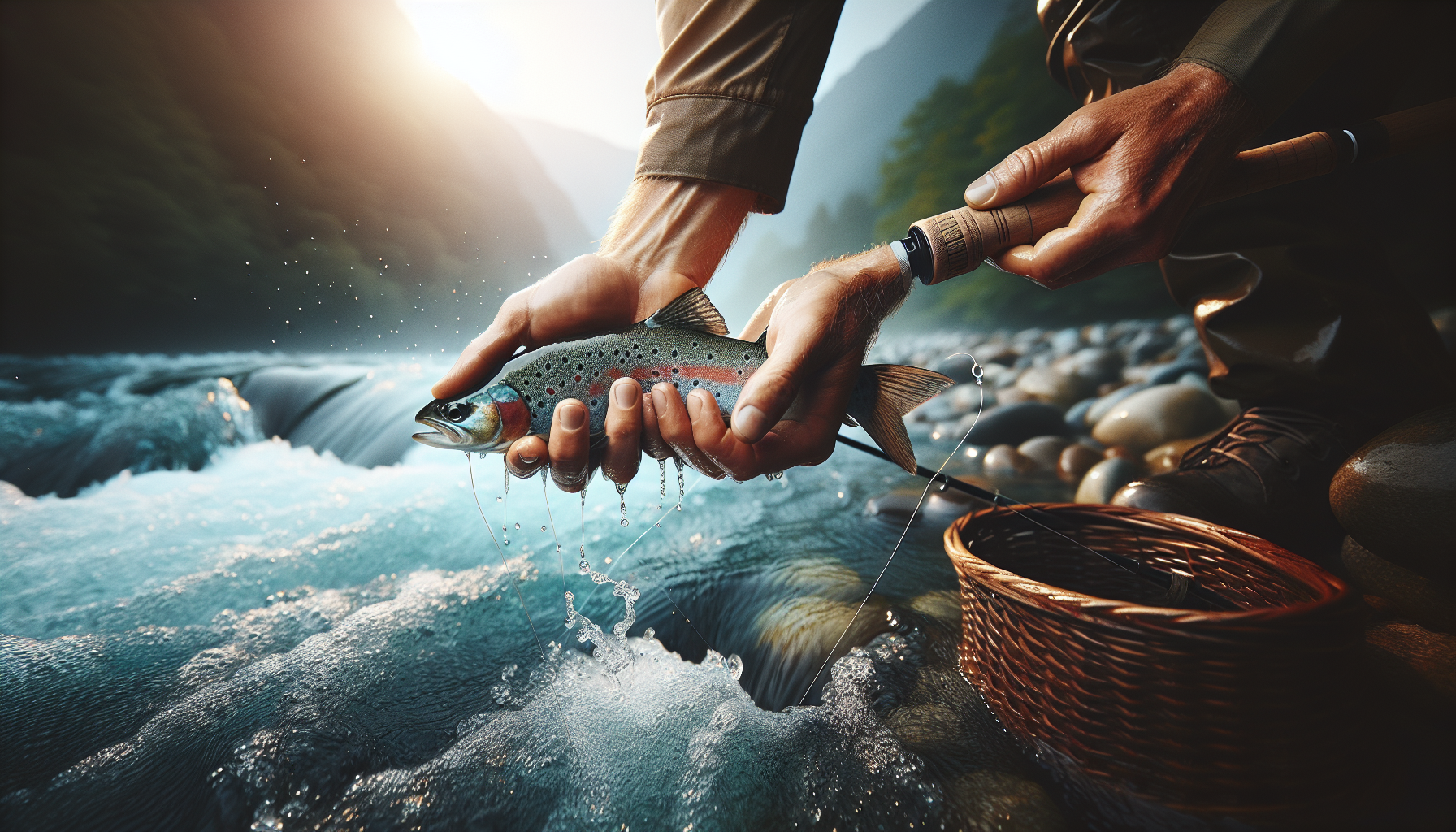
Before touching the fish, wet your hands. The mucus coating on a fish acts as a protective barrier against pathogens and helps maintain osmotic balance. Dry hands, gloves with rough texture, and cloth landing surfaces strip that barrier away. Support the fish horizontally whenever possible, especially larger fish. Holding a heavy fish vertically by the jaw can damage connective tissue, vertebrae, and internal organs. This is particularly important for species such as pike, muskie, snook, tarpon, and large bass.
Keep the fish in the water while removing the hook whenever conditions allow. In a boat, that may mean leaving the fish in the net beside the gunwale while you use pliers. In a river, it may mean gently controlling the fish in shallow current while the hook is backed out. If a photo is planned, have the camera ready first. Lift the fish only when everything is prepared, and return it to the water immediately after a quick shot. A useful standard is “one breath or less” out of water, though less is always better.
| Handling factor | Best practice | Why it matters |
|---|---|---|
| Fight time | Use adequate tackle and steady pressure | Reduces exhaustion and lactic acid buildup |
| Net choice | Use knotless rubberized netting | Limits slime loss, fin damage, and hook tangles |
| Hand contact | Wet hands before touching fish | Protects the mucus layer and skin |
| Body support | Hold fish horizontally with two points of support | Prevents jaw, spine, and organ injury |
| Air exposure | Keep fish submerged whenever possible | Improves oxygen recovery and survival |
| Release timing | Release only when fish can swim strongly | Reduces immediate predation and collapse |
Hook Removal, Deep Hooking, and When Cutting the Line Is Better
Hook removal should be decisive and gentle. With fish held securely in water or in a soft net, use pliers to rotate the hook back along the entry path. Barbless hooks usually come free quickly, which is one reason they are so effective for catch and release. Treble hooks require extra care because one point may be in the fish while another is in the net, your sleeve, or the fish’s eye area. In these cases, hook cutters are often safer than trying to twist everything free at once.
Deep-hooked fish create one of the most difficult ethical decisions in catch and release. Many anglers instinctively try to remove a hook lodged in the throat or gullet, but forceful extraction can tear gills, esophagus, or major blood vessels. In many cases, especially with smaller hooks, cutting the line close to the hook and releasing the fish is the better option. Research across several species has shown that some fish can shed or encapsulate retained hooks over time, whereas traumatic removal often causes immediate fatal injury. The exact outcome depends on species, hook type, bait ingestion, and bleeding severity, but the general rule is clear: do not turn a survivable deep hook into catastrophic damage.
If the hook is in the gills and bleeding is heavy, prognosis is poor, and local regulations may determine what you can do next. Where harvest is legal and the fish meets regulations, keeping a mortally injured fish may be the most responsible choice. Where mandatory release applies, minimize handling, cut the line if necessary, and release the fish promptly. Ethical angling includes honesty about these hard cases. Not every released fish survives, but proper decisions improve the odds substantially.
Species, Water Temperature, and Other Conditions That Change Best Practice
Catch and release is never one-size-fits-all. Coldwater species such as trout, char, and salmon are especially sensitive to elevated temperatures. Many experienced trout anglers stop fishing when water temperatures approach the upper 60s Fahrenheit because stress and mortality increase sharply. Warmwater species such as largemouth bass and pike generally tolerate higher temperatures better, but they are not immune to exhaustion, low oxygen, or handling injury. In saltwater, species such as tarpon, bonefish, permit, and reef fish each present different challenges, from prolonged fight stress to barotrauma in deeper water.
Spawning periods require extra caution. Fish on redds, in shallow nesting areas, or staging before migration are already under biological strain. Disturbance can reduce reproductive success even if the fish swims away strongly. Predation pressure also matters. Bonefish released near sharks, or salmonids released near seals or birds after a long fight, may face elevated risk if they are disoriented. In those scenarios, quick recovery and release in the safest available water become even more important.
Depth is another overlooked factor. Species brought up rapidly from deeper water can suffer barotrauma, visible through bloated abdomens, protruding stomachs, or bulging eyes. Bottom species in saltwater and some freshwater fish may require descending devices or recompression techniques approved by fisheries managers. Simply tossing them back often leads to floating and predation. The broader lesson is that proper handling depends on species biology and fishing context. Anglers who learn those specifics release fish more successfully than anglers who rely on generic advice.
Recovery, Release, and Common Mistakes to Avoid
Reviving a fish means helping it regain balance and ventilation without adding stress. Hold the fish upright in the water and support it gently under the belly or at the wrist of the tail, depending on species. In current, face the fish into moderate flow so water passes naturally over the gills. In still water, move the fish slowly only as needed to maintain orientation. Do not pump the fish hard back and forth. That motion can force water the wrong way through the gills and may worsen stress.
Watch for signs of readiness: steady gill movement, regained equilibrium, attempts to maintain posture, and a strong tail kick. Release the fish when it initiates swimming powerfully on its own. If it rolls repeatedly, continue support longer. With highly migratory or powerful species such as tarpon or large striped bass, boatside recovery may take time, especially after warm-water fights. Patience here can determine survival.
The most common mistakes are predictable and avoidable. Anglers often overplay fish on light tackle, place fish on dry ground for hero photos, squeeze the body too hard, put fingers in gills, hold large fish vertically, or spend too long trying to remove a difficult hook. Another frequent error is assuming that a fish that swims away is automatically fine. Delayed mortality can occur hours later from metabolic stress or injury. That is why the process matters so much. If you fish with partners, guides, or children, build a release routine everyone follows: tools ready, hands wet, fish low, photo fast, release calm. Consistency saves fish.
Building an Ethical Catch and Release Mindset
Handling fish properly for catch and release is ultimately about aligning angling enjoyment with long-term stewardship. The practical habits are clear: prepare gear before fishing, land fish quickly, use fish-friendly nets and hooks, keep fish wet, minimize air exposure, support the body correctly, cut the line on dangerous deep hooks, and release fish only when they are strong enough to swim away. Those steps protect individual fish, but they also protect the quality of entire fisheries by preserving larger breeders, sustaining natural age classes, and reducing waste hidden behind the phrase “it swam off.”
In my experience, anglers adopt better fish handling fastest when they treat it as part of the craft rather than an afterthought. The same attention used to choose lures, read currents, or tune drags should be applied to release technique. That mindset improves outcomes immediately and sets a standard others notice on the water. If this article is your starting point for the catch and release subtopic, use it as your baseline: review your tools, adjust your tackle, and practice a faster, lower-impact release routine on your next trip. Better handling is one of the simplest ways any angler can contribute to conservation and ethics today.
Frequently Asked Questions
Why is proper fish handling so important for catch and release?
Proper fish handling is critical because a fish can swim away after release and still die later from stress, injury, or exhaustion. Many anglers assume that if a fish kicks off strongly, it automatically survived, but delayed mortality is a real issue. The fight, the landing, the time out of water, and the way the fish is touched or restrained all affect whether it truly recovers. Fish are highly adapted to life in water, and even short periods of rough handling can damage their protective slime coat, bruise internal organs, injure gills, or interfere with breathing and balance.
Catch and release works best when anglers focus on reducing total stress from the moment the fish is hooked until it is fully revived. That means using appropriate tackle to land fish quickly, keeping them in the water whenever possible, handling them with wet hands, and avoiding unnecessary photos or prolonged exposure to air. It also means understanding that different species, water temperatures, and conditions can increase risk. In warm water, for example, a fish may already be under metabolic stress before it is ever hooked. In those cases, careful handling is not just a best practice; it can be the difference between life and death after release.
What is the best way to handle a fish once it has been landed?
The best approach is to plan for release before the fish ever reaches your hand. Use gear that allows you to land it efficiently, and have pliers, hook removers, and your net ready in advance. If possible, keep the fish in the water while removing the hook. A rubberized, knotless landing net is one of the best tools for catch and release because it supports the fish, reduces scale and slime loss, and helps prevent tangling or fin damage. Once the fish is contained, wet your hands before touching it. Dry hands, gloves, and rough surfaces can strip away the slime coat that protects fish from infection and disease.
Support the fish gently and horizontally rather than hanging it vertically by the jaw or gill plate, especially with larger fish. Vertical holds can strain the jaw, vertebrae, and internal organs. Never squeeze the body, and never put fingers into the gills unless there is a very specific, species-appropriate reason and the fish is being harvested rather than released. The gills are delicate and essential for oxygen exchange. If you want a quick photo, have the camera ready first, lift the fish only briefly, support its weight properly, and return it to the water immediately. Efficient, calm, organized handling always gives the fish the best chance of survival.
How long can a fish safely stay out of the water?
The practical answer is: as little time as possible. There is no universal safe time that applies to every species and condition, because air exposure affects fish differently depending on water temperature, species sensitivity, fight duration, and overall stress level. Even short periods out of water can be harmful, especially after a long fight. A useful rule for conservation-minded anglers is to keep the fish in the water for almost everything and only remove it briefly if absolutely necessary. If a photo is important, think in terms of seconds, not minutes.
Air exposure compounds the stress a fish already experiences during capture. Once out of water, the fish is no longer able to extract oxygen normally through its gills, and its body weight is no longer supported by the surrounding water. That can lead to breathing problems, disorientation, and physical strain. A good habit is to prepare all tools first, remove the hook quickly, and, if taking a picture, lift the fish once for a fast shot and then release it immediately. If you need multiple attempts, put the fish back in the water between them. The more you can reduce air exposure, the more effective your catch-and-release practices will be.
What should you do if a fish is deeply hooked or seems exhausted?
If a fish is deeply hooked, the first priority is to avoid causing more damage during removal. In many cases, especially when the hook is in the throat or difficult to reach without tearing tissue, it is better to cut the line as close to the hook as possible rather than aggressively digging for it. Research and on-the-water experience both show that many fish can survive with a hook left in place, while forceful removal can cause severe bleeding and trauma. Using barbless hooks or crimping barbs ahead of time can make hook removal much easier and much less damaging.
If the fish is exhausted, revive it in the water before release. Hold it upright in a normal swimming position and allow water to move naturally across the gills. In current, face the fish into the flow. In still water, move it gently only enough to encourage water exchange, avoiding hard back-and-forth motions that can do more harm than good. Watch for signs that it is regaining control, such as steady balance, regular gill movement, and the ability to swim on its own. Do not let go too early if the fish keeps rolling or drifting. At the same time, recognize that prevention matters more than revival. Using tackle strong enough to shorten the fight and avoiding overplaying fish are among the most effective ways to reduce post-release mortality.
What gear and techniques improve survival rates in catch and release fishing?
Survival starts with choosing tackle that matches the species and conditions. Many anglers mistakenly think lighter gear is always more sporting, but if it leads to overly long fights, it can severely stress fish. A properly balanced rod, reel, and line setup helps you control and land fish quickly, which reduces exhaustion and improves recovery. Hooks also matter. Circle hooks are often a good choice when fishing natural bait because they can reduce deep hooking, and single hooks are generally easier to remove than trebles. Barbless hooks, or hooks with the barb pinched down, can dramatically speed up release and reduce tissue damage.
Beyond hooks and tackle, a few simple tools make a major difference: rubberized landing nets, long-nose pliers, hemostats, and line cutters should all be within easy reach. Good technique matters just as much as gear. Fight fish efficiently, keep them in the water during unhooking, wet your hands before touching them, support their bodies properly, and avoid placing them on hot, dry, or abrasive surfaces such as boat carpet, rocks, or docks. It is also wise to adjust your fishing based on environmental conditions. During periods of very warm water, low oxygen, or extreme stress, some species are far less likely to survive release, no matter how careful you are. The most responsible anglers recognize those conditions and may shorten outings, change target species, or stop fishing altogether when survival odds are poor.