Catch and release in fly fishing is the practice of landing a fish, minimizing handling stress, and returning it to the water in the best possible condition so it can survive, spawn, and be caught again. In conservation and ethics, it sits at the center of modern trout, salmon, bass, and saltwater fly angling because it connects recreation to stewardship. I have spent enough days on cold freestone rivers and technical tailwaters to know that release is not a symbolic gesture; done well, it preserves fisheries, protects wild genetics, and keeps angling opportunity alive during periods of pressure, habitat loss, and warming water. Done poorly, it can become delayed mortality with a photo attached.
The importance of catch and release in fly fishing starts with a clear definition of success. Success is not only hooking fish. It is bringing a fish to hand quickly, keeping it wet, avoiding injury, and sending it back strong. That matters because many fly fisheries depend on wild fish surviving multiple encounters across a season. In heavily fished rivers, some individual trout are caught several times per year. If each release is careful, those fish continue feeding, reproducing, and contributing to the quality of the fishery. If each release adds avoidable stress, cumulative impacts become real, especially in summer or during spawning migrations.
Catch and release also matters because regulations increasingly reflect biological limits. Many rivers have wild trout management plans, fly-only sections, seasonal closures, or mandatory release rules designed around recruitment, carrying capacity, and thermal stress. Anglers who understand catch and release are better prepared to follow those rules and support them. This article serves as a hub for the topic by covering why release matters, what science says about survival, which tackle and handling methods improve outcomes, where the limits are, and how ethical choices on the water shape the future of fly fishing.
Why catch and release matters for fish populations
At a population level, catch and release helps maintain abundance, age structure, and genetic diversity. In wild trout systems, older fish are disproportionately valuable. Larger females generally produce more eggs, and larger males often hold prime spawning positions. Releasing those fish protects more than a single memorable catch; it protects future year classes and the complex life history traits that make wild fisheries resilient. In anadromous species such as steelhead and Atlantic salmon, every adult returned to the system can matter because runs are often constrained by ocean survival, dams, and habitat fragmentation long before anglers arrive.
The effect is easiest to see where harvest pressure once reduced quality. Many blue-ribbon trout rivers improved after managers adopted reduced bag limits, slot limits, or mandatory release in specific reaches. Fish that survive one season grow into the next size class, and anglers begin seeing more holdover fish, more large individuals, and more stable catch rates. On small spring creeks, where wild fish numbers are finite and visibility to anglers is high, careful release can be the difference between a fishery that fishes consistently and one that degrades after a few busy weekends. Catch and release does not solve habitat problems, but it buys biological breathing room.
It also supports social sustainability. A fish that survives can be experienced by many anglers across many seasons. That shared opportunity is especially important on public water, where the resource belongs to everyone. In practical terms, catch and release lets a river keep producing meaningful fishing days without relying on constant stocking or replacement. Stocked fisheries have their place, but wild fish management depends on survival. When anglers treat release as part of the catch, they turn individual restraint into a measurable population benefit.
What science says about survival after release
The direct answer most anglers want is simple: catch and release works best when fight time is short, air exposure is minimal, water temperatures are safe, and hook placement does not cause severe injury. Mortality rates vary by species, season, gear, and handling, but the scientific direction is consistent. Fish released quickly in cool water with low-stress methods often survive at high rates. Mortality rises when fish are exhausted, exposed to warm water, dropped onto dry surfaces, squeezed, or held out of the water for extended photos.
Physiologically, a hard fight builds lactate, reduces blood pH, and increases oxygen demand. In warm water, that recovery burden becomes harder because dissolved oxygen declines as temperature rises. Trout are particularly vulnerable. Many experienced guides stop targeting trout when water temperatures approach the upper sixties Fahrenheit, and some use 68 degrees as a hard cutoff, though local regulations and species tolerance vary. The point is not a single magic number; it is recognizing that temperature changes the cost of capture. A release that looks clean in July may still fail hours later if the fish was already near its thermal limit.
Hooking location matters too. Fish pinned in the jaw typically fare better than fish hooked in gills, eyes, or deep in the throat. That is one reason fly anglers often favor single barbless hooks, especially on small flies and streamers used with active retrieves. Barbless hooks are easier to remove quickly, reduce tissue damage, and often make it possible to release smaller fish without touching them at all. Research across freshwater and saltwater species does show nuance: gear restrictions alone do not guarantee low mortality. The full handling sequence matters more than any single rule.
Tackle, rigging, and fish fighting methods that improve release outcomes
Good catch and release begins before the cast. Tackle should match the fish and the conditions well enough to land fish efficiently. An ultralight rod can be enjoyable on small streams, but underpowering your setup on large rivers or in current often extends the fight and increases exhaustion. I rig stronger tippet than many anglers expect, not because I want to horse fish, but because I want to end the contest quickly and keep fish out of heavy structure. In trout fishing, moving from 6X to 5X or 4X when conditions allow often shortens fights without reducing eats if the leader is built correctly and the presentation remains natural.
Net choice matters. A rubber or silicone landing net is better than knotted nylon because it supports the fish, protects slime, and reduces fin abrasion and tangled hooks. Knotless mesh also makes releases faster for anglers and guides managing multiple fish in a day. Forceps or hemostats should be instantly accessible, not buried in a vest pocket. If you need to fumble for tools while a fish thrashes on the bank, your system is not set up for conservation. The same goes for cameras and phones. Prepare before the fish arrives.
| Practice | Why it helps | Plain example |
|---|---|---|
| Use appropriately strong tippet | Shortens fight time and reduces exhaustion | Fishing 4X instead of 6X on a freestone river when fish are not leader shy |
| Choose barbless single hooks | Speeds hook removal and reduces tissue damage | Pinching barbs on nymphs and streamers before the first cast |
| Carry a rubber landing net | Protects slime coat and controls fish in current | Netting a trout, keeping it submerged, and removing the fly without beaching it |
| Keep fish in the water | Limits air exposure and supports recovery | Lifting for one quick photo, then immediately reviving and releasing |
| Stop during warm water periods | Avoids compounding thermal stress | Quitting at midday when river temperature reaches 68°F |
During the fight, the goal is steady pressure, side angles, and efficient control. Rods lifted straight up can prolong the fight and stress light tippets. Side pressure turns the fish, disrupts balance, and brings it to the net faster. Once the fish is under control, lead it into the net headfirst. Never drag fish onto rocks, gravel bars, boat decks, or dry grass unless regulations or species-specific harvest rules make retention immediate and legal. For release, water is the safest workspace. These details seem small, but over a season they define whether an angler merely releases fish or truly practices effective catch and release.
Handling fish correctly from net to release
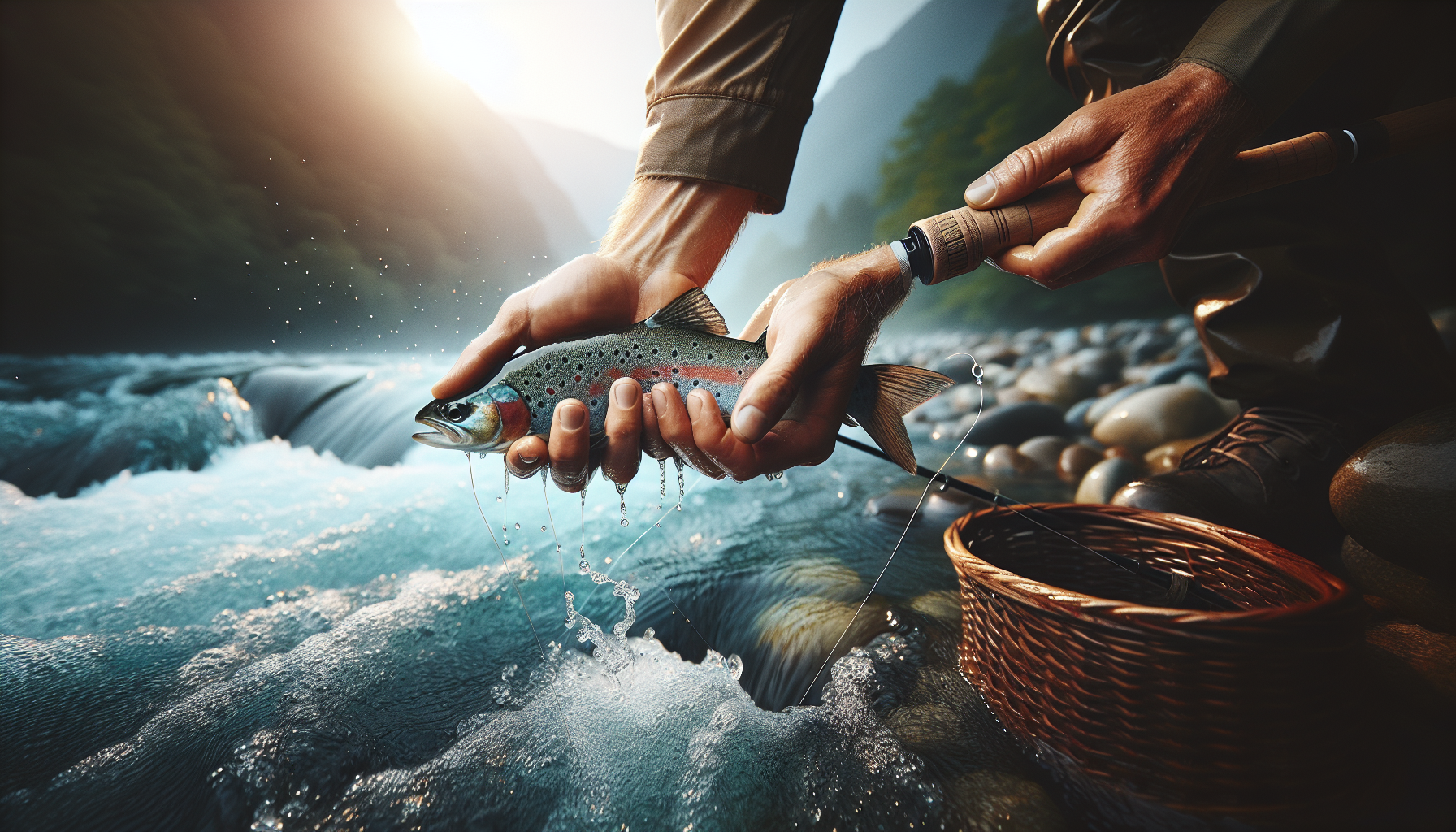
The best handling rule is concise: keep the fish wet, keep it supported, and keep the process short. A fish’s slime coat is a protective barrier against infection and abrasion. Dry hands, gloves, carpeted boat surfaces, and hot sand all damage that barrier. Wet your hands before touching the fish, cradle it gently under the belly if support is needed, and avoid compressing the gills or abdomen. Large trout, pike, and salmonids should not be suspended vertically by the jaw for photos. That posture can strain connective tissue and internal organs, especially in heavier fish.
Air exposure is one of the most preventable mistakes in fly fishing. A practical rule many guides teach is simple: if you want a photo, have the camera ready first, lift the fish briefly, and return it to the water within a few seconds. Repeated hero shots are not harmless. Studies on released fish show that cumulative air exposure increases mortality risk. One clean image with the fish supported low over the water is enough. Better yet, take in-water photos. They record the moment while respecting the fish that made it possible.
Revival should match the fish and conditions. In moderate current, hold the fish upright facing into the flow and let it regain equilibrium. Do not pump it back and forth aggressively; that can force water the wrong way through the gills. Watch for balance, steady opercular movement, and a purposeful kick. Some fish recover instantly, especially if they were landed quickly. Others need time. If a fish cannot maintain orientation in warm or low water, the ethical lesson may be that the encounter should not have happened under those conditions. Honest anglers learn from that and change tactics, timing, or destination next time.
Ethics, regulations, and the limits of catch and release
Catch and release is important, but it is not automatically harmless, and saying so honestly strengthens conservation rather than weakening it. There are times when the most ethical choice is not to fish. High water temperatures, low flows, redds packed with spawning trout, concentrated holding water during drought, or post-release predation risk in clear, shallow margins can all change the equation. A fish released in visible distress below a popular bridge may become easy prey for birds or seals. Anglers should recognize these situational limits rather than treating release as a universal permission slip.
Regulations provide the minimum legal standard, not the full ethical standard. If a river is open but trending warm, you can still choose dawn hours, fish colder tributaries where legal, target more resilient species, or switch entirely to practice casting. If salmon are stacked at a barrier and clearly not feeding, repeatedly flossing or lining fish and calling it release is not ethical fly fishing. On trout streams, avoid stepping on redds, targeting paired spawning fish, or handling fish excessively for social media content. Conservation is a set of habits, not just compliance with a rule book.
This hub article should also point anglers toward related topics within conservation and ethics. Responsible release connects directly to water temperature management, proper fish handling, barbless hook use, seasonal closures, wild versus stocked fisheries, and the role of habitat restoration. Each deserves its own deep dive, but the through-line is simple: anglers have influence. Every decision on rigging, timing, playing fish, taking photos, and choosing when to stop has biological consequences. Catch and release matters because it turns that influence toward protection instead of depletion.
The importance of catch and release in fly fishing is ultimately practical, biological, and ethical at the same time. Practically, it keeps fisheries fishable by allowing individual fish to survive multiple encounters and continue growing. Biologically, it protects spawning adults, preserves wild genetics, and reduces unnecessary mortality in systems already stressed by warming water, degraded habitat, and heavy recreational pressure. Ethically, it asks anglers to treat fish as living wildlife rather than disposable props. That shift changes behavior on the water in ways that managers, guides, and everyday anglers can all see.
The main takeaway is straightforward: releasing a fish is not the end of the catch; it is the final and most important part of it. Use tackle that lands fish quickly, choose barbless hooks when possible, carry a rubber net, keep fish in the water, limit air exposure, and stop fishing when conditions push survival odds down. Those are not abstract ideals. They are field-tested habits that improve outcomes immediately. If you care about conservation and ethics in fly fishing, make catch and release a skill, not a slogan, and apply it deliberately every time you step into the river.
Start by auditing your own routine on the next trip. Check water temperature, pinch barbs, organize tools before the first cast, and commit to faster, gentler releases. Then keep learning across the rest of this catch and release hub, from fish handling methods to warm-water decision making. Better release practices protect the fish you value most and help ensure that the next angler, and the next generation, can experience the same wild pull at the end of a fly line.
Frequently Asked Questions
Why is catch and release so important in fly fishing?
Catch and release matters because it helps protect fish populations while allowing anglers to enjoy the resource responsibly. In fly fishing, especially on rivers and lakes that receive steady pressure, every fish returned in strong condition represents future spawning potential, continued genetic diversity, and a healthier fishery overall. This is particularly important for trout, salmon, bass, and many saltwater species that may already face pressure from habitat loss, warming water, drought, overuse, or seasonal stress. Releasing fish is not just about letting them go; it is about giving them a realistic chance to survive after the encounter.
From a practical standpoint, fisheries cannot always sustain unlimited harvest, especially in places where growth rates are slow or wild fish populations are the primary draw. Catch and release helps preserve quality angling by keeping more mature fish in the system. Larger fish often contribute disproportionately to reproduction, and their continued presence supports both ecological balance and the long-term experience of the sport. For many fly anglers, this is where ethics and enjoyment meet. The fish is not treated as a disposable outcome of recreation, but as part of a living system the angler is choosing to respect.
It also reinforces a stewardship mindset. Fly fishing has long been tied to ideas of observation, restraint, and care for watersheds. When catch and release is done correctly, it turns a moment of success into a moment of responsibility. That shift is what makes it so central to modern fly angling.
Does catch and release actually help fish survive, or is it just a feel-good practice?
When done properly, catch and release can be highly effective, and it is far more than a symbolic gesture. The key point is that survival depends on how the fish is fought, handled, exposed to air, and released. A fish that is landed efficiently, kept in the water as much as possible, touched minimally with wet hands, and released quickly has a much better chance of recovering than one that is overplayed, dropped on the bank, squeezed, or held out of the water for repeated photos. In other words, catch and release works best when the angler understands that the release process begins the moment the fish is hooked.
Scientific observations and on-the-water experience both support this. Many fish survive release very well under favorable conditions, especially when water temperatures are cool and handling is careful. Mortality tends to rise when fish are exhausted, deeply hooked, exposed to warm water, or stressed by long air exposure. That is why experienced anglers pay attention not only to whether they release fish, but to how they do it. The technique matters every bit as much as the intention.
So no, it is not simply a feel-good ritual. It is a meaningful conservation tool when practiced correctly. That said, poor release practices can undermine its value. Ethical catch and release asks anglers to be honest: if conditions are too hot, fish are too stressed, or handling has become careless, the responsible decision may be to stop fishing altogether. Real stewardship is measured by outcomes, not slogans.
What are the best catch and release techniques for fly anglers?
The best catch and release techniques are all about reducing stress and physical injury. Start by using appropriate tackle for the fish and the conditions so you can land fish quickly rather than prolonging the fight. Overplaying a fish builds exhaustion and lactic acid stress, which can make recovery much harder after release. A balanced rod, strong enough tippet, and decisive fish-fighting technique are often more humane than ultralight setups that turn every fish into a prolonged struggle.
Once the fish is close, keep it in the water whenever possible. A rubber or knotless landing net is ideal because it supports the fish gently and reduces damage to scales, fins, and protective slime. Wet your hands before touching the fish, and avoid grabbing it with dry hands, gloves, or cloth that can strip away that protective coating. If you need to remove the hook, do so quickly with forceps or hemostats. Barbless hooks or pinched barbs make this process significantly easier and usually reduce handling time.
Air exposure should be kept to an absolute minimum. If you want a photograph, prepare the camera first, lift the fish briefly only when everything is ready, and return it to the water immediately. A good rule is that if the fish is out of water longer than you can comfortably hold your own breath, it is out too long. Avoid placing fish on rocks, sand, grass, boat decks, or dry banks. Those surfaces can injure the fish and remove slime.
For release, hold the fish gently upright in current or calm water until it regains strength and swims away on its own. Do not forcefully push it back and forth. The goal is support, not agitation. In rivers, point the fish into moderate current so water moves naturally through the gills. In still water, steady support may be all that is needed. If a fish cannot maintain balance, more recovery time is necessary. Done correctly, these small steps make a major difference in post-release survival.
When is catch and release most harmful to fish?
Catch and release becomes more harmful when environmental conditions or angling practices sharply increase stress. One of the biggest factors is warm water. Trout and salmon, in particular, are highly vulnerable when water temperatures rise because their bodies are already under pressure from reduced oxygen and metabolic strain. A fish may swim away after release and still die later if it has been pushed beyond its ability to recover. That is why many responsible anglers carry thermometers and stop fishing when temperatures become unsafe for the species they are targeting.
Long fights are another major problem. The more exhausted a fish becomes, the harder it is for it to recover, especially in warm or low-water conditions. Deep hooking also raises risk, as does excessive handling, squeezing, touching the gills, or prolonged air exposure. In saltwater settings, the issue can be compounded by surf, boat-side mishandling, predators, and the challenge of reviving strong, fast-moving species. Even in freshwater, fish released into shallow margins may be more vulnerable to birds, otters, or other predators if they are disoriented.
Spawning periods and post-spawn recovery windows can also require extra caution. Fish that are actively spawning or recovering from spawn may be less resilient. In some waters, it may be legal to fish during these periods, but legality is not the same as good judgment. Heavy angling pressure, low flows, poor water quality, and repeated captures can all add cumulative stress as well.
The broader lesson is simple: catch and release is not automatically gentle just because the fish is not harvested. Conditions matter. Species matter. Water temperature matters. The angler’s choices matter. The best fly anglers understand that responsible release sometimes means changing methods, targeting different species, fishing at safer times of day, or deciding not to fish at all.
How does catch and release reflect the ethics and conservation values of fly fishing?
Catch and release sits at the heart of fly fishing ethics because it expresses the idea that access to fish comes with responsibility to the fishery. Fly angling has always carried a strong conservation identity, in part because anglers spend so much time immersed in watersheds, insect life, seasonal changes, and fish behavior. That intimacy tends to produce respect. Releasing fish in good condition is one of the clearest ways anglers translate that respect into action.
Ethically, it recognizes that fish are not props for sport. They are wild animals living within fragile ecosystems, and the privilege of catching them does not erase the obligation to minimize harm. That is why experienced anglers often speak less about numbers landed and more about the quality of the encounter, the condition of the water, and the care taken during release. In that sense, catch and release is about restraint as much as success. It asks anglers to enjoy the challenge of pursuit without treating the fish as expendable.
From a conservation perspective, widespread catch and release can help maintain fisheries that might otherwise decline under harvest pressure, especially where wild fish are limited or habitat conditions are unstable. It also helps build a culture of advocacy. Anglers who care about releasing fish well are often the same people supporting habitat restoration, stream access, coldwater protection, dam management reform, and science-based regulations. The act of release becomes part of a larger stewardship ethic.
At its best, catch and release is not about claiming moral superiority. It is about humility, care, and the recognition that good fishing depends on healthy fish populations long after any single day on the water ends. That perspective is a major part of what gives fly fishing its enduring depth and purpose.