Understanding fish physiology is the foundation of better catch and release because every decision an angler makes, from tackle choice to handling time, affects how a fish breathes, balances stress, and survives after release. Fish physiology means the internal processes that keep a fish alive: oxygen uptake at the gills, circulation, muscle function, temperature regulation, acid-base balance, and recovery from exertion. Catch and release is the practice of returning fish to the water after capture with the goal of preserving individual fish and sustaining fisheries. That goal is only achieved when released fish actually survive, recover, and continue normal feeding, spawning, and migration.
After years on rivers, lakes, and saltwater flats, I have learned that many release failures happen before the fish ever reaches the net. Long fights, heavy air exposure, warm water, and poor hook placement all create physiological stress that may not be visible when a fish swims away. A trout can kick hard and still die hours later from oxygen debt. A bass can appear strong but abandon a nest after excessive handling. A tarpon can revive boat-side and then fall to sharks because exhaustion delayed escape responses. Better catch and release starts by seeing the fish not as a trophy in hand, but as a living system operating close to its limits.
This matters for conservation and ethics because modern fisheries management increasingly depends on release practices. In many waters, seasonal closures, size limits, and slot limits assume that anglers will release fish in good condition. Research from agencies such as NOAA Fisheries, state wildlife departments, and peer-reviewed journals consistently shows that release mortality varies widely by species, water temperature, gear type, and handling method. The practical takeaway is simple: catch and release is not one skill but a sequence of choices. When anglers understand how fish bodies respond to capture, they can reduce mortality, protect breeding fish, and support healthier fisheries over time.
How Fish Physiology Changes During Capture
When a fish is hooked, the first major physiological event is acute stress. The fish surges, accelerates, and recruits white muscle fibers for burst swimming. That intense effort relies partly on anaerobic metabolism, which produces lactate and hydrogen ions. As those byproducts build, the fish develops metabolic acidosis, often described by anglers as the fish being “blown up” or “spent.” At the same time, stress hormones such as cortisol and catecholamines rise, heart rate changes, blood chemistry shifts, and energy reserves begin to drain. These are normal survival responses, but they become dangerous when the fight is prolonged.
Gills are central to this process. They do far more than extract oxygen. Gills regulate carbon dioxide removal, acid-base balance, and ion exchange, including sodium and chloride movement. During a hard fight, a fish needs high oxygen delivery, yet the very act of capture can disrupt efficient gill function. If the fish is then held out of water, the thin gill filaments can collapse, sharply reducing gas exchange. Air exposure essentially turns an exhausted fish into an athlete asked to recover while not breathing. Even short exposure matters, especially in warm water where oxygen demand is already elevated.
Species differences are important. Trout and salmon generally have high oxygen needs and can be especially vulnerable in warm, low-oxygen conditions. Largemouth bass often tolerate handling better than salmonids, but deep hooking or high summer temperatures still raise mortality. Pelagic species such as tuna and mackerel generate enormous heat and metabolic waste during capture. Bottom species brought up from depth may also face barotrauma, a pressure-related injury that affects buoyancy and organ position. Good release practice therefore starts with species-specific awareness, not generic advice.
Temperature, Oxygen, and Why Conditions Matter
Water temperature shapes nearly every aspect of catch and release outcomes because fish are ectotherms. Their body temperature and metabolic rate are tied to the surrounding water. As water warms, metabolism rises and oxygen demand increases, while dissolved oxygen often declines. That combination creates a narrow safety margin. In my own trout fishing, the difference between releasing fish at 58 degrees Fahrenheit and 68 degrees is dramatic. At cooler temperatures, fish typically regain equilibrium faster. In warmer water, even brief fights can leave them disoriented and slow to recover.
Low dissolved oxygen can occur in warm backwaters, eutrophic ponds, slow summer rivers, and estuaries during calm weather. Fish captured under these conditions start the fight with less physiological buffer. They are more likely to accumulate severe oxygen debt and require longer revival. This is one reason many responsible anglers stop targeting coldwater species during hot spells, even when regulations technically allow fishing. Ethical restraint is often more protective than any release technique used after the hook-up.
Season also matters. Spawning fish are already under energetic stress, and nest-guarding species may suffer reduced reproductive success even if they survive release. In winter, cold water slows metabolism and can reduce fight stress, but ice formation, freezing air, and rough handling can damage eyes, skin, and gills. Environmental context is therefore not background information. It is a primary part of fish physiology and should guide whether to fish, where to fish, and how quickly to release.
Gear Choices That Reduce Injury and Exhaustion
Tackle selection has direct physiological consequences. The most important principle is matching gear to the fish so fight time stays short. Using ultralight tackle on powerful fish may feel sporting, but from the fish’s perspective it extends anaerobic exertion and recovery time. Heavier leaders, properly set drags, and rods with enough lifting power reduce exhaustion. This is especially true around structure, current, or warm water, where a prolonged battle compounds stress rapidly.
Hook design also matters. Circle hooks are widely recognized for reducing deep hooking in many bait fisheries because they tend to catch in the jaw corner when used correctly. Inline single hooks often make release easier than trebles, particularly on hard baits used for trout, salmon, pike, and striped bass. Barbless hooks or crimped barbs speed unhooking and reduce tissue damage without causing major losses for anglers who maintain tension. Deep hooking increases bleeding, organ injury, and delayed mortality, so prevention is far better than trying to manage the damage boatside.
Nets deserve more attention than they usually get. Rubber or knotless mesh nets reduce scale loss, fin fraying, and slime removal compared with abrasive nylon. That slime coat is a protective mucus layer involved in disease defense and osmoregulation. Once damaged, fish become more vulnerable to fungal and bacterial infection. A good landing net functions like a recovery cradle, allowing the fish to remain in water while the hook is removed and the fish regains strength.
| Gear choice | Physiological effect on fish | Better practice |
|---|---|---|
| Undersized rod and light line | Longer fight, greater lactate buildup, more exhaustion | Use tackle matched to species and conditions |
| Treble hooks | More punctures, longer unhooking time, higher handling stress | Swap to single hooks when practical |
| Barbed hooks | More tissue tearing during removal | Use barbless or pinch barbs down |
| Abrasive netting | Scale loss and mucus damage | Choose rubber or knotless nets |
| Bait rigging that encourages swallowing | Higher deep-hooking rates and internal injury | Use circle hooks and avoid delayed hooksets |
Handling, Air Exposure, and In-Water Release
The best handling rule is straightforward: keep fish wet, supported, and out of water only when absolutely necessary. A fish’s skeleton and internal organs are supported by buoyancy in water. Out of water, gravity places unusual load on jaw hinges, vertebrae, and organs, especially in larger fish. This is why lipping large fish vertically for photos can cause injury, and why species such as salmon, pike, muskie, and carp benefit from horizontal support with both hands.
Air exposure is one of the most documented contributors to release mortality. Studies on salmonids have shown that even brief air exposure after exhaustive exercise can impair recovery and increase delayed death. The practical target many experienced anglers use is zero to a few seconds, not repeated lifts for photos, measuring, and conversation. Prepare tools before landing the fish. Have forceps, camera, and line cutters ready. If the hook is embedded badly, cutting the line may be safer than prolonged surgery.
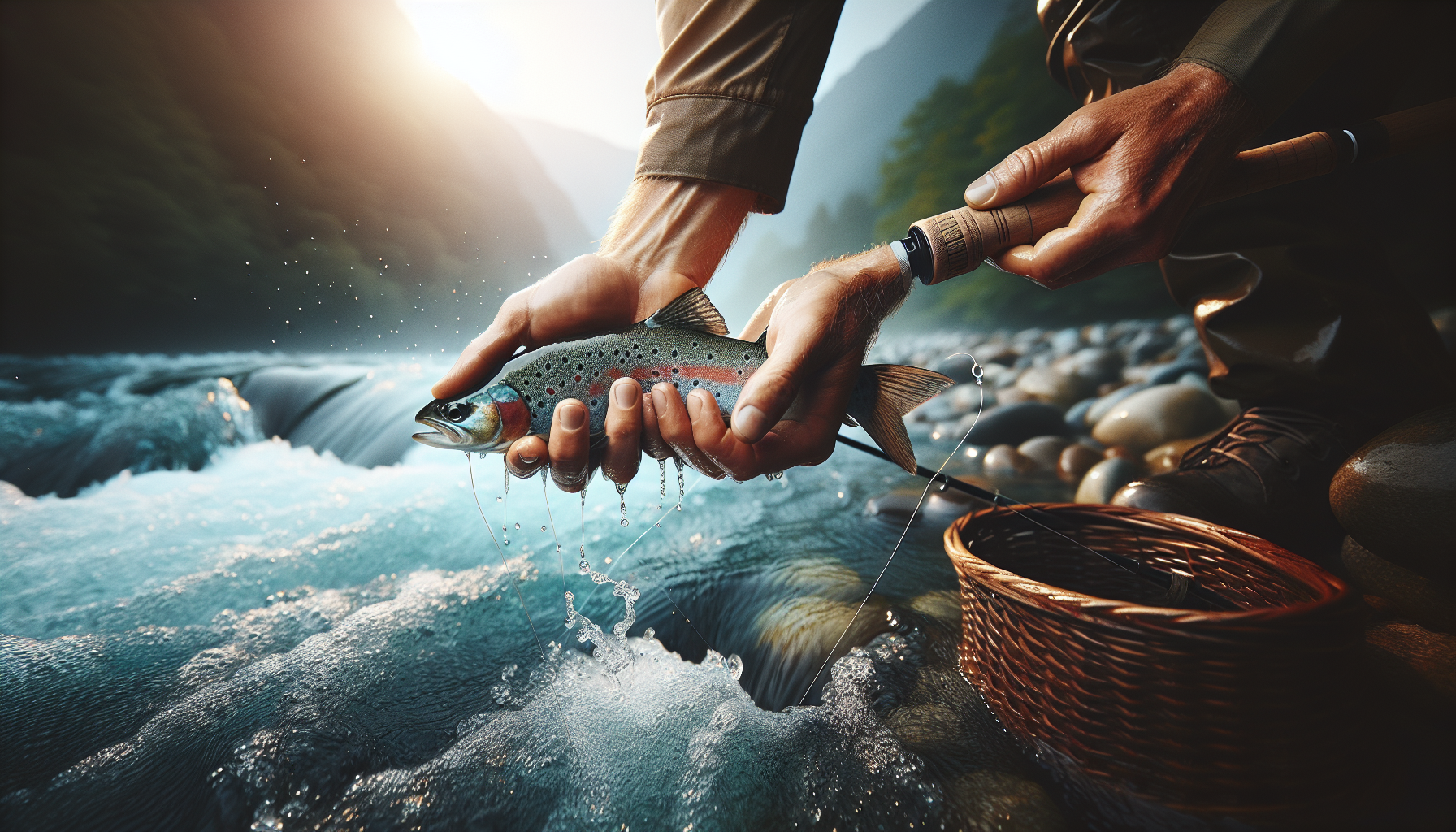
Revival should also be done correctly. In rivers, hold the fish upright facing into gentle current so water moves naturally across the gills. Do not pump the fish back and forth aggressively; that can disrupt normal gill function. In still water, support the fish and allow it to ventilate on its own until it maintains balance and swims with purpose. If predators are present, move the boat or wade to a safer release point when possible. The endpoint is not “it moved.” The endpoint is controlled swimming and regained equilibrium.
Species-Specific Risks in Catch and Release
Different fish fail for different reasons after release. Trout often struggle most with warm water, low oxygen, and extensive handling. Their relatively high oxygen demand makes them poor candidates for prolonged summer catch and release, particularly in tailwaters or small freestone streams during heat waves. Black bass are generally hardy, but nesting males removed from beds can lose eggs or fry to predators within minutes. That is a behavioral consequence with population effects even when direct mortality is low.
Esocids such as pike and muskie have mouths full of hooks and leverage points, so poor net control and rushed unhooking can produce severe jaw and gill injury. Saltwater species add another layer. Bonefish and permit may be highly sensitive to air exposure and elevated water temperatures on shallow flats. Tarpon often survive capture itself but become vulnerable to sharks if they are released in an exhausted state. Reef fish like snapper and grouper may suffer barotrauma when retrieved quickly from depth, showing everted stomachs, bulging eyes, or inability to descend.
These differences are why a catch and release hub must connect to more detailed guidance by species and method. Fly anglers, bait anglers, and lure anglers face different hook-placement patterns. Boat anglers and shore anglers face different landing constraints. Freshwater and saltwater fisheries present different predation risks. The common thread is physiological respect: know the fish, know the conditions, and adapt your approach accordingly.
Turning Physiology Into Better Angling Decisions
The most effective catch and release strategy begins before the cast. Check water temperature, seasonal closures, and local handling rules. Carry long-nose pliers, hemostats, hook cutters, and a rubber net. Fish tackle heavy enough to land fish efficiently. Avoid bait methods likely to cause swallowing when regulations or species vulnerability make deep hooking unacceptable. If conditions deteriorate, such as hot afternoon water or obvious spawning activity, change target species or stop fishing. Responsible anglers treat restraint as part of skill, not as lost opportunity.
During the fight, apply steady pressure and end it decisively. At the landing stage, keep the fish in water while removing hooks, and wet your hands before touching the fish. Skip hero shots that require multiple lifts, especially with large fish or sensitive species. If a fish shows signs of extreme stress, including rolling, gaping opercula, lack of equilibrium, or inability to kick away, give it additional support in the water and reduce future pressure on that stock by changing tactics immediately.
Catch and release works best when anglers understand that survival is not measured at the instant a fish leaves the hand. It is measured hours or days later, in whether the fish resumes feeding, evades predators, spawns successfully, and maintains health. Fish physiology gives anglers the clearest path to that outcome. Learn how temperature, oxygen, gear, fight time, hook placement, and handling interact, then build those principles into every trip. If you want conservation and ethics to mean more than intention, make physiological awareness your standard every time you catch and release a fish.
Frequently Asked Questions
Why is fish physiology so important to successful catch and release?
Fish physiology explains what is happening inside a fish during the entire catch-and-release event, and that knowledge helps anglers make better decisions that improve survival after release. When a fish is hooked and fought, its body shifts into a high-stress state. Muscles work hard, oxygen demand rises, energy stores are used rapidly, and waste products such as carbon dioxide and lactic acid can build up. At the same time, the fish still has to maintain normal functions like breathing through the gills, circulating blood, balancing salts and fluids, and keeping its body systems stable enough to recover once it is released.
If an angler understands those basic processes, many best practices make immediate sense. A shorter fight reduces exhaustion. Using gear strong enough to land the fish quickly limits stress and acid buildup. Keeping the fish in the water protects gill function and reduces physical injury. Wet hands and gentle handling help preserve the slime coat, which acts as a barrier against infection. Avoiding hot water periods matters because warm water contains less dissolved oxygen while also increasing the fish’s metabolic demand. In other words, fish physiology turns catch-and-release from a simple idea into a science-based practice. It shows that release alone is not the goal; release in a condition that allows the fish to recover and survive is what really matters.
What happens inside a fish’s body during the fight and immediately after release?
During a fight, a fish experiences intense physical exertion similar to sprinting while also being unable to fully control its movement. Its muscles burn energy quickly, and when demand outpaces available oxygen, the fish relies more heavily on anaerobic metabolism. That process allows short bursts of power, but it also produces lactic acid and contributes to a drop in normal acid-base balance. The fish’s heart and circulation work harder to deliver oxygen and move metabolic waste, while the gills must continue extracting oxygen from the surrounding water under stressful conditions.
Immediately after release, a fish is often in a recovery phase rather than an instantly normal state. Even if it swims away strongly, it may still be dealing with elevated stress hormones, depleted energy reserves, disrupted blood chemistry, and fatigue in the swimming muscles. Recovery requires oxygen, time, and stable conditions. That is why fish released into warm, low-oxygen water or after prolonged air exposure may look fine at first but still face delayed mortality. The fish may need time to clear lactic acid, restore acid-base balance, normalize circulation, and regain coordination. Understanding this recovery window helps anglers see why minimizing fight time, handling, and air exposure can make such a significant difference in post-release survival.
How do gills, oxygen, and air exposure affect a fish after it is caught?
Gills are the primary organs fish use to extract oxygen from water, and they are extremely efficient in that environment but not designed to function well in air. When a fish is removed from the water, the delicate gill filaments can collapse or stick together, greatly reducing the surface area available for gas exchange. At the same time, the fish’s oxygen demand is often still elevated because it has just been exercised during the fight. That creates a dangerous mismatch: the fish urgently needs oxygen, but air exposure interferes with its ability to get it.
Air exposure also compounds other stressors. A fish may already be acidotic from exertion, and reduced oxygen uptake makes recovery harder. In addition, handling out of water can increase physical damage to gills, eyes, fins, and protective mucus. The longer a fish is held up for photos, unhooking, or measuring, the greater the physiological strain can become. This is why experienced conservation-minded anglers prepare in advance. They keep tools ready, use landing nets designed to reduce injury, unhook fish quickly, and keep the fish submerged whenever possible. If a photo is important, it is best taken quickly with the fish supported properly and returned to the water immediately. From a physiological standpoint, limiting air exposure is one of the most effective ways to improve release outcomes.
How do water temperature and environmental conditions influence catch-and-release survival?
Water temperature has a major effect on fish physiology because fish are ectothermic, meaning their body temperature and metabolic rate are closely tied to the surrounding water. As water warms, a fish’s metabolism speeds up, so it needs more oxygen and burns energy faster. Unfortunately, warm water usually holds less dissolved oxygen than cooler water. That combination creates a serious challenge during and after angling: the fish is stressed, oxygen demand is high, and oxygen availability may be lower. In these conditions, even a moderate fight and brief handling period can push some fish beyond their ability to recover efficiently.
Other environmental factors matter as well. Low dissolved oxygen, poor water quality, strong currents, spawning stress, and depth-related pressure changes can all affect recovery. Species also differ in tolerance. Coldwater species such as trout are often more vulnerable in warm conditions, while some warmwater species may handle higher temperatures better, though they are not immune to stress. Seasonal timing is important too. During heat waves or midsummer low-flow periods, responsible anglers may need to shorten outings, fish only during cooler hours, move to more suitable waters, or avoid targeting especially sensitive species altogether. Understanding these environmental effects helps anglers recognize that catch and release is not equally safe under all conditions. The best practice is to match fishing behavior to the fish’s physiological limits, not just to what is legally allowed.
What are the most effective catch-and-release practices based on fish physiology?
The most effective practices all aim to reduce the amount of physiological stress and physical injury a fish experiences. Start with tackle that allows you to land fish efficiently. Overly light gear can prolong the fight, increasing exhaustion and the buildup of metabolic waste. Use hooks that are easier to remove, and consider gear choices that reduce deep hooking. Once the fish is close, handle it calmly and deliberately. Keep it in the water as much as possible, use wet hands or a rubberized net, avoid squeezing the body, and support the fish horizontally if it must be lifted. Protecting the slime coat and skeletal structure is especially important for larger fish.
Unhook the fish quickly with the right tools, and avoid touching the gills unless absolutely necessary. Minimize air exposure to only a few seconds if the fish needs to come out of the water at all. Be thoughtful about photos and measurements; planning ahead reduces unnecessary delay. After release, allow the fish to regain orientation in the water, especially if current is strong or the fish is clearly fatigued. However, avoid excessive “reviving” that forces water unnaturally through the gills. In many cases, simply supporting the fish facing into gentle current until it is ready to swim off is sufficient.
Most importantly, adjust your behavior to conditions. If water temperatures are high, if fish are showing signs of severe stress, or if a species is known to be especially vulnerable, the best physiological decision may be not to target that fish at all. Good catch and release is not a single technique but a series of choices that respect how fish breathe, recover, and survive. When anglers understand those internal processes, they can fish more responsibly and help ensure that released fish remain part of a healthy fishery.