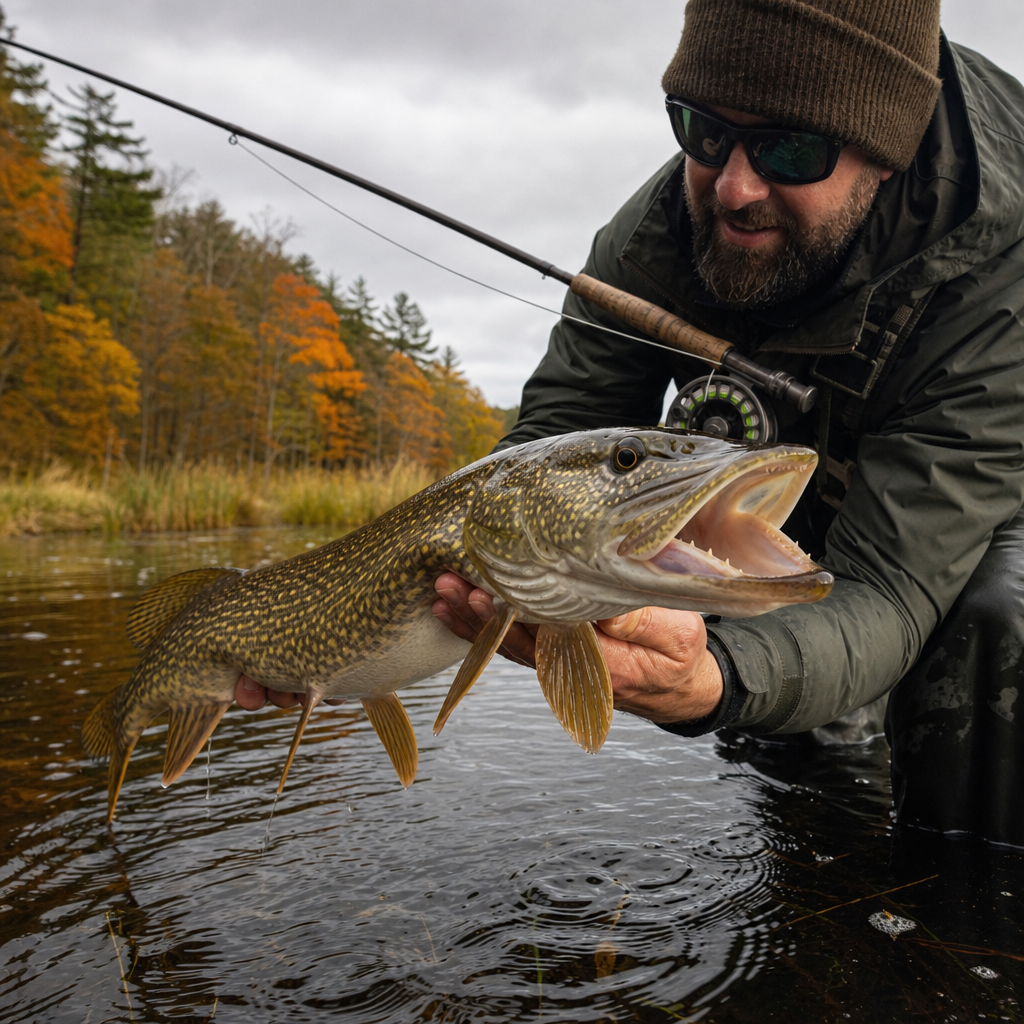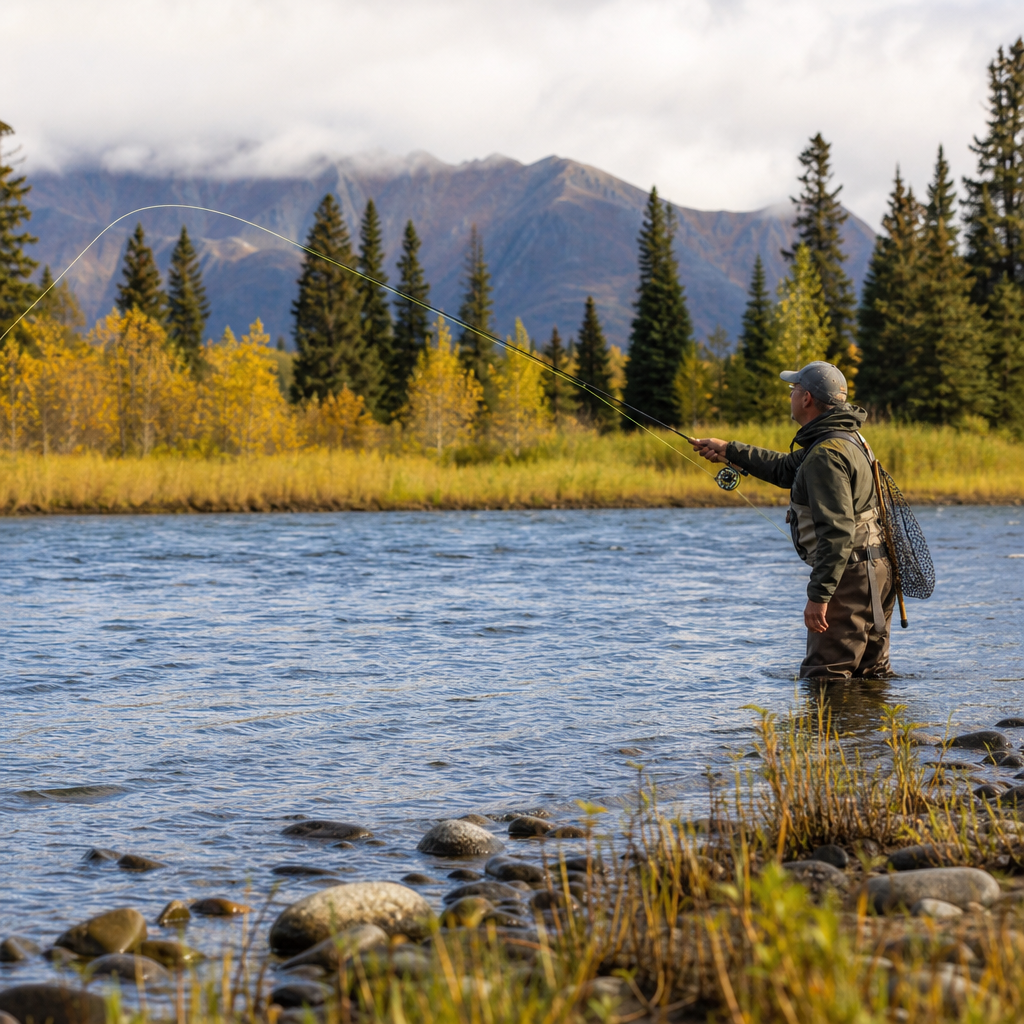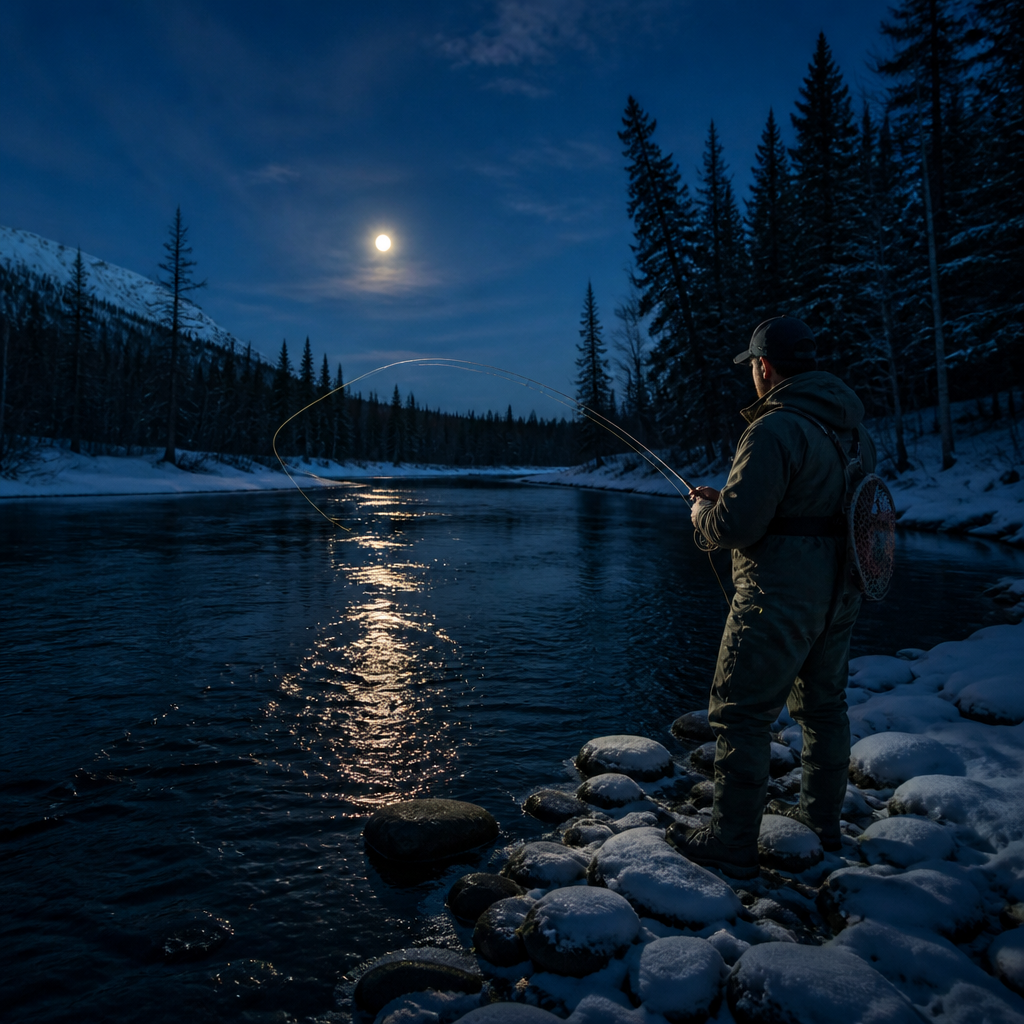
Night fly fishing in winter combines the season’s most demanding conditions with the hours when trout often feel safest, creating a style of angling that is quiet, technical, and surprisingly productive for anglers who prepare correctly. Winter fly fishing means pursuing trout and other coldwater species when water temperatures are low, insect activity is reduced, and fish conserve energy by holding in slower current, deeper pools, and temperature-stable lies. Night fly fishing adds another layer: low visibility, stronger reliance on sound and feel, and a greater emphasis on streamcraft than on sight casting. Together, these conditions reshape everything from fly choice and leader design to wading strategy, safety planning, and fish handling.
This sub-pillar hub covers winter fly fishing comprehensively, with a focus on what changes after dark and why those changes matter. In my own winter sessions on tailwaters and spring creeks, the difference between an empty night and a productive one has usually come down to three controllable factors: locating temperature-stable water, slowing presentations to match reduced fish metabolism, and using gear that preserves dexterity without sacrificing safety. Those same principles apply whether you fish midge hatches on a technical tailwater, swing streamers for brown trout along cutbanks, or dead-drift eggs and small nymphs through wintering runs.
Why does this topic matter enough to deserve a hub page? Because winter concentrates fish, magnifies mistakes, and rewards precision. Cold water lowers a trout’s metabolic rate, so fish generally feed less often and move shorter distances to intercept prey. At night, however, larger fish often become less cautious, especially in clear water and heavily pressured systems where daylight pushes them into cover. The result is a narrow but real opportunity window. Anglers who understand winter hydrology, thermal behavior, forage availability, and night safety can access fish that remain difficult during the day. This article explains the techniques, gear, conditions, and decision-making framework that consistently matter most, while also serving as the organizing page for the broader winter fly fishing topic.
How winter conditions change fish behavior after dark
Winter trout behavior is governed first by temperature, second by oxygen and current, and third by food availability. In most rivers, the coldest part of a winter day is early morning, while late afternoon and early evening can retain slightly warmer water, especially below dams, near groundwater influence, or after a stable weather pattern. That small temperature difference matters. A one- or two-degree shift can improve feeding activity, particularly when fish are already concentrated in softer seams, tailouts, and drop-offs. At night, trout often slide shallower along banks, shelves, and gravel transitions because reduced light lowers their exposure to predators and anglers.
Brown trout are the species most anglers associate with winter night fishing, and for good reason. Larger browns frequently patrol structure after dark, using lateral-line detection more than vision to track prey. Rainbows and cutthroat can also feed at night in winter, but they are usually more predictable around known food sources such as midge emergences, scuds, eggs, and small baitfish. On tailwaters, fish may remain active through winter because discharge and temperature are comparatively stable. On freestone rivers, activity windows are often shorter, especially during cold snaps or after anchor ice forms in slower edges.
The practical takeaway is direct: in winter, fish seldom chase far, but they will eat confidently if your fly enters the right lane at the right speed. That is why productive night presentations are usually slower, tighter to structure, and more deliberate than summer tactics.
Where to find trout on winter nights
The best winter night water is rarely the fastest or deepest section in a river. Instead, focus on areas that combine security, manageable current, and access to food. Productive lies include deep buckets at pool heads, inside seams below riffles, undercut banks with moderate depth, tailwater ledges, foam lines along slower banks, and soft water adjacent to structure such as root wads or boulders. In very cold conditions, trout prefer places where they can hold with minimal effort and shift only inches to feed.
I narrow a river quickly by eliminating water that burns energy. If the current is heavy enough that a trout must constantly correct position, it is less likely to hold there in winter unless food delivery is exceptional. Conversely, dead-flat water can hold fish, but it is often less consistent unless depth, cover, or groundwater influence gives trout a reason to stay. Transitional water is the sweet spot: moderate depth, enough flow to deliver insects or baitfish, and enough softness to let fish conserve energy.
Bank-oriented structure becomes especially important after dark. Big trout use undercut edges, log shadows, and shelf drops as travel lanes. On regulated rivers, the edges below dams can be excellent if flows are stable. On spring creeks, weed edges and underbanks often hold fish all winter because water temperatures fluctuate less. Lakes and reservoirs follow a similar logic near inlets, drop-offs, and cruising margins, though wading safety and access deserve extra caution.
Night fly fishing techniques that work in winter
Three techniques dominate winter nights: dead-drifting small subsurface patterns, swinging or crawling streamers, and fishing eggs or attractors where trout key on spawning-related food. Dead drifts are most effective when trout are feeding on midges, mayfly nymphs, scuds, sowbugs, or tiny stoneflies. Because takes are subtle and visibility is limited, I favor short-line presentations, tight contact, and heavily rehearsed drifts in water I have already seen in daylight. Rather than covering broad water, fish a few high-confidence lanes thoroughly.
Streamer fishing becomes more productive when targeting larger browns that patrol after dark. In winter, streamer success usually comes from downsizing and slowing down, not from aggressive summer strips. A sparse woolly bugger, sculpin imitation, or rabbit-strip pattern moved with short pulses near the bank often outfishes a large articulated fly ripped through fast current. Think crawl, pause, and slight swing. The fly should stay in the strike zone for as long as possible.
Egg patterns are situational but powerful where brown trout, brook trout, or late-spawning fish have deposited eggs, or where stocked fish respond well to high-visibility food cues. On heavily pressured rivers, pairing a small egg with a midge pupa or perdigon-style nymph can be especially effective. Keep indicator use limited at night unless you know the water intimately; many anglers detect winter takes more reliably by maintaining direct contact and watching the leader butt against ambient light.
Best flies, tippet, and rigging for winter fly fishing
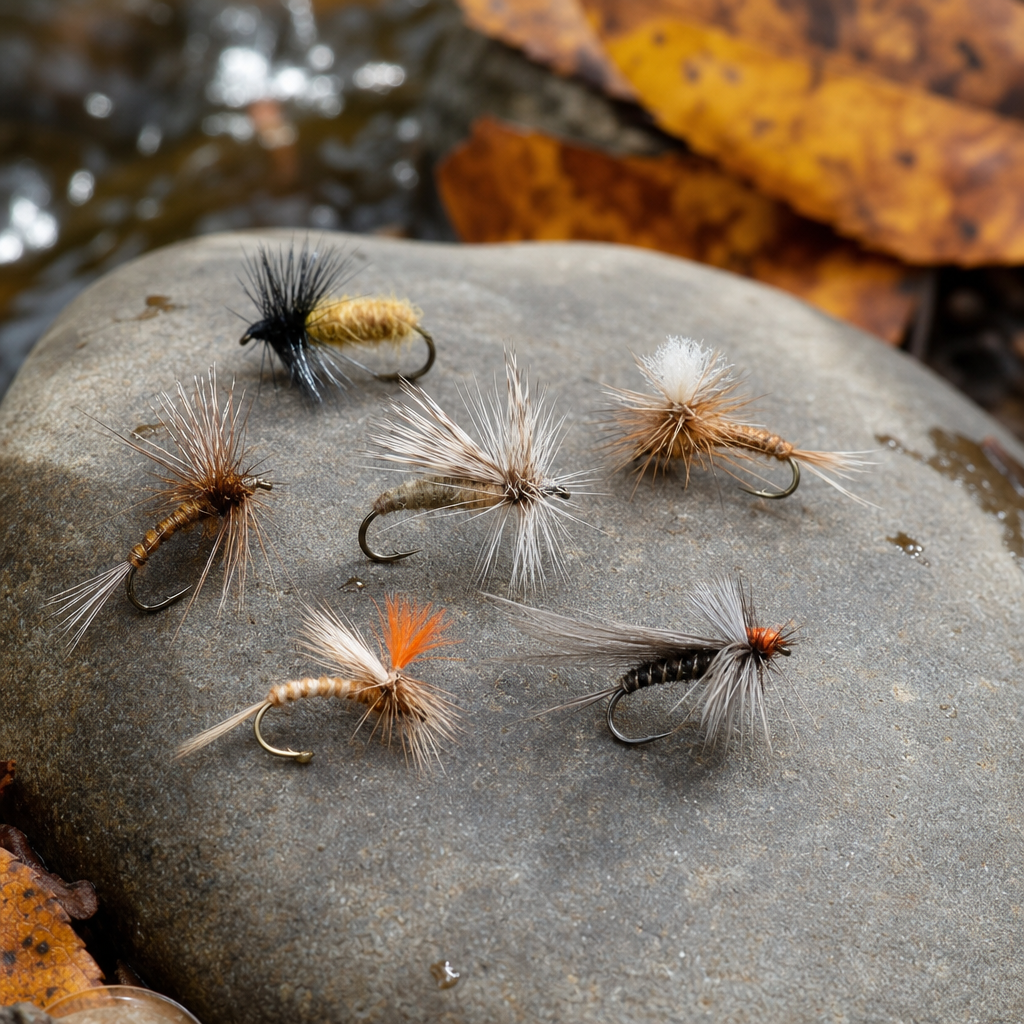
Winter fly selection should reflect the reality that most available food is small, sparse, and energy efficient for fish to eat. Reliable categories include zebra midges, RS2-style emergers, pheasant tails, tiny perdigons, scuds, sowbugs, eggs, leeches, and compact streamers in black, olive, and white. Black remains a proven nighttime color because it creates a strong silhouette. Olive suggests sculpins and aquatic life well. White can excel when fish key on pale baitfish or when slight moonlight improves contrast.
Leader setup depends on technique. For nymphing, a 7.5- to 9-foot leader tapered to 4X through 6X covers most winter conditions, with finer tippet reserved for clear, slow water and tiny flies. For streamers, shorter leaders in the 4- to 6-foot range with 0X to 3X improve turnover and control. Fluorocarbon helps subsurface work because it sinks more readily and resists abrasion, though nylon remains useful for dry-dropper or emerger situations. Split shot size should be adjusted continuously; winter trout often hold inches from the bottom, and being six inches too high can be the same as fishing empty water.
| Situation | Best Fly Types | Tippet Range | Presentation Priority |
|---|---|---|---|
| Clear tailwater, midge activity | Zebra midge, RS2, small pheasant tail | 5X–6X | Long, drag-free dead drift near bottom |
| Spring creek at night | Scud, sowbug, midge pupa | 4X–5X | Short-line contact drift along weed edges |
| Freestone pool in cold snap | Egg, perdigon, small stonefly nymph | 4X–5X | Slow, deep drift in softer seams |
| Brown trout bank patrol | Black bugger, sculpin, rabbit-strip streamer | 0X–3X | Crawl-pause retrieve tight to cover |
Essential winter night gear
The best gear for night fly fishing in winter balances warmth, dexterity, control, and safety. Rod selection is straightforward: a 9-foot 4- or 5-weight handles most nymphing and light streamer work on trout rivers, while a 6-weight gives better authority for larger streamers and wind. Reels matter less for drag than for reliability in freezing conditions. A line with a supple cold-weather coating reduces memory and tangles; many standard lines stiffen noticeably below freezing.
Layering deserves the same attention as fly choice. Start with a moisture-managing base layer, add insulating mid-layers such as grid fleece or light synthetic puffy pieces, and finish with a weatherproof shell. For legs and feet, breathable waders paired with non-cotton thermal layers work well if they are not overstuffed; compressed insulation leads to colder feet. Studded boots or studs paired with felt where legal increase traction dramatically on icy rocks. A wading staff is not optional on unknown water at night.
Hands are the hardest system to optimize. I prefer a thin liner glove for knot tying, a fold-back insulated glove or mitten over that, and chemical warmers stored in a chest pocket rather than applied directly to wet skin. A dependable headlamp with fresh batteries is mandatory, but use it sparingly. Red-light modes preserve night vision, and a backup light should always ride in a separate pocket. Add nippers on a retractor, a thermometer, a waterproof phone case, and a compact first-aid kit. If air temperatures are severe, carry a dry emergency layer in the vehicle.
Safety, planning, and fish care in cold weather
Night wading in winter carries risks that deserve plain talk. The biggest hazards are slips, cold-water immersion, route-finding errors, and overestimating how long dexterity will last. Scout access points during daylight, note fence lines and private boundaries, and memorize safe wading limits before dark. Fish with a partner when possible and share a check-in time. If flows are dam controlled, verify release schedules; a nighttime increase below a dam is significantly more dangerous in winter.
Hypothermia does not require dramatic immersion. Wet gloves, wind, exhaustion, and gradual heat loss can impair judgment long before an angler recognizes the problem. Keep sessions shorter than summer outings, build in warm-up breaks, and leave immediately if coordination drops. A thermos with a hot drink is practical, not decorative. So is a vehicle staged with dry footwear and spare clothes.
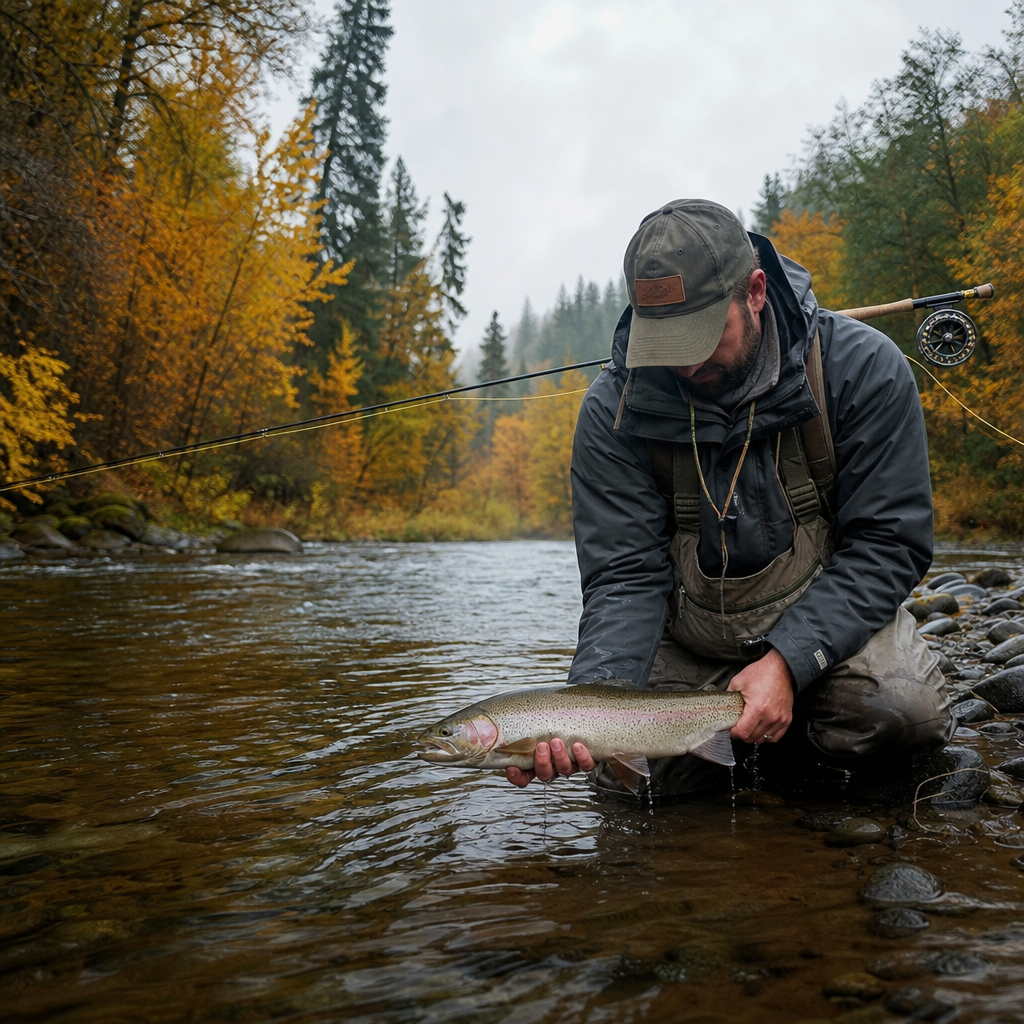
Fish care also changes in winter. Trout recover more slowly when fought too long, and freezing air can damage eyes and gills. Use strong enough tippet to end fights quickly, keep fish in the water during unhooking, and avoid extended photo handling. Rubber nets reduce slime loss, and barbless hooks make releases faster. If temperatures are extremely low, consider skipping hero shots entirely. Responsible winter fly fishing means protecting fish from both angling stress and exposure injury.
Building a complete winter fly fishing strategy
As a hub for winter fly fishing, this page should help you build a repeatable system rather than chase isolated tips. Start with conditions: identify whether you are on a tailwater, freestone, spring creek, or stillwater, then assess recent air temperatures, current water temperature, flow trend, moonlight, and likely forage. Next, match water type to technique. If fish are concentrated and food is tiny, fish small nymphs deep and slowly. If larger browns are using shoreline cover after dark, switch to compact streamers and cover short bank sections methodically. If trout are keyed on eggs or scuds, rig accordingly and stay near the bottom without constant snagging.
Keep notes after every trip. Record water temperature, start time, weather stability, productive depth, fly size, and the exact type of holding water that produced fish. Over a season, patterns emerge quickly. On one western tailwater I fish, the best winter night window often starts later than expected, after banks lose residual human activity and the water settles. On a limestone spring creek, by contrast, the first hours after sunset can be better because fish move only briefly before the cold deepens. There is no substitute for that kind of logbook evidence.
The main benefit of mastering night fly fishing in winter is not simply catching more trout. It is learning to read conditions with precision, make disciplined presentations, and fish efficiently when opportunities are narrow. Success comes from thoughtful water selection, slow and accurate technique, reliable cold-weather gear, and uncompromising safety habits. Use this page as your foundation for the broader winter fly fishing category, then apply these principles on your own water, one carefully planned night at a time.
Frequently Asked Questions
Is night fly fishing in winter actually productive, or are trout too inactive in cold water?
Yes, night fly fishing in winter can be productive, but it rewards a very specific approach. Trout are not usually feeding as aggressively in winter as they do during warmer months, because cold water slows their metabolism and encourages them to conserve energy. That said, nighttime can still create a meaningful advantage for anglers. Larger trout often feel more secure under darkness, especially in rivers or streams that see daytime pressure, and they may move short distances to feed when they would remain hidden during daylight hours. In winter, these movements are rarely dramatic, which is why success comes from presenting flies close to where fish already hold rather than expecting them to chase.
The most productive winter night scenarios usually involve stable weather, relatively moderate cold rather than severe cold snaps, and water temperatures that are cold but consistent. Trout tend to hold in slower seams, tailouts with softer flow, deeper pools, undercut banks, and other lies where they can avoid fighting current. If you target those areas methodically and keep your drift controlled, you can contact fish that are feeding opportunistically on midges, small nymphs, sculpins, leeches, or other high-value food sources. The key is adjusting expectations: winter night fishing is typically about fewer chances, but often better-quality fish and less competition on the water.
What flies work best for winter night fly fishing?
The best flies for winter night fly fishing generally fall into two categories: slow, natural subsurface patterns and larger profile flies that are easy for trout to detect in darkness. Because winter insect activity is limited, many successful anglers lean heavily on nymphs, midge patterns, small streamers, and leech-style flies. If fish are feeding selectively, midge larvae, midge pupae, small mayfly nymphs, and other compact patterns in dark, natural, or slightly flashy colors can be excellent choices. These imitate the food sources trout are most likely to encounter consistently in cold water.
Streamers can be especially effective at night in winter, but they should usually be fished more deliberately than they are in warmer seasons. Instead of stripping quickly, think in terms of short pulls, long pauses, and presentations that keep the fly near the bottom and in the strike zone for as long as possible. Patterns with strong silhouettes such as black woolly buggers, sculpin imitations, zonkers, and rabbit-strip leeches often perform well because fish can locate them more easily in low light. Dark flies frequently outproduce lighter patterns at night because they create contrast against the faint ambient light above.
Fly size depends on water clarity, fish size, and local forage, but winter often favors moderation. Oversized flies can work for trophy trout, yet many nights are won with medium-size streamers and small-to-mid-size nymphs placed precisely. If you are unsure where to begin, start with a two-part strategy: fish a compact nymph rig in slower water and a dark streamer in deeper runs and bankside structure. Let the fish tell you whether they want subtle, easy meals or a larger target worth moving for.
What gear is most important for staying safe and effective while fly fishing at night in winter?
Safety and thermal protection matter just as much as rods, reels, and flies. Winter night fishing exposes anglers to cold air, cold water, reduced visibility, slippery banks, and slower emergency response if something goes wrong, so your gear choices should start with protection. A reliable wading setup is essential: breathable or insulated waders paired with warm layering systems, moisture-wicking base layers, insulating mid-layers, and a weatherproof outer shell. Avoid cotton, which traps moisture and loses insulating value quickly. Good wading boots with strong traction are critical, and in icy or rocky conditions, studs can significantly improve footing.
Lighting is another major priority. A high-quality headlamp with fresh batteries is mandatory, but it should not be your only light source. Carry a backup light in a separate pocket, and consider a model with a red-light mode to preserve night vision when retying or checking gear. Keep your essentials streamlined and easy to reach because digging through packs in freezing darkness wastes time and increases risk. Forceps, nippers, tippet, extra leaders, indicators if you use them, and a compact fly box should all be accessible by feel.
From a fishing standpoint, many anglers prefer slightly heavier setups than they might use in daylight winter conditions. A 5- or 6-weight rod covers a broad range of nymphing and streamer work, while a 6- or 7-weight may be useful on larger rivers or when targeting bigger trout with sink-tip lines and weighted flies. Reels should have dependable drag, but more important is pairing them with a line system suited to depth and speed. Floating lines handle indicator and tight-line approaches, while sink-tips can be invaluable for slowly presenting streamers in deep holding water.
Finally, carry basic emergency and comfort items: a fully charged phone in a waterproof case, hand warmers, a dry hat and gloves, warm fluids, and a clear plan for entry and exit points. Night fishing in winter is not the time to explore unfamiliar water. Familiarity, organization, and cold-weather discipline are what keep the trip both productive and safe.
How should you present flies differently at night during winter compared with daytime or warmer-season fishing?
The biggest adjustment is slowing everything down. In winter, trout typically will not move far to intercept a fly, and at night they rely more on feel, silhouette, and close-range detection than on extended visual tracking. That means your presentation has to be precise, controlled, and close to the fish. Whether you are nymphing or fishing streamers, the goal is to keep the fly in likely holding water for as long as possible without creating unnatural speed or drag.
For nymphing, focus on deeper, softer lanes where trout can hold with minimal effort. Use enough weight to reach the lower part of the water column, but not so much that you constantly snag. Short drifts can be more productive than long casts because they give you better contact and strike detection in the dark. Many takes at night in winter are subtle, so any hesitation, heaviness, or slight stop should be treated as a possible fish. Fishing close and methodically is usually more effective than covering water aggressively.
For streamers, think less about provoking a chase and more about placing an easy meal in front of a fish. Cast quartering downstream or across current, allow the fly to sink, and retrieve with slow strips and generous pauses. Often the strike comes when the fly is hanging, swinging slowly, or barely moving at all. This is especially true in winter when trout prefer calories they can take without burning much energy. Structure and current transitions matter tremendously: slow edges next to deeper flow, submerged wood, undercut banks, and the inside seams of pools are all strong targets.
Because visibility is limited, simplify your approach. Fish water you understand, reduce false casts, and maintain line control at all times. At night in winter, presentation is not about speed or variety. It is about confidence, repeatability, and keeping the fly where a cold-water trout can take it with minimal effort.
What are the best conditions and locations for winter night fly fishing?
The best conditions usually involve stability. A steady weather pattern, manageable wind, and water temperatures that are cold but not plunging tend to fish better than sudden fronts or extreme freezes. Trout dislike abrupt environmental changes, and winter fish are especially sensitive to them. A slight warming trend, overcast conditions rolling into evening, or a day when water temperatures hold steady into the night can all improve the odds. Clear water is generally helpful for controlled presentations, although lightly stained water can also be excellent for larger dark streamers because fish feel secure and the fly becomes easier to silhouette.
As for location, focus on winter holding water first and nighttime movement second. In practical terms, that means deeper pools, slow runs, soft seams, undercut banks, tailouts with nearby depth, spring-influenced sections, and any area with reduced current and stable temperature. Fish are rarely scattered randomly in winter; they concentrate where they can conserve energy. At night, larger trout may slide from the deepest cover to adjacent feeding lanes, but they usually do not travel far. That makes transition zones especially valuable. If a deep pool dumps into a gentle tailout, or a bank shelf drops into slower depth, those are classic winter night targets.
Small streams can be productive if they have enough depth and overwintering habitat, but medium and larger rivers often provide more consistent nighttime winter opportunities because they maintain stable temperatures better and hold larger forage. Tailwaters and spring creeks are especially attractive because they tend to experience less temperature volatility. Regardless of river type, choose water you know well in daylight, keep your route simple, and concentrate on a few high-probability lies instead of trying to cover long distances. Winter night success usually comes from understanding where trout can comfortably live and then fishing those places with patience and discipline.