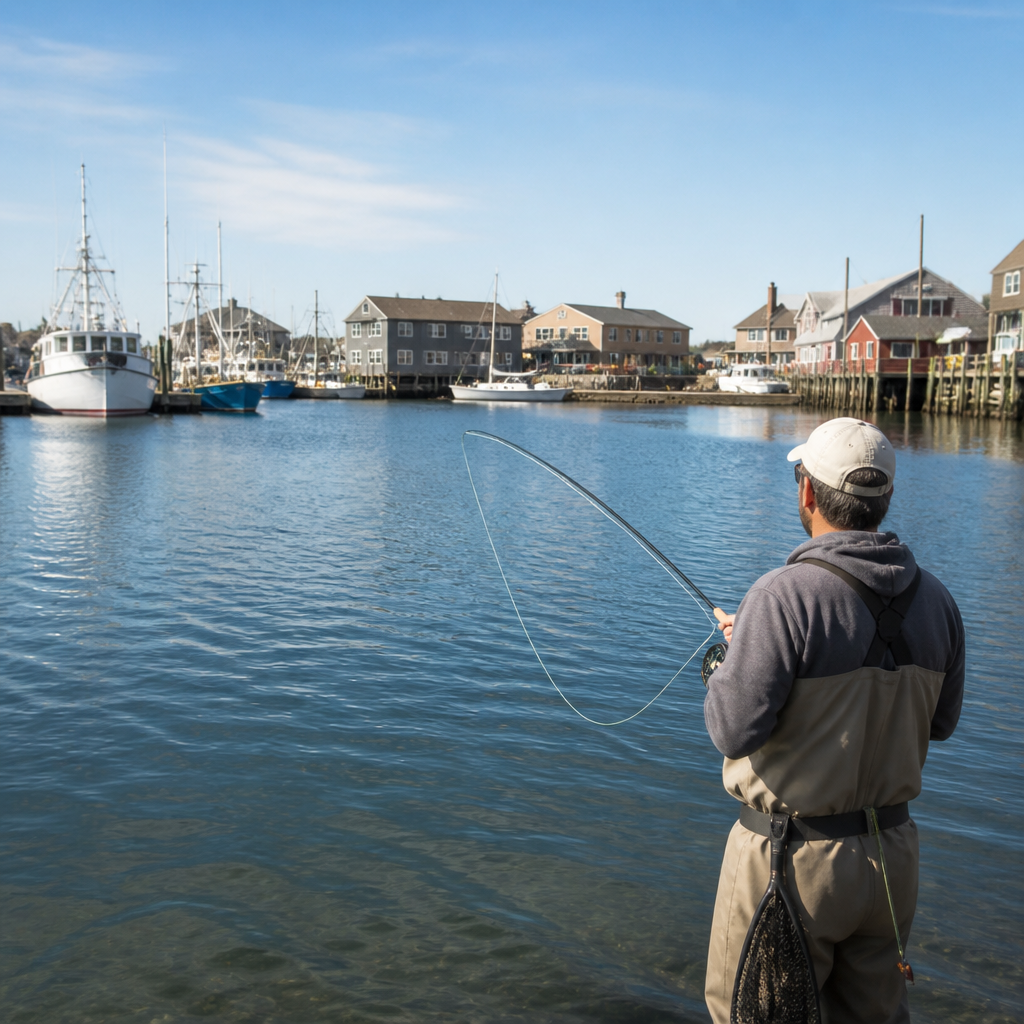
Fly fishing in harbors demands a different playbook than rivers, surf beaches, or offshore flats because current is redirected by walls, bait is pinned against structure, and fish use man-made cover with ruthless efficiency. In practical terms, a harbor is any protected coastal basin shaped by jetties, breakwalls, marinas, channels, docks, boat ramps, and tidal creeks that funnel into deeper, calmer water. Water types and conditions inside these areas vary sharply over short distances: glassy back-eddies may sit beside wind-raked chop, muddy runoff can border clear tidal seams, and shallow mudflats may drop abruptly into dredged channels. That variability is exactly why harbors reward thoughtful fly anglers. If you can read current lines, light levels, bottom composition, boat traffic, and bait movement, you can find feeding fish consistently when open beaches or offshore water are difficult to fish. I have spent enough dawns in working harbors to know that success rarely comes from blind casting. It comes from understanding where oxygen, shelter, forage, and ambush angles intersect. This guide covers the harbor systems, conditions, strategies, and gear that matter most.
Why Harbors Hold Fish and How to Read Their Water
Harbors concentrate fish for simple biological reasons: food arrives on every tide, structure creates protection, and depth changes provide thermal and security advantages. Predators such as striped bass, snook, sea trout, bluefish, and juvenile tarpon often patrol harbor edges because baitfish are easier to trap there than in open water. Even species usually associated with beaches or estuaries will slide into harbor water when wind, temperature, salinity, or prey availability shifts. Start with the major water types. Main channels are the deep highways; fish use them to travel with tides and often stage on channel edges rather than in the middle. Flats inside a harbor warm quickly, grow shrimp and crabs, and draw mullet or anchovies on calm mornings. Basin corners, marina fairways, and lee shorelines become feeding zones when wind pushes plankton and bait into them. Outflows from storm drains, creek mouths, and culverts can be excellent if runoff is not severely polluted, because they create current breaks and food washouts.
Reading harbor water means breaking it into moving pieces. First, identify current direction on the flood and ebb. In many harbors, the strongest movement occurs not across the whole basin but at choke points near bridge abutments, slips, mooring fields, and jetty gaps. Second, look for edges: clear water against stained water, shadow against sun, fast current beside slack water, or rippled surface beside calm slicks. Predators prefer these edges because they can hold with minimal effort and attack prey crossing the seam. Third, assess depth transitions. A drop from three feet to twelve feet may be more important than a hundred yards of featureless shoreline. Fourth, note surface life. Nervous water, dimpling bait, terns hovering, or mullet showering often reveal feeding activity before fish show themselves. Harbor fish are opportunistic, but they are not random. They sit where the water delivers a steady advantage.
Tides, Current, Wind, and Light: The Harbor Conditions That Matter Most
The best harbor anglers treat conditions as a stack, not a single variable. Tide height matters, but tidal movement matters more. A strong incoming tide may push clean, oxygenated water into a muddy basin and trigger feeding along the first drop-offs. An outgoing tide often pulls shrimp, crabs, and disoriented bait from backwaters through narrow exits, creating short windows of concentrated action. Around slack tide, fish commonly reposition tighter to structure or suspend deeper, which often calls for slower presentations and heavier flies. Wind can improve or ruin a harbor session. A moderate onshore breeze corrals bait into corners, roughens the surface so fish feel safer, and helps disguise leaders. Too much wind, however, can muddy shallow zones and make accurate casting around pilings difficult. In harbors, I often prefer ten to fifteen knots over dead calm because the chop adds cover without destroying boat control or line management.
Light level is equally important. Early morning and late evening enlarge shadow lines around docks and seawalls, allowing predators to move shallower. Midday sun can still be productive when water is clear because fish become more visible and often hold under floating docks, barges, and moored boats. Night fishing in harbors deserves special attention. Artificial lights attract plankton, then glass minnows and shrimp, then predators. The key is to avoid casting directly into the brightest cone every time. Often the best fish sit on the dark edge just outside the light line, intercepting bait flushed from the illuminated zone. Moon phase affects this pattern. During a bright full moon, fish may feed more broadly across the harbor, while darker nights can make dock lights disproportionately important. Barometric pressure matters less than many anglers think compared with bait presence and moving water, but a sudden post-front temperature drop can slow warmwater species significantly.
Harbor Structure, Bottom Composition, and Seasonal Fish Positioning
Not all harbor structure is equal. Riprap absorbs heat, grows mussels and algae, and shelters crabs, making it valuable year-round. Vertical seawalls create ambush lanes, especially when depth lies close to the wall. Wood pilings are usually more productive than bare concrete because they host more marine growth and soften current. Floating docks create shade and a protected undercanopy, while fixed docks create both shade and stronger current deflection at higher tidal stages. Boat hulls, mooring chains, and anchored barges also create microstructure that many anglers ignore. Dredged channels matter because they provide temperature stability. In summer, cooler deeper water can hold fish through bright periods; in winter, the deeper basin may buffer overnight cold compared with adjacent flats. Bottom composition determines forage. Mud supports worms, crustaceans, and burrowing life; sand favors sandeels and small crabs; broken shell attracts bait and can abrade leaders if you fight fish carelessly near bottom.
Season shifts harbor strategy dramatically. In spring, warming shallows and increasing bait populations pull fish onto flats and into creek mouths on sunny afternoons. In summer, dawn, dusk, and night often outperform midday, especially in heavily trafficked marinas where prop wash and noise intensify. During fall, harbors can become migration rest stops. Mullet runs, anchovy schools, or juvenile herring movements may stack predators along channel mouths and breakwalls for weeks. Winter varies by region. In mild climates, black drum, school striped bass, sheepshead, and sea trout may remain in protected harbor water. In colder zones, warmwater species retreat, but harbors near power plant discharges, deep basins, or urban heat islands can still fish well. Matching seasonal positioning to water type is the hub skill. The same dock that is dead on a summer afternoon may be prime on a winter flood tide if warmer water and bait collect there.
Fly Selection, Lines, and Leaders for Harbor Conditions
Harbor fly fishing rewards versatile systems more than hyper-specialized ones. The dominant forage in many harbors includes anchovies, silversides, mullet, small herring, juvenile menhaden, shrimp, and crabs, so your boxes should reflect profile and behavior rather than color trends. Clouser Minnows remain essential because they sink efficiently and ride hook point up around rocks and pilings. Deceivers, Half and Halfs, EP baitfish patterns, and sparse bucktail streamers cover most baitfish situations. Shrimp flies shine on slower currents and flats, while crab patterns matter around riprap, oyster edges, and sheepshead or drum structure. Harbor water is often stained, so silhouette usually beats intricate detail. Olive-over-white, chartreuse-over-white, gray, tan, and black are staple colors. Black is particularly effective at night because it creates the strongest profile under artificial light. Carry flies in multiple weights. The same pattern tied with small dumbbell eyes may be right for a two-foot dock edge but too slow for a six-knot jetty seam.
Line choice controls depth and presentation more than any other tackle decision. A weight-forward floating line is ideal for shallow flats, surface bait eruptions, gurglers around lights, and precise casts tight to dock edges. An intermediate line is the best general harbor line because it cuts surface chop, tracks straight in current, and keeps streamers in the upper water column where many baitfish travel. Fast-sinking integrated shooting heads excel for channels, deep walls, and strong outflows. Leaders should be shorter than many trout anglers expect. In current and around structure, six- to nine-foot leaders turn over larger flies better and help maintain direct contact. Fluorocarbon tippet is useful around abrasion and clear water, though nylon still works well for topwater because it floats better. For striped bass or snook, sixteen- to twenty-pound class leaders are common; for bluefish or mackerel, a short bite tippet of wire or heavy fluorocarbon can save flies. The tradeoff is reduced stealth, so use it selectively.
Approach, Presentation, and Gear Setups for Common Harbor Scenarios
Approach matters as much as gear because harbor fish are conditioned by noise, prop wash, and repetitive casting. Wading anglers should move slowly and use shadows, especially along marinas and urban seawalls where fish may sit only a rod length away. Kayak and skiff anglers need boat control: use tide and wind to drift past targets quietly rather than powering down on top of them. Most harbor presentations are short to medium range. You are often casting fifteen to fifty feet at defined lanes, not bombing ninety-foot casts into empty water. Make the first cast count. Predators tucked under docks or against pilings frequently spook after one bad line slap. For dock lights, land the fly outside the cone, let it sink on tension, then strip across the edge. For current seams, cast slightly up-current, mend if needed, and allow the fly to swing into the ambush lane before beginning strips. Around riprap, vary retrieve speed because fish may want a panicked baitfish one day and a near-dead drift the next.
| Harbor scenario | Best line | Useful flies | Primary tactic |
|---|---|---|---|
| Dock lights at night | Intermediate | Black Deceiver, sparse shrimp | Work dark edge, not brightest center |
| Riprap on outgoing tide | Floating or intermediate | Clouser, crab pattern | Swing fly through seam beside rocks |
| Deep channel edge | Sink head | Half and Half, heavy baitfish | Count down to depth, short strips |
| Wind-blown harbor corner | Intermediate | EP baitfish, mullet pattern | Cast across bait push and strip fast |
| Shallow mudflat at dawn | Floating | Shrimp, small baitfish | Longer lead, gentle landing, slow retrieve |
Rod selection should match both species and fly size. An 8-weight is the most useful all-around harbor fly rod because it handles medium streamers, moderate wind, and common inshore fish without becoming tiring. A 6- or 7-weight suits calm harbors, school fish, and smaller flies. A 9- or 10-weight is appropriate for larger tarpon, oversized stripers around bridges, or heavy sink heads. Reels need smooth drags and corrosion resistance more than huge arbor diameter. Good examples include sealed-drag models from Nautilus, Hatch, Lamson, and Tibor. Stripping baskets are underrated on breakwalls and jetties because dock cleats, rocks, and shell fragments tangle fly line instantly. Polarized glasses help by day, while a compact headlamp with red mode protects night vision. Harbor-specific extras include a long-handled net for elevated seawalls, quality pliers for rusty hooks, and footwear with secure grip on algae-slick concrete. None of this is glamorous, but all of it directly improves landing rates and safety.
Safety, Access, and Conservation in Working Harbors
Harbors are productive because they combine fish habitat with human infrastructure, but that also makes them less forgiving than many shoreline environments. Boat traffic is the first hazard. Large vessels create wake, suction, and blind zones, especially in channels and around ferry routes. Never anchor or wade in navigation lanes, and assume operators cannot see a low-profile kayak against docks or glare. Tidal flow around bridge footings, culverts, and breakwall gaps can be stronger than it appears at the surface; if your stripping basket, anchor line, or loose fly line snags there, do not chase recklessly. Water quality is the second concern. After heavy rain, urban harbors often receive runoff carrying fuel residue, bacteria, trash, and fine sediment. Fish may still feed aggressively, but wading cuts and hand contact require care. Gloves, prompt rinsing, and common-sense avoidance of obvious spills are worthwhile. Access rules also matter. Productive water around marinas and terminals may be private or restricted, and trespassing quickly damages relations that local anglers depend on.
Conservation in harbors begins with recognizing that these places often function as nurseries. Juvenile baitfish, small gamefish, and invertebrates depend on eelgrass edges, marsh drains, riprap algae, and dock shade. Handle fish quickly, keep them in the water when practical, and use barbless or de-barbed hooks if local regulations and target species allow. Circle hooks are not part of standard fly rigs, so strip-set discipline matters to avoid deep hooking fish that eat on slack line. Be careful around fish holding under docks in summer, where low oxygen can increase post-release stress. If a fish is exhausted after a hard run around pilings, revive it in clean moving water before release. Finally, leave no clipped tippet, packaging, or damaged mono behind. In highly visible urban harbors, angler behavior shapes public acceptance. Respectful access, quiet handling, and clean shorelines do more for the future of harbor fly fishing than any new pattern or casting fad. Study your local tide chart, scout structure at low water, and fish the next moving tide with a plan.
Frequently Asked Questions
What makes fly fishing in harbors different from fishing rivers, surf beaches, or open flats?
Harbors fish differently because everything in them is shaped by man-made structure and redirected current. In a river, current is generally obvious and continuous. On an open beach, waves and longshore movement spread bait over broad areas. On flats, fish often travel open lanes with relatively predictable visibility and presentations. In a harbor, by contrast, bait and predators are compressed into tight, irregular zones created by jetties, breakwalls, docks, pilings, mooring fields, marinas, ramps, and channel edges. Water can change from clear to dirty, shallow to abruptly deep, calm to turbulent, all within a short cast. That means fish often hold with ruthless efficiency in precise spots: the shadow line under a dock, the soft seam behind a piling, the eddy beside a rock wall, or the drop where a tidal creek pours into the basin.
Another major difference is how fish use cover. Harbor fish are often less interested in roaming and more interested in ambush. They sit where current delivers food and structure gives them concealment and protection. For the fly angler, that means accuracy matters more than simply covering water. A fly landed two feet from the feeding lane may go unnoticed, while a fly dropped tight to a piling or swept naturally along a wall can get eaten immediately. Harbors also reward anglers who can read artificial environments the same way trout anglers read seams and buckets. Every dock corner, ladder, pontoon float, moored boat, culvert, and riprap line can create a feeding position. In practical terms, harbor fly fishing is less about pretty open-water casting and more about problem-solving: interpreting current, identifying bait concentration, making controlled presentations in tight quarters, and fighting fish away from structure before they cut you off.
Where should I focus first when trying to locate fish inside a harbor?
Start with places where current, depth change, and structure intersect. Those three ingredients consistently concentrate bait and give predators an efficient feeding station. The highest-percentage areas are often harbor mouths, channel edges, corners of jetties, the down-current side of breakwalls, marina entrances, dock rows with moving water, boat ramps with adjacent drop-offs, and the mouths of tidal creeks draining into the basin. Fish use these areas because they create conveyor belts of food. Even a modest current sweeping around a seawall or through a gap between docks can pin bait against structure and force easy feeding opportunities.
Pay close attention to transition zones. A harbor is full of them: bright water to shade, shallow flat to dredged channel, dirty runoff to cleaner tidal inflow, slack pocket to moving seam, and open basin to tight structure. These transitions often outproduce featureless water because predators can wait in the comfortable side of the break and strike into the vulnerable side. For example, a fish may hold in shadow under a dock and rush into sunlit water to intercept silversides, or sit just outside muddy runoff where disoriented bait spills into clearer water. If you are new to a harbor, resist the urge to fish the entire shoreline evenly. Instead, make a milk run of the obvious feeding stations and spend extra time on places with visible life: nervous bait, shrimp flicking, birds working, slicks, boils, wakes along walls, or fish flashing in current seams.
Tide stage should shape your search as well. On incoming water, fish often push farther into marinas, along flooded edges, and into creek mouths where clean water brings bait in. On outgoing water, they commonly set up at drains, pinch points, and channel lips where food is flushed toward them. Slack tide can be slower, but harbors still produce at dawn, dusk, or around artificial lighting when fish switch from current-based feeding to sight-based ambush. If you fish at night, dock lights, bridge lights, and marina spill zones become major fish magnets because they gather plankton, then bait, then predators. A good first-pass strategy is simple: find moving water, identify the nearest structure that interrupts it, then fish the shadow line, the seam, and the drop-off before moving on.
What fly patterns and tackle work best for harbor fishing?
Harbor fly tackle should be versatile, durable, and capable of making accurate casts around abrasive structure and variable depth. For most saltwater harbors, an 8-weight is the all-around sweet spot because it handles wind, medium-to-large baitfish flies, sinking lines, and strong fish without becoming too heavy to cast all day. A 7-weight can be excellent when fish are smaller or conditions are protected, while a 9-weight makes sense around larger predators, heavy current, or bigger flies. Pair the rod with a corrosion-resistant reel that has a smooth drag and enough backing for fast runs in channels or around basin mouths. In a harbor, you are often not just fighting the fish; you are fighting pilings, rocks, mooring lines, and barnacle-covered edges, so dependable drag and quick pressure matter.
Line choice is critical because harbor fish may feed on the surface one hour and hug a wall in six to fifteen feet of water the next. A floating line is useful for poppers, gurglers, unweighted baitfish, and shallow presentations along marsh edges, calm docks, or surface-feeding schools. However, many harbor anglers rely heavily on intermediate lines because they cut surface chop, keep the fly in the zone, and work well over mixed depths without constantly snagging bottom. A sink-tip or full sinking line is valuable when probing channel edges, steep walls, bridge abutments, or deep marina basins where fish suspend below bait schools. The best setup for many anglers is a floating or intermediate line on one spool and a faster-sinking option on another.
As for flies, think bait first, then profile, then sink rate. Harbor forage commonly includes anchovies, silversides, juvenile mullet, herring, sand eels, shrimp, crabs, and small baitfish pushed against hard structure. Clouser Minnows remain a staple because they cast well, get down quickly, and imitate a wide range of prey. Deceivers, Half and Halfs, baitfish imitations with synthetic wings, shrimp patterns, crab flies for bottom-oriented species, and sparse small streamers for finicky fish should all have a place in the box. Color usually follows water clarity and light: white, olive, tan, gray, and translucent patterns are reliable in cleaner water; chartreuse, pink accents, black, and darker silhouettes can stand out better in dirty water or at night. Do not underestimate black flies after dark around lights and shadow lines. In many harbors, a black or purple baitfish pattern throws a stronger silhouette than a natural-colored fly and gets noticed faster.
Leader setup should also match the environment. In open, clear sections, a 9-foot leader tapered to an appropriate tippet can help with stealth. Around tight structure, many anglers shorten leaders for turning over weighted flies accurately and maintaining better control. Fluorocarbon tippet is popular because of its abrasion resistance, though no material is invincible against barnacles and rusted metal. Check the terminal section constantly. One rough spot is enough to lose a fish on the next run around a piling.
How should I present a fly around docks, jetties, channels, and other harbor structure?
The key is to present the fly in a way that matches how bait moves through the structure, not how you wish the fly would drift. Around jetties and breakwalls, cast up-current or quartering across current so the fly can sink and sweep naturally along the face of the rocks. Many fish hold close to the wall where turbulence and eddies trap food, so keep the fly in that lane as long as possible. Vary your retrieve until the fish tell you what they want. A steady strip may imitate a baitfish fleeing along a wall, while a pause-and-drop can trigger strikes from fish pinning prey against rock. Around deep channel edges, let the fly sink longer than you think, then retrieve just fast enough to stay above snag level. Predators often sit right on the lip where shallow basin meets dredged depth.
Docks and marinas demand precision and control. Fish use pilings, float edges, ladders, moored boats, and especially shade lines as ambush stations. Cast tight to the target, but not carelessly into it. Often the best presentation is parallel to the dock face or alongside a row of pilings so the fly spends maximum time in the strike zone. If current is moving under the dock, position yourself to let the fly drift or swing into the dark water naturally before starting the retrieve. At night, avoid firing repeated casts directly into a lit zone full of bait. Instead, target the edge where bright water fades into darkness. Predators usually sit just outside the light cone and slash inward.
Strip cadence should reflect the forage and fish mood. Small, quick strips can imitate panicked anchovies or silversides. Longer pulls followed by slack can mimic a wounded baitfish. Short hops near bottom are effective when fish are feeding on crabs or shrimp around pilings and rubble. If fish follow but do not eat, the problem is often speed, depth, or angle rather than the fly itself. Change one variable at a time. Count the fly down longer. Retrieve slower. Present from farther up