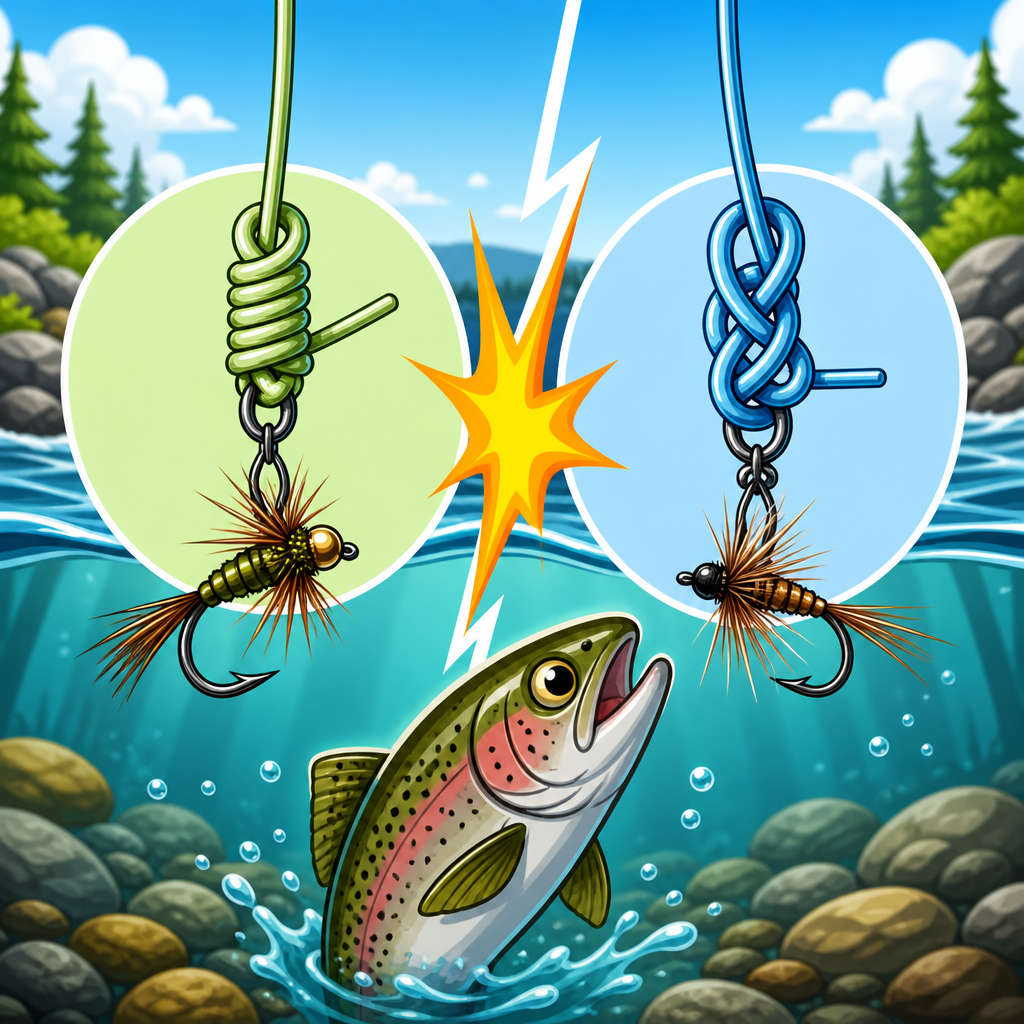
Choosing between the Improved Clinch and the Davy Knot for small flies comes down to a simple question: do you value maximum familiarity and holding power, or the smallest, neatest connection possible? In practical fly fishing, both knots catch trout, grayling, panfish, and small stream bass, but they behave differently when tied to tiny hooks, light tippet, and delicate dry flies. I have tied both knots streamside for years, often with cold hands and fading light, and the differences become obvious once you use them on size 18 through size 24 patterns.
Knot tying is one of the core skills within fly fishing basics because every cast, drift, and hookset depends on the connection between fly and tippet. The Improved Clinch Knot is a long-established terminal knot formed by wrapping tag around standing line and passing the tag back through loops before seating it. The Davy Knot is a compact, low-bulk knot designed for speed and minimal material use. Small flies usually means patterns tied on fine-wire hooks, often below size 16, where knot bulk can affect how a fly sits, drifts, or sinks. On technical water, especially when fishing spring creeks or tailwaters, that matters.
This article serves as a hub for knot tying within fly fishing basics by comparing these two popular knots in depth while also explaining the broader principles behind terminal knots, tippet diameters, lubrication, seating, and inspection. If you understand why one knot performs better in a given situation, you improve more than one connection. You learn how to choose knots based on fly size, hook eye diameter, leader material, and fishing conditions. That judgment is more valuable than memorizing one favorite knot.
What the Improved Clinch and Davy Knot Actually Do
The Improved Clinch Knot has remained standard because it is widely taught, easy to remember, and dependable with monofilament and many fluorocarbon tippets when tied correctly. The structure creates friction through multiple turns, then locks by passing the tag through the initial eye loop and the larger loop created afterward. On moderate hook sizes, it is forgiving and strong. Many anglers learn it first because it appears in beginner books, shop classes, and knot cards from brands like Orvis, Rio, and Umpqua.
The Davy Knot was developed for fly fishing speed and compactness. It uses fewer wraps and less tag, forming a very small terminal knot that leaves little material at the eye. That smaller footprint is the main reason anglers consider it for tiny dries, emergers, and midge patterns. In my own use, the Davy becomes especially attractive when changing flies repeatedly during a hatch. You can tie it fast, trim close, and keep the fly’s profile clean. The tradeoff is that it demands proper orientation and careful seating. Sloppy tying costs more with a Davy than with an Improved Clinch.
For small flies, the key issue is not only absolute knot strength in a lab. It is fishable strength under real conditions: low visibility, short tags, stiff fluorocarbon, and hook eyes barely large enough for 6X or 7X tippet. A knot can test well yet frustrate anglers if it is hard to tie accurately on size 22 hooks. Ease of tying under pressure is part of performance.
Which Knot Works Better With Small Flies
For most small-fly situations, the Davy Knot works better because it is smaller, quicker to tie, and less likely to crowd the eye of a tiny hook. That direct answer fits the way most anglers actually fish technical trout flies. With little material bunched at the eye, small dry flies tend to land lighter and sit more naturally. Tiny nymphs and midges also benefit because the knot does not create unnecessary mass. If your priority is presentation with size 18 to 24 flies, the Davy usually has the edge.
The Improved Clinch still works very well with small flies, especially if you already tie it flawlessly and use supple nylon tippet. It often feels more secure psychologically because many anglers trust its familiar sequence and slightly fuller structure. On marginally larger small flies, such as size 14 to 18 nymphs and wets, it remains an excellent all-around choice. Where the Improved Clinch loses ground is on very tiny hook eyes and very fine tippet, where extra wraps and extra bulk make streamside tying slower and more error-prone.
The best summary is this: the Davy is usually better for the smallest flies and frequent fly changes; the Improved Clinch is better when you want a universally familiar knot with broad reliability across many fly sizes. Anglers who fish small flies regularly should know both. One knot rarely solves every terminal-connection problem.
Performance on Tiny Hooks, Fine Tippet, and Delicate Presentations
Small-fly fishing amplifies every weakness in a knot. Hook eyes are tiny, often partially closed with lacquer or head cement. Tippets in 5X, 6X, and 7X are harder to handle, especially in wind. Fine nylon is supple but can coil; fluorocarbon is abrasion resistant and dense but can be stiffer and less forgiving in some knot geometries. In that environment, knot bulk and tying sequence matter.
The Davy Knot shines because it uses very little line and can be tied with a short tag end. That matters when conserving expensive tippet and when your hands are cold. On a size 22 Baetis imitation, a compact knot is easier to seat neatly against the eye without stacking turns over each other. The fly often tracks straighter, and tiny dry flies are less likely to tip awkwardly because of knot mass. I notice this most on CDC patterns and sparse comparaduns, where balance is delicate.
The Improved Clinch performs best when there is enough eye diameter to pass and manage the tag cleanly. On size 20 and smaller hooks, especially barbless competition hooks with very fine wire, the wraps can bunch if rushed. If the tag crosses poorly or the knot is not lubricated before tightening, it can seat unevenly and weaken. This does not make it a bad knot. It means the margin for user error grows as flies get smaller.
| Factor | Improved Clinch | Davy Knot | Best Use |
|---|---|---|---|
| Knot bulk at hook eye | Moderate | Very low | Davy for size 18 to 24 flies |
| Speed of tying | Moderate | Fast | Davy during heavy hatches |
| Ease with cold hands | Familiar but more steps | Fewer moves, smaller motion | Davy if well practiced |
| Forgiveness when tied imperfectly | Higher | Lower | Improved Clinch for beginners |
| Compatibility across fly sizes | Broad | Best on small flies | Improved Clinch as general default |
| Presentation on tiny dry flies | Good | Excellent | Davy for technical dry-fly fishing |
Strength, Slippage, and Material Considerations
Anglers often ask which knot is stronger, but knot strength is conditional. It depends on line material, diameter, number of wraps, hook wire finish, and how cleanly the knot is seated. Published knot testing varies because protocols differ. Some tests use steady pull, others shock load; some compare nylon only, while others include fluorocarbon. In practice, both knots are strong enough for trout on standard tippet sizes when tied correctly. Failures usually trace to poor tying, nicked tippet, or friction damage during tightening.
The Improved Clinch traditionally performs best in monofilament nylon, where its wraps cinch predictably. With stiffer fluorocarbon, especially in lighter diameters, some anglers prefer fewer wraps or switch to alternative knots such as the Orvis Knot, Pitzen, or Improved Trilene because they can seat more consistently. The Davy Knot can also hold very well in nylon and fluorocarbon, but only when the finishing tuck is correct and the knot is drawn down in sequence. If you rush it and trap a crossed section, slippage risk increases.
For very small flies, practical strength includes how much the knot deforms the fly’s attitude and how likely it is to foul micro hackle or tippet rings of material at the eye. A knot that is theoretically stronger but disrupts presentation may be worse in use. That is why experienced small-fly anglers often prioritize neatness, repeatability, and compact shape alongside breaking strength.
How to Choose the Right Knot for the Situation
Use the Davy Knot when fishing tiny dry flies, midges, emergers, and light nymphs where subtle presentation matters most. It is especially effective on spring creeks, tailwaters, and clear freestone streams during selective hatches. It also excels when you change patterns often and need efficiency. If your home water demands size 20 Blue-Winged Olives for rising trout, the Davy earns its place quickly.
Use the Improved Clinch when you want one knot for varied fly sizes, when you are teaching beginners, or when conditions are less technical. It remains a smart choice for wets, small streamers, unweighted nymphs, and general trout fishing from size 12 to 18. If you can tie it perfectly without thinking, that familiarity has real value. A good knot tied confidently is better than a theoretically ideal knot tied inconsistently.
As a knot tying hub within fly fishing basics, this comparison should point you toward a broader system. Terminal knots are only one piece. Anglers should also learn loop knots for streamer action, line-to-leader connections such as nail knots and loop-to-loop systems, leader-to-tippet blood knots or double surgeon’s knots, and tippet-ring setups for extending leader life. Once you understand where the Improved Clinch and Davy fit, the rest of the knot family makes more sense.
Common Mistakes and Best Practices for Reliable Knot Tying
The most common mistake with both knots is failing to lubricate before cinching. Water or saliva reduces friction heat, which can weaken nylon and fluorocarbon. Another frequent problem is trimming tags too close before fully testing the knot. With the Davy in particular, leave a modest tag until you confirm the knot has seated properly. Fine tippet can creep slightly under load, and a little insurance matters.
Anglers also underestimate hook-eye issues. Tiny flies often have partially obstructed eyes from varnish. Clear them with a hook-eye cleaner before tying. Forcing tippet through a blocked eye roughens the line and creates hidden damage right where stress is highest. I see more break-offs from that than from true knot design flaws. Good knot tying starts before the first wrap.
Practice matters more than collecting dozens of knots. Pick a small set, tie them repeatedly at home under magnification, then test them by pulling against a scale or steady hand pressure. Brands such as Scientific Anglers and TroutHunter publish diameter data for tippet; use those charts to understand what you are actually tying. Match knot choice to material, and inspect every finished connection. If a knot looks twisted, uneven, or cloudy from friction burn, cut it off and retie. Efficient anglers retie early, not after the fish of the day breaks them off.
Conclusion
Improved Clinch versus Davy Knot is not a debate with one universal winner, but for small flies the Davy usually works better. Its compact profile, fast tying sequence, and clean seating on tiny hook eyes make it especially effective for size 18 to 24 patterns and technical trout fishing. The Improved Clinch remains highly relevant because it is familiar, versatile, and dependable across a wider range of fly sizes. If you fish only one knot, it can still serve you well, but it gives up some efficiency and finesse at the smallest end of the spectrum.
The bigger lesson for knot tying within fly fishing basics is that knot choice should follow the job. Consider hook size, eye diameter, tippet material, fly style, and how often you change patterns. Then tie carefully, lubricate, seat the knot correctly, and inspect it every time. Those habits improve success more than chasing marketing claims about miracle strength.
If you want better drifts, fewer break-offs, and more confidence with small flies, learn both knots and test them on your own water this season. Tie the Davy for your tiniest patterns, keep the Improved Clinch ready as an all-purpose standby, and build the rest of your knot system from there.
Frequently Asked Questions
1. Is the Davy Knot better than the Improved Clinch for very small flies?
For very small flies, the Davy Knot often has a real practical advantage because it creates a smaller, cleaner connection at the eye of the hook. That matters more than many anglers realize. On tiny dry flies, midges, emergers, and other delicate patterns, excess bulk at the knot can affect how neatly the fly sits, how easily it passes through the water surface, and even how simple it is to thread the fly in the first place. The Davy Knot uses very little material, tightens into a compact shape, and leaves a short, unobtrusive finish that pairs well with light tippet and small hook eyes.
That said, “better” depends on what you value most. The Improved Clinch remains one of the most familiar terminal knots in fishing for a reason: it is dependable, widely trusted, and many anglers can tie it almost automatically without thinking. If you already tie the Improved Clinch well and consistently, it may outperform a poorly tied Davy Knot simply because familiarity reduces mistakes. In real streamside conditions, confidence and consistency matter as much as theoretical neatness.
So if the question is which knot usually feels more refined on tiny flies, the Davy Knot often gets the nod. If the question is which knot gives many anglers greater confidence because they have used it for years, the Improved Clinch still deserves respect. For small flies specifically, most experienced fly anglers lean toward the Davy when they want the smallest possible connection, but the better choice is the one you can tie correctly every time in cold water, low light, and a hurry.
2. Which knot is stronger with light tippet: Improved Clinch or Davy Knot?
In light tippet, knot strength is only part of the story; knot reliability is just as important. The Improved Clinch has a longstanding reputation for solid holding power across a wide range of fishing situations, especially when tied carefully and lubricated before tightening. Many anglers trust it because it has proven itself over decades on trout, panfish, and light freshwater species. When tied well with suitable line diameters, it can be very secure and forgiving.
The Davy Knot, however, surprises many people because it can be extremely effective on fine tippet and small flies when tied correctly. Its simplicity and low bulk mean there is less material wrapped and stacked near the hook eye, which can help when dealing with tiny terminal setups. Some anglers find that the Davy seats very cleanly in these situations and performs exceptionally well with small hook eyes and lighter presentations. On the water, it is more than strong enough for typical trout, grayling, and panfish fishing when matched to appropriately light tackle.
The key distinction is this: the Improved Clinch often wins the confidence test for anglers who prioritize traditional holding power, while the Davy often wins the efficiency and finesse test with tiny flies. In practical terms, both knots are strong enough for most small-fly freshwater fishing if tied correctly. Break-offs are more often caused by damaged tippet, poor knot seating, wind knots, abrasion, or rushed tying than by a cleanly tied knot choice between these two. If you fish very light tippet, the strongest option is usually the knot you can inspect, cinch, and trust without hesitation.
3. Which knot is easier to tie on the stream with cold hands and fading light?
Under difficult streamside conditions, the answer can go either way depending on your muscle memory. The Improved Clinch is familiar to a huge number of anglers, and that familiarity matters when your fingers are stiff, your glasses are fogged, and you are trying to re-tie a fly during an evening hatch. Because so many anglers have tied it thousands of times, they can often complete it almost from habit. That built-in repetition makes it feel easier, even if it involves more wraps and a slightly bulkier finish.
The Davy Knot, on the other hand, is appealing because it is fast and compact. It uses fewer motions, and once learned properly, it can be extremely efficient with tiny flies. That efficiency becomes valuable when small hook eyes and short tag ends make more elaborate knots frustrating. Many anglers who switch to the Davy for small dries and midges do so precisely because it reduces streamside fuss. It is especially handy when you are changing flies often and want a quick, neat tie without wasting much tippet.
The catch is that the Davy Knot demands precision. If you miss a step, cross the line incorrectly, or rush the finish, it is easier to tie it wrong without immediately noticing. The Improved Clinch is a bit more forgiving in that sense because its structure is more familiar and visually obvious to many anglers. So for pure speed on tiny flies, the Davy often wins after practice. For instinctive reliability under stress, the Improved Clinch may feel easier for anglers who grew up with it. In short, the easier knot is usually the one you have practiced enough that your hands can tie it without your brain needing perfect conditions.
4. Does knot size really affect how small dry flies and nymphs fish?
Yes, with very small flies, knot size can matter more than anglers sometimes assume. On larger streamers or heavy nymph rigs, the difference between a compact knot and a bulkier knot is usually negligible. But once you move into tiny dry flies, midges, sparse emergers, and little soft hackles, the connection at the eye becomes more visible and potentially more influential. A larger knot can crowd the hook eye, collect more surface film, slightly alter the angle at which the fly hangs, and make delicate patterns appear less tidy.
This is one reason the Davy Knot has earned such a strong following among anglers who fish small technical flies. Its compact profile complements the purpose of those patterns. When presenting a size 18, 20, or smaller fly to selective fish, many anglers prefer everything in the system to be as refined as possible, including the terminal knot. The smaller knot also leaves less clutter when threading tiny hook eyes, which is a real quality-of-life improvement on the water.
That said, knot size should not be exaggerated into the only thing that matters. Trout and other fish are usually responding to drift, drag, depth, profile, and presentation first. A well-presented fly tied with an Improved Clinch will generally outfish a poorly presented fly tied with a Davy Knot every time. So yes, knot size can affect how small flies fish, especially in technical situations, but it is part of a larger presentation puzzle. Think of the Davy Knot as a refinement advantage rather than a magic solution.
5. When should I choose the Improved Clinch over the Davy Knot for small flies?
You should favor the Improved Clinch when you want maximum familiarity, proven all-around dependability, and a knot you can inspect and trust instantly. If you have spent years tying the Improved Clinch, there is tremendous value in not changing systems unnecessarily. Confidence is not a minor factor in fishing; it affects how quickly you re-rig, how often you check your knot, and how calmly you respond when a good fish eats. For many anglers, the Improved Clinch remains the default because it simply feels solid and proven.
It is also a sensible choice when your flies are small but not ultra-tiny, when hook eyes are still manageable, and when you are not trying to minimize every bit of terminal bulk. In those situations, the practical gap between the two knots narrows. If the Improved Clinch is easy for you to tie correctly, seats well with your tippet material, and gives you full confidence on the hook set, there may be no compelling reason to switch.
Choose the Davy Knot when compactness, speed, and neatness become the top priorities, especially with very small dry flies and fine tippet. Choose the Improved Clinch when security through familiarity matters more than shaving off a little knot size. That is really the heart of the comparison. Both knots work. Both catch fish. The better one is determined less by theory and more by your fly size, tippet diameter, tying conditions, and personal consistency. If possible, the smartest approach is to know both well and let the situation dictate the choice.