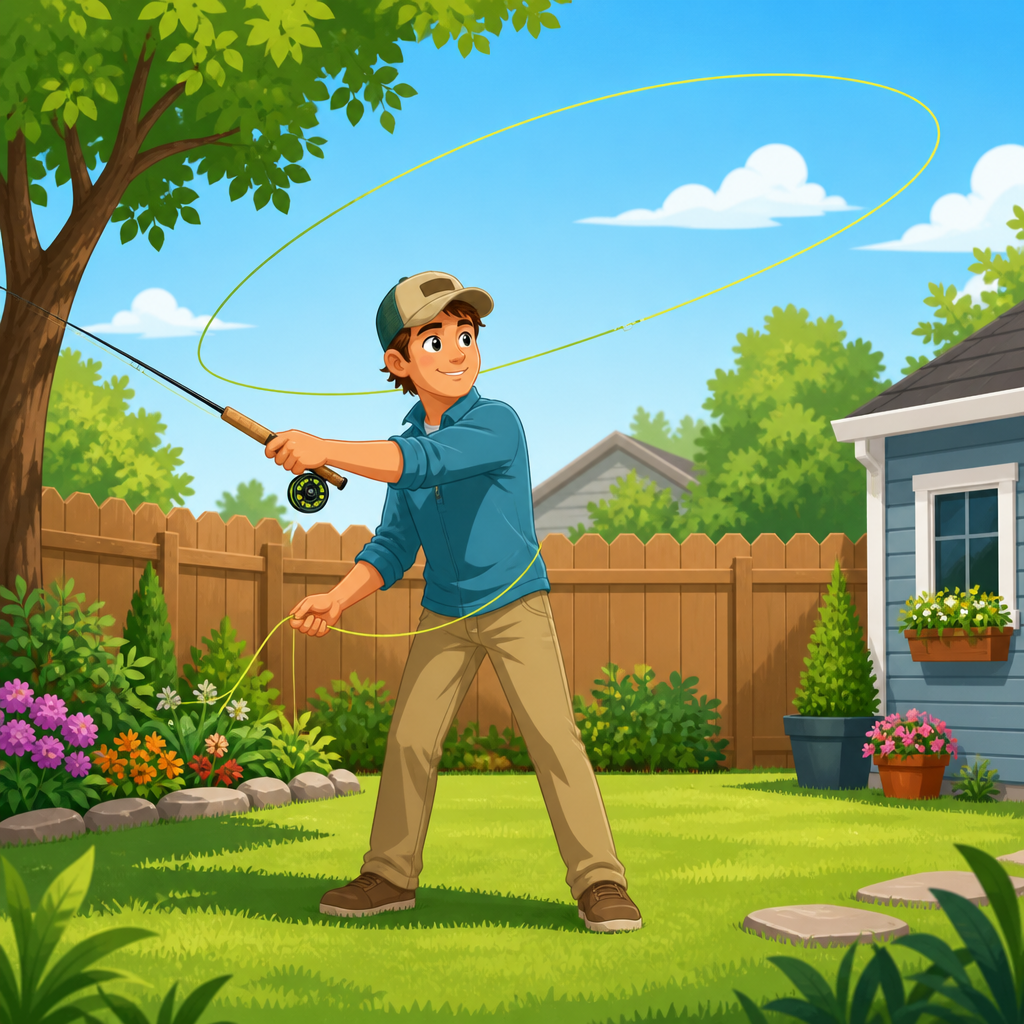
Learning how to practice fly casting in a backyard without a hook is one of the safest, cheapest, and fastest ways to build real fly fishing skill before you ever step into a river. Backyard practice means rehearsing the mechanics of a fly cast on grass, pavement, or an open lawn using a hookless fly, a piece of yarn, or a practice casting plug so you can focus on timing, loop control, and line management without the distraction of fish. In my own instruction sessions, I have seen beginners improve more in thirty focused minutes on a lawn than in three rushed hours on moving water, because they can repeat the same motion dozens of times and immediately see what the line is doing. That matters because fly casting is not brute force. It is controlled acceleration, a crisp stop, and efficient transfer of energy from rod to line. When those basics are solid, every other part of fly fishing gets easier, from presenting a dry fly softly to throwing a longer cast into the wind.
Practicing without a hook also removes the biggest backyard risk. A bare hook can snag skin, pets, shrubs, screens, and clothing, while a yarn indicator, hookless practice fly, or trimmed leader lets you train with far less chance of damage. For beginners, this setup makes it easier to commit to regular sessions. For experienced anglers, it creates a reliable place to refine casting techniques such as false casting, shooting line, changing direction, and controlling loop shape. A backyard is not a perfect substitute for water, current, or real presentations, but it is the best controlled environment most anglers have. If your goal is to build muscle memory, diagnose mistakes, and create a foundation for better days on the water, a hook-free backyard routine is the smartest place to start.
Set Up a Safe and Effective Backyard Practice Area
The best backyard fly casting practice starts with space, safety, and realistic tackle. You do not need a huge lawn, but you do need a clear casting lane behind and in front of you. For most beginners, thirty to fifty feet of open space is enough to practice the pickup and laydown cast, overhead false casts, and short presentations. Remove obvious hazards first: patio furniture, hanging planters, low tree branches, fences with protruding wire, and anything breakable. I also tell anglers to check above them, not just around them. Power lines are an absolute no-go. If overhead wires are anywhere near your casting lane, move to a park or open field instead.
Your equipment should match the kind of fly fishing you plan to do. A 5-weight rod with a weight-forward floating line is the standard all-around practice tool because it loads clearly at short and medium distances and translates well to trout fishing. A nine-foot tapered leader ending in 3X to 5X works fine, but shorten the leader if the lawn is grabbing it too aggressively. Instead of a fly, tie on a small piece of bright yarn, a hookless practice fly, or a purpose-built casting plug. Bright yarn is especially useful because you can track turnover easily against grass. Wear polarized glasses for eye protection even without a hook, and keep pets and children outside the practice lane. Good habits in safety and setup are part of casting techniques, not separate from them.
Use the Right Hookless Practice Setup for Skill Building
Many beginners assume any object tied to the end of the leader will do, but the terminal setup changes how the cast behaves. Yarn is the safest and most forgiving option. It creates very little impact if it hits something, and it gives enough drag to help you see whether the leader is turning over cleanly. A commercial practice fly without a hook shank can feel more like a real fly and may help with turnover. Small casting plugs, often used in conventional casting practice, can work for fly rods too, but only if they are light enough not to overpower the leader or encourage a tailing, forceful stroke. The goal is to simulate line control, not to throw weight with the rod tip.
I recommend a simple progression. Start with twenty to thirty feet of fly line beyond the rod tip and a short piece of fluorescent yarn. Once your loops are stable, add line gradually and test a slightly longer leader. If you are practicing in a tight yard, use a shorter leader and focus on precision at twenty feet rather than distance at forty. If you have room, place targets such as paper plates, hula hoops, or small towels on the grass. Those targets make your practice measurable. You can work on landing the yarn softly, crossing the target with the leader straight, and changing direction to a second target without stepping. That kind of intentional setup turns random casting into actual training.
Learn the Core Overhead Cast Before Anything Else
The overhead cast is the foundation of backyard practice and the gateway to every other casting technique. At its simplest, it consists of lifting the line, accelerating smoothly into a back cast, stopping the rod high enough to form a tight loop, waiting for the line to unroll, then accelerating forward and stopping again so the line carries energy toward the target. New casters often hear “ten to two” as shorthand for rod movement, but in practice the stroke length changes with line length and rod load. What matters is not a clock face. What matters is straight-line rod tip travel during the power application, followed by a crisp stop.
A good first drill is the pickup and laydown cast. Strip out a manageable amount of line, usually twenty-five feet, lift smoothly until the line leaves the grass, make one back cast, wait for full straightening behind you, then deliver forward and let the line land. This teaches tempo better than endless false casts. Another useful drill is to watch the back cast deliberately. Turn your head and inspect the loop. If it is wide and collapsing, you are probably applying power too early or dropping the rod tip during the stroke. If the line snaps downward into itself, creating a tailing loop, you are usually overpowering the cast, creeping forward before the line straightens, or making a concave rod tip path. These are easier to diagnose on a lawn because the variables stay consistent from cast to cast.
Build Timing, Loop Control, and Distance in Stages
Timing is the invisible skill that makes fly casting look effortless. The pause between back cast and forward cast must match the amount of line outside the rod tip. More line means a longer pause because the line needs more time to unroll. Beginners usually rush this transition. They start forward before the back cast straightens, which wastes energy and causes the line to collapse. In a backyard, you can isolate this single variable better than on the water. Cast twenty feet, pause briefly, then cast thirty feet and feel how the pause lengthens. The rod will tell you when the line comes tight behind you if you stay relaxed enough to feel it.
Loop control comes next. Tight loops are efficient and cut wind better, but they only happen when the rod tip travels mostly straight during the casting stroke and stops decisively. Wide loops can be useful for certain presentations, yet accidental wide loops usually indicate poor tracking or a stroke that is too long for the amount of line aerialized. To improve tracking, imagine the rod moving along a narrow hallway rather than around your body. Distance should come last, not first. When I coach anglers in a yard, the biggest jump in distance usually comes from cleaner loops and better timing, not from trying harder. Shooting line is a natural extension of efficient casts. Once the line is carrying speed on the final forward cast, release a little line with your line hand and let momentum do the work.
| Practice goal | What to do | What success looks like |
|---|---|---|
| Timing | Make ten pickup and laydown casts at 20, 30, and 40 feet | Back cast straightens before the forward stroke begins |
| Loop control | Watch back casts and keep the rod tracking in a straight lane | Narrow, even loops without line collision |
| Accuracy | Cast to targets at different angles without moving your feet | Yarn lands on or just beyond the target with a straight leader |
| Distance | False cast efficiently, then shoot line only on the delivery cast | Extra line slips through smoothly without loss of loop shape |
Practice Essential Casting Techniques That Transfer to Water
As a casting techniques hub, backyard work should cover more than the basic overhead cast. Once your loops are controlled, practice false casting with purpose. False casting is not simply waving line in the air. It is a tool for changing direction, drying a fly, adjusting distance, and setting up a final presentation. Keep the number of false casts low. Two or three controlled strokes are usually enough. Next, work on changing direction. Make a back cast toward one target, then rotate your torso and deliver forward toward another target. The line should straighten fully behind you before you redirect. This drill matters on trout streams where fish rise in different lanes and you need to recast without stripping all the way in.
Another useful skill is line pickup from the ground. Grass grips line differently than water, but the drill still teaches clean tension management. Start with the line laid straight, lift gradually until it comes free, then transition into the back cast without jerking. You should also practice accuracy at short range, because many trout are caught within thirty feet. Place targets at fifteen, twenty-five, and thirty-five feet and vary your angle. If your yard allows, add a light wind factor by practicing on breezy days. Learn to lower the forward cast slightly into the wind and maintain tighter loops. Avoid sidearm casts unless your space demands them, but if obstacles force a lower plane, keep the same rules: smooth acceleration, straight tracking, crisp stop. Good backyard repetition makes those responses automatic when water, brush, and fish pressure are added.
Fix Common Backyard Casting Mistakes Quickly
Most fly casting errors are visible if you know what symptom matches what cause. If the line slaps the grass behind you before the forward cast, your back cast is dropping from a low stop, your pause is too long, or you are not lifting enough line cleanly at the start. If the cast piles up in front, the forward loop is losing energy because you stopped too softly, started forward too early, or aimed too high. Tailing loops are among the most common problems. They happen when the top leg of the loop crosses the bottom leg, often producing a leader knot or a crack. The usual causes are excessive force, a casting arc that is too narrow for the amount of bend in the rod, or creeping forward before the back cast straightens.
Tracking errors are another major issue. If the line kicks off to one side, the rod tip is probably not traveling in a straight plane relative to the target. Watch your thumb path and your elbow position. Many right-handed casters drift the rod around their body on the back cast, creating a wide, inefficient path. The correction is usually simple: square your stance slightly, keep your wrist from collapsing, and think about driving the line backward and forward on parallel rails. Finally, do not overpractice fatigue. Short sessions with feedback beat long sessions with sloppy mechanics. Fifteen to twenty-five minutes is enough for most people. Stop when your stroke deteriorates. Precision is learned through quality repetition, not exhaustion.
Turn Backyard Repetition Into a Complete Casting Plan
The most productive backyard routine follows a structure rather than a random series of casts. Begin with five minutes of short pickup and laydown casts to establish tempo. Move into ten minutes of false casting and line control at one distance, focusing on clean back cast turnover. Then spend five to ten minutes on target work, changing direction, and one specific weakness such as tracking or shooting line. Finish with a few accurate delivery casts, because the last cast is what counts on the water. I have used this format for years because it gives beginners enough repetition to improve while keeping the objective clear. Every block should answer one practical question: what part of my cast am I trying to improve today?
Keep notes after each session. Write down line length, wind conditions, the drill you used, and the one cue that helped most. Over time, patterns emerge. You may notice that your best casts happen when you slow down, lengthen the pause, or reduce false casts. You may discover that accuracy falls apart beyond thirty-five feet, which tells you exactly where to focus next. Backyard practice works best when it supports on-water learning. After a trip, identify the cast that failed under pressure, then recreate that problem at home. If your streamside issue was missing short shots under overhanging branches, set a lower target lane in the yard. If you struggled to change direction quickly, build a two-target drill. That is how a simple lawn becomes a true fly fishing basics training ground.
Practicing fly casting in a backyard without a hook is not a shortcut or a compromise. It is one of the most effective ways to learn casting techniques safely, cheaply, and with enough repetition to create lasting skill. A clear practice lane, a suitable rod and line, and a hookless yarn setup give you everything needed to refine timing, loop shape, accuracy, and controlled distance. The overhead cast comes first because it teaches the mechanics that support every other presentation, but a smart routine should also include false casting, changing direction, target work, and line pickup. The value of backyard practice is that it removes noise. Without current, fish, and streamside obstacles competing for attention, you can see exactly what the line and rod are telling you.
The anglers who improve fastest are rarely the ones who cast hardest. They are the ones who practice deliberately, fix one mistake at a time, and repeat good movements until those movements become automatic. That is the main benefit of hook-free backyard training: it gives you a low-risk place to build reliable habits before those habits are tested on real water. If you want to get more from every trip, start with three short sessions this week, use targets, and keep your focus narrow. Then carry those cleaner casts into the rest of your Fly Fishing Basics progression and onto the water where they count.
Frequently Asked Questions
1. How can I safely practice fly casting in a backyard without using a hook?
The safest way to practice fly casting in a backyard is to remove the hook entirely and substitute it with a piece of brightly colored yarn, a hookless fly, or a purpose-made casting plug. That lets you work on the exact mechanics of fly casting without the obvious risk of snagging yourself, another person, a pet, or nearby objects. Before you start, choose an open space with plenty of clearance behind, in front, and above you. Keep well away from fences, power lines, trees, patio furniture, parked cars, and anything fragile. Even with a hookless setup, a fly line moving at speed can still tangle or strike objects, so space matters.
It also helps to wear sunglasses or protective glasses while practicing. Instructors recommend eye protection not because the setup is dangerous in the same way as a barbed fly, but because good habits formed in practice carry over to the water. If you are practicing with children nearby, make sure they stay outside your casting arc. The same goes for dogs, who often become curious about moving line. Start with short casts rather than trying to throw the entire line immediately. Short-line practice is not only safer, it is also where most of the real learning happens because you can clearly feel the rod load and unload.
If your lawn is small, you can still practice effectively by focusing on false casting, pickup-and-laydown presentations, and line control at short distances. You do not need a huge backyard to improve. In fact, many beginners advance faster in smaller practice spaces because they are forced to slow down and pay attention to timing, tracking, and clean stops instead of overpowering the cast. Safe backyard casting is really about controlled motion, clear surroundings, and simple training tools.
2. What should I use instead of a real fly when practicing fly casting at home?
The best substitute for a real fly is usually a short piece of yarn tied to the leader. Yarn is light, highly visible, inexpensive, and extremely forgiving if it hits grass, pavement, or your rod. It is especially useful for beginners because it allows you to see where the end of your leader is traveling, which makes it easier to diagnose tailing loops, drifting, and uneven timing. A hookless practice fly can also work well if you want something that more closely resembles the feel of a real setup, but for pure backyard training, yarn is often the most practical choice.
Another good option is a commercial casting plug, sometimes called a practice plug. These are more commonly associated with conventional tackle, but they can be useful in specific fly practice situations, especially when you want a bit more visual feedback during pickup, delivery, and accuracy drills. That said, many fly instructors still prefer yarn because it behaves more like the unweighted, air-resistant end of a normal fly-fishing leader system. If the goal is to improve your actual fly-casting mechanics rather than simply hit targets, yarn usually gives better training feedback.
Try to keep the substitute simple. You do not need weight, flash, or anything complicated. A two- to four-inch piece of yarn is enough for most backyard sessions. Bright colors like orange, chartreuse, or white are easiest to track against grass. You can also practice with no fly substitute at all in some drills, but attaching yarn gives you a clearer sense of turnover and presentation. The main idea is to remove danger while preserving enough realism to improve your stroke, timing, loop shape, and line management.
3. What fly-casting skills can I actually improve by practicing in the backyard?
You can improve far more than most beginners expect. Backyard practice is excellent for building the foundational mechanics that make someone effective on the water. The first major skill is timing. Fly casting depends on making a smooth acceleration to a firm stop, then waiting just long enough for the line to straighten before beginning the next stroke. Practicing this repeatedly in a quiet backyard setting helps you feel when the rod loads and when the line is ready to change direction. That timing becomes much harder to learn when fish, moving water, and excitement are involved.
You can also make huge progress with loop control. Tight, efficient loops are usually the result of a straight rod tip path, controlled power application, and crisp stops. In a backyard, you can watch your back cast and forward cast without the distractions of current or wind coming off a river. That visual feedback is incredibly valuable. If your loops collapse, cross, tail, or widen too much, you can slow down and correct one variable at a time. This is why many experienced anglers still practice on grass even after years of fishing.
Backyard sessions are also ideal for improving accuracy, line pickup, laydown casts, false casting rhythm, and basic line management. You can place paper plates, hula hoops, or small markers on the lawn and practice delivering the yarn fly to a specific target at controlled distances. You can work on stripping line neatly, managing slack, and starting each cast cleanly. If you want to prepare for real fishing situations, you can rehearse changing direction, varying trajectory, and making casts from awkward stances. While backyard practice does not replace water-based presentation skills entirely, it absolutely builds the core motor patterns that make river casting feel natural later.
4. How often should I practice fly casting in the backyard, and how long should each session be?
Short, consistent sessions are usually much better than occasional marathon practice. For most beginners, ten to twenty minutes at a time is enough to produce real improvement without creating fatigue or sloppy habits. Fly casting is a coordination skill, and like most coordination skills, it responds well to frequent repetition with focus. Practicing three to five times a week, even for brief sessions, often leads to faster progress than spending a single hour on the weekend trying to fix everything at once.
The reason shorter sessions work so well is that good casting depends on precision, not brute force. Once your arm, wrist, or attention starts to tire, mechanics often break down. People begin rushing the back cast, overpowering the forward stroke, or letting the rod tip wander off path. Those repetitions can reinforce the wrong movement patterns. It is much more productive to spend a quarter of an hour working on one or two specific goals, such as cleaner stops or straighter tracking, then finish before your form slips.
A useful structure is to divide each practice session into phases. Start with a few easy pickup-and-laydown casts at short distance. Then spend several minutes on a focused skill, such as watching your back cast, tightening your loops, or hitting a target at twenty feet. Finish with a few smooth, relaxed casts that reinforce rhythm. If possible, record yourself occasionally on a phone. Video often reveals mistakes that are hard to feel in real time. The ideal practice schedule is one you can repeat consistently, because steady repetition is what turns fly-casting mechanics into instinct.
5. What are the most common mistakes beginners make when practicing fly casting in a backyard?
The most common mistake is trying to cast too hard. Many beginners assume distance comes from force, but in fly casting, excessive power usually creates poor loops, timing problems, and tangles. A better cast comes from smooth acceleration and a decisive stop, not from muscling the rod. When people rush the stroke, they often start the forward cast before the back cast has fully straightened, which causes the line to collapse and the rod to fight itself. Slowing down is often the fastest fix.
Another frequent mistake is making the casting stroke too big for the amount of line being used. With short line outside the rod tip, you need a relatively compact stroke. If your arm travels too far or your wrist breaks excessively, the rod tip path becomes inefficient and the loops open or tail. Closely related to this is poor tracking, where the rod moves in a curved or wandering path instead of traveling straight. That can cause line to cross itself or kick unpredictably. Practicing in a backyard is actually a great way to spot this because you can deliberately watch your line shape from cast to cast.
Beginners also often ignore the back cast entirely and look only at the forward delivery. In reality, the back cast is half of every fly cast, and many problems begin there. If your back cast is low, wide, or rushed, the forward cast will suffer too. It is worth turning your head and watching the line straighten behind you during practice. Finally, many people practice without a clear goal. Random casting has some value, but targeted drills produce better results. Pick one thing to improve during each session, whether that is timing, loop shape, or accuracy, and you will progress much faster than if you simply stand in the yard and cast without feedback.