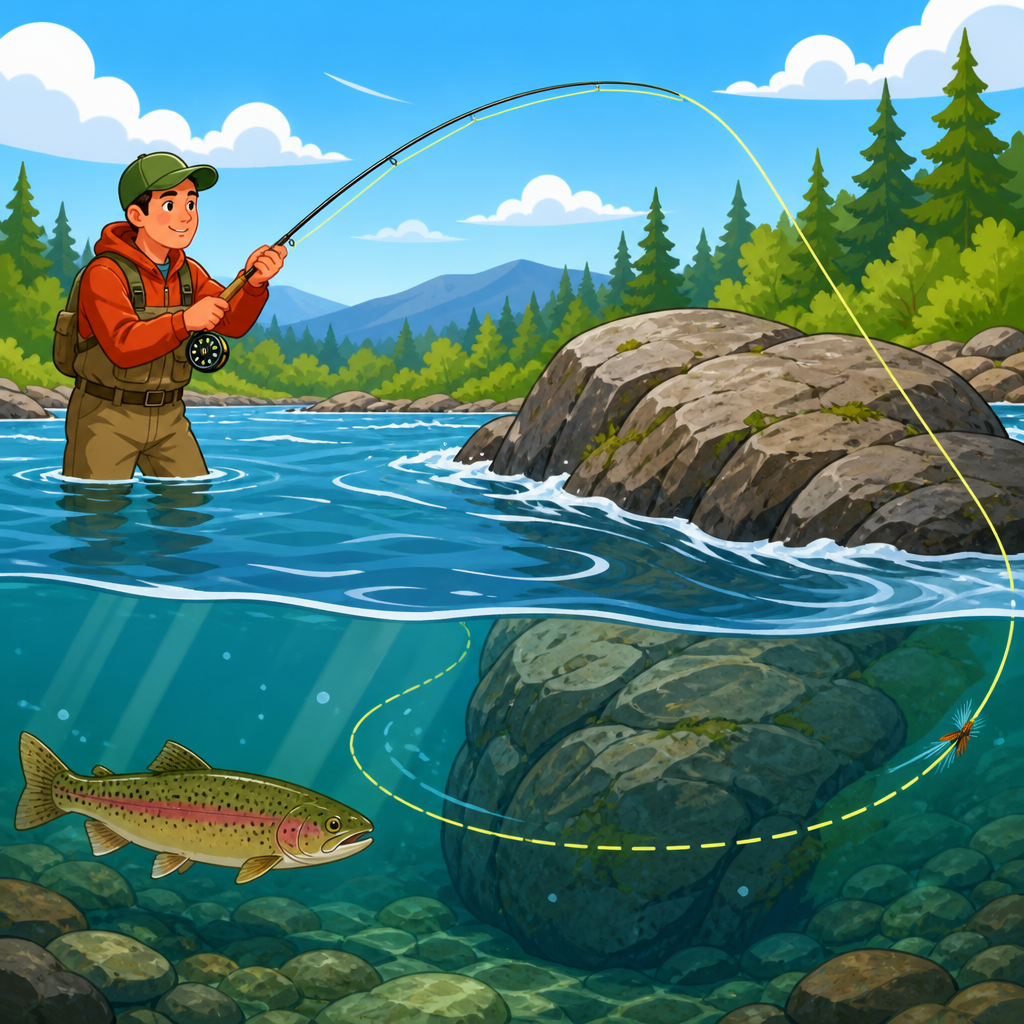
Learning how to make a curve cast around a rock or current seam can change the way you present a fly, because many trout lies are protected by obstacles or divided by conflicting currents that punish a straight-line delivery. In fly fishing, a curve cast is any intentional cast that lands with the fly line bending left or right rather than unrolling on a perfectly straight track. That bend lets the fly reach sheltered water, drift beside structure, or touch down upstream of a seam while the thicker line lands away from the fish. Among casting techniques, it sits in the practical middle ground: easier than a full aerial mend, more deliberate than a simple reach cast, and often the fastest fix when one false cast and one presentation must solve the problem.
I rely on curve casts most on moderate rivers where pocket water, midstream boulders, and intersecting current speeds create feeding lanes that are only a rod length wide. A trout tucked behind a rock sees food funnel through a cushion in front and a soft tongue beside the stone, yet a normal cast often drags instantly as the line crosses faster water. The same issue appears on current seams, where one side of the river moves quickly and the other side creeps. If your line and leader land across both speeds in a straight path, tension forms, the fly skates, and the drift stops looking natural. A controlled curve introduces planned slack and changes where line touches the water.
This article is the casting techniques hub for fly fishing basics, so the goal is broader than one trick cast. You need to understand when a curve cast works, how it differs from a reach cast, pile cast, tuck cast, and standard mend, and how to build the mechanics so the shape happens on purpose instead of by accident. You also need a simple system for reading obstacles, choosing casting angles, matching the cast to current speed, and recovering when the line piles, hooks too hard, or straightens before the fly lands. Once those pieces click, curve casts stop feeling like specialty moves and become part of your normal presentation toolkit for dry flies, nymphs, and small streamers.
What a curve cast does and when to use it
A curve cast changes the landing geometry of the line. Instead of sending the leader, fly line, and fly along one straight axis, you introduce lateral shape during the turnover so the leader and fly finish on a different track from the main line. Around a rock, that means the fly can land in the quiet pocket while the thicker line lands in the faster chute outside it. Along a current seam, it means the fly can drift on the soft side while the belly of line lands on water moving at closer to the same speed, reducing immediate drag. The cast buys time, usually one to three extra seconds of natural drift, and on many trout that is the difference between refusal and eat.
Use a curve cast when an obstacle blocks a direct line, when conflicting currents would grab a straight cast, or when a fish is tucked under cover and likely to spook if the fly line passes overhead. It is especially useful at short to medium range, roughly fifteen to forty feet, where you still control the loop and can shape the presentation before the line lands. I use it often with dry flies on freestone streams, with unweighted nymphs beside boulders, and with small emergers to bank feeders. It is less effective in strong wind, with very heavy indicator rigs, or at long distances where the line’s momentum wants to straighten everything before touch down.
A left curve or right curve is named from the caster’s perspective as the line lands. If you are right-handed and want the fly to finish left of the main line, you can curve left by moving the rod tip across the target line late in the forward stroke or by tilting the casting plane and introducing side force. Reverse the direction for the opposite shape. The point is not to make a dramatic horseshoe. Most useful fishing curves are subtle, often just enough bend to move the fly a foot or two around a current edge. Small, controlled shapes are easier to repeat and create less slack to manage after the drift begins.
Reading rocks, seams, and feeding lanes before you cast
The best curve cast starts before the back cast. You must identify where the fish can hold, where the food travels, and which currents will act on your line first. Behind a rock, look for three zones: the cushion in front, the soft pillow directly behind, and the side eddies or tongues where insects slip past. On a seam, identify the speed contrast. A seam is not just a visible line; it is the boundary between two flow rates, sometimes only a shade change or a series of bubbles traveling at different speeds. Your fly should land in the lane the fish watches, while your line should land where current speed best matches that lane or at least avoids crossing the fastest band.
Angle matters more than many beginners realize. If you cast directly upstream to a fish on a seam, your line often straddles both currents and drags immediately. By stepping a few feet and casting quartering upstream, you may create a natural path for a downstream curve that lands the line on the slower side first. Around rocks, moving one rod length to either side can open a pocket and make a modest curve cast possible instead of forcing an extreme one. In guiding and teaching, I have seen anglers struggle with technique when the real fix was position. Better footwork shortens the cast, improves the angle, and reduces how much curve you need.
Also judge depth and fly type before selecting the cast. Dry flies need a clean first drift, so line placement is critical and subtle curves shine. Nymphs can tolerate slightly more slack if the leader straightens enough to sink, but too much curve delays contact and hurts strike detection. Streamers are different again: if you plan to swing or strip, a curve cast may set up the initial track, but an aggressive mend can often do the same after the line lands. In other words, the same rock or seam can call for different casting techniques depending on whether you need dead drift, controlled sink, or broadside movement.
Core mechanics: rod path, timing, and loop control
Every effective curve cast comes from three basics: a stable casting stroke, a controlled loop, and a deliberate finish. Start with enough line out to load the rod cleanly but not so much that you overpower the forward cast. Make a compact back cast, pause until the line straightens, then drive the forward cast on a slightly lower trajectory than a textbook overhead presentation. The line should unroll with energy, but not at maximum speed. Too much force straightens the leader and pulls the cast into a line; too little force collapses the loop and dumps slack without shape. You are looking for crisp turnover that still allows the tip movement at the end to redirect the layout.
The rod tip creates the line path. If the tip travels straight and stops hard, the line wants to straighten. If the tip moves laterally late in the stroke, the line follows and lands in a curve. The key word is late. Most anglers trying to learn this move sweep too early, which opens the loop and destroys turnover. Make the forward stroke normally first, then, just before the stop or as part of the stop, drift the tip to the side you want the line to curve. Think “cast straight, finish sideways.” That finish can be small. On a twenty-five-foot dry-fly cast, even a six- to twelve-inch sideways pull of the tip can create plenty of shape.
Plane control helps. An overhead cast with a slight side component is easiest for many anglers because it preserves loop shape. A more sidearm delivery can accentuate the curve, especially under overhanging branches or when you want the line to snake around a rock from a low angle. Keep the wrist firm enough to avoid tailing loops, and use forearm rotation rather than a big body sweep. Good curve casts are compact. The line should turn over, bend, and settle. If your shoulders spin or your hand crosses your body dramatically, you are usually compensating for poor timing rather than refining the cast.
How to make the cast around a rock or across a seam
Onstream execution becomes easier when you follow a repeatable sequence. Around a rock, pick the exact lie and the exact place where the thick fly line must not land. Aim your forward cast just outside the obstacle, then finish the rod tip back toward the lie so the leader and fly hook behind the line. Across a seam, aim to the side of the target lane that matches the line placement you want, then bend the final layout so the fly lands in the feeding lane and the belly lands in friendlier current. In both cases, the fly should land first or nearly first, with the line following in a shape that buys drift time rather than pulling the fly tight.
| Situation | Best angle | Rod-tip finish | Main goal |
|---|---|---|---|
| Fish behind a midstream rock | Quartering upstream from one side | Late sweep toward the pocket | Land fly in soft water, line outside fast chute |
| Fish on soft side of a current seam | Quartering upstream from fast side | Finish toward soft lane | Reduce drag from faster current |
| Bank fish under cover | Across-and-up from open water | Subtle curve away from overhead branches | Hide line and leader from fish |
| Short pocket water shot | Close, high-angle approach | Compact sideways stop | Create one clean dead drift quickly |
Practice first with targets on grass. Place a hat as the rock and a second marker as the desired fly landing spot. Cast so the leader curves around the hat while the fly lands beyond it. Then move to water and watch where the line touches down relative to speed changes. If the curve disappears in the air, reduce power and make the sideways finish later. If the cast puddles short, you are sweeping too much or not carrying enough line speed into the turnover. For right-handed casters, curving left is often easier with a standard overhead stroke, while curving right may feel cleaner with a slight sidearm plane. Left-handed casters often experience the opposite, though everyone develops personal preferences.
One more adjustment matters: leader design. A long, fine leader straightens delicately and can preserve subtle curves well with dry flies. A short, stout leader turns over hard and may erase shape, which is useful for accuracy but less useful for finesse around seams. I often fish nine- to twelve-foot leaders for this reason, tapering to match fly size and conditions. If you are casting weighted nymphs or indicators, accept that the curve will be less elegant and rely on a modest shape plus an immediate mend. The cast does not have to do everything alone; it simply needs to improve the initial layout.
How curve casts fit with other casting techniques
Fly anglers often confuse curve casts with other presentation adjustments, so it helps to separate the jobs. A reach cast moves the rod upstream or downstream after the forward stop to reposition line before it lands. It is excellent for adding slack and changing line angle, but it usually shifts the whole layout rather than wrapping the fly around an obstacle. A pile cast checks the line so it falls in loose waves, useful for drag-free drifts at short range, especially with dries. A tuck cast drives a weighted fly or nymph down first by kicking the leader under the line. A mend, by contrast, happens after the line lands, lifting and repositioning line on the water.
In real fishing, these techniques overlap. Around a rock, I may throw a modest curve cast and then make a small upstream mend to extend the drift another foot. On a seam, I might use a reach cast when the fish is farther away because the reach holds shape better at distance, then switch to a pure curve cast when I can wade closer and need the fly to sneak behind visible structure. The important point for a casting techniques hub is selection. Choose the curve cast when obstacle avoidance and lateral layout are the primary problems. Choose a mend when the line already landed well but currents begin to distort the drift. Choose a tuck cast when sink rate, not line geometry, is the limiting factor.
If you are building skills systematically, learn in this order: standard overhead cast, roll cast, mending, reach cast, then curve cast, followed by tuck and pile variations. That progression mirrors what I teach beginners because each step adds one layer of line control. The curve cast becomes much easier once you understand loop shape and can already place line on one side of a current with a mend. It is not advanced because it is flashy; it is advanced because precision matters. Still, once learned, it often replaces more complicated on-water corrections because you solve the problem at the moment of presentation.
Troubleshooting, practice drills, and common mistakes
The most common mistake is overpowering the cast. Anglers see the line fail to curve, so they push harder, which only makes it straighten more aggressively. Back off and let the rod do the work. Another frequent problem is moving the rod tip sideways too soon. Early movement opens the loop, kills turnover, and leaves a heap of line short of the target. Delay the sideways finish until the line is already unrolling forward. Third, many anglers demand too much bend. On trout water, a six-inch or one-foot offset is often enough. Extreme curves look impressive on grass but are less accurate and harder to fish effectively.
Wind is a real limitation. A crosswind can either enhance or ruin the shape depending on direction, but it always adds variability. In strong wind, simplify: shorten the cast, tighten the loop slightly, and pair a smaller curve with a quick mend after the line lands. Weighted rigs are another challenge because mass in the leader system resists elegant turnover. Open your loop a bit for safety, reduce ambition, and use the cast to place the leader generally where you want it before mending. Accuracy also suffers when anglers stare at the obstacle instead of the landing spot. Focus on where the fly should finish, not on the rock itself.
For practice, use three drills. First, the “cone and cup” drill on grass: set one object as the obstacle and another as the target, then repeat both left and right curves at twenty, thirty, and thirty-five feet. Second, the “seam lane” drill on water: pick two bubble lines moving at different speeds and cast so the fly lands on one and the belly on the other, then watch drift duration. Third, the “one false cast rule”: present after a single false cast to build fishing tempo. Curve casts are most valuable when they appear quickly and naturally onstream. Master that pace, and your presentations around rocks and current seams will become calmer, cleaner, and far more convincing.
A curve cast is not a novelty move; it is one of the most practical ways to solve the line-placement problems that rocks, bank cover, and current seams create. When you understand the purpose, the cast becomes simple: read the holding water, choose the right angle, make a normal forward delivery, and finish the rod tip late to bend the layout. The benefit is immediate and measurable. You keep thicker line away from the fish, buy extra seconds of drag-free drift, and put the fly into feeding lanes that a straight cast cannot reach cleanly.
As a hub within fly fishing basics, this topic connects directly to the rest of casting techniques. Curve casts work best when supported by solid overhead mechanics, smart wading position, good loop control, leader choice, and timely mends. They also help you understand a bigger truth about presentation: the cast is not finished when the fly leaves the rod tip; it is finished when the line lands in a shape that suits the current. That mindset improves dry-fly fishing, nymphing, and small-stream precision alike.
The fastest way to learn is to practice both directions on grass, then apply the cast on easy visible targets beside rocks and seams before trying it on difficult fish. Keep the curve modest, the timing late, and the angle thoughtful. Do that consistently, and you will turn a frustrating obstacle into an opening. The next time a trout sits protected behind a boulder or on the soft side of a seam, use a curve cast and let the current work for you instead of against you.
Frequently Asked Questions
What is a curve cast, and why is it so useful around rocks and current seams?
A curve cast is a deliberate presentation cast that causes the fly line, leader, and often the fly itself to land in a curved shape rather than in a straight line. That bend can arc left or right, depending on the direction you need the fly to reach. Around a rock, that matters because trout often sit in soft, protected water just beside or behind structure where a straight cast cannot place the fly cleanly without dragging line across faster current. Along a current seam, the same principle applies: a straight-line delivery frequently puts thick fly line in one speed of water and the fly in another, which immediately creates drag and ruins the drift.
The real value of the curve cast is separation. It lets you position the fly in one lane of current while keeping more of the line in another, or outside the fish’s window altogether. For example, if a trout is holding just inside a seam, you may need the fly to land upstream and tight to the softer side while the main line lands farther out in faster water. A well-shaped curve makes that possible. Instead of fighting the current after the cast with aggressive mends, you build the presentation into the cast itself. That usually gives you a more natural drift from the first second the fly touches down, which is often when trout decide to eat or refuse.
How do you actually make a curve cast around a rock or into a protected lie?
The basic idea is simple: make a normal cast, then change the direction of the rod tip during the final delivery so the line unrolls on a curved path instead of a straight one. For a right-hand curve, many anglers use a forehand stroke and, on the forward cast, finish with the rod tip tracking slightly across the target line to the right. For a left-hand curve, you can either reverse that motion or use a backhand-style delivery, depending on your casting hand, stance, and the amount of room you have. The key is that the rod tip must move smoothly and decisively during the final stroke. If you simply “flick” at the end without good timing, the line often piles up or collapses instead of forming a useful bend.
Think of it as controlled misalignment. You still want a stable loop and a clean turnover, but you intentionally direct the energy off-center during the presentation stroke. Start with shorter casts first. Pick a visible target on calm water and practice making the fly land to one side of that target while the belly of the line curves around it. Once you can create a repeatable bend, apply it to real structure. If you are casting around a midstream rock, aim so the fly lands in the soft pocket or cushion water while the line curves outside the obstruction. If you are fishing a seam, try landing the fly just upstream of the trout’s lane and shaping the line so the thicker sections avoid crossing the seam too aggressively. Smooth acceleration, a crisp stop, and a purposeful rod-tip sweep are what make the cast work.
When should you use a curve cast instead of a mend, reach cast, or straight presentation?
Use a curve cast when the problem exists before or at the moment the fly lands, not just after the drift begins. That distinction is important. A mend is helpful once the line is already on the water, but if conflicting currents grab the fly line immediately, you may not have enough time to fix the drift before the fly drags unnaturally. A curve cast solves that by placing line and fly in better relative positions from the start. It is especially useful when a rock, log, undercut edge, or narrow seam creates a protected feeding lane that a straight cast cannot reach cleanly.
A reach cast and a curve cast are related but not identical. A reach cast primarily repositions line upstream or downstream during presentation to buy drag-free drift, while a curve cast changes the lateral shape of the cast to bend around an obstacle or angle into a separate current lane. In practice, skilled anglers often combine the two ideas. A straight presentation still has its place, of course. If the water is uniform and you can line up directly with the fish, simpler is usually better. But when a trout is tucked behind a boulder, set just off a seam, or feeding in a narrow window that punishes straight-line turnover, a curve cast is often the most efficient and elegant solution.
What are the most common mistakes anglers make with curve casts?
The first common mistake is trying to overpower the cast. Many anglers assume a dramatic curve requires extra force, but too much power usually causes tailing loops, poor turnover, or line that straightens too much and defeats the purpose. A curve cast works best when the loop stays controlled and the directional change comes from rod-tip path and timing, not brute strength. The second major mistake is making the directional sweep too late. If the rod tip only jerks sideways after the stop, the cast often collapses into a pile rather than unrolling into a deliberate arc.
Another mistake is choosing the wrong amount of curve. Too little bend will not move the fly far enough around the obstacle or away from competing currents. Too much bend may dump the line in slack piles that kill accuracy and make hook sets difficult. Anglers also often stand in the wrong position. If you can wade two steps to improve your angle, the cast becomes much easier and more reliable. Finally, many people practice only on open grass or smooth water, then struggle on moving currents because they have never matched the cast to actual drift problems. To improve quickly, watch what the current is doing, identify exactly where you want the fly, leader, and fly line to land relative to each other, and then shape the cast to fit that map. That level of intention is what separates a useful curve cast from a gimmick.
How can you practice curve casts so they hold up in real trout fishing situations?
Start with controlled, short-range practice where accuracy matters more than distance. Place targets on grass or calm water and work on landing the fly to the left or right of the target while the line forms a clean, predictable curve. Do not worry about hero casts at first. Most practical curve-cast situations on trout streams happen at moderate distance, where precision and drift control matter far more than length. Practice both directions, because streamside reality may force you to cast from awkward banks, under overhanging limbs, or with the wind favoring one side.
Once you can shape the line consistently, move to current and simulate real fishing problems. Practice casting beside a visible seam, around a protruding rock, or into a soft pocket behind current structure. Watch not just where the fly lands, but how long it drifts naturally before drag appears. That is the true measure of success. You can also experiment with different line lengths, leader lengths, and rod-tip trajectories to see how each affects the shape of the cast. In time, you will notice that curve casting is less about one rigid technique and more about solving a presentation puzzle. The more clearly you see the current lanes and the fish’s protected holding water, the better you will become at choosing the exact bend needed to deliver the fly naturally and keep it drifting where trout expect real food to travel.