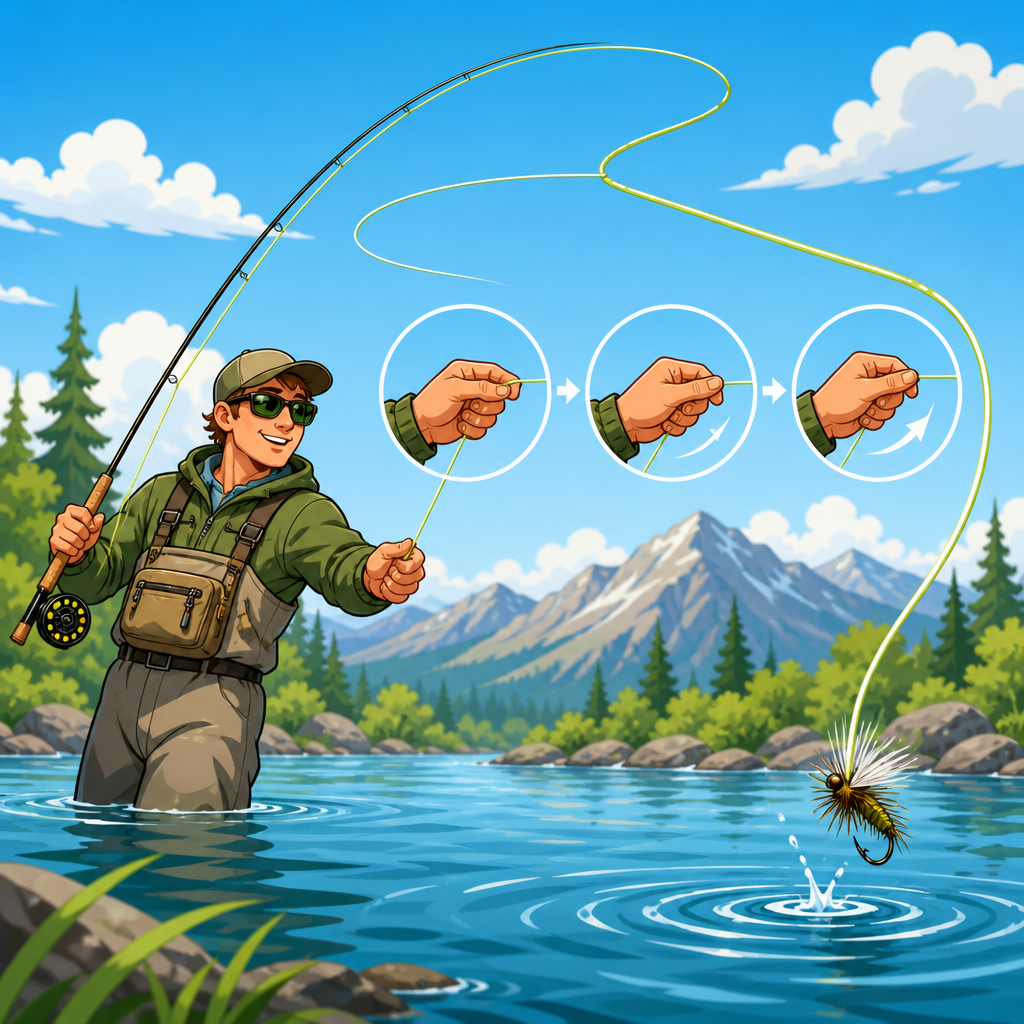
An aerial mend is a line adjustment made while the fly line is still in the air, before the fly, leader, and tippet touch the water. In practical terms, you change the line’s path during the forward cast so it lands with built-in slack or a deliberate curve, helping the fly drift naturally across currents that move at different speeds. If you fly fish rivers, especially pocket water, riffles, seams, and tailouts, learning how to perform an aerial mend before your fly lands is one of the most useful casting techniques you can master.
I teach this skill early because it solves a problem nearly every beginner faces: drag. Drag happens when faster or slower currents pull on the fly line and leader, causing the fly to skate, stall, or move unnaturally. Trout, grayling, and many other freshwater species notice that unnatural movement immediately. A clean aerial mend places the line upstream, downstream, or in a curve so the fly can drift first and the line follows. That small timing adjustment often produces more takes than changing flies.
Within fly fishing basics, casting techniques are not just about distance. They are about delivering the fly with control. Good casters manage loop shape, rod tip path, line speed, presentation angle, and slack. The aerial mend sits at the center of that control because it connects the cast to line management before the line ever touches current. It is the hub skill that links together reach casts, curve casts, tuck casts, pile casts, and on-water mending.
This article covers that full casting techniques picture, with the aerial mend as the focus. You will learn what an aerial mend is, when to use it, how it differs from a reach cast, what the rod hand should do, how to match the cast to current structure, and how to fix the mistakes that ruin a drift. I will also connect this skill to the broader Fly Fishing Basics framework: line control, presentation, drift management, and efficient rig handling. If you want a dependable dead drift without constant emergency mends after the line lands, this is the place to start.
What an aerial mend does and when to use it
The simplest definition is this: an aerial mend repositions the fly line in the air to create a better drift once it lands. Most often, anglers use an upstream aerial mend when the current between rod tip and fly is faster than the current holding the fly. By placing a bow of line upstream, you buy time before that faster current tightens the system and drags the fly. A downstream aerial mend does the opposite, useful in certain swing setups, downstream presentations, and when you need the fly to lead the line differently.
Use an aerial mend whenever conflicting current speeds will affect your drift immediately. A classic example is fishing from the near bank to a seam on the far side. The fast water in the middle grabs the belly of the line long before the fly finishes drifting along the slower edge. If you cast straight and then try to mend after the line lands, you may already have moved the fly unnaturally. An aerial mend puts the correction in place before the current has a chance to interfere.
It also matters with dry flies, emergers, small nymphs under light indicators, and even unweighted wet flies. Heavily weighted rigs reduce how much line shape alone can protect the drift, but the cast still matters. On spring creeks and clear tailwaters, where fish inspect a fly closely, landing with the right line layout often decides whether a fish eats or refuses.
How the aerial mend fits into core casting techniques
In fly fishing basics, casting techniques are best understood as presentation tools rather than isolated tricks. The overhead cast builds line speed and directional control. The roll cast and single-hand Spey variations reposition line when back-cast room is limited. The reach cast extends the rod to place line upstream or downstream during delivery. The curve cast changes the line’s flight path to bend around obstacles or currents. The pile cast intentionally drops slack in a heap for short drag-free drifts. The tuck cast drives weighted flies down quickly. The aerial mend overlaps with several of these, but its purpose is specific: alter line placement before contact with the water.
Many anglers confuse the aerial mend with the reach cast. The difference is timing and mechanics. In a reach cast, after the forward stop you move the rod sideways or upstream/downstream while the line unrolls, repositioning the entire layout. In an aerial mend, you usually introduce a controlled lateral or curving motion during the forward delivery phase so the line itself lands with a mend shape. In practice, the two blend together, and experienced anglers combine them. What matters is the result: the fly lands first or on target, and the line lands in a shape that preserves drift.
As a hub topic, casting techniques should always be tied to fishing situations. Distance casting is occasionally useful, but river fishing rewards line control more often than power. A 30-foot cast with a precise aerial mend catches more fish than a 60-foot cast that lands straight across three current speeds.
Step-by-step mechanics for performing an aerial mend
The foundation is a stable overhead cast. Start with enough line outside the rod tip to reach the target comfortably, not at your maximum distance. Accelerate smoothly on the back cast, pause until the line nearly straightens, then begin the forward cast with a straight-line rod tip path. The forward stroke should be crisp but not rushed. High line speed helps the line stay airborne long enough for the mend to take shape.
As the rod approaches the forward stop, decide the direction of the mend. For an upstream aerial mend with a right-handed caster on river left facing across, this often means moving the rod tip slightly upstream during or immediately after the stop. The motion is compact, not a giant sweep. Think “flick and place,” not “sling and hope.” Your goal is to reposition the line belly while still delivering the fly accurately. If the rod hand travels too far, the leader kicks, the loop collapses, or the fly misses the lane.
Timing is the critical variable. Move too early and you throw a curve cast unintentionally or dump energy before turnover. Move too late and the line has already straightened too much to accept the mend. The sweet spot is just as the loop is unrolling forward and the line still has enough energy to follow the rod tip. When taught on grass, I tell anglers to watch the leader: if the fly turns over and the line lands with a smooth upstream bow, the timing is right.
| Situation | Best line layout | Why it works |
|---|---|---|
| Fast midstream current between you and the fly | Upstream aerial mend | Adds slack before the fast current pulls the belly tight |
| Downstream presentation with a controlled swing | Downstream aerial mend | Helps align the line for tension and angle control |
| Short drag-free drift to a rising fish | Pile or slack presentation | Buys a few extra feet of natural drift without moving the fly |
| Need to cast around a current tongue or rock | Curve cast with aerial adjustment | Places line away from conflicting current lanes |
Reading current seams before you cast
A perfect aerial mend starts before the rod moves. You need to map the currents between your position and the target fish. Look for pillows in front of rocks, V-wakes, foam lines, slicks, chop, and pace differences between adjacent lanes. If the line will cross faster water than the fly, plan an upstream mend. If the fly will drift in faster water while the line sits in slower water, your line may need a different angle or less slack to maintain contact.
One mistake I see often is anglers focusing only on the trout’s lie and not on the water between them and the fish. The fish may be feeding steadily on the far seam, but the cast crosses two tongues of quick current. Without an aerial mend, drag begins almost instantly. A better plan is often to change your position first, then use a shorter cast with a smaller mend. Good casting techniques and good wading decisions work together.
Named approaches from river instructors support this. The “lane analysis” method used in many guide schools breaks the drift into fly lane, leader lane, and fly-line lane. If those lanes move at different speeds, your cast must account for it. An aerial mend is the preemptive answer.
Practice methods that make the skill stick
You do not need fish to practice this well. Grass practice is excellent because it removes current and lets you evaluate line shape clearly. Set plates or yarn targets at 25, 30, and 35 feet. First, make standard overhead casts that land straight. Then cast to the same targets and land the line with a visible upstream bow of one to three feet while keeping the leader aimed at the target. Repeat on both shoulders if your local rivers demand awkward angles.
On water, practice in a moderate current where you can see the line clearly. Cast across and slightly upstream with a dry fly or yarn fly. Compare a straight cast to one with an aerial mend. Count how many seconds pass before drag appears. That simple test gives immediate feedback. Most anglers become believers after seeing the drift length double with no fly change.
Video helps. A smartphone in slow motion will reveal whether the rod tip is making a compact repositioning move or a big sweep that opens the loop. If you use common casting benchmarks from organizations such as Fly Fishers International, the same fundamentals apply: straight-line rod tip path for efficient loops, smooth acceleration, and a crisp stop.
Common mistakes and how to correct them
The first major mistake is overpowering the mend. Anglers try to force a huge sideways move, which bleeds energy and dumps the leader in a heap. Correction: shorten the motion and increase line speed on the forward cast. The second mistake is mending with the whole arm rather than the hand and forearm. Large movements reduce accuracy. Use a compact rod-tip repositioning move.
The third mistake is poor timing. If your mend forms a tailing loop or piles unpredictably, you are likely moving before the forward loop forms cleanly. If nothing changes in the layout, you are moving too late. Practice with small changes in timing until the line follows the rod tip while the leader still turns over. The fourth mistake is trying this beyond your comfortable range. Start at 25 to 35 feet. At extreme distance, line control becomes harder and error increases sharply.
Another frequent problem is using the wrong cast for the job. Sometimes anglers attempt an aerial mend when a reach cast, curve cast, or simple repositioning step would work better. Casting techniques are situational tools. Choose the one that solves the current problem with the least motion and the highest odds of accurate delivery.
How this hub connects to the rest of casting techniques
If you are building a complete Fly Fishing Basics foundation, treat the aerial mend as the bridge between casting and presentation. From here, the next related skills are the reach cast for line placement, the curve cast for obstacle and current avoidance, the tuck cast for nymph depth, and on-water mending for drift maintenance after the line lands. Hauling, loop control, trajectory management, and slack-line presentations all support the same end goal: putting the fly where fish can accept it naturally.
In my own fishing, the anglers who improve fastest stop asking only, “How do I cast farther?” and start asking, “How do I make this drift last longer?” That shift changes everything. The aerial mend is one of the first advanced-looking skills that is actually very approachable, and it pays off immediately on real water.
To perform an aerial mend before your fly lands, make a solid forward cast, read the current lanes, and reposition the rod tip at the right moment so the line lands with purposeful shape. The result is simple but powerful: less drag, longer natural drifts, and more effective presentations across complex currents. As part of a complete casting techniques hub, this skill belongs near the top of your practice list because it improves dry-fly fishing, nymphing, and many cross-current presentations without requiring extra gear.
The key takeaways are straightforward. First, an aerial mend is preventive line control, not a rescue move after the line lands. Second, the cast works best when paired with current reading, smart angles, and moderate fishing distances. Third, accuracy still matters; the fly must land in the lane while the line lands in a shape that protects the drift. Finally, this skill connects directly to other essential casting techniques, especially the reach cast, curve cast, pile cast, and on-water mend.
If you want better drifts on your next river, practice this on grass first, then test it on a seam where drag usually starts too quickly. Watch how much longer the fly floats naturally. From there, build out the rest of your casting techniques toolkit and make line control the center of your Fly Fishing Basics progression.
Frequently Asked Questions
What is an aerial mend, and why does it matter before the fly lands?
An aerial mend is a line adjustment you make while the fly line is still traveling through the air on the forward cast, before the fly, leader, and tippet touch the water. Instead of waiting to reposition the line after it lands, you build the desired shape into the presentation itself. That shape might be an upstream curve, a downstream curve, or controlled slack placed in the line so the fly can drift more naturally through mixed currents.
This matters because rivers rarely move at one uniform speed. In pocket water, riffles, seams, and tailouts, faster and slower currents often sit side by side. If your line lands straight and tight across those currents, the faster water can grab it immediately and pull the fly off course. That creates drag, which is one of the biggest reasons a dry fly, nymph, or emerger looks unnatural to fish. An aerial mend helps prevent that problem before it starts by giving the drift a head start.
In practical terms, a good aerial mend improves drag-free drift, line control, and presentation accuracy. It can also reduce the need for a big on-water mend that might disturb the drift or move the fly unnaturally once it is already in the strike zone. Skilled fly anglers use aerial mends not because they look flashy, but because they solve a very real current problem in an efficient, fishable way.
How do you perform an aerial mend correctly on the forward cast?
The core idea is simple: make your normal cast first, then alter the rod tip path during the final part of the forward stroke and line unroll. Most anglers learn the aerial mend by starting with a standard overhead cast. As the forward cast straightens and the loop travels toward the target, you move the rod tip in the direction of the mend you want. For an upstream aerial mend, that usually means a subtle sweep or reach upstream. For a downstream mend, you guide the rod tip downstream. The fly line follows that motion in the air and lands with a built-in curve or repositioned belly.
Timing is everything. If you try to mend too early, during the power application, you can throw the cast off, widen the loop, or lose accuracy. If you wait too long, the line may already be landing, and the mend becomes ineffective. The best time is after the rod has delivered the cast but while the loop is still unrolling forward. Think of it as a controlled repositioning, not a hard yank. Smoothness matters much more than force.
Your rod tip should move deliberately but not violently. A sudden, exaggerated sweep often piles line in the wrong place or causes the leader to kick. A clean aerial mend comes from a crisp forward cast followed by a calm directional repositioning. Keep the motion compact at first. Practice at short and medium distances until you can consistently make the line land with the shape you intended. Once that becomes reliable, you can apply the same skill in more technical currents and at longer ranges.
When should you use an upstream aerial mend versus a downstream aerial mend?
An upstream aerial mend is most useful when the current between you and the fly is moving faster than the water where you expect the fly to drift. In that case, a straight line will get pulled quickly by the faster current, creating immediate drag. By placing an upstream curve or a bit of upstream slack into the line before it lands, you buy the fly extra time to drift naturally. This is especially effective in pocket water, across multiple seams, and when presenting dry flies or lightly weighted nymphs that need a natural, unhurried drift.
A downstream aerial mend is the right choice when the water carrying the fly is faster than the current acting on the line closer to you. In that situation, the fly can start pulling ahead while the slower line belly resists, again leading to unnatural tension. A downstream aerial mend helps align the line with the current structure so the fly can travel at the proper speed without being checked by the line behind it. It is also useful on certain downstream or across-and-down presentations where you want the line to land in a controlled shape.
The best way to choose between the two is to read the current lanes before you cast. Look at the path the fly will drift, then identify which sections of water will contact the fly line, leader, and belly. If the line will land over faster water than the fly, consider an upstream mend. If the fly will drift in faster water than the line, consider a downstream mend. With experience, this choice becomes less theoretical and more instinctive: you begin seeing the currents and matching the cast shape to the water automatically.
What are the most common mistakes anglers make when learning aerial mends?
The most common mistake is using too much force. Many anglers hear the word “mend” and think they need a large, aggressive motion. In reality, aerial mends are usually subtle. Overpowering the repositioning move can collapse the loop, destroy turnover, and make the leader land in a heap. A good aerial mend is controlled and intentional, with just enough rod-tip movement to influence the line’s final shape.
Another frequent issue is poor timing. If the mend starts before the forward cast is properly formed, the cast loses energy and accuracy. If it happens after the line has mostly landed, it stops being a true aerial mend and often turns into a sloppy on-water correction. Many beginners also try to mend with too much slack already in the system, which makes it difficult to transmit clean line shape through the cast. Aerial mends work best when the forward cast itself is fundamentally sound.
Anglers also often fail to match the size of the mend to the fishing situation. Not every cast needs a dramatic curve. Sometimes a small reach or slight directional adjustment is enough to extend the drift significantly. Another mistake is focusing only on the line and not the target. You still need the fly to land where the fish is likely to feed. Presentation control is not just about adding slack; it is about placing useful slack in the right location without sacrificing accuracy.
Finally, many anglers practice only on still grass and then get frustrated on moving water. Grass can help with mechanics, but current reading is part of the skill. To improve faster, practice on easy river sections where you can clearly see how different aerial mends affect the drift. Watch where the line lands, how long the fly drifts naturally, and how quickly drag develops. That feedback teaches far more than mechanics alone.
How can you practice aerial mends and get better at using them in real river situations?
Start by building consistency in your basic forward cast. An aerial mend is not a substitute for sound casting mechanics; it is an add-on to a cast that already unrolls well. Practice making straight, accurate casts at short range first. Then begin adding a small upstream or downstream rod-tip repositioning after the forward stroke. Use targets on the ground and focus on making the line land with a visible curve while still placing the fly accurately. At this stage, shorter casts are ideal because they make the timing easier to understand.
Once that feels reliable, move to water where you can clearly observe current speed differences. Try casting across two distinct seams and experiment with different aerial mend sizes. Notice how an upstream mend can lengthen a dead drift and how a downstream mend can help the fly move more naturally in faster water. Fish these presentations with intention rather than making the same cast every time. Ask yourself what the current is likely to do to the line, then choose the line shape that best counters that effect.
It also helps to practice specific presentations rather than generic mends. For example, work on reach-style aerial mends for dry flies, controlled slack presentations for short drifts in pocket water, and directional mends for seam crossings. Film yourself if possible, because what the rod tip is doing and what you think it is doing are often different. Even a short phone video can reveal rushed timing, excessive movement, or poor tracking.
Most importantly, keep your goals practical. You do not need a dramatic competition-style cast to fish effectively. You need a repeatable way to land the line so the fly drifts naturally through conflicting currents. If your aerial mend gives you even one or two extra feet of drag-free drift in the right lane, that can be the difference between a refusal and an eat. Like many advanced-looking fly fishing skills, it becomes much simpler once you break it down into current reading, cast quality, timing, and a smooth rod-tip adjustment.