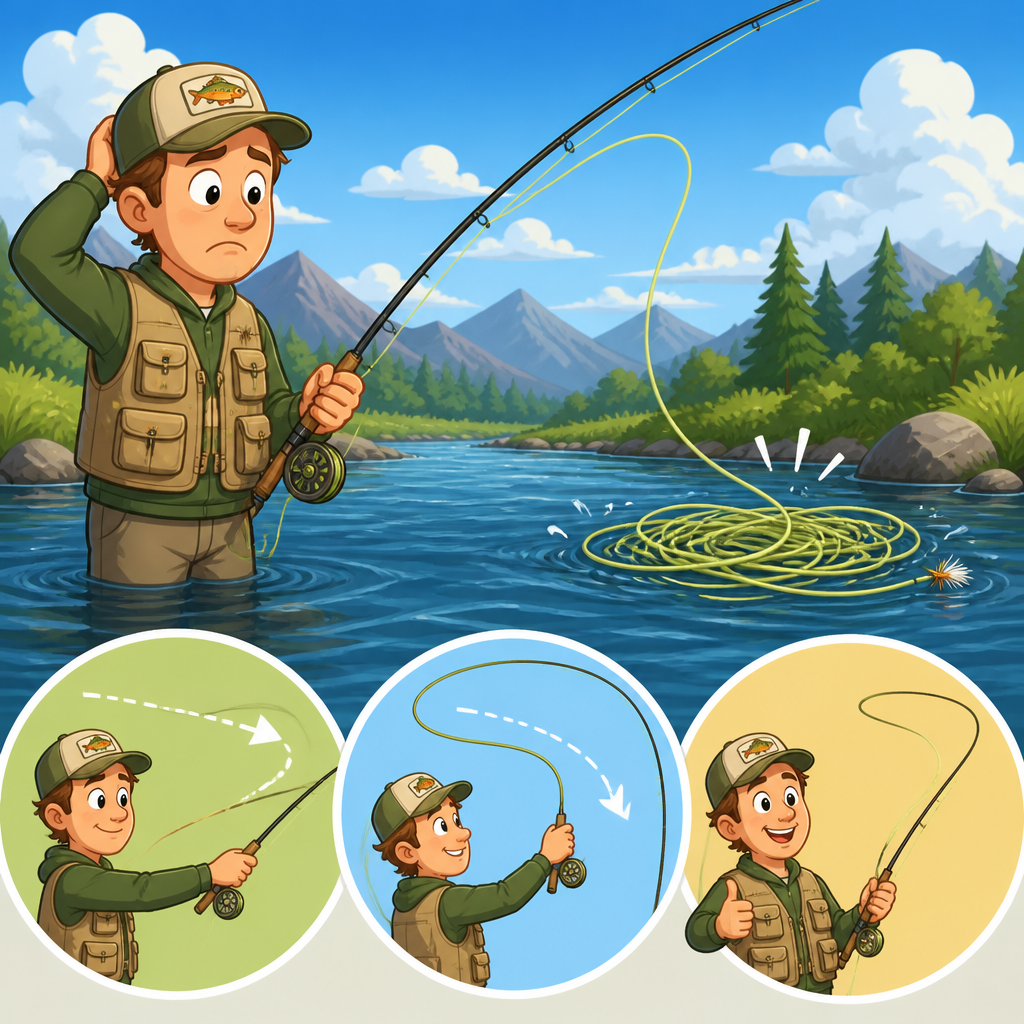
A fly leader that lands in a pile usually means the cast ran out of energy before the leader could fully unroll, and that single symptom points to a handful of correctable problems in timing, loop shape, and power application. In fly fishing basics, this matters because the leader is the final delivery system between fly line and fly. If it collapses, the fly often lands short, drags immediately, or slaps the water and spooks fish. I have seen beginners blame their tippet, their fly, even the wind, when the real issue was upstream in the casting stroke. Once you understand why the leader piles, your whole approach to casting techniques becomes clearer.
Start with the key terms. The fly line carries mass and transfers energy. The leader is a tapered connection that dissipates that energy in a controlled way so the fly turns over. Turnover means the line, leader, and fly straighten in sequence at the end of the cast. A pile cast, by contrast, happens when that sequence collapses and the leader lands in coils, curves, or a loose heap. Sometimes anglers want controlled slack on purpose for a drag-free drift, but accidental slack is different. Accidental slack is lost efficiency.
This article is the hub for casting techniques within fly fishing basics because nearly every skill connects back to turnover. Pick-up and lay-down casts, false casts, roll casts, mends, shooting line, and presentation casts all depend on managing line speed and loop shape. If your leader piles unexpectedly, the cast is telling you something useful. Usually, the rod tip traveled on a poor path, the pause was off, or the forward stroke lacked a smooth acceleration to a firm stop. Less often, your tackle match or leader formula is working against you. Fix those inputs and the output changes fast.
Why does this deserve focused attention? Because better turnover improves both distance and accuracy, but more important, it improves presentation. Trout in clear water often react to the leader and fly landing before they react to the line. Bonefish and carp are even less forgiving. In my own guiding and practice sessions, the fastest way to raise success rates has been to diagnose the cast at the leader. Watch the final three feet, and you can usually identify what the rod hand did wrong. The three fixes below solve most pile-ups and also build a stronger foundation for every other cast you will learn.
Fix 1: Correct Your Timing So the Rod Loads and Unloads Cleanly
The most common reason a fly leader lands in a pile is poor timing between the back cast and the forward cast. Many anglers begin the forward stroke before the back cast has straightened. When that happens, the rod cannot load efficiently because the line is still traveling backward. The result is a weak forward delivery with reduced line speed. The fly line starts forward, but the leader never receives enough energy to turn over fully, so it folds onto the water.
The direct fix is to lengthen or shorten your pause based on the amount of line outside the rod tip. More line requires more time to straighten behind you. Less line requires less pause. This is why experienced casters seem calm rather than hurried. They are not waiting randomly; they are allowing the line to nearly unroll before changing direction. You can hear this rhythm on grass. The back cast straightens, tension comes into the rod, then the forward stroke begins.
A practical drill is the watch-and-wait drill. Make short casts at twenty feet and turn your head slightly to watch the back cast. Do not start forward until the line almost straightens. Then repeat at thirty and forty feet. You will feel that the pause lengthens as line length increases. This drill teaches timing better than verbal instruction alone because it links visual feedback to rod load. Once the sensation is familiar, return your eyes forward and keep the same cadence.
Timing errors also show up when anglers rush false casts. Two or three false casts are enough for most fishing situations, yet many anglers make six or seven increasingly sloppy strokes. Each rushed change of direction bleeds energy. The leader piles on the final delivery because the cast was compromised several strokes earlier. If you want cleaner turnover, reduce unnecessary false casting and make each stroke deliberate.
Wind complicates timing, but the principle stays the same. Into the wind, you need a tighter loop and often a slightly lower trajectory on the forward cast. With a tailwind, the back cast may straighten faster, while the forward cast can deceptively appear fine even when turnover is weak. Good casters adjust tempo to conditions instead of using one fixed rhythm all day.
Fix 2: Improve Your Loop Shape by Tracking Straight and Stopping Firmly
If timing is acceptable and the leader still lands in a pile, look at loop shape. A fly cast works best when the rod tip travels in a near-straight path during the power application. That produces an efficient loop that carries energy forward. When the rod tip dips, sweeps, or travels in a wide arc, the loop opens too much. Wide loops bleed speed, wobble in the air, and fail to transfer enough energy into the leader.
Tracking is the term for keeping the rod traveling in a straight line relative to the target. Poor tracking often sends the line in crossing paths, creating tailing tendencies, accuracy problems, or a delivery that collapses left or right of the target. I see this constantly with anglers who cast across their body or push the rod hand outward on the forward stroke. They are trying to force distance, but they are actually moving the tip off plane and reducing turnover.
The fix starts with stance and hand path. Stand with shoulders relaxed, rod hand moving mostly back and forward rather than in a side sweep. Use the forearm as the engine, and limit wrist break until the stop. Then make a crisp stop on both back and forward casts. The stop matters because it allows the rod to unload and form the loop. Without it, the tip continues drifting and the loop opens.
Many anglers misunderstand power and try to cast hard from the start. Effective casting is not about a violent hit. It is about smooth acceleration to an abrupt stop. Think of line speed building progressively, not appearing instantly. This matters because a jerky stroke often creates shock waves in the line that show up as poor turnover or tailing loops. A smooth stroke with a firm stop produces better energy transfer to the leader.
Use this comparison as a quick diagnostic guide when the leader piles repeatedly.
| Symptom | Likely cause | What to change |
|---|---|---|
| Leader falls short in loose coils | Open loop from wide casting arc | Narrow the stroke, accelerate smoothly, stop firmly |
| Cast lands left or right of target and piles | Poor tracking | Move rod hand straight toward the target, avoid side sweep |
| Line kicks then collapses | Jerky power application | Start slow, increase speed late, finish with a crisp stop |
| Back cast looks fine but forward cast dies | Rod tip drift after the stop | Hold the stop momentarily and maintain plane |
A simple training tool is a yarn fly and a lawn target. On grass, loop shape is easier to see than on moving water. Cast parallel to a fence line or painted field stripe so you can judge tracking. Another proven exercise is the narrow-loop drill: keep the elbow quiet, shorten the stroke, and focus on a hard stop at about one o’clock on the forward cast. You are not trying to muscle distance. You are trying to send the line in a cleaner, more efficient path.
Line control after the stop also matters. If you lower the rod tip too early on delivery, the line can collapse before the leader turns over. Wait until the loop is traveling, then follow it down to the water. That small change alone fixes many last-second pile-ups.
Fix 3: Match Power, Line Length, and Leader Design to the Cast
The third major fix is matching your stroke to the amount of line you carry and the leader you are trying to turn over. Even a technically sound casting motion can produce a piled leader if the system is mismatched. Long leaders, tiny flies, split shot, weighted streamers, and bushy dry flies all demand different energy profiles. Good casting techniques are not one-size-fits-all.
First, adjust power to line length. Short casts require compact strokes and restrained power. When anglers use a long-distance stroke at fifteen feet, the line often kicks over and then recoils, leaving slack and a messy leader. Longer casts require a longer stroke and a later, stronger acceleration because more line mass must be moved. The best casters scale stroke length and power with carry length. That is a foundational skill in fly fishing basics.
Second, examine leader design. A standard 9-foot tapered leader for trout is versatile, but not universal. If you are casting a size 18 dry fly on 6X, turnover will be softer than with a size 8 hopper on 3X. If the butt section is too limp or too short relative to the fly line and fly size, energy transfer suffers. If the leader is too long for your current skill level or the wind conditions, piling becomes more likely. There is no shame in shortening to 7.5 feet while you refine mechanics.
Third, consider the fly itself. Heavily weighted nymph rigs and air-resistant indicators can collapse a cast that would easily turn over a single unweighted dry. In those situations, open the loop slightly for safety, change casting angle, and rely on water-loaded or roll-based presentations when appropriate. Trying to force a tight, high-speed overhead cast with a pair of tungsten nymphs is how anglers create tangles and dangerous rebounds.
This is also where line management enters the picture. Slack between your line hand and the first stripping guide reduces control and robs energy before the cast even forms. So does starting with the rod tip too high, which leaves slack line on the water before the pickup. A clean pickup, tensioned line, and organized stripping basket or deck space are part of casting technique, not separate from it.
For real-world context, consider three common scenarios. On a small creek at twenty feet, a compact pick-up and lay-down cast with a 7.5-foot leader often performs better than repeated false casts with a 12-foot leader. On a windy western river, a 9-foot 3X leader and a driving forward stop will turn over a hopper far more reliably than a long fine leader built for flat calm. On saltwater flats, where accuracy and speed matter, the caster who can carry forty feet with one back cast and a clean haul will always outfish the caster whose leader piles at the end of every rushed presentation.
How This Hub Connects the Core Casting Techniques
Leader pile-ups are not an isolated problem; they are a signal that links every major casting skill. In the pick-up and lay-down cast, clean turnover depends on lifting into tension and making one efficient delivery. In false casting, the goal is aerial control without bleeding energy. In shooting line, the haul and release must complement loop shape rather than compensate for poor mechanics. In roll casting and single-hand Spey variations, anchor placement and D-loop formation replace the back cast, but the principle is identical: organized energy produces turnover, disorganized energy produces slack.
As you build this part of fly fishing basics, practice in an order that compounds skill. Start with stance, grip, and straight-line tracking. Then learn pause control and loop observation. Add line shooting only after you can deliver thirty feet cleanly. Progress to specialty casts such as reach casts, curve casts, and slack-line presentations once you can intentionally choose between straight turnover and controlled slack. Intentional slack catches fish; accidental slack wastes shots.
The biggest improvement usually comes from diagnosis, not effort. Watch the loop, watch the leader, and ask a simple question after every miss: did the cast lose energy because of timing, loop shape, or system match? Those three categories solve most problems fast. If you can identify the category, the fix is usually obvious.
Your fly leader lands in a pile because energy did not travel cleanly from rod to line to leader to fly. In practice, that usually means one of three things: your timing was rushed, your loop was inefficient, or your stroke and leader setup did not match the fishing situation. Fix the pause so the rod loads against a straightening back cast. Fix the rod-tip path so the loop stays controlled and direct. Fix the system by matching stroke length, power, leader design, and fly choice.
These three casting fixes do more than stop messy presentations. They make you more accurate, more adaptable in wind, safer with weighted flies, and better prepared for every other skill in casting techniques. That is why this topic belongs at the center of fly fishing basics. When turnover improves, everything downstream improves too: presentation, drift, hook-setting range, and confidence.
Next time your leader lands in a heap, do not guess. Diagnose the cast, change one variable, and test again at short range before adding distance. Build clean mechanics first, then add complexity. If you want faster progress, practice on grass with targets, watch your back cast occasionally, and keep notes on what each adjustment changes. Master these three fixes, and your fly leader will stop piling and start delivering the fly the way you intended.
Frequently Asked Questions
Why does a fly leader land in a pile instead of straightening out on the water?
A fly leader usually lands in a pile because the cast loses energy before the leader can fully turn over. In practical terms, the fly line unrolls partway, but there is not enough speed and tension left in the system to carry the leader and fly all the way to a straight presentation. That breakdown often comes from one of three core issues: poor timing, a loop that is too wide, or power that is applied at the wrong moment. All three reduce efficiency, and when efficiency drops, the leader is the first thing to show it.
Many anglers assume the problem starts with the leader itself, but in most cases the leader is only revealing what happened earlier in the cast. If the rod tip travels in a sloppy path, if the caster starts the forward stroke before the back cast has straightened, or if the power is dumped too early instead of being smoothly accelerated to a clean stop, the line cannot transfer energy effectively. The result is a leader that collapses, kicks, or puddles on the surface.
This matters because the leader is the final delivery system between the fly line and the fly. If it piles up, the fly often lands short of the intended target, starts dragging right away, or hits the water with more disturbance than you want. So while the symptom shows up at the leader, the real fix usually comes from improving the cast itself, not replacing terminal tackle.
What are the three most common casting fixes for a leader that piles up?
The three most reliable fixes are better timing, tighter loop control, and smoother power application. These are the big levers because they directly affect how much energy reaches the leader at the end of the cast. If you improve these three areas, leader turnover usually improves quickly.
First, work on timing. A very common mistake is beginning the forward cast before the back cast has fully straightened. When that happens, the rod is forced to move line that is still slack or still traveling in the wrong direction, which immediately robs the cast of energy. The fix is to pause long enough on the back cast for the line to nearly straighten before starting forward. The amount of pause changes with the amount of line you have in the air, but the principle stays the same: let the cast finish behind you before asking it to go forward.
Second, improve loop shape. A narrow, controlled loop carries energy much more efficiently than a wide, lazy loop. Wide loops are often caused by too much wrist, a rod tip path that dips or arcs excessively, or a casting stroke that is not matched to the amount of line being carried. Focus on making a smooth stroke with a crisp stop. That stop helps the line roll out in a cleaner, tighter loop, which gives the leader a much better chance to turn over.
Third, fix the way power is applied. Many anglers hit the cast too hard at the beginning of the stroke, thinking more force will solve the problem. Usually it does the opposite. Good casts are built on smooth acceleration followed by a firm stop. In other words, start controlled, build speed gradually, and let the rod do the work. A sudden punch at the start of the stroke often creates tailing problems, shock waves, and wasted energy. A progressive application of power transfers energy more cleanly from rod to line to leader.
How can I tell whether the problem is timing, loop shape, or power application?
You can diagnose the cause by watching the line behavior in the air and by paying attention to what the rod hand is doing during the stroke. If timing is the problem, the cast often feels rushed. You may hear the line crack unexpectedly, feel the rod load unevenly, or notice that the forward cast starts while the back cast is still traveling. A rushed forward stroke often produces weak turnover because the line never has a chance to straighten and build tension before changing direction.
If loop shape is the issue, you will often see big, open loops instead of tight, efficient ones. The line may seem to travel in a broad, collapsing arc rather than unrolling neatly. Wide loops usually mean the rod tip is not traveling in a straight enough path during the stroke. Excess wrist movement, dropping the rod tip, or overpowering the cast can all contribute. When the loop is too wide, energy bleeds off early, and the leader lands in a heap.
If power application is the culprit, the cast may look jerky or feel abrupt. A common sign is a hard jab at the start of the forward cast. Another is using too much force overall, especially at short or medium distances where less effort is actually needed. Instead of sending more usable energy down the line, that sudden hit can create inefficiency and instability. The cast may appear fast at first, but the leader still fails because the energy was not delivered in a smooth, controlled way.
A useful habit is to practice at short range and observe one thing at a time. Watch whether the back cast straightens. Watch whether the forward loop stays narrow. Notice whether your hand accelerates smoothly or surges early. Breaking the cast into those parts makes troubleshooting much easier than trying to fix everything at once.
Could my leader, tippet, or fly setup be causing the pile-up, or is it almost always a casting issue?
It is usually a casting issue, but tackle can contribute. The key is understanding the order of importance. In most cases, a leader that piles up is telling you the cast ran out of energy before turnover finished. That points first to mechanics, not materials. Anglers often blame the tippet, the fly, or the leader formula because those are easy to change, but changing tackle rarely fixes a cast that is losing speed or tension too soon.
That said, leader design still matters. A very long leader, an extremely fine tippet, or a wind-resistant fly can all make turnover more demanding. If you are casting a bulky dry fly, an indicator setup, or a weighted nymph rig, the system needs more energy and cleaner mechanics to fully straighten. Likewise, if the butt section of the leader is too soft or too light for the line and fly combination, energy transfer can suffer. So while tackle is not usually the root problem, it can make a small casting flaw much more obvious.
A practical way to separate tackle issues from casting issues is to simplify everything. Use a standard leader length, a normal tippet size for the rod and line, and a small, unweighted practice fly or yarn. If the leader still piles up under those simple conditions, the problem is almost certainly in timing, loop control, or power application. Once the basic cast works, you can return to more specialized rigs and make leader adjustments if needed.
In short, do not ignore your setup, but do not let it distract you from the main cause. Good casting mechanics turn over a wide range of leaders and flies. Poor mechanics can make even a perfectly matched setup fail.
What is the best way to practice so my leader consistently lands straight instead of in a puddle?
The best practice method is to shorten the distance, slow the process down, and focus on one correction at a time. Start with a manageable amount of line outside the rod tip, because trying to fix turnover problems at long range usually makes bad habits worse. At short to medium distance, you can clearly see the loop, feel the rod load, and recognize whether the leader is turning over with energy or simply falling at the end.
Begin by practicing clean back-and-forth false casts with one goal: let each back cast nearly straighten before starting forward. This alone fixes a surprising number of turnover problems. Once the timing improves, pay attention to the shape of the loop. Try to produce a narrow, stable loop by using a smooth stroke and making a firm stop on both the back cast and the forward cast. Then add the final layer: controlled acceleration. Think of gradually increasing speed through the stroke instead of punching the cast hard at the beginning.
Another effective drill is to watch the leader specifically, not just the fly line. Many anglers admire the loop and miss what happens at the very end. If the fly line unrolls well but the leader still collapses, you know energy is fading too soon. Keep making small adjustments until the leader turns over straight or nearly straight without extra force. That is the sign that the cast is becoming efficient rather than merely aggressive.
If possible, practice in calm conditions first. Wind can hide or exaggerate mistakes and make diagnosis harder. Once you can consistently straighten the leader in easy conditions, test the same mechanics with slightly more line or with a more realistic fly. The goal is not to cast harder. The goal is to cast cleaner. When timing, loop shape, and power application improve together, the leader stops piling up and starts delivering the fly with much more accuracy, control, and delicacy.