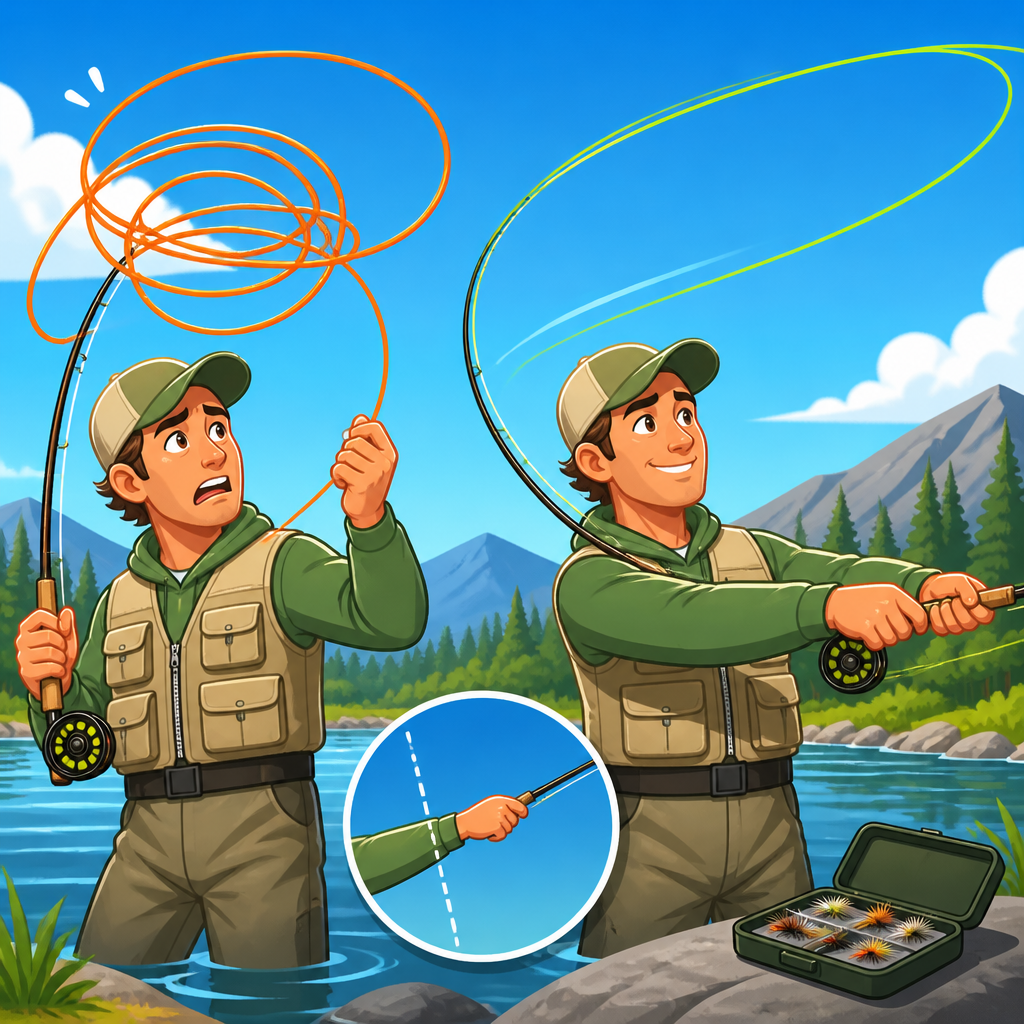
Tailing loops frustrate new and experienced fly anglers because they collapse turnover, create wind knots, and rob a cast of both accuracy and distance. In plain terms, a tailing loop happens when the top leg of the fly line dips below the bottom leg during the unrolling loop, usually because the rod tip travels in a concave path instead of a mostly straight path. I have fixed this problem with hundreds of students on grass fields and rivers, and the fastest improvement almost always comes from one focused casting drill rather than from adding power, changing rods, or buying a new line. If you want cleaner loops, better presentations, and fewer tangles, learning how to stop tailing loops is one of the highest-value skills in fly fishing basics and in casting techniques overall.
This article works as a hub for casting techniques because tailing loops connect directly to nearly every core skill: grip, stance, timing, power application, loop control, line management, distance casting, and casting in wind. A good cast is not about force. It is about controlling rod tip path, stroke length, and acceleration so the loop stays narrow, stable, and aligned with the target. When anglers ask why their fly line crosses itself, why leaders knot under pressure, or why short casts seem harder than medium casts, tailing loops are often part of the answer. Understanding the cause matters because the fix is mechanical and repeatable. Once you can diagnose the shape of the loop, you can adjust your hand path, your pause, and your power application with confidence instead of guessing.
The simple drill at the center of this article is the paintbrush drill. Imagine the rod tip is a paintbrush moving under a low ceiling. Your task is to make short overhead false casts while keeping the imaginary brush moving in a level track, then stopping crisply at the end of each stroke. This image immediately cleans up the most common fault: punching the cast too hard at the start, which bends the rod deeply too soon and drives the tip downward and then upward in a dip. The result of the drill is not just fewer tailing loops. It is a more efficient casting stroke that scales from ten feet to sixty feet, improves line speed without shock, and teaches you what a straight-line rod tip path feels like in your hand.
Before getting into the drill, define three terms that appear throughout casting instruction. Rod tip path is the path the tip follows during the casting stroke, and it largely determines loop shape. Casting arc is the angular rotation of the rod during the stroke; it must widen as more line is carried in the air. Timing refers to when you start the next stroke, especially after allowing the loop to unroll. If any one of those elements is off, tailing loops show up quickly. That is why a single drill can solve so much: it organizes all three elements at once while giving instant feedback you can see in the air.
What causes tailing loops in fly casting
A tailing loop has one primary cause: the rod tip travels on a concave path during the stroke. In practical terms, that concavity usually comes from uneven acceleration, an overly abrupt power application, a stroke that is too short for the amount of line aerialized, or a creep-and-hit sequence where the caster drifts forward during the pause and then compensates by snapping the rod. I see this most often when anglers try to cast farther by pushing harder. They start the forward cast with a jab, the rod bends sharply, the tip dips, and the loop crosses itself. The same thing can happen on the back cast when the wrist collapses or when the elbow drops during the stroke.
Other contributing errors matter too. A very wide casting arc can create open, lazy loops, while an arc that is too narrow for the amount of bend can contribute to a tail. Tracking errors, where the rod tip waves side to side instead of traveling on one plane, add crossing loops that many anglers misidentify as timing problems. Poor slack management also creates false symptoms. If line lies in a pile at your feet or the back cast starts with slack, the rod loads unpredictably, and the caster often responds by over-powering the next stroke. Equipment can amplify faults, but it is rarely the root cause. A line that is too heavy for the rod, a very soft tip, or an extra-long leader may magnify a poor stroke, yet a mechanically sound cast still produces a clean loop.
The one simple casting drill that fixes them
The paintbrush drill is simple enough for a beginner and precise enough for an advanced angler rebuilding mechanics. Start with twenty to twenty-five feet of fly line beyond the rod tip, no fly, and a yarn indicator or bare leader for safety. Stand with an open stance so your casting-side foot is slightly back. Raise the rod and make short overhead casts at about eye level. Your goal is to imagine brushing paint in a straight strip just below a ceiling on both the back cast and forward cast. Accelerate smoothly, stop crisply, pause until the line nearly straightens, then make the next stroke. Keep the hand traveling in a compact path and avoid punching at the beginning of either stroke.
This drill works because it changes sensation before it changes theory. Instead of thinking about twenty separate instructions, you feel a level hand path, a smooth load, and a clear stop. As soon as the rod tip stops dipping, the tail disappears. Students usually see improvement within five minutes because the loop itself becomes the feedback tool. If the loop crosses, the stroke was too abrupt, too short, or mistimed. If the loop opens too much, the stop was mushy or the arc was too wide. If the line piles on the back cast, the pause was short. Every mistake leaves a signature, and the drill teaches you to read that signature without needing an instructor beside you.
| Problem you see | Likely cause | Adjustment in the drill |
|---|---|---|
| Line crosses itself midair | Sudden power application causing concave tip path | Slow the start, then accelerate smoothly to a firm stop |
| Very wide, weak loop | Arc too wide or stop too soft | Shorten the stroke and make a crisper stop |
| Line snaps on the forward cast | Starting before back cast straightens | Lengthen the pause and watch the back cast unroll |
| Cast dies behind you | Back cast dropping low or tracking off plane | Keep the hand level and cast on a consistent plane |
| Wind knots in leader | Repeated tailing loops under tension | Reduce force and repeat the drill with shorter line |
How to practice the drill step by step
Begin on grass, not water, because removing current, fish, and target anxiety speeds learning. Strip out a measured twenty feet of line. Make ten back-and-forth false casts without shooting line. Watch the loop, not the rod. You are looking for parallel loop legs that unroll without crossing. Next, narrow your focus to tempo: smooth start, fast finish, hard stop, full pause. After ten clean cycles, carry a little more line, about five feet at a time. Each increase requires a slightly longer stroke and slightly wider casting arc. That relationship is fundamental in casting techniques. Short line needs a short stroke; long line needs a longer stroke. When anglers ignore that rule, tailing loops return.
Then add hauling only after the base stroke stays clean. A haul magnifies both good and bad mechanics. In my coaching sessions, anglers often try to solve line speed with a haul before they can hold a stable rod tip path. That usually makes the tail worse. Once the loop remains clean at thirty to thirty-five feet, introduce a light single haul and keep the rod hand smooth. The line hand should add speed while the rod hand preserves shape. Finally, practice changing planes: shoulder-high casts, slightly sidearm casts for wind, and accuracy casts to targets at twenty, thirty, and forty feet. The same principles apply in every plane. Smooth acceleration and a straight tip path still govern loop quality.
Common mistakes when using the drill
The first mistake is practicing too long with too much line. Fatigue makes mechanics sloppy, and sloppy practice teaches sloppy movement. Keep sessions short, often fifteen minutes, and stop when the loop shape deteriorates. The second mistake is staring only at the forward cast. Many tails originate on the back cast, especially when the caster rushes the pause or drives the rod too far back. Turn your head and watch behind you. The third mistake is over-isolating the wrist. Some instructors tell beginners to lock the wrist completely, but in real casting a small amount of controlled wrist movement is natural. The goal is not rigidity. The goal is a controlled rotation that matches line length and rod bend.
Another mistake is blaming gear before checking fundamentals. Fast-action rods do punish abrupt strokes more visibly than moderate rods, but they do not create tailing loops on their own. Likewise, overweight lines can make a rod feel overloaded at short range, yet most anglers still improve more by fixing the stroke than by changing line tapers. Use reputable standards as a reference. The AFFTA line weight system gives a baseline for matching line grain weight to rod designation, and major line makers publish head weights for half-size-heavy tapers. If your setup is wildly mismatched, correct it. If it is reasonably matched, return to mechanics. The drill remains the best first intervention.
How this drill connects to all major casting techniques
Because this article is a hub for casting techniques, it helps to see where the paintbrush drill fits into the bigger skill tree. In overhead casting, it builds the straight tip path that creates efficient loops. In distance casting, it teaches the principle that longer carry demands longer stroke, better timing, and disciplined application of power. In accuracy casting, it improves loop stability, which is why the line lands on target instead of spraying left or right. In roll casting and single-hand Spey casts, the same idea appears as anchor placement and sustained rod load: smooth force applied in the right sequence creates shape, while sudden force collapses shape.
The drill also supports line management and presentation. Clean loops turn over leaders more predictably, which matters when fishing dry flies on spring creeks, throwing weighted nymph rigs, or driving streamers into a headwind. Consider three real examples. On a small trout stream, a tailing loop clips a branch behind you because the back cast dips. On a flats skiff, a tailing loop with a crab pattern piles up at forty feet, costing a shot at a redfish. On a western river, repeated tails with a double nymph rig create knots that consume the best hour of a hatch. In each case, the visible problem looks different, but the underlying mechanical fault is the same, and the same drill helps correct it.
When tailing loops are not the whole problem
Not every ugly cast is a tailing loop, and accurate diagnosis matters. If the loop is wide but does not cross, the issue may be a rounded tip path from a wide arc, not a true tail. If the line kicks sideways, the problem is probably tracking. If the leader puddles at the end, the cause may be intentional slack presentation or simply not enough line speed for the leader formula. Heavy indicator rigs, split shot, and large streamers also change the game. Those setups often require more open loops for safety and turnover. You are not trying to force every cast into a tight, pretty competition loop. You are trying to match loop shape to the fishing problem while avoiding the specific crossing geometry that causes knots and collisions.
The simplest rule is this: if the top leg crosses under the bottom leg, fix the stroke before changing anything else. Use the paintbrush drill, reduce line length, smooth the acceleration, and rebuild from there. Once that is stable, branch into the rest of casting techniques: double haul, shooting line, reach cast, curve cast, slack-line presentations, and specialty casts for tight cover or wind. Strong fundamentals make those advanced skills easier, not harder. If you want to improve quickly, practice the drill for a week, film yourself from the side with a phone, and compare what you feel to what the loop actually does. That combination of deliberate practice and visual feedback is how tailing loops stop becoming a recurring habit.
Tailing loops are not random, and they are not a sign that you lack strength or expensive gear. They are a clear mechanical message that the rod tip path dipped into a concave shape, usually because power was applied too abruptly, the stroke was too short, or the timing was rushed. The best fix is the paintbrush drill: short overhead casts, a level hand path, smooth acceleration, crisp stops, and pauses long enough for the line to straighten. That one drill organizes the essentials of fly casting and gives immediate feedback you can trust.
As a hub within fly fishing basics, this guide points to the larger truth about casting techniques: every advanced cast rests on the same fundamentals of rod tip path, arc, tracking, and tempo. Clean loops improve distance, accuracy, presentation, and line control, whether you are casting dry flies at twenty feet or streamers at sixty. Start on grass, practice in short sessions, and let the loop tell you what needs correction. If you want better fly casting this season, spend fifteen minutes with this drill, then build outward into the rest of your casting skills.
Frequently Asked Questions
What exactly is a tailing loop, and why does it ruin a fly cast?
A tailing loop happens when the top leg of the fly line crosses or dips below the bottom leg as the loop unrolls. Instead of a clean, narrow loop that turns over smoothly, the line folds into itself. That breakdown in loop shape is what causes so many common casting problems. The cast loses energy, the leader and fly fail to straighten properly, and accuracy drops because the line is no longer tracking on a clean path.
In practical fishing terms, tailing loops lead to wind knots, ticking the rod with the fly, slack in the presentation, and reduced distance. They are frustrating because even a strong casting stroke can feel weak if the loop collapses halfway through the cast. Many anglers assume the problem is the line, the rod, or the wind, but the real issue is usually the path of the rod tip during the stroke.
The core cause is that the rod tip travels in a concave path rather than a mostly straight path. When that happens, the line mirrors that path and forms a tail. That is why fixing tailing loops is less about “trying harder” and more about improving mechanics. Once you understand that loop shape reflects rod-tip path, the problem becomes much easier to diagnose and fix.
What usually causes tailing loops in the first place?
The most common cause is applying power too early in the casting stroke, especially with a sudden jab from the shoulder, forearm, or wrist. When power is dumped too soon, the rod bends deeply before it should, which forces the tip into a dip and creates the concave path that produces a tailing loop. This is extremely common among newer anglers, but experienced casters do it too when they rush, try to force extra distance, or change tempo under pressure.
Another major cause is an overly long casting stroke for the amount of line being carried, or the opposite problem: a stroke that is too short and abrupt for the amount of line in the air. Stroke length and casting arc need to match line length and rod bend. If they do not, the rod tip path becomes uneven. Poor timing on the back cast, creeping forward before the line has straightened, and drifting into bad positions can also set up the forward cast for a tailing loop.
Slack is another hidden culprit. If the cast begins with slack line or a drooping rod tip, the caster often compensates with a sudden hit to get the line moving. That rushed correction commonly creates the same dip in the rod-tip path. In short, tailing loops are usually a symptom of flawed stroke mechanics, rushed timing, or poor setup rather than a lack of effort or athletic ability.
What is the one simple casting drill that helps stop tailing loops fastest?
The most effective simple drill for many anglers is a smooth acceleration-and-stop drill done with short to moderate line, usually on grass or calm water. Start with about 25 to 35 feet of line outside the rod tip. Make controlled false casts and focus on one goal: accelerate gradually during each stroke and finish with a crisp stop, rather than hitting the cast hard at the beginning. That smooth build of speed helps the rod tip travel on a straighter path and prevents the dip that creates tailing loops.
A useful way to practice it is to imagine you are painting a straight line in the air with the rod tip. Begin slowly, increase speed smoothly, and then stop cleanly. Keep the wrist quiet and avoid punching the rod forward. If it helps, pause between false casts long enough to let the line nearly straighten before changing directions. The moment you rush the transition or jab the rod, the tailing loop often reappears, which makes the drill excellent immediate feedback.
This drill works so quickly because it simplifies the cast down to the core mechanical fix. You are not trying to cast farther, power harder, or manage difficult presentations. You are retraining tempo, stroke shape, and stop quality. For many students, just a few minutes of practicing smooth acceleration with short line is enough to produce visibly cleaner loops and a much better feeling cast.
How can I tell if I am fixing the problem correctly while I practice?
The easiest sign is visual. Clean loops look narrow, stable, and unroll without the top leg crashing into the bottom leg. If your loop shape improves and the leader turns over more consistently, you are moving in the right direction. On grass, watch the unrolling line carefully. On water, pay attention to whether the cast straightens with less kick, fewer knots, and less splashy collapse.
You can also judge progress by feel. A correct stroke often feels easier, not harder. The rod loads more predictably, the line seems to follow the rod without drama, and the cast stops feeling like a forced effort. Many anglers are surprised to discover that reducing unnecessary power actually creates better line speed because the loop remains efficient instead of self-destructing.
Another good checkpoint is consistency. One clean cast does not mean the problem is solved. Look for repeated clean loops over several false casts and changes of direction. If the cast only falls apart when you try to add distance, that usually means your mechanics are good at shorter range but break down when stroke length, timing, or power application change. In that case, keep the same smooth drill and lengthen line gradually, making sure the quality of the loop stays intact as you scale up.
Can tailing loops be caused by the rod or line setup, or is it almost always the caster?
In most cases, the caster is the main cause, not the tackle. Tailing loops are overwhelmingly a mechanics issue tied to rod-tip path, timing, and power application. A properly matched rod and line can make casting feel easier, but even excellent gear cannot overcome a concave rod-tip path. Likewise, a modest setup in skilled hands can produce clean, efficient loops all day long.
That said, equipment can contribute at the margins. A line that is far too heavy or too light for the rod can change timing and loading enough to expose flaws more quickly. Very soft or very fast rods may also make a caster’s mistakes feel different, though they do not fundamentally create tailing loops on their own. Leaders that are too long for the caster’s skill level or flies that are too wind resistant can exaggerate turnover problems, making the symptom look worse even when the core issue is still stroke mechanics.
The best approach is to assume the fix starts with technique. Work on smooth acceleration, a controlled casting arc, solid stops, and proper pause timing before blaming gear. If you can produce clean loops with short line and moderate effort, your setup is probably adequate. Once your mechanics improve, you can fine-tune rod, line, and leader choices with much better results and far less frustration.