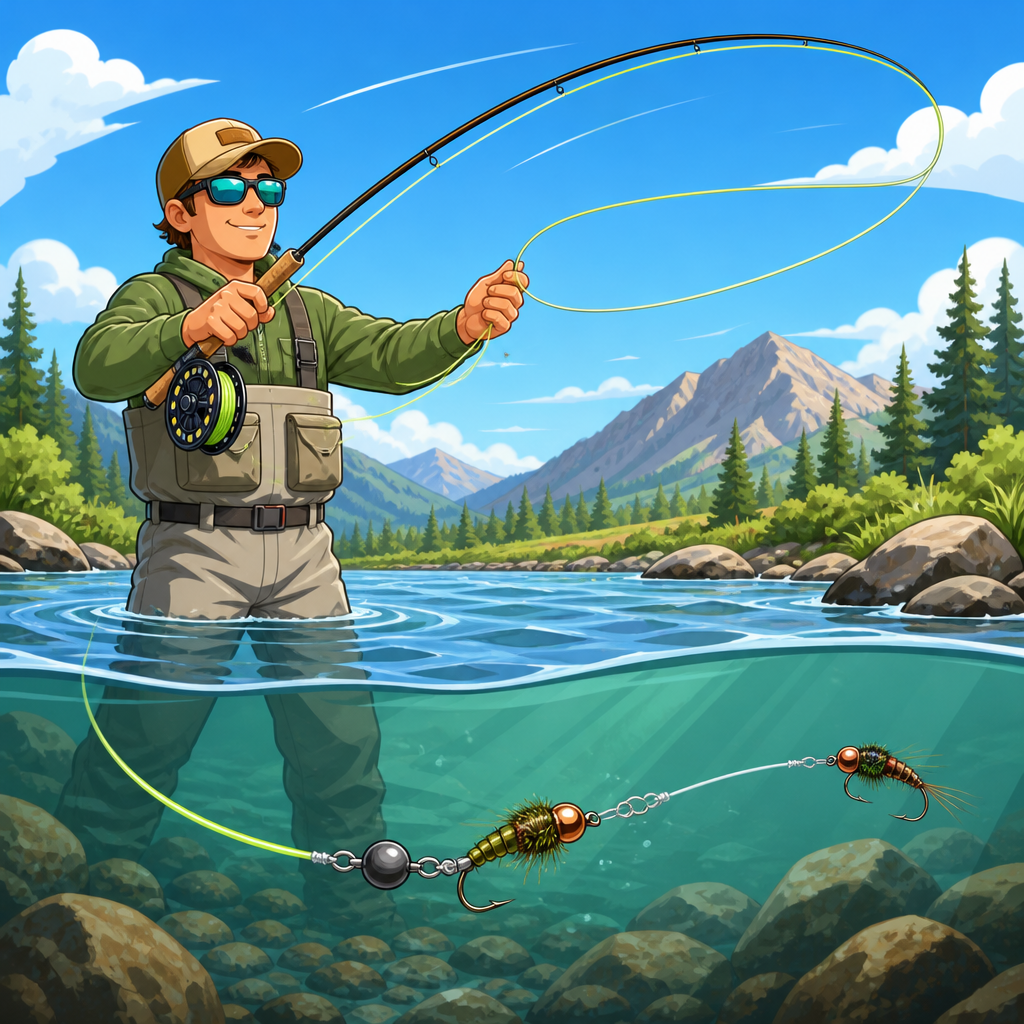
How to cast a heavy nymph rig without tangling starts with understanding why these setups misbehave in the air. A heavy nymph rig usually includes one or two weighted flies, split shot, a strike indicator, and often a longer leader than anglers use for dry flies. Every added component changes mass distribution, loop shape, and timing. When the cast is rushed or the stroke is too wide, those parts collide, hinge, and wrap around each other. The result is familiar: wind knots, indicator tangles, twisted droppers, and flies buried in the leader.
In practice, this matters because heavy nymphing catches fish in fast, cold, and deep water where trout feed most consistently. A poor cast wastes drifts, spooks fish with splashy landings, and burns time retying instead of fishing. I learned this the hard way guiding on freestone rivers where clients could dead-drift perfectly once the rig landed, but only after we fixed the cast. The goal is not pretty aerial loops. The goal is controlled turnover that delivers weight safely, straightens enough leader to start the drift, and avoids self-destruction.
Casting techniques for heavy nymph rigs differ from standard trout casting in a few important ways. You generally open the loop, reduce false casting, slow down the tempo, and use water tension whenever possible. Roll casts, water-loaded pickups, lobs, and Belgian casts often outperform a textbook overhead cast. Rod tip path still matters, but the ideal shape is broader and more forgiving because the payload is unstable. If you fish indicators, euro-style contact rigs, or hopper-dropper variations, mastering these adjustments will improve both efficiency and fishability across the entire fly fishing basics progression.
This hub article covers the essentials of casting techniques for weighted nymph systems: how rig design affects turnover, which casts reduce tangles, how to match leader and rod setup, what common mistakes cause knots, and how to adapt for wind, depth, and tight quarters. If you want cleaner presentations, fewer breakoffs, and more time with flies drifting at the right depth, these are the mechanics that make it happen.
Why heavy nymph rigs tangle in the first place
Most tangles happen because the rig loses separation during the casting stroke. In a dry-fly cast, the leader and fly line usually unroll in sequence with relatively even energy transfer. In a heavy nymph rig, the weight can overtake lighter sections, especially if the stop is too abrupt or the angler forces extra line speed. Split shot and tungsten beads create a hinging effect. Indicators add air resistance and can kick the leader off plane. If you also use a tag dropper, two flies may orbit each other mid-cast. Once that rotation starts, the tangle is already forming.
Three variables control most of the problem: stroke path, tempo, and rig geometry. A narrow, high-speed loop is excellent for punching a single streamer into the wind, but it is often terrible for a two-fly indicator rig. The flies crash into the leader because the loop collapses too tightly around the weight. Tempo is just as important. Weighted setups need time to straighten on the back cast before the forward stroke begins. Many anglers start forward too soon, causing the rig to rebound and pile up. Rig geometry matters because fly spacing, tag length, split-shot placement, and leader butt stiffness determine whether the system turns over or folds.
Current, wind, and wading angle also contribute. Casting quartering downstream with a weighted rig often encourages the flies to swing across the line during the pickup. Casting into a headwind magnifies any tailing tendency and drives the indicator back toward the leader. Even the water surface affects control. A line anchored briefly by surface tension can stabilize the load for a roll cast or water haul, while a fully aerialized cast exposes every flaw in timing. The solution is not brute force. It is designing the cast around the physics of an awkward payload.
Build a rig that is castable before you ever make a cast
The easiest way to avoid tangles is to start with a heavy nymph rig that can actually turn over. I prefer a 9-foot 4X or 3X tapered leader for indicator nymphing, then add tippet sections based on depth and fly size instead of building an extremely limp leader from scratch. A stronger butt section helps transfer energy. For two-fly rigs, 16 to 24 inches between flies is usually enough. Longer gaps can be useful in slower water, but they tangle more often during aggressive casting. If I need extra depth, I would rather add a small amount of split shot than create an overly long, collapsing leader.
Indicator placement matters as much as fly weight. Put the indicator far enough above the upper fly to reach depth, but recognize that a very long distance increases hinging. Large foam indicators cast worse than compact air-lock styles because they add drag and wobble. Split shot should be secured cleanly and positioned so it does not slide into knots. Many anglers pinch on too much weight in one place. Two smaller shot spaced slightly apart often cast and drift better than one oversized shot because they distribute mass and reduce the hard pivot point.
Fly selection also changes castability. A slim perdigon with a tungsten bead turns over more cleanly than a bushy hare’s ear plus extra lead wraps. Jig hooks can reduce bottom snagging, but they still carry concentrated weight. If your top fly is much lighter than your point fly, expect hinging unless the tippet lengths and casting stroke compensate. In guide settings, I often simplify beginners to one heavy fly and one lighter dropper before introducing more complex combinations.
| Rig element | Better for clean casting | More likely to tangle |
|---|---|---|
| Leader butt | Stiffer tapered butt section | Long limp level material |
| Fly spacing | 16 to 24 inches | 30 inches or more with two weighted flies |
| Weight | Two small shot or balanced bead weight | One oversized shot crimped near a knot |
| Indicator | Compact, secure, correctly sized | Bulky, wind-resistant, too large for the rig |
| Fly profile | Slim patterns like perdigons | Bushy patterns with heavy wraps |
The safest and most effective casting techniques
If you remember one rule, remember this: cast heavy nymph rigs with slower acceleration and an open loop. That means shortening false casts, widening the casting arc, and making deliberate stops instead of hard punches. The standard overhead cast still works at short to moderate range, but only when you let the back cast fully straighten and keep the rod tip traveling on a clean path. I teach anglers to imagine throwing a small paintbrush rather than cracking a whip. Smooth power application keeps the flies from overtaking the leader.
The Belgian cast is one of the best solutions when the rig is especially weighty. Instead of forcing the line to reverse direction on the same plane, the back cast travels to the side in a continuous oval and the forward cast comes over the top. Because tension stays more constant, the rig is less likely to kick and tangle. This cast is also safer around weighted flies because they remain away from the rod tip and, if performed correctly, away from the caster. In windy conditions, adjust the plane so the flies stay downwind of your body.
Roll casts and water hauls are equally important. With a heavy nymph rig, the water is an ally. Lift just enough line, let the anchor stick, then use the surface tension to load the rod. On medium rivers, a roll cast pickup followed by one forward presentation often outfishes repeated false casts because it lands quickly and starts the drift sooner. A single back cast after the roll pickup can be useful, but only if there is room and the rig is already under control. On brushy banks, a tuck-style finish can help drive the flies downward, although it requires discipline to avoid overpowering the stop.
For short drifts, a simple lobbing cast is often best. This is not elegant, but it is effective. Open the loop, aim higher, and let the rig turn over under its own momentum. Many anglers resist this because it feels less like classic fly casting. Fish do not care. They care that the flies arrive untangled and sink promptly. When I guide beginners through pocket water, the cleanest approach is often one pickup and one controlled forward lob at 20 to 30 feet.
Timing, tracking, and stroke length that prevent knots
Good casting techniques depend on timing more than strength. Weighted rigs need a longer pause on the back cast because the payload takes longer to unroll. If you hear the indicator or flies snap behind you, you started forward too early or applied power too abruptly. Watch the line in open water when possible. Seeing the back cast nearly straighten teaches the correct tempo faster than any verbal cue. On the forward cast, stop high enough to let the rig unfold, but not so sharply that it rebounds into a tailing loop.
Tracking is the other overlooked factor. The rod should travel in a consistent plane, whether overhead or Belgian. When the hand drifts inward and outward unpredictably, the weighted flies swing around the line. That creates crossed trajectories and instant tangles. I often tell anglers to keep the elbow quiet and move the forearm like it is sliding along a narrow hallway. The image is simple, but it helps maintain a stable path. On longer casts, increase stroke length rather than forcing extra speed with the wrist. A wider stroke gives the rig space to travel.
Slack management matters before and after the cast. Too much loose line at the pickup creates a jerky start that slings shot and flies into each other. Strip in until you can lift smoothly, then make the cast. After the presentation, mend only once the flies and indicator separate clearly on the water. An immediate violent mend can knot the terminal section you just managed to straighten. Efficient anglers treat the cast, landing, and first drift adjustment as one connected sequence.
Adapting for wind, river size, and tight casting lanes
Wind exposes weak mechanics faster than any other condition. In a headwind, shorten the casting distance, reduce aerialization, and use a more water-dependent cast. A Belgian cast or compact roll cast pickup keeps the rig under control. If you must cast overhead, drive the forward cast slightly downward with a firm but not abrupt stop so the loop does not balloon and blow back. In a crosswind, change shoulders if you can do so safely, or alter the casting plane to keep weighted flies away from your body. Eye protection is mandatory, not optional, when tungsten beads and shot are involved.
River size influences the best approach. On small streams, most heavy nymph presentations happen inside 25 feet. Reach matters less than angle and drift length, so a bow-and-arrow style flip, short roll cast, or open-loop lob may outperform anything aerial. On medium rivers, the most versatile sequence is often a water haul into one back cast and one forward cast. On broad tailwaters where longer drifts matter, line control after the cast becomes critical. You may need a higher stop for turnover followed by an immediate stack mend, but only after the rig lands straight enough to avoid crossing the droppers.
Tight casting lanes force compromises. Trees behind you eliminate standard back casts, so use roll casts, single Spey-style water loads where legal and practical, or reposition your wading angle. Many anglers stand in one place too long and try to solve a geometry problem with more effort. Two careful steps can open the lane and remove the need for a heroic cast. If the current seam is close, fish it close. High-percentage heavy nymphing rarely requires maximum distance.
Troubleshooting the most common tangles and casting failures
If your heavy nymph rig tangles repeatedly, diagnose the exact failure instead of blaming the rig generally. A leader wrapped around the indicator usually means the forward loop was too tight or the cast collapsed in the wind. Droppers twisted around the point fly often indicate excessive false casting or too much spacing between flies. Shot bouncing into knots points to poor placement or a violent pickup. A pile of slack with no turnover usually means the leader butt is too soft, the indicator is too large, or the cast lacked enough sustained tension to carry the load.
There are practical fixes for each problem. First, remove complexity. Fish one fly instead of two, or switch to a lighter indicator. Second, shorten everything slightly: less line out, less distance between flies, fewer false casts. Third, slow down. Most anglers improve immediately when they wait longer on the back cast and apply power later in the stroke. Fourth, inspect terminal tackle. Curled tippet, damaged knots, and partially crimped split shot all increase spin. Replace compromised sections early. Fluorocarbon can help sink rate and abrasion resistance, but it also coils when abused, so stretch it lightly before fishing.
Finally, know when to change systems. If the water is shallow and fast at close range, contact nymphing with a lighter leader-only setup may be more efficient than casting a large indicator rig. If the flies must be extremely heavy to reach depth, consider repositioning upstream and fishing a shorter drift rather than adding more weight. Good casting techniques solve many problems, but smart rig choice solves even more. Practice these adjustments on grass with yarn markers, then confirm them on moving water. The payoff is immediate: fewer tangles, safer casting, better drifts, and more trout. For the rest of your Fly Fishing Basics progression, build your casting habits around control, not force, and every weighted presentation will improve.
Frequently Asked Questions
Why does a heavy nymph rig tangle so easily compared with a standard dry fly setup?
A heavy nymph rig tangles more easily because it is not a balanced, lightweight casting system. Instead of turning over one relatively simple fly on a tapered leader, you are trying to move and control several pieces with different weights and wind resistance at the same time. Weighted nymphs, split shot, and strike indicators all affect how energy travels through the cast. If that energy is uneven, the rig no longer unrolls in a straight, predictable path. It hinges, collapses, or rebounds, and that is when parts begin wrapping around each other.
Leader length also plays a major role. Many nymph anglers fish longer leaders to get better drift and depth control, but a longer leader gives the cast more opportunities to lose tension. When tension disappears, the flies and indicator can overtake one another midair. Add a rushed casting stroke, an abrupt stop, or a loop that is too tight for the amount of weight being carried, and tangles become much more likely. In simple terms, heavy nymph rigs misbehave because they magnify every casting mistake. Good timing, a smooth stroke, and a loop shape matched to the rig are what keep the system organized in flight.
What is the best casting stroke for a heavy nymph rig if I want to avoid tangles?
The best casting stroke for a heavy nymph rig is smooth, deliberate, and slightly more open than what you would use for a dry fly. The goal is not to generate extreme line speed with a narrow, aggressive loop. The goal is to move the rig under control so the flies, split shot, and indicator stay separated and turn over in sequence rather than crashing into one another. Most anglers get into trouble when they try to cast a weighted setup the same way they cast a single dry. That usually creates too much abrupt acceleration and too tight a loop for the amount of mass being carried.
Think in terms of a slower tempo and a wider casting arc. Start the rod smoothly, accelerate gradually, and come to a clean stop without snapping the rod tip. That controlled acceleration gives the rig time to straighten behind you and then in front of you. On both the back cast and forward cast, wait long enough for the line to nearly straighten before changing direction. If you begin the forward stroke too early, the rig is still traveling backward and it will kick, hinge, and tangle. A slight oval or Belgian-style casting path can also help because it keeps the weighted flies moving on a more continuous plane, reducing the chance that the rig crosses itself in the air. The key principle is simple: slow down, open the loop, and let the rig fully load and unfold before asking it to change direction.
Should I use a different loop shape or casting style when throwing split shot, two flies, and an indicator?
Yes, and this is one of the most important adjustments anglers can make. A heavy nymph rig generally casts better with a more open loop rather than the tight, high-speed loop prized in many other forms of fly fishing. Tight loops are efficient for light, aerodynamic flies, but they are less forgiving when you add weight and multiple connection points. With split shot, two flies, and an indicator, a tight loop often causes the upper and lower sections of the rig to converge too aggressively, which encourages collisions and wraps.
An open loop gives the components more room to travel without crossing paths. This does not mean the cast should be sloppy or uncontrolled. It means the rod tip should travel on a path that produces a stable, rounded loop capable of carrying weight safely. Many anglers find that a Belgian cast, also called an oval cast, is especially useful here. Instead of allowing the back cast and forward cast to track on the exact same plane, the oval motion keeps the weighted rig moving continuously and away from the rod tip and line path where tangles often begin. This style is particularly helpful in windy conditions or when the rig includes larger indicators or heavily weighted anchor flies. If your current cast feels compact and punchy, open it up. A heavier rig almost always rewards smooth separation over raw speed.
How should I set up my heavy nymph rig to reduce tangles before I even start casting?
Good casting matters, but rig design matters just as much. A poorly arranged nymph setup can tangle even in the hands of a competent caster. Start by keeping the system as simple as the fishing situation allows. If one fly will do the job, use one fly. If less split shot will still get you down, remove the extra weight. Every additional item adds another chance for the rig to fold or wrap during the cast. Simpler rigs are easier to turn over and easier to manage on the water.
Pay close attention to spacing. Flies that are too close to split shot or too close to each other tend to collide more often. Reasonable separation between the indicator, weight, and flies helps each component track more independently. Leader material can help as well. Butt sections with enough stiffness transfer energy more effectively than limp material, and that improves turnover. At the same time, the tippet sections below the indicator should not be excessively long for your casting ability. Many tangles come from anglers fishing a leader they cannot comfortably control. Also check knots frequently. Curled tippet, damaged leader sections, and poorly seated knots all contribute to unpredictable turnover. In practice, a well-built nymph rig is compact enough to cast, long enough to fish effectively, and not overloaded with unnecessary hardware.
What are the most common mistakes anglers make when casting a heavy nymph rig, and how can they fix them?
The most common mistake is rushing the transition from back cast to forward cast. With a heavy nymph rig, timing errors are punished immediately. If you start forward before the line and leader have straightened behind you, the weighted flies and indicator will lag, swing off plane, and tangle. The fix is to slow down and consciously wait for the rig to finish traveling before changing direction. You do not need a dramatic pause every time, but you do need enough patience to let the load develop properly.
Another frequent mistake is trying to overpower the cast. Anglers often see weight and instinctively apply more force, but abrupt power usually makes the problem worse. It creates shock waves in the system, collapses turnover, and sends the flies into the leader. The correction is a smoother acceleration with a firmer but not violent stop. A third mistake is using too narrow a casting arc. Heavier setups need more room. If the arc stays too tight, the loop becomes too cramped for the rig. Widening the stroke usually improves turnover immediately.
Anglers also run into trouble by false casting too much. Every extra back-and-forth cycle is another chance for the rig to twist, especially with split shot and dual-fly setups. In many cases, one back cast and one forward presentation is enough. Water-loading or roll-casting into the pickup can be even better. Finally, many people ignore the role of rig size. Oversized indicators, too much shot, or excessively long tag ends below knots all increase the likelihood of tangles. If your casting mechanics are reasonable but the rig still knots itself, simplify the setup. Most heavy nymph casting problems improve when anglers cast less aggressively, reduce unnecessary complexity, and match their stroke to the weight they are actually carrying.