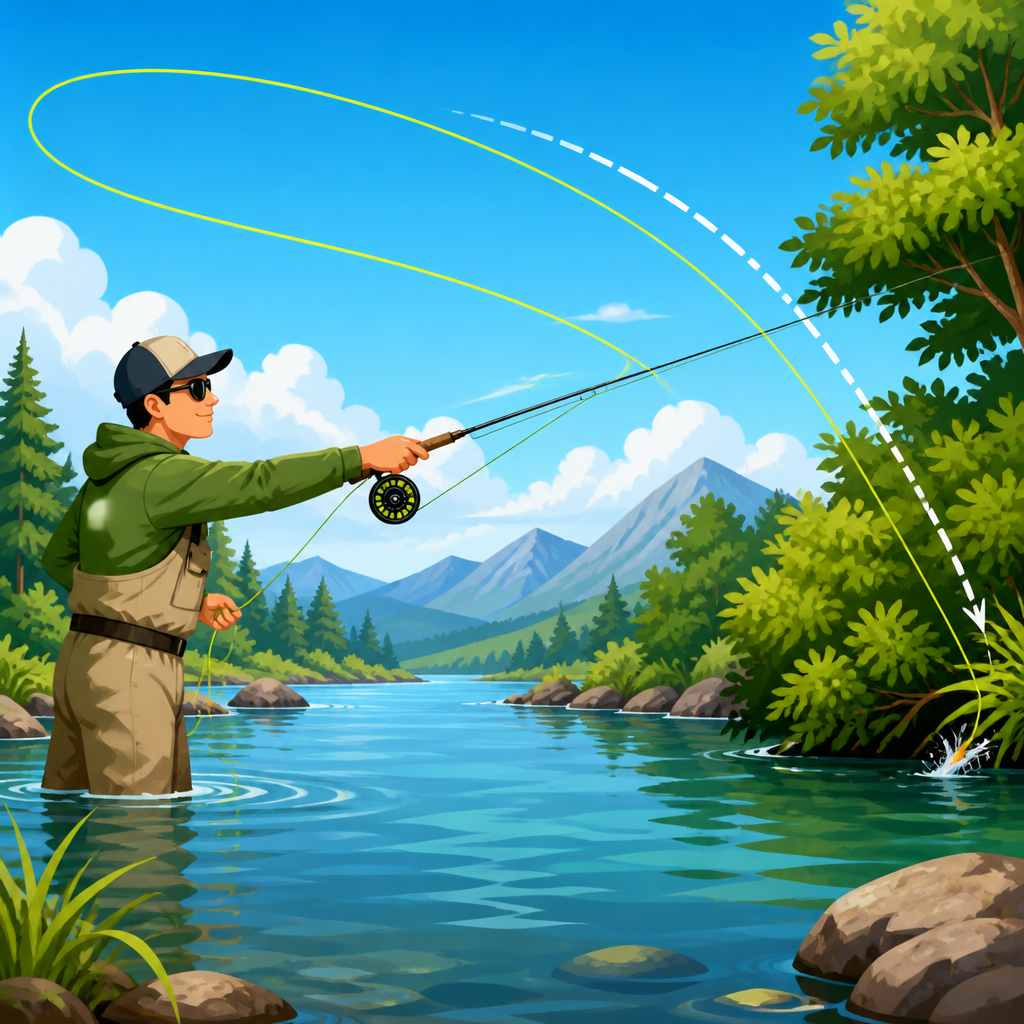
A reach cast is a controlled aerial mend made during the forward cast, where the angler moves the rod upstream, downstream, or across the body just before the line lands so the fly line and leader settle with built-in slack or a deliberate angle. In fly fishing, that simple adjustment solves one of the most common presentation problems: drag. I teach new anglers that a good cast is not just about distance or accuracy. It is about delivering the fly so it drifts naturally, under tension when needed, and in the lane you intended. The reach cast sits at the center of that lesson because it connects mechanics, line control, current reading, and presentation strategy.
Within casting techniques, the reach cast is best understood as a presentation cast rather than a power cast. It does not replace the basic overhead cast, roll cast, or pick-up-and-lay-down cast. Instead, it builds on them. If you can form a stable loop, stop the rod cleanly, and track in a straight path, you can learn a reach cast quickly. Yet despite being approachable, it remains one of the most useful advanced-looking skills in practical river fishing. I use it constantly on trout streams, moderate freestone rivers, spring creeks, and even from a drift boat when I need a fly to land with a built-in upstream mend before conflicting currents grab the line.
Why does it matter so much? Because current speed is rarely uniform. Water near the bank may crawl while the seam in front of you moves fast and the bucket behind a rock swirls back upstream. If your line lands straight across those currents, the faster water pulls first, the fly skates unnaturally, and the drift ends before it begins. A reach cast changes the geometry of the line on the water. That change buys time, preserves a dead drift, improves nymph depth control, and sets up dry flies to float naturally over feeding fish. It can also improve streamer swings and wet-fly angles when used intentionally.
This article serves as a hub for casting techniques within Fly Fishing Basics, so it covers the reach cast in depth while connecting it to the wider skills every angler should build. You will learn what a reach cast is, when to use it, how to perform it, what mistakes to avoid, and how it compares with related casts and mends. If you are deciding whether to learn this before double hauling or specialty distance casts, my answer is yes. A clean reach cast catches more fish in ordinary trout situations than many flashier techniques because presentation beats raw casting distance most days.
What a Reach Cast Does and Why It Works
The reach cast works by repositioning the rod after the forward stop but before the line fully lands. That rod movement shifts the line’s landing path, usually upstream in a dead-drift situation or downstream when you want a different tension profile. The key point is timing. You are not moving the fly after it lands, as you would with a traditional mend. You are shaping the line in the air so it lands pre-mended. In practical terms, that means less surface disturbance, faster control, and a better drift from the first second the fly touches water.
On the water, the effect is easy to see. Imagine you are standing on river left, casting quartering upstream to a rising trout. A fast seam sits between you and the fish. If you make a straight cast, that seam will pull the belly of the fly line downstream and drag the fly. If, however, you stop the rod high and then reach upstream with your rod hand before the line lands, the line and leader settle with an upstream angle. That angle delays the current’s pull, often long enough for the dry fly to drift drag-free through the feeding lane. The fish sees the fly first, not a line skating unnaturally over its head.
I explain it to clients as borrowed time. Every mend buys some amount of drift. The reach cast buys that time before the river can take it away. This is especially useful at short to medium trout distances, roughly 20 to 45 feet, where line control matters more than line speed. It also helps when fishing from awkward positions where an immediate on-water mend would be difficult, such as when brush blocks your rod path or when a fast pocket demands instant correction at touchdown.
When You Should Use a Reach Cast
You should use a reach cast whenever line placement matters as much as fly placement. The classic case is dry-fly fishing across mixed currents, especially quartering upstream or across-and-up presentations. But that is only the start. I also use a reach cast while indicator nymphing to reduce premature drag on the indicator, while tight-line adapting from a more traditional overhead delivery, and while fishing soft hackles where I want the line to land on a controlled angle before the swing develops.
There are four especially common situations. First, use it to create an upstream mend before a dry fly lands over a feeding trout. Second, use it to position the line around a current seam, boulder pillow, or foam lane that would otherwise pull against the drift. Third, use it when your first mend needs to happen instantly but the fly is so close to a fish that a splashy on-water mend may spook it. Fourth, use it from a drift boat or while wading at an angle when your body position makes a standard mend awkward after the cast.
It is not always the right answer. In heavy wind, a reach cast can collapse if you overpower the move or reach too early. At long distances, excess slack can cost strike detection. In very technical spring creek conditions, a pile cast or parachute cast may create better slack for a long downstream presentation. And if you simply need to move lots of line after touchdown, an aerial or on-water mend may be more efficient. Good anglers do not force one cast into every situation. They choose the tool that matches current speed, target angle, fly type, and expected drift length.
| Situation | Best Use of a Reach Cast | Main Benefit | Potential Limitation |
|---|---|---|---|
| Dry fly across mixed currents | Reach upstream just after forward stop | Longer drag-free drift | Too much slack can reduce hook-set speed |
| Indicator nymphing at medium range | Reach upstream to position line above indicator | Cleaner drift and sink path | Poor timing can kick the rig off target |
| Soft hackle or wet fly swing | Reach downstream to shape swing angle | Controlled tension and speed | Less useful if current is uniform |
| From a drift boat beside seams | Reach away from conflicting currents before landing | Immediate line control | Requires stable footing and timing |
How to Perform a Reach Cast Step by Step
The mechanics are straightforward when broken down correctly. Start with a normal overhead cast. Accelerate smoothly on the forward stroke and make a firm stop high enough to unroll the loop above the water. As soon as the rod stops and the line is traveling forward, move the rod laterally in the direction you want the mend built into the cast. For most trout presentations, that means reaching upstream. The move should be deliberate but not jerky. Think slide, not snap. Then lower the rod tip as the line lands, following it down so you do not tug the line back out of position.
The biggest technical mistake is reaching before the stop. If you move early, you curve the whole cast, lose loop efficiency, and often miss the target. The second common mistake is reaching too far. A small lateral repositioning often does plenty. On a 30-foot cast, a reach of one to three feet at the rod tip can create meaningful slack geometry. The third mistake is dropping the rod tip too soon, which piles line uncontrollably instead of laying it out with purpose. Controlled slack is the goal; random slack is not.
When I teach this, I begin on grass with yarn instead of a fly. We place a cone as the fish, then another cone as the fast seam. First, the student makes a straight cast and sees how the imaginary current would grab the line. Next, they stop high, reach around the seam cone, and let the line settle offset from the target path. That visual click matters. The reach cast is easier to learn when you understand that you are not trying to move the fly itself very much. You are moving the line path behind it so current cannot immediately control the drift.
How the Reach Cast Fits Within Core Casting Techniques
As a casting techniques hub, this page should place the reach cast in the larger system of fly casting. Every angler should first learn stance, grip, rod loading, timing, loop control, and straight-line tracking. From there, the foundational casts usually include the overhead cast, roll cast, sidearm cast, and false cast. Presentation casts come next: reach cast, curve cast, tuck cast, pile cast, and parachute cast. Line-management skills then layer on top, including aerial mends, stack mends, on-water mends, line shooting, and slack recovery.
The reach cast overlaps with several of those skills. It resembles an aerial mend because both reposition line before it lands, but the reach cast is usually simpler and more compact. It differs from a curve cast because the line does not need to bend dramatically around an obstacle; the aim is usually angle and slack, not a visible sideways arc. It differs from a pile cast because the goal is not concentrated slack in heaps but directional slack spread through the line layout. Compared with an on-water mend, it is subtler and often quieter, which is why experienced dry-fly anglers rely on it so heavily in clear water.
If you are building a progression plan, practice in this order: basic overhead cast, loop control at different distances, roll cast, aerial mend, then reach cast. That sequence works because the reach cast depends on a stable forward loop and a clean stop. Without those, the rod movement becomes compensation for poor mechanics rather than a presentation choice. Good instruction matters here. Organizations such as Fly Fishers International have long emphasized tracking, tempo, and stop position because those fundamentals directly affect line control casts like the reach cast.
Practical Examples for Dry Flies, Nymphs, and Streamers
For dry flies, the reach cast is at its best when a fish is feeding in a narrow lane beyond a faster seam. Picture a trout rising beneath overhanging grass on the far bank. You cast a size 16 parachute Adams 28 feet upstream and across. A straight-line delivery would drag almost instantly. By reaching upstream after the stop, you set the line above the fly, giving it several extra feet of natural drift. On technical rivers such as the Delaware, Henry’s Fork, or many tailwaters, those extra seconds are often the difference between a refusal and a confident take.
For nymphs under an indicator, the same principle improves sink and drift. If the floating line lands below or directly in conflicting current, it starts pulling the indicator sideways before the flies reach depth. An upstream reach cast places the line where it resists that early pull, so the indicator tracks more naturally and the nymphs sink on a cleaner vertical path. With euro-style or contact nymphing adaptations, a compact reach can also help align leader and sighter before you establish tighter control, though dedicated tight-line methods often rely on different rod angles and less aerial repositioning.
For streamers and wet flies, anglers often overlook the downstream reach. Yet it is a smart way to shape the start of a swing. Suppose you are casting a soft hackle across current and want the fly to tighten gradually rather than snap into tension. A downstream reach before landing places the line in a way that smooths the swing and controls speed. For streamers, especially in moderate current, that same move can help keep a broadside presentation in the strike zone longer. The principle never changes: line placement determines how the fly behaves after touchdown.
Common Errors, Practice Drills, and Gear Considerations
The most frequent reach-cast errors are poor timing, overreaching, and using it to mask bad tracking. If your loops tail, the cast will not become efficient just because you add a reach. Fix the engine first. Practice with short casts at 25 feet, then 35, then 45. Use targets and simulate seams with ropes or chalk lines. One drill I use is the “stop, slide, settle” drill: make the forward stop, slide the rod upstream six to twelve inches, and let the leader turn over. Another is the “two-lane” drill: cast to one target while deliberately landing the line in a second lane to the side.
Gear matters less than technique, but some setups make learning easier. A medium-action 9-foot 5-weight with a true-to-weight floating line is ideal for most anglers because it shows timing clearly and does not force rushed movements. Very fast rods can work well, but beginners often overapply power with them. Long leaders magnify mistakes yet reward good execution. I usually teach the reach cast with a 9-foot leader first, then extend to 12 feet for dry-fly work. Keep false casting to a minimum on the water. One clean back cast and one forward presentation teach line control better than five decorative false casts ever will.
The main takeaway is simple: the reach cast is one of the highest-value presentation skills in fly fishing. It creates immediate line control, extends natural drifts, and helps anglers solve real current problems without noisy corrections after the fly lands. As you build your understanding of casting techniques, treat this cast as a core skill, not a specialty trick. Practice it on grass, then on easy current, then around real seams and feeding fish. When you can deliver the fly and the line exactly where each needs to land, your presentations improve fast. Use this article as your casting-techniques hub, then apply the reach cast on your next trip and watch how much longer your best drifts last.
Frequently Asked Questions
What is a reach cast in fly fishing?
A reach cast is a controlled aerial mend made during the forward cast, just before the line lands on the water. Instead of stopping the rod and letting the line fall straight, the angler deliberately moves the rod upstream, downstream, or across the body so the fly line and leader land with a specific angle or a bit of built-in slack. That small repositioning changes how the line settles and how the fly begins its drift.
The main purpose of a reach cast is to improve presentation. In practical terms, it helps reduce drag, which happens when currents grab the fly line and pull the fly unnaturally across the water. By placing the line at a better angle from the start, the angler gives the fly more time to drift naturally before conflicting current speeds begin to influence it. This is especially important in moving water, where a perfect-looking cast can still fish poorly if the line lands in a way that immediately creates tension.
It is useful to think of the reach cast as a proactive adjustment rather than a correction made after the line lands. A standard mend happens on the water after the cast is complete. A reach cast happens in the air, before contact with the surface, which often makes it quieter, cleaner, and more effective. For new anglers, that distinction is important: a good cast is not only about distance or hitting the target, but about setting up the drift so the fly behaves the way real food does in current.
When should you use a reach cast?
You should use a reach cast whenever you need to control drag from the moment the fly lands. It is especially helpful when fishing across multiple current seams, casting upstream or across-stream to rising trout, presenting dry flies, nymphs, or emergers that need a natural drift, and approaching fish that are positioned in softer water while faster current lies between you and the target. In all of these cases, line placement matters just as much as fly placement.
An upstream reach cast is commonly used when you want extra slack between the rod tip and the fly so the fly can drift freely before the current tightens the line. This is often the go-to option for dead-drift presentations. A downstream reach cast can be useful when you want to reposition the line to set up a specific swing, control the angle of the drift, or keep line off conflicting current. The direction of the reach depends on where the faster and slower currents are and how you want the fly to behave after landing.
You do not need difficult conditions to justify using it. Even on modest streams, small differences in current speed can pull a fly off course almost instantly. If you know ahead of time that a standard straight cast will result in immediate tension or drag, a reach cast is a smart choice. It gives you a cleaner first drift, and in fly fishing, the first good drift often matters most because it is the one least likely to alert the fish.
How does a reach cast help reduce drag and improve presentation?
A reach cast reduces drag by changing the shape and angle of the line before it touches the water. Rather than landing in a straight, tight connection from rod tip to fly, the line lands offset or with controlled slack. That extra room gives the fly time to drift naturally at the speed of its own current rather than being immediately influenced by the pull of faster water acting on the fly line.
Imagine the fly lands in slow water, but the belly of the line lands in faster current. If the line is straight, the faster current starts pulling right away, and the fly skates or drifts unnaturally. With a reach cast, you can place the line farther upstream or at a more favorable angle so the conflicting current takes longer to tighten everything. That delay may only be a second or two, but those seconds are often the difference between a refusal and a confident take.
Another advantage is that a reach cast can create a more delicate, less disruptive presentation than an immediate on-water mend. Because the line is repositioned in the air, the fly and leader can settle more softly and with less disturbance near the fish. That is particularly valuable in clear, shallow, or slow water where trout have time to inspect the drift closely. In short, the reach cast improves presentation by giving you better line control at the exact moment when the drift begins.
How do you perform a reach cast correctly?
To perform a reach cast correctly, make your normal forward cast with good loop control and timing, then execute the reach during the unrolling phase of the forward cast, just before the line lands. After the forward stop, move the rod smoothly in the direction you want the line to reposition—upstream, downstream, or across your body—while keeping the rod tip stable enough to avoid collapsing the loop. The key is that the reach happens after the line is on its way forward but before it touches down.
The motion should be deliberate but not abrupt. If you reach too early, you may alter the path of the cast and miss your target. If you reach too late, the line will already be landing and you will lose the benefit of the aerial mend. Most anglers learn best by starting with short to moderate casts and focusing on smoothness rather than power. Watch where the leader and line land relative to the fly. If the fly lands accurately but the line settles with a useful angle or a touch of slack, you are doing it well.
A common mistake is overpowering the cast or making too large a rod movement, which can open the loop, dump the line, or reduce accuracy. Another is forgetting that the cast still needs a solid foundation: good timing, a clean stop, and enough line speed to carry the presentation. The reach cast is not a substitute for casting mechanics; it is an added layer of control. Once the basic timing clicks, many anglers find it becomes one of the most practical and repeatable presentation casts they use on moving water.
What is the difference between a reach cast and a regular mend?
The biggest difference is when the adjustment happens. A reach cast is an aerial mend made before the line lands, while a regular mend is made after the line is already on the water. Both are designed to improve line control and reduce drag, but they solve the problem at different stages of the drift.
A reach cast is often more subtle and efficient because it sets up the line correctly from the start. That can produce a softer presentation and reduce the need for aggressive on-water corrections near the fish. It is especially valuable when the first few feet of drift are critical, when fish are close to the landing zone, or when water clarity and fish pressure demand a quiet presentation. Since the line lands in a better orientation, the drift begins cleaner and with less immediate interference from mixed currents.
A regular mend, on the other hand, is still essential and often unavoidable. Conditions change during the drift, and even a well-executed reach cast may need follow-up mends as currents continue to act on the line. The best anglers use both tools together. They use the reach cast to start with the highest-quality presentation possible, then mend on the water only as needed to preserve that drift. In that sense, the reach cast is not a replacement for mending. It is a smart, proactive first step in better fly presentation.