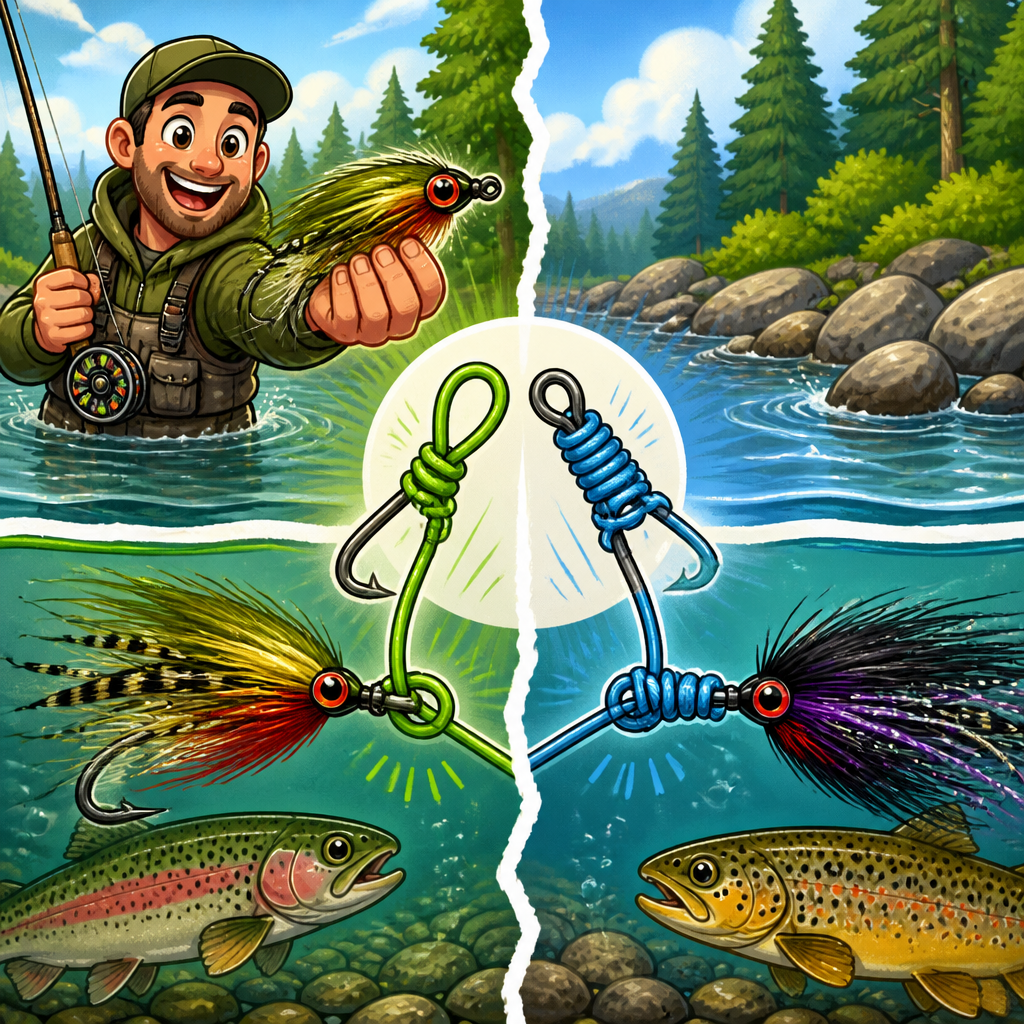
Choosing between a non-slip loop and a clinch knot for streamers changes more than terminal connection strength; it changes fly action, hookup mechanics, tippet wear, and how efficiently you fish through a full day on the water. In fly fishing basics, knot tying is not a side skill but a control point that affects presentation every cast. A streamer is a baitfish, leech, or larger aquatic imitation typically stripped through the water with motion, so the knot at the eye becomes part of the fly’s design. A clinch knot cinches tight to the eye and creates a fixed connection. A non-slip loop, often tied as the non-slip mono loop, leaves a small loop ahead of the eye and lets the streamer articulate more freely. That simple structural difference explains why anglers see changes in swing, jig, tracking, snag resistance, and even confidence. I have fished both knots across trout rivers, warmwater banks, and saltwater flats, and the pattern is consistent: the right knot depends on fly type, line class, current speed, and the specific behavior you need from the fly.
This article serves as the knot tying hub within fly fishing basics by explaining not only which knot to choose for streamers, but also how to think about knot function across the wider system. Good knot tying means understanding materials, eye geometry, tippet stiffness, knot strength, ease of inspection, and the tradeoff between freedom of movement and control. It also means knowing where each knot fits among other essentials such as the improved clinch, Davy, Orvis, perfection loop, surgeon’s knot, blood knot, and loop-to-loop connections. For streamers specifically, the non-slip loop versus clinch knot question matters because streamers are retrieved flies. They accelerate, pause, and change direction under tension, so any restriction at the eye alters what fish see. If you want a direct answer, here it is: use a non-slip loop when you want maximum action and a clinch knot when you want a compact, direct, fixed connection. The rest of the decision comes from conditions, fly construction, and your tolerance for retying.
Why the Knot Changes Streamer Behavior
The core difference is mechanical. A clinch knot seats against the hook eye, fixing the tippet at one point. That makes the pull angle more consistent and limits how far the fly can pivot. On slim streamers, balanced baitfish patterns, and weighted sculpins, this often produces a straighter track. A non-slip loop creates a hinge in front of the eye. On the strip, pause, and swing, the fly can yaw and kick with less restriction. In real fishing, that usually means more side-to-side movement at slow strip speeds and a livelier hang on the pause. If you have ever switched a conehead bugger from a clinch to a loop and watched it breathe more in the margin, you have seen the effect immediately.
That extra movement is not automatically better. Streamers with wide heads, articulated shanks, deer-hair collars, or large dumbbell eyes already create substantial action. Add a loop knot, and some patterns become too loose, rolling on the retrieve or fouling more often around the hook bend. By contrast, a fixed clinch can calm the fly and help it track true. I see this often with longer synthetic baitfish on sinking lines. In fast current, a loop knot can exaggerate wandering, while a clinch preserves a tighter line of pull and cleaner depth control. The change is subtle in hand and obvious underwater.
Hydrodynamics explain the result. Water pressure hits the face, body, and materials of the streamer, then transmits force through the knot to the leader. A fixed knot reduces degrees of freedom, so water pressure must move the whole fly along a narrower path. A loop allows the eye to move inside the loop arc, so the same pressure can rotate the fly farther before tension checks it. This matters most at low to moderate retrieve speeds, on pauses, and in cross-current swings where the fly is repeatedly loading and unloading tension.
When a Non-Slip Loop Is the Better Choice
A non-slip loop is usually best when the goal is animation. Unweighted streamers, rabbit-strip leeches, lightly weighted baitfish, small single-hook saltwater streamers, and sparse trout patterns often look more natural on a loop. The fly can breathe during pauses instead of freezing in line with the tippet. That matters in cold water, post-front conditions, or pressured fisheries where fish follow but hesitate. A loop also helps smaller streamers move at slower strip speeds, which is useful when trout are keyed on injured minnows rather than fleeing bait.
In practical terms, I reach for a non-slip loop in three situations. First, when fishing bank structure with short strips and long pauses, because the pause triggers takes and the loop preserves movement right then. Second, when using floating or intermediate lines over shallow flats or shoals, where subtle action matters more than aggressive jigging. Third, when the streamer itself is sparse and mobile, such as marabou, rabbit, craft fur, or soft hackle materials. These materials already pulse, and the loop lets them do the work without overdriving the fly.
The non-slip mono loop also has a reputation for strong breaking strength when tied correctly. Many anglers trust it in heavier tippet because the knot does not jam down on the eye in the same way a clinch does. With fluorocarbon, especially stiffer diameters, that can be an advantage. The caveat is that the knot must be dressed and tightened carefully. If the overhand base is uneven or the tag wraps cross, the loop can slip or seat poorly. Precision matters more than speed.
When a Clinch Knot Makes More Sense
A clinch knot makes sense when you want direct contact, compactness, and simplicity. On weighted streamers, jig hooks, coneheads, and flies that already have built-in articulation, a fixed connection often improves control. The fly responds immediately to the strip because there is no loop to absorb the first bit of force. That can sharpen a jigging motion, help maintain a desired running depth, and reduce the wandering path that sometimes causes fouling. For many trout anglers fishing sink-tip lines, that directness is valuable because depth and line angle are everything.
The clinch is also practical in cold weather, low light, and frequent retie situations. If you are changing flies often, tying on small streamers with cold hands, or working from a drift boat where speed matters, a standard or improved clinch is simply faster for most anglers. It is easier to inspect too. A clean clinch seated against the eye gives an immediate visual check: stacked wraps, snug finish, trimmed tag. A loop knot needs the right loop size and symmetry, so there is one more variable to judge.
There are material limits to remember. Traditional clinch knots can be less reliable in very heavy mono or hard fluorocarbon, and they are not ideal with large wire diameters or slick coatings. In those cases, many anglers move to the improved clinch, Orvis knot, or a uni-style terminal knot. Still, within typical trout streamer tippet sizes, the clinch remains a standard because it is compact, easy to tie, and predictable. If your fly is tracking well and fish are eating, there is no performance prize for changing knots just because a loop is fashionable.
Direct Comparison: Action, Strength, and Efficiency
The easiest way to choose is to compare the outcomes that matter most on the water. The table below summarizes the real changes anglers notice when switching between a non-slip loop and a clinch knot for streamers.
| Factor | Non-Slip Loop | Clinch Knot |
|---|---|---|
| Fly action | Maximum freedom and better motion on pauses | More restrained, straighter tracking |
| Depth control | Slightly less direct on the initial strip | More immediate pull and often better depth discipline |
| Fouling risk | Can increase on long or soft patterns | Usually lower on streamlined retrieves |
| Ease of tying | Moderate; demands careful dressing | Easy and fast for most anglers |
| Inspection | Need to confirm loop size and knot seating | Simple visual check at the eye |
| Best use | Sparse, mobile, pause-oriented streamer fishing | Weighted, articulated, or control-oriented streamer fishing |
Strength comparisons always depend on line type, knot quality, and testing method, so blanket percentages should be treated carefully. In field use, both knots are strong enough when tied properly within their intended range. Failure is more often caused by burn from poor lubrication, crossed wraps, damaged tippet, or repeated stress after multiple fish and snags. I replace tippet sooner with loop knots not because the knot is weak, but because the loop section sees repeated flex and I want a fresh connection before a big fish exposes fatigue.
Efficiency matters too. If a knot takes longer to tie and you hesitate to retie after a rough fish or a rock hang, your system becomes less reliable. Many anglers lose fish because they stick with a compromised knot. That is why the best knot is not just the theoretically strongest or most active one. It is the one you can tie correctly, inspect quickly, and trust enough to replace without delay.
How This Fits Into Knot Tying Basics
As a hub for knot tying within fly fishing basics, this comparison only makes sense when placed in the larger system. Terminal knots attach fly to tippet. Joining knots connect tippet sections, such as blood knot, double surgeon’s knot, or tippet ring connections. Loop knots create movement or modularity, including the non-slip loop and perfection loop. Good anglers know where each belongs. You do not solve every problem with one knot; you build a toolkit. For a beginner, that toolkit can start with five knots: improved clinch or Orvis for terminal connections, non-slip loop for streamers, double surgeon’s for joining, perfection loop for loop-to-loop systems, and a nail knot or welded-loop connection at the fly line interface.
The teaching sequence matters. I have found that anglers learn faster when they first understand what the knot is supposed to do mechanically. A clinch is for direct attachment. A loop is for freedom of movement. A surgeon’s knot is for quick line joining. Once function is clear, memorizing steps becomes easier. Tools can help, but they are not a substitute for repetition. Nippers with a knot tool, tying apps from brands like Orvis, and manufacturer diagrams from Rio or Scientific Anglers are useful references, yet the real benchmark is being able to tie the knot standing in current, in wind, with cold fingers.
Knot testing should also be part of basics. After tying any streamer knot, pull firmly with steady pressure before fishing. Watch for curl, slippage, or seating changes. If the tag creeps, retie. If the fluorocarbon turns white at the bend, you generated too much heat or stress; cut it off. These simple checks prevent most terminal failures and build habits that carry into every area of fly fishing.
Best Practices for Streamer Knots in Real Conditions
Use loop size intentionally. A non-slip loop should be small enough to control the fly and large enough to allow articulation. Oversized loops invite fouling and reduce precision. Match knot to fly design. Sparse patterns benefit most from loops, while articulated or heavily weighted patterns often do better with a fixed clinch. Match knot to leader material too. Softer nylon tends to tie forgiving clinch knots, while stiffer fluorocarbon often rewards careful dressing and slower tightening. Always lubricate before cinching. Water or saliva reduces friction heat that weakens mono and fluorocarbon at the point of highest stress.
Check the hook eye. Cheap hooks, painted eyes, and slightly burred eyes can cut tippet or prevent clean seating. I run the tippet through and feel for abrasion before committing a knot, especially on jig streamers and budget saltwater patterns. Retie after fish, hard snags, or obvious eye damage. Streamer fishing applies repeated shock loads because strips, stops, and aggressive takes all create dynamic tension. Even a good knot degrades under that cycle.
One final rule is often missed: let fish response decide. If follows increase but eats do not, a loop knot may add life without changing the fly. If your streamer is rolling, fouling, or missing the intended depth lane, switch to a clinch before changing the entire setup. Knot choice is a small adjustment with outsized effects, which makes it one of the most efficient refinements in streamer fishing.
Non-slip loop versus clinch knot for streamers is ultimately a choice between movement and control, not a contest to declare one universal winner. The non-slip loop gives a streamer more freedom, especially on pauses and slower strips, which often helps sparse baitfish, leech, and rabbit patterns look alive. The clinch knot fixes the connection at the eye, which improves tracking, depth discipline, and tying speed, especially on weighted or already-articulated flies. Both are essential skills within fly fishing basics, and both belong in any serious knot tying toolkit.
The broader lesson is that knot tying is functional, not ceremonial. Every knot in your system should solve a specific problem: joining materials, creating movement, preserving strength, or making streamside changes faster. When you understand that purpose, your choices become simpler and your presentations become more consistent. Start by mastering the clinch, improved clinch, and non-slip loop, then build outward into joining knots and loop connections as your fishing expands.
If you want better streamer results without buying new lines, rods, or flies, practice these two knots until you can tie them cleanly every time, then fish each one deliberately and watch how the same pattern behaves. That small experiment will teach you more about streamer control than a dozen gear changes, and it will improve every part of your knot tying foundation.
Frequently Asked Questions
1. What is the biggest practical difference between a non-slip loop and a clinch knot when fishing streamers?
The biggest real-world difference is how each knot lets the streamer move. A non-slip loop leaves a small open loop at the hook eye, which gives the fly more freedom to swing, pivot, dart, and track naturally during the strip. That extra articulation can make a streamer look more alive, especially patterns meant to imitate baitfish, sculpins, or leeches. A clinch knot, by contrast, cinches tight to the eye and creates a more fixed connection. That tends to limit some of the fly’s independent motion and can make the action slightly more direct and restrained.
That does not automatically mean a loop knot is always better. In some situations, the controlled connection of a clinch knot is useful. If you want the fly to track straighter, ride in a more predictable line, or respond with less wander in heavy current, a clinch knot can help. With weighted streamers, jig-style patterns, or flies that already have a built-in action from materials and design, the difference may be noticeable but not always dramatic. With sparse baitfish patterns, articulated streamers, and unweighted or lightly weighted flies, the added movement from a non-slip loop is often much easier to see.
There is also a fishing-efficiency angle. Because the knot changes how the fly behaves, it changes how you fish it. A loop knot often rewards pauses, short strips, and erratic retrieves because the fly has room to kick and turn. A clinch knot often favors a cleaner, more linear presentation. So the practical difference is not just “one knot is stronger” or “one knot is looser.” It is that each one changes presentation, response, and the overall personality of the streamer in the water.
2. Does a non-slip loop actually improve streamer action enough to matter to fish?
Yes, often enough that many experienced streamer anglers treat it as a meaningful choice rather than a minor detail. A streamer is not a dead drift fly. It is usually moved, stripped, swung, pulsed, or paused to suggest life. Since the knot sits at the exact point where the fly connects to the leader, it directly affects how freely the pattern can react to current and retrieve speed. A non-slip loop creates a hinge-like connection, and that small freedom can help the fly slide sideways, kick on the pause, or roll more naturally at the end of a strip. Those little changes are often what make a streamer look vulnerable instead of mechanical.
How much it matters depends on the pattern and the conditions. With articulated flies, marabou streamers, rabbit-strip patterns, and slim baitfish imitations, a loop knot can noticeably enhance the action because these flies are designed to breathe and move. In clear water, pressured fisheries, or colder conditions where fish inspect a fly more closely, that improved movement can make a real difference. In fast, stained water where fish are reacting more than inspecting, the action boost may still help, but it may be less important than depth, speed, and where the fly lands.
It is also worth remembering that “better action” does not mean “wilder action” in every scenario. Fish do not always want a fly that darts unpredictably. Sometimes they prefer a steady, straightforward retrieve. In those moments, a clinch knot’s tighter connection can be an advantage because it reduces extra swing and keeps the fly tracking with more discipline. So yes, the action difference matters, but the best knot is situational. The non-slip loop matters most when you want the streamer itself to contribute more lifelike motion with minimal input from the angler.
3. How do these knots affect hookups, landing fish, and overall knot reliability?
Hookups and reliability are influenced by more than raw break strength. A clinch knot is popular because it is compact, familiar, and quick to tie. When tied correctly and seated well, it is dependable and efficient. Many anglers trust it because it is simple to inspect and easy to reproduce consistently, even in poor light or cold weather. A non-slip loop can also be very strong, but it depends more on clean tying, proper tag management, and correct tightening. If rushed or tied carelessly, a loop knot is easier to get wrong than a standard clinch or improved clinch.
On the hookup side, the differences are subtle but real. A loop knot can allow the fly to move more freely during the take, which some anglers feel improves the way a fish engulfs a streamer, especially on side-swiping or following eats. Because the fly is not pinned rigidly at the eye, it may enter the fish’s mouth with a slightly more natural angle. On the other hand, some anglers prefer the direct feel of a clinch knot because the connection is tight and immediate. That can make the fly feel more “connected” during the strip-set, especially with short-line presentations or aggressive retrieves.
When fighting fish, both knots can perform extremely well if tied properly in material suited to the fly size and target species. The main reliability concerns are different. With clinch-style knots, slippage can become a problem in some very slick modern tippet materials, especially if the knot is not well lubricated and fully seated. With non-slip loop knots, the main issue is user error: incorrect turns, poor alignment, or a loop left too large or too small. In practical terms, the best knot for landing fish is the one you can tie perfectly every time. For many anglers, that means using a non-slip loop when fly action matters most and switching to a clinch knot when speed, simplicity, and consistency are the bigger priorities.
4. Which knot causes more tippet wear, twisting, or leader problems over a full day of streamer fishing?
Over a full day, the knot choice can influence leader fatigue and line management more than many anglers expect. A non-slip loop allows more fly freedom, which is often an advantage, but that extra movement can also mean the fly has more opportunity to torque, kick, and twist during aggressive strips, hard casts, or when throwing wind-resistant patterns. If you are fishing bulky streamers, coneheads, or articulated flies, that freer connection can contribute to more leader twist over time, especially if your casting stroke already introduces tailing loops or shock into the leader system.
A clinch knot generally creates a more fixed and stable tie-in point, which can reduce some of that extra rotational behavior. That does not eliminate twist, because twist often begins with casting mechanics, fly design, or retrieve style, but it can make the whole system feel a little tidier. The leader may track more cleanly, particularly with heavier flies and shorter, punchier streamer leaders. For anglers making hundreds of casts in wind, that added stability can reduce tangles and save time.
Tippet wear is another issue. With a clinch knot, the wear point is concentrated right at the eye where the knot seats firmly. With a loop knot, the material can experience stress differently because the loop remains mobile and the knot structure itself is more complex. That does not necessarily make it weaker, but it does mean inspection matters. After repeated strikes, bottom contact, or fish landed, a loop knot should be checked for abrasion and deformation. In practice, neither knot is automatically harder on tippet in every setting. The bigger lesson is that streamer fishing puts repeated dynamic load on the terminal connection, so whichever knot you choose, you should retie more often than you might when fishing smaller flies. Over a long day, the angler who checks frequently and reties before failure will usually fish more efficiently than the one relying on a single knot from dawn to dark.
5. When should I choose a non-slip loop, and when is a clinch knot the smarter option?
Choose a non-slip loop when you want maximum fly freedom and when the pattern benefits from independent movement. That usually includes baitfish imitations, leech patterns, rabbit-strip streamers, marabou flies, and many articulated designs. It is especially useful when you want the fly to come alive on the pause, swing naturally at the end of the drift, or show more side-to-side motion during short strips. If fish are following but not committing, changing from a fixed knot to a loop knot can be one of the simplest ways to alter the streamer’s behavior without changing the fly itself.
Choose a clinch knot when you want efficiency, simplicity, and a clean, compact terminal connection. It is a smart option for anglers who retie often, fish in cold weather, or need a knot they can tie quickly and confidently under pressure. It can also be the better choice when using flies that already have strong built-in action or when you want a more controlled, straight-tracking retrieve. In heavy current, around structure, or while throwing larger weighted streamers, that tighter connection can make the fly feel more predictable and easier to manage.
The smartest approach is not to treat one knot as universally superior. Think of knot choice as part of fly design and presentation. If your goal is animation, choose the non-slip loop. If your goal is control and convenience, choose the clinch knot. Many skilled streamer anglers use both and switch based on pattern, water type, fish mood, and how the day is unfolding. That is really the core answer to what