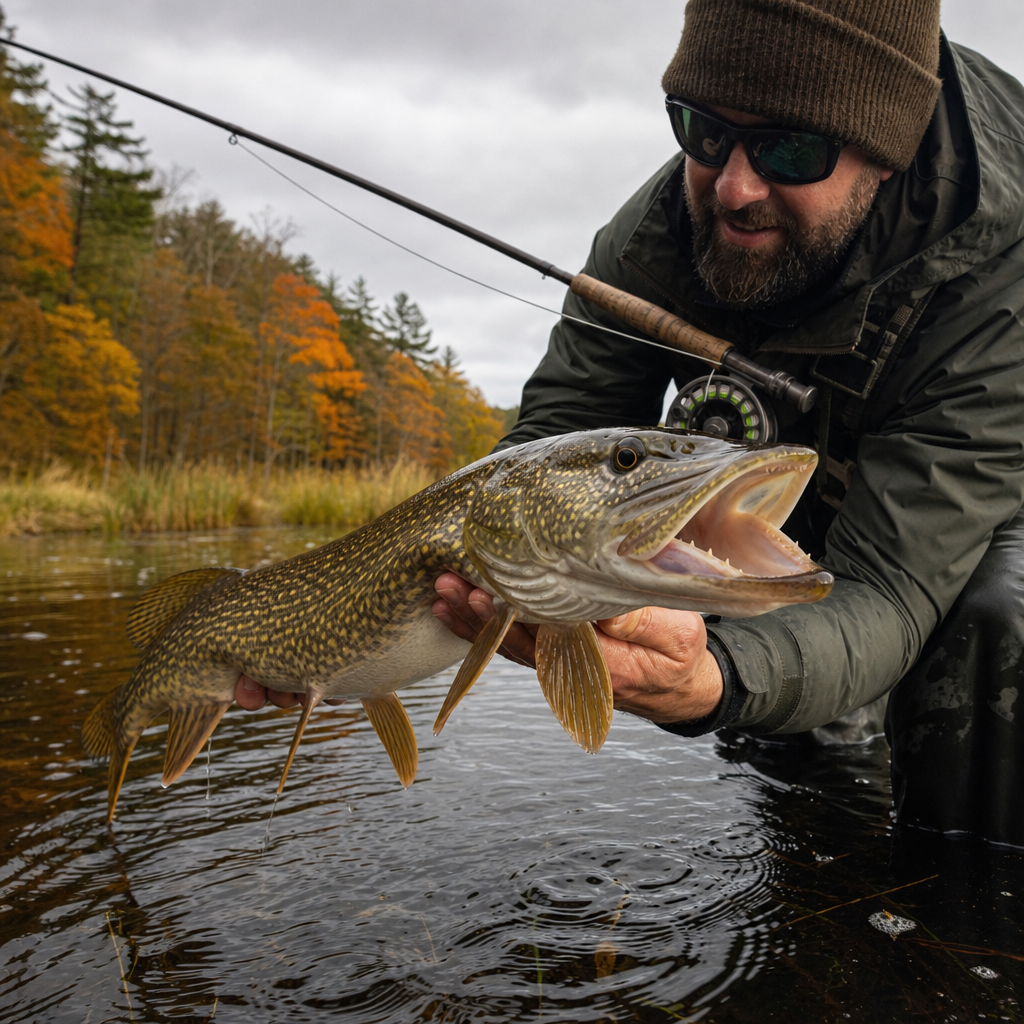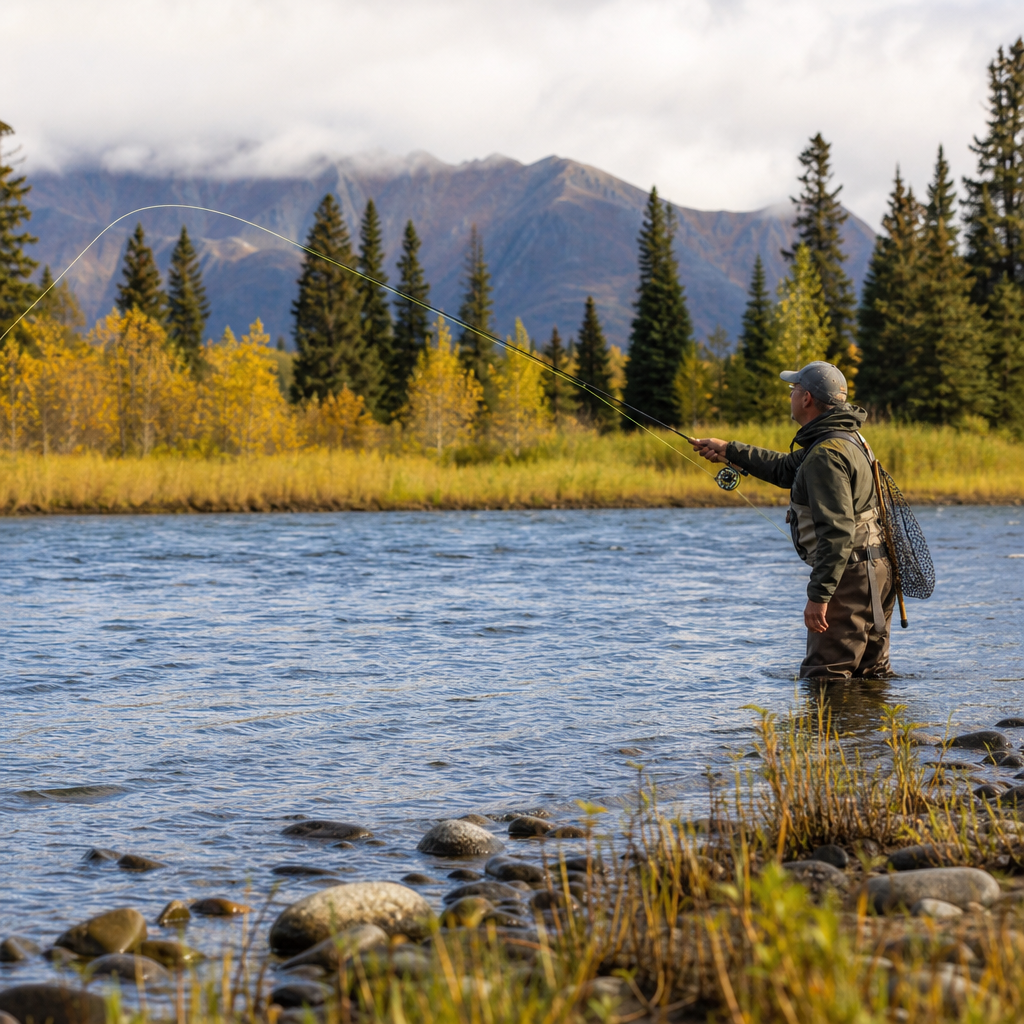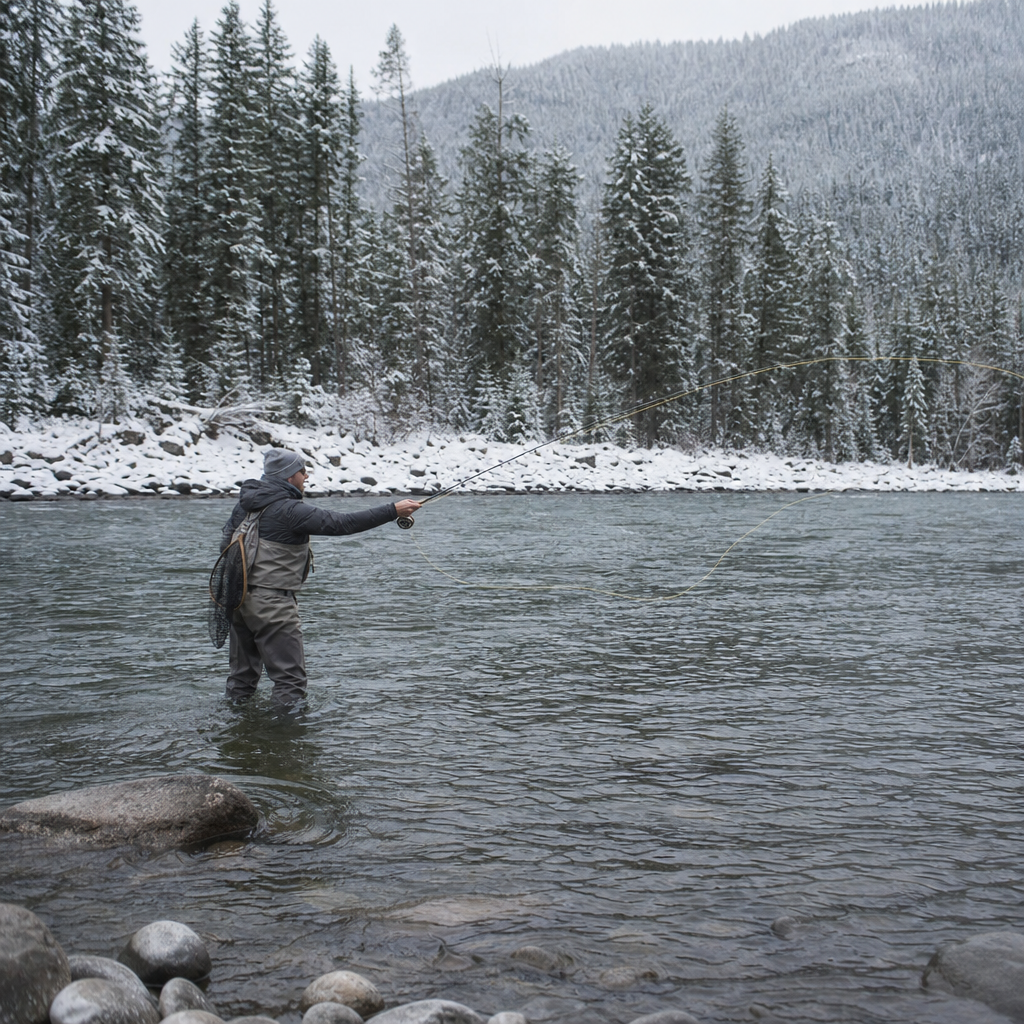
Winter fly fishing for steelhead demands patience, precise presentation, and a clear understanding of how cold water changes fish behavior. In this season, steelhead hold differently, travel on narrower temperature windows, and often reward anglers who slow down, fish deeper, and cover classic holding water methodically. Winter fly fishing refers to pursuing fish during the coldest months, usually when water temperatures fall into the upper 30s and 40s, flows rise with rain or snowmelt, and daylight shrinks. Steelhead are migratory rainbow trout that return from the ocean to freshwater rivers, and winter runs are especially valued because they enter systems during harsh conditions, often in powerful, chrome-bright condition.
I have spent enough winter days swinging sink tips through green tailouts, nymphing soft seams under freezing guides, and hiking muddy access trails to know that success rarely comes from random casting. It comes from reading current speed, depth, water clarity, and holding structure with discipline. A productive winter steelhead angler understands where fish rest, how presentation changes between 38-degree and 45-degree water, and why river sections that seem lifeless can suddenly produce after a minor drop in flow. This matters because winter is one of the most technical and misunderstood periods in fly fishing. Many anglers quit too early, fish too fast, or ignore the exact kinds of runs steelhead prefer when cold conditions reduce their willingness to move.
As a hub page for winter fly fishing, this article covers the core techniques, gear choices, river conditions, and locations that consistently matter most. It also answers the questions anglers usually ask first: where do winter steelhead hold, what flies work, when should you swing versus dead drift, and which rivers are worth traveling to in the Pacific Northwest and Great Lakes regions. If you understand those fundamentals, every linked topic under seasonal conditions becomes easier to apply on the water.
How Winter Conditions Change Steelhead Behavior
Winter steelhead are governed by water temperature, river height, oxygen, and migration timing. In cold water, a steelhead often conserves energy by holding close to the bottom and near softer current cushions beside stronger flow. That is why bucket water, walking-speed runs, ledge drops, tailout troughs, inside seams, and boulder-softened lanes become high-percentage targets. In practical terms, fish that might move several feet to a summer fly may move only inches in 39-degree water. Your fly therefore needs to arrive closer to the fish and stay in the strike zone longer.
Water clarity also shapes behavior. On glacially tinted or rain-swollen rivers, steelhead may feel secure enough to hold in surprisingly shallow walking-speed water. In clear, low winter flows, they often slide into depth, structure, or shade and become notably less willing to chase. A one-foot drop in river level after a storm can create a major window because fish that were previously moving now settle into identifiable holding lies. Barometric pressure matters less than many anglers think; stable flows and manageable clarity are usually the stronger predictors of fishability.
Travel timing varies by river. Some systems receive early winter fish in late fall, while others peak from January through March. Wild winter steelhead in coastal systems often enter during rain events and pause in travel when flows crash or temperatures fall sharply. Hatchery fish can concentrate near access points and terminal sections, but wild fish distribute through broader habitat. Understanding that distinction helps you choose water logically instead of chasing crowds.
Best Winter Fly Fishing Techniques for Steelhead
The two foundational methods are swinging flies and dead-drifting nymph or egg patterns. Swinging shines when fish are aggressive enough to track a moving fly across current, especially in 41- to 47-degree water, stable green flows, and classic runs with even depth and speed. A controlled swing with a Skagit head, sink tip, and intruder-style fly lets you cover water efficiently. The key is angle and pace. Cast slightly across, mend to establish depth, then allow the fly to fish broadside without ripping unnaturally fast. In colder water, smaller swings, slower pace, and tips that maintain depth through the middle third of the run consistently outperform a fast, shallow presentation.
Dead drifting is often the higher-percentage tactic when water is very cold or fish are holding in compact slots. Indicator nymphing, tight-line approaches with weighted flies, and short-line presentations from a boat all produce because they keep the fly near bottom for a prolonged period. Egg patterns, stonefly nymphs, jig-style flies, and sparsely tied baitfish imitations work when balanced with enough weight to tick substrate occasionally. If you are not touching bottom at all, you are usually fishing above winter steelhead.
The best anglers switch methods according to temperature and holding water rather than personal preference. I often start with a swung fly in broad tailouts and transition to indicator rigs in deeper slots or when the thermometer stays below 40 degrees through midday. That flexibility matters more than loyalty to one style.
| Condition | Best Technique | Typical Setup | Why It Works |
|---|---|---|---|
| Stable green water, 42 to 47 degrees | Swinging | Two-hand rod, Skagit head, 10 to 12 foot T-8 or T-11 tip, intruder or tube fly | Covers broad holding water and triggers traveling or responsive fish |
| Cold water below 40 degrees | Dead drift | Indicator rig, split shot or tungsten flies, egg or stonefly pattern | Keeps the fly in the strike zone longer near the bottom |
| High slightly colored flows | Short controlled swing | Heavier tip, larger profile fly in black, blue, or purple | Improves visibility and slows presentation in softer edges |
| Clear low winter water | Light nymphing or subtle swing | Longer leader, smaller fly, reduced splash and tighter casting angle | Protects against spooking fish in soft, transparent conditions |
Rods, Lines, Leaders, and Flies That Actually Matter
For most winter steelhead rivers, a two-hand rod between 12 feet 6 inches and 13 feet 6 inches in 6- to 8-weight covers the widest range of swinging situations. Shorter switch rods around 11 feet are excellent on smaller coastal systems with overhanging brush, while a 13-foot 7-weight remains the all-around workhorse. Matching the rod with a Skagit head allows efficient casting of heavy sink tips and bulky winter flies. Common tip choices include T-8, T-11, and T-14, selected according to depth, current speed, and fly size. In slow three- to six-foot walking-speed water, T-8 may be ideal. In heavier slots, T-11 or T-14 holds the line down better.
For nymphing, a 10-foot 7-weight single-hander or a versatile switch rod gives line control and fish-turning authority. Leaders are usually short and practical. On swung rigs, many anglers fish three to five feet of 10- to 15-pound Maxima or fluorocarbon tippet off the sink tip. On indicator rigs, leader formulas vary, but the principle stays fixed: enough butt strength to turn over weight, enough tippet finesse to drift naturally, and enough total depth to place flies near bottom without constant snagging.
Fly choice matters less than depth and presentation, but certain winter patterns earn their reputation for a reason. Intruders in black, blue, purple, pink, and cerise remain standards because they show profile in colored water and create movement with minimal bulk. Marabou tubes, rabbit-strip leeches, and sparse spey-style flies all produce. For dead drifting, beads, glo bugs, stonefly nymphs, woolly buggers under indicators, and jig flies with tungsten slotted beads are dependable. In clear water, smaller and sparser generally outfishes oversized patterns. In dirty water, silhouette and contrast beat fine detail every time.
Reading Winter Water and Covering Runs Efficiently
If there is one skill that separates consistent winter steelhead anglers from occasional success, it is reading holding water correctly. Steelhead seek a blend of security and efficiency. That usually means moderate current, nearby depth, and a stable cushion where they can hold without burning energy. Productive winter lies include the inside edge of a tailout trench, the walking-speed seam below a ledge, the softer band beside a heavy midriver chute, and the drop where a riffle pours into a bucket. Fish often stack in slots that look unremarkable until you map the current carefully.
When swinging a run, step at a pace matched to your sink rate and current speed. In cold water, most anglers move too quickly. If your fly has not fully fished the hang-down and lower seam, you are leaving fish behind. Mend immediately after the cast when needed, but avoid repeated mends that lift the fly. With dead-drift rigs, start short, achieve depth, and extend gradually. Good winter nymphing is controlled, not frantic. The drift should look boring to the angler and natural to the fish.
Boat anglers have an advantage on larger rivers because they can probe every shelf and slot with short drifts, but bank anglers can be just as effective by focusing on proven access water at the right height. Watch where experienced locals stop. If several anglers repeatedly fish one walking-speed seam below a broad gravel bar, there is usually a structural reason, not superstition.
Top Winter Steelhead Regions and Rivers
The Pacific Northwest remains the center of winter steelhead fly fishing because it combines strong run timing, suitable river gradients, and a culture built around migratory fish. In Washington, the Olympic Peninsula rivers, including the Hoh, Sol Duc, Bogachiel, and Queets, are widely known for wild winter fish and rain-driven conditions. These rivers often fish best when dropping into green shape after storms. They reward anglers who understand heavy wood, soft edges, and constantly changing gravel bars.
Oregon offers classic options such as the North Umpqua in select winter periods, the Sandy, the Clackamas, the Wilson, and the Nestucca. Coastal streams can be short-window fisheries, but those windows can be excellent when water clears to two to four feet of visibility. The Deschutes is more famous for summer steelhead, yet seasonal context matters because many anglers use winter to refine sink-tip and swing discipline on other waters before prime summer runs.
British Columbia has legendary steelhead rivers, but many winter opportunities are limited by climate, regulations, and timing compared with fall systems. In the Great Lakes, New York’s Salmon River, Pennsylvania tributaries, and Ohio streams provide a different model of winter steelheading. Fish are often resident in tributaries through winter, and dead-drift techniques with eggs, nymphs, and streamers dominate. These fisheries can be highly productive, but they demand close attention to special regulations, seasonal closures, and crowds near popular access sites.
No destination should be chosen without reviewing current regulations, wild fish handling rules, and access status. Rules change often, especially around native steelhead protection, bait restrictions, and emergency closures tied to flows or temperature. Responsible trip planning is part of successful winter fly fishing.
Safety, Ethics, and Seasonal Strategy
Winter rivers are dangerous in ways summer anglers often underestimate. Cold shock, slippery cobble, rising water, and limited daylight can turn a routine outing into a rescue scenario. Studded boots, a wading staff, layered insulation, and a dry bag with spare gloves are not luxuries. They are standard equipment. I also treat every coastal river crossing as temporary; a morning route can become unsafe after upstream rain, even if the local sky stays clear. Checking USGS gauges before and during the day is one of the simplest habits that prevents bad decisions.
Ethics matter even more in winter because many fisheries depend on fragile wild runs. Keep fish in the water, use strong enough tackle to shorten fights, and avoid repeated pressure on visible spawners or fish holding in extremely low water. On crowded rivers, run etiquette is straightforward: enter at the top, fish through at a shared pace, and do not jump ahead of anglers already working the seam. Nothing ruins winter steelhead water faster than chaos in limited holding water.
A strong seasonal strategy is to fish around trends, not hopes. The best days often come on the drop after a rise, during moderate warming, or when visibility improves from unfishable to green. Plan around those windows, keep both swing and nymph gear ready, and accept that winter steelheading is a game of few chances. One grab all day can still validate every careful decision.
Winter fly fishing for steelhead is challenging because the fish are mobile, the water is cold, and conditions change fast, but that difficulty is exactly what makes the pursuit so compelling. The anglers who do best are not necessarily the ones who cast farthest or own the most gear. They are the ones who understand how winter flows position steelhead, how temperature changes presentation, and how to match technique to the exact water in front of them. Swing broad, stable runs when fish are willing to move. Dead drift deeper slots when cold water pins them near bottom. Prioritize depth, pace, and clean coverage over constant fly changes.
The most useful winter steelhead locations share the same core ingredients: migratory fish, manageable access, reliable flow windows, and holding water with moderate current and nearby depth. Whether you fish Olympic Peninsula rivers, Oregon coastal systems, or Great Lakes tributaries, the process stays consistent. Watch gauges, study clarity, respect regulations, and arrive with a plan flexible enough to change by the hour. That is how winter fly fishing becomes repeatable instead of random.
Use this hub as your starting point for the broader winter fly fishing topic, then build outward into river-specific tactics, gear systems, and seasonal condition guides. If you want more success this winter, begin by simplifying your approach: find green water, slow down, fish deeper, and cover proven holding lies thoroughly.
Frequently Asked Questions
What changes in steelhead behavior during winter, and how should that affect your fly fishing approach?
Winter changes steelhead behavior in ways that directly influence how anglers should present a fly. As water temperatures drop into the upper 30s and 40s, steelhead generally become less willing to move long distances to intercept a fly. Instead of chasing aggressively, they often settle into slower, softer holding water where they can conserve energy while still staying close to travel lanes. That means anglers usually need to fish more deliberately, more slowly, and much closer to the fish than they might in warmer conditions.
In practical terms, this is why winter steelheading often becomes a game of depth, speed control, and thorough water coverage. Productive presentations usually involve getting the fly down near the fish and keeping it there long enough for a response. Whether you are indicator nymphing, tight-line dead drifting, or swinging sink tips and intruders, the goal is the same: put the fly in the fish’s narrow window and let it stay in that zone. Fast, shallow presentations that might trigger fish in fall conditions often become far less effective in winter.
Another important change is where fish hold. Winter steelhead commonly stack in classic holding water such as tailouts of deep pools, walking-speed runs, seams beside heavier current, inside bends, and softer slots behind structure. They often avoid wasting energy in fast, turbulent water unless conditions are warming or flows are changing in a favorable way. As a result, anglers who methodically cover proven holding water and make repeated, well-controlled drifts usually outperform those who move too quickly from run to run.
Patience matters more in winter than in almost any other steelhead season. Fish may be present, but they are not always immediately responsive. Slow down, fish every likely lie thoroughly, and adjust your depth before changing flies excessively. In cold water, a small improvement in presentation often matters more than a dramatic fly change.
What are the most effective winter fly fishing techniques for steelhead?
The most effective winter fly fishing techniques for steelhead usually center on dead-drift presentations and controlled deep swings. Indicator nymphing is one of the most reliable methods because it allows precise depth control and repeated drifts through likely holding water. Common setups include weighted stonefly nymphs, egg patterns, worms, and smaller attractor nymphs fished beneath a strike indicator with enough split shot or weighted flies to reach near-bottom depth. In winter, being too shallow is one of the most common mistakes, so many experienced anglers adjust weight frequently until they are ticking bottom occasionally without constantly snagging.
Tight-line or contact nymphing can also be very effective in shorter drifts, softer seams, and pocketed holding water. This approach offers excellent strike detection and direct control over the fly, which can be important when winter takes are subtle. Rather than aggressive grabs, cold-water steelhead often produce hesitation, a slight pause, or a small change in leader movement. Anglers who stay connected and watch carefully often detect fish that others miss.
Swinging flies still has a strong place in winter steelheading, especially on rivers with classic swung-fly water and fish that respond well to broadside presentations. The key difference in winter is that swinging usually requires slower currents, deeper sink tips, and more restrained fly speed. Larger profile flies such as intruders, leeches, or rabbit-style patterns can help fish find the fly in cold, colored water, but presentation remains more important than pattern alone. A controlled swing through softer buckets, ledges, and tailouts often outfishes a fast, high swing through heavy current.
Whichever technique you choose, success usually comes from covering water methodically. Fish a run step by step, maintain consistent casting angles, and make changes based on depth and speed first. Winter steelhead are rarely everywhere in a river; they are usually concentrated in the most efficient holding water. Once you find the correct travel lane, depth, and pace, the pattern often repeats throughout the day.
Where are the best winter locations to find steelhead in a river system?
The best winter locations to find steelhead are usually the parts of a river that offer security, moderate current, and energy-efficient holding conditions. In cold water, steelhead commonly avoid long stretches of heavy, pushy current and instead settle into slower walking-speed runs, deep troughs, inside seams, transitional water below riffles, and tailouts where they can rest without expending unnecessary energy. These are the classic places to begin, especially after rain events or during stable winter flows.
Travel lanes are especially important. Winter steelhead still move through river systems, but they often do so along defined corridors where current speed, depth, and temperature are favorable. Look for water that connects one holding area to another rather than isolated dead water with no obvious movement. Fish may stack at the head of a pool, slide into a mid-run bucket, or hold along a soft seam beside a heavier tongue of current. In larger rivers, edges near structure, ledges, and depth changes can be especially productive because they combine current break, cover, and access to migrating pathways.
Water conditions should also guide location choices. During higher flows, steelhead often move closer to shore, into softer side channels, flooded margins, and protected inside bends where they can avoid the heaviest current. As flows drop and clear, they may settle into deeper, more defined holding lies. Temperature can matter just as much as level. Even slight warming trends, especially after a cold snap, can make certain sections of river more productive than others, particularly where tributary influence, groundwater input, or sun exposure creates marginally warmer conditions.
If you are choosing among multiple rivers or reaches, prioritize systems known for dependable winter runs, manageable flows, and access to classic holding water. Productive winter steelhead water rarely looks random. It usually has a clear combination of depth, pace, and structure. The more you learn to identify these winter-specific lies, the faster you can eliminate unproductive water and focus on places where fish are most likely to hold.
What flies, leader setups, and tackle work best for winter steelhead on the fly?
Winter steelhead tackle should match cold-water conditions that demand depth, control, and enough strength to manage large fish in heavy flows. For rods, many anglers prefer 7- to 8-weight single-hand or two-hand setups, depending on river size and technique. A switch rod or Spey rod is especially useful for covering broad runs with sink tips and swung flies, while a single-hand rod can be ideal for indicator fishing or shorter, more technical drifts. The best choice depends less on trend and more on the water you fish most often.
Fly selection should reflect visibility, profile, and presentation depth. Productive winter patterns often include egg flies, stonefly nymphs, jig-style leeches, worms, and attractor nymphs for dead-drift methods. For swinging, intruders, marabou tubes, rabbit strip flies, and leech patterns in colors such as black, purple, blue, pink, cerise, and orange are perennial producers. In clearer water, smaller and sparser flies can be more effective. In higher or more colored water, larger silhouettes and brighter accents can help fish locate the fly.
Leader and line setup are critical. For indicator nymphing, longer leaders with enough shot or weighted flies to reach the strike zone are often necessary, and the indicator should be adjusted constantly as depth changes. For swinging, a Skagit-style line paired with appropriately matched sink tips is common in winter because it allows anglers to fish heavier flies and get down effectively. Tippet strength is generally stronger than in trout fishing, often in the 8- to 15-pound range, depending on water clarity, fly size, and the size of fish present.
The biggest tackle mistake in winter is choosing a setup that cannot maintain depth and control. Fancy fly choices matter far less than presenting a fly at the right level and speed. If your rig is not consistently getting into the lower part of the water column where fish are holding, your chances drop sharply. Build your system around depth first, then refine fly size, color, and profile based on water clarity and fish response.
When are the best conditions and times to fish for winter steelhead?
The best winter steelhead conditions usually combine fishable flows, slightly improving water temperatures, and stable or slowly dropping river levels after a rise. Many anglers focus on dramatic weather, but winter steelhead often respond best when conditions settle into a manageable window. A river that is coming down and clearing after a storm can be excellent because fresh fish often enter and move during the rise, then become more reachable as visibility improves and holding water becomes easier to cover effectively.
Water temperature is one of the most important variables. Steelhead can certainly be caught in very cold water, but even a modest increase of a degree or two can improve fish activity. This is why late morning through midafternoon can often outperform first light during the coldest periods. As the day warms slightly, fish may become marginally more willing to adjust position or react to a well-presented fly. That does not mean early or late is unproductive, only that winter success is often tied more to temperature trends than to classic low-light assumptions.
Flow level and clarity also matter