Fly fishing is often described as a sport, a craft, and a way to pay attention, but it is also an ongoing series of ethical choices. Every angler decides how to approach fish, rivers, other people, and the habitats that make the experience possible. A personal code of ethics for fly fishing is a deliberate set of standards that guides those choices before, during, and after a day on the water. It turns vague good intentions into practical rules you can follow when conditions are difficult, pressure is high, or nobody else is watching.
In conservation and ethics, ethical fishing practices mean more than following local regulations. Regulations set the legal floor: seasons, bag limits, tackle restrictions, access rules, and protected species requirements. Ethics go further. They address questions that laws cannot fully answer, such as whether to fish during extreme water temperatures, how closely to approach another angler, when to stop targeting visibly stressed trout, whether to share a fragile location online, and how to balance personal success with stewardship. In my own seasons guiding and fishing heavily pressured trout, bass, and saltwater water, I have learned that the best days come when my decisions are shaped by restraint as much as skill.
This matters because fly fishing now sits at the intersection of recreation, social media, tourism, climate stress, and habitat decline. Trout streams face warming water, sedimentation, low flows, and crowding. Warmwater and saltwater fisheries face shoreline development, invasive species, pollution, and overuse. A strong personal code helps you reduce harm, fish more responsibly, and contribute to the long-term health of fisheries. It also improves your judgment. Ethical anglers usually become better anglers because they learn to read conditions, understand fish biology, respect access, and accept that leaving fish alone can be the right call. This hub article explains how to build that code and apply it across catch and release, fish handling, access, conservation, social conduct, and everyday decision-making.
Start with Purpose, Species Knowledge, and Local Context
The first step in developing a personal code of ethics for fly fishing is to define your purpose. Ask a plain question: what do you want your fishing life to stand for? For some anglers, the answer is harvest for food within sustainable limits. For others, it is catch and release focused on wild fish protection. For many, it is a mix that changes by species and place. Your code should state your priorities clearly. A useful starting point is this: protect the resource first, respect people second, and measure success by the quality of decisions rather than the number of fish landed.
Next, ground that purpose in fish biology and local regulations. Ethical fishing practices depend on the species in front of you. Wild trout in a freestone stream, stocked rainbows in a put-and-take pond, smallmouth bass on a summer river, and redfish on a grass flat do not face the same pressures. Learn spawning periods, temperature thresholds, handling sensitivity, migration patterns, and whether a fishery is wild, stocked, native, restored, or hatchery supported. Trout Unlimited, state fish and wildlife agencies, Keep Fish Wet, and local watershed groups provide reliable guidance. A code based on actual ecology is stronger than one based on image or tradition.
Local context matters just as much. Some rivers can handle moderate pressure; others are fragile and recover slowly. Tailwaters may fish well in summer because dam releases keep temperatures stable, while nearby freestones become unsafe for trout once water temperatures rise into the upper sixties Fahrenheit. In many trout fisheries, 68 degrees Fahrenheit is a common caution point, and 70 degrees can be a practical stop-fishing threshold because warmer water reduces dissolved oxygen and increases post-release mortality. Your code should include place-specific limits: when you will stop fishing, where you will not wade, and which waters you will avoid during spawning or low-flow periods.
Build Rules for Catch and Release That Reduce Mortality
Catch and release is not automatically harmless. When done poorly, it can injure fish through exhaustion, tissue damage, air exposure, and infection. When done well, it is a valuable conservation tool. A personal code of ethics for fly fishing should treat catch and release as a technical discipline, not a slogan. Commit to landing fish quickly with tackle matched to the species and water. Fighting a fish to total exhaustion on light gear may feel sporting, but it increases stress and can push fish past recovery, especially in warm water.
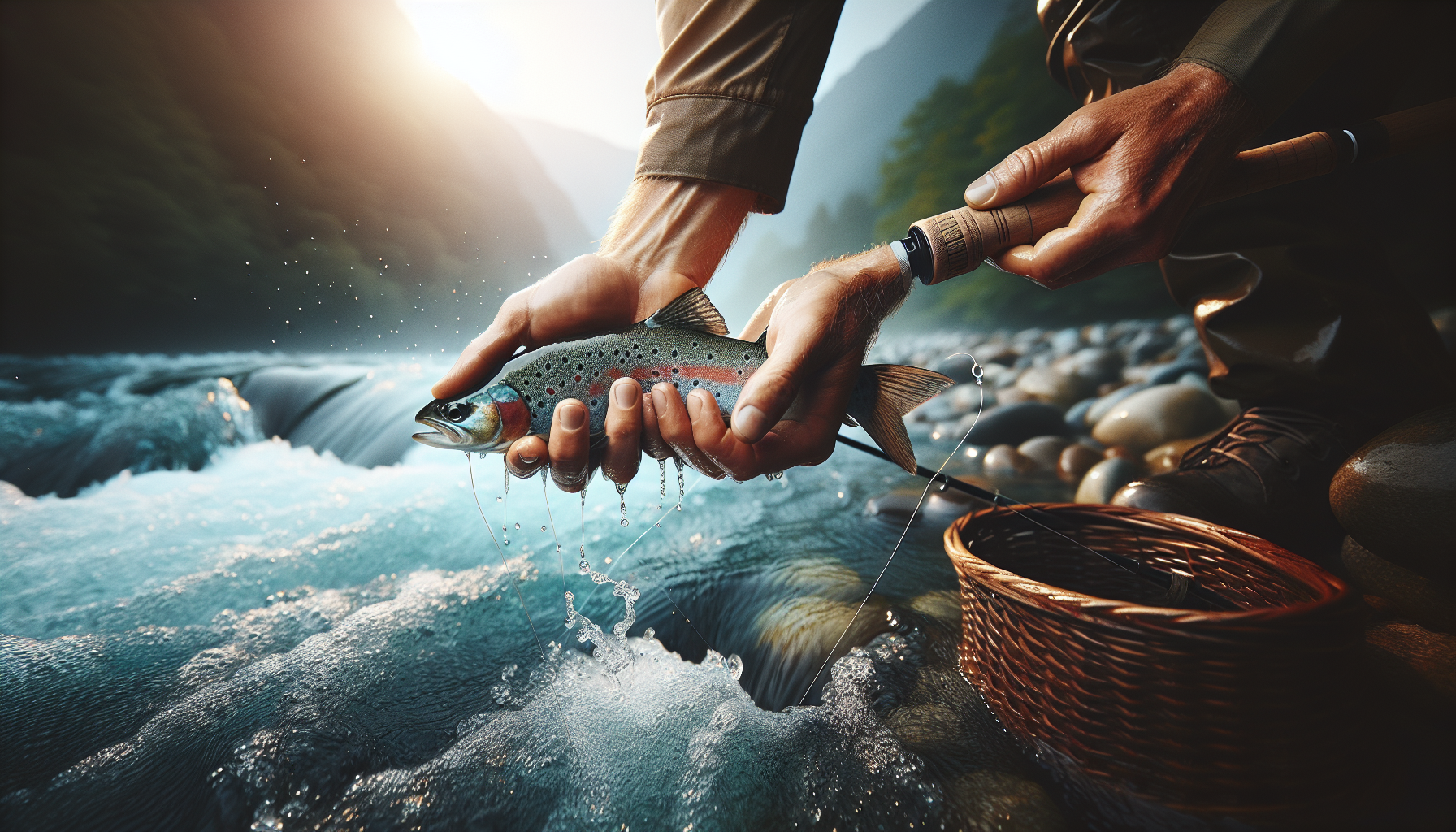
Use barbless or de-barbed hooks whenever regulations allow. They shorten handling time, reduce tearing, and make releases safer for fish and anglers. Keep fish in the water as much as possible. Scientific guidance from fisheries researchers and organizations such as Keep Fish Wet consistently points to air exposure as a major risk factor. If you want a photo, prepare before lifting the fish, support it gently, and keep total air exposure to a bare minimum. Wet your hands before touching fish, avoid squeezing, and never hold large fish vertically by the jaw unless the species and fishery clearly support that handling method. For trout, salmon, and char, horizontal support is the safer standard.
Your code should also cover landing tools and stopping points. A rubberized landing net is generally better than abrasive knotted mesh because it protects slime coat and fins. Cut the leader when a hook is deeply embedded rather than digging aggressively. Stop targeting fish when repeated captures show signs of stress, when water temperatures become unsafe, or when spawning fish are clearly visible on redds or nests. Ethical restraint is often situational. There are days when the right decision is not changing flies but walking away. That decision protects the fishery more than any release photo ever will.
Set Standards for Harvest, Selectivity, and Species Protection
Ethical fishing practices do not require universal catch and release. Responsible harvest can be fully consistent with conservation when it follows biological reality, local regulation, and common sense. A personal code should define when keeping fish is appropriate and when releasing fish is the better choice. In many systems, selective harvest of abundant hatchery fish can reduce pressure on wild stocks and provide excellent food. In others, especially fragile wild trout streams or native fish waters, release may be the only ethical option even if limited harvest is technically legal.
Think in terms of selectivity. Keep fish in sizes and numbers that the fishery can sustain, and release large breeding fish where they are important to population health. Know the difference between native, wild, stocked, and invasive species in your water. In some regions, harvesting certain nonnative species is encouraged to benefit native fish. In others, strict identification is essential because protected trout, char, or salmon may be mixed with legal species. If you cannot confidently identify the fish, your code should require release and no hero shots. Good ethics begin with humility.
Selective harvest also extends to where and when you fish. Avoid targeting fish concentrated in spawning runs or wintering pools simply because they are easy to catch. Legality is not the same as fairness or stewardship. Many experienced anglers use a simple test: would this decision still feel responsible if everyone on the river copied it for a month? If the answer is no, it probably does not belong in your code. Ethical fly fishing is scalable; it holds up when practiced by a community, not just by one careful person on a quiet day.
Respect Habitat, Access, and Other People on the Water
Most ethics problems in fly fishing are not about casting; they are about impact. Wading through spawning beds, trampling bankside vegetation, cutting fences, blocking launches, crowding runs, and posting precise access points to fragile water can do more harm than poor fish handling. A strong personal code sets rules for habitat protection and human respect. Stay on established trails where possible. Enter and exit the river at durable access points. Avoid walking on clean gravel in likely spawning areas. On spring creeks and small streams, even a few careless footsteps can collapse banks, damage vegetation, and increase erosion.
Access ethics deserve special attention because much fly fishing depends on trust. Know the law on navigability, high-water marks, easements, and private land boundaries in your state or province. Do not assume customs from one region apply in another. If land is private, ask permission, follow conditions, leave gates as you found them, and pack out more trash than you brought in. One inconsiderate angler can close access for everyone. I have seen landowners change from welcoming to hostile after repeated littering, trespass, and social media exposure of quiet stretches. Access survives when anglers act like guests, not entitled consumers.
River etiquette belongs in the same code. Give other anglers room, communicate before stepping into a run, and do not low-hole someone by entering downstream and pushing through water they are clearly working. On crowded trout rivers, a short conversation prevents most conflict. On flats, give skiffs and wading anglers wide berth to avoid blowing fish. Ethical fishing practices include emotional discipline: patience, courtesy, and the ability to move on. Protecting the experience of others is part of conserving the resource.
Use a Decision Framework for Tough Conditions
A personal code becomes useful when conditions get complicated. Heat waves, low water, high angling pressure, algae blooms, spawning activity, and viral location sharing all create gray areas. Instead of relying on impulse, use a written decision framework. I recommend a simple sequence: Is it legal? Is it biologically responsible? Is it fair to other anglers and landowners? Would I be comfortable explaining this choice publicly to a respected guide, biologist, or warden? If any answer is no, do not do it.
The table below shows how ethical fishing practices can be translated into repeatable decisions.
| Situation | Ethical question | Best-practice response |
|---|---|---|
| Trout stream reaches 68 to 70°F | Will catch and release likely increase mortality? | Stop targeting trout, switch species or waters, check local advisories |
| Visible spawning redds or beds | Am I targeting vulnerable fish or damaging reproduction? | Avoid wading and fishing through spawning zones |
| Another angler is working a run | Am I crowding or interrupting their water? | Ask, wait, or move to a different section |
| Deeply hooked fish | Will extra handling cause more harm? | Keep fish wet and cut the leader close to the hook |
| Posting photos online | Could this expose a fragile fishery or private access? | Share selectively, omit exact locations, highlight stewardship |
Write your own version and keep it simple enough to remember. The best codes are portable. They work on a famous tailwater, a farm pond, or a tidal creek because they are based on effects, not ego.
Make Conservation, Learning, and Accountability Part of the Code
A complete personal code of ethics for fly fishing should extend beyond behavior on the water. Ethical anglers support the systems that keep fisheries alive. That means buying licenses, following emergency closures, reporting poaching, participating in stream cleanups, donating to habitat groups, and paying attention to policy decisions about water withdrawals, dam operations, mining, forestry, and shoreline development. Conservation is not abstract. If summer flows are cut, if culverts block migration, or if sediment buries spawning gravel, fish suffer whether individual anglers handle them perfectly or not.
Learning should be written into your code as an obligation. Review agency updates before trips. Carry a thermometer when fishing temperature-sensitive species. Practice fish handling until it is automatic. Learn knot strength, hook removal, species identification, and how to revive fish without excessive manipulation. If you guide, fish with beginners, or post online, treat teaching as part of stewardship. Normalize saying, “These fish are stressed; we are done for the day.” That sentence builds better anglers than a grip-and-grin ever will.
Finally, build accountability. Put your code in writing and revisit it each season. Ask whether your actions matched your standards. Did you crowd someone because the hatch was hot? Did you fish too long in warm water because the bite was good? Did you share a spot that could not absorb attention? Honest review matters because ethics drift unless they are maintained. The benefit of a written code is clarity. It removes negotiation in the moment and replaces it with principle. Over time, that consistency becomes your reputation on the river.
Developing a personal code of ethics for fly fishing is one of the most practical things an angler can do for fish, habitat, and community. It begins by distinguishing law from ethics, then grounding decisions in species biology, local conditions, and respect for other people. Strong ethical fishing practices include careful catch and release, selective harvest, habitat protection, responsible access, courteous behavior, and the discipline to stop when conditions turn risky. The goal is not moral perfection. The goal is a reliable framework that helps you make better choices under real pressure.
The main benefit of a personal code is that it turns conservation into daily behavior. Instead of reacting case by case, you know where you stand on warm-water closures, spawning fish, fish handling, social media, private land, and crowding. That makes your fishing more consistent and your impact lighter. It also makes this page a useful hub for the wider conservation and ethics conversation, because every detailed topic in ethical fishing practices starts with the same premise: the health of the fishery comes first.
Write your code down, share it with the people you fish with, and refine it each season. If you want to become a better fly angler in the fullest sense, start by becoming a more deliberate one.
Frequently Asked Questions
What is a personal code of ethics in fly fishing, and why does it matter?
A personal code of ethics in fly fishing is a set of clear principles you choose in advance to guide how you fish, how you treat fish and wildlife, how you interact with other anglers, and how you care for the water itself. It matters because fly fishing constantly presents judgment calls that are not always covered by regulations. The law can tell you whether a season is open, whether a section is catch-and-release, or how many fish you may keep, but it cannot fully decide what is responsible in a low-water year, on a crowded run, during a trout spawn, or when fish are visibly stressed by heat. Your personal code fills that gap.
At its best, an ethical framework helps you make good decisions before emotion, competition, or convenience take over. It can keep you from justifying poor behavior in the moment, such as fishing over spawning fish because “everyone else is doing it,” staying too long on a run another angler is working, or handling a fish carelessly just to get a better photo. A strong code also creates consistency. Instead of making every choice from scratch, you rely on standards you have already thought through, such as limiting fight time, pinching barbs, avoiding certain waters during stressful conditions, and giving others space.
Just as important, a personal code turns fly fishing into a practice of stewardship rather than simple recreation. It encourages you to think beyond your own success and consider the health of the fishery over time. When you build your habits around respect, restraint, and attention, you help preserve the experience for others and for future seasons. That is why many anglers see ethics as central to the identity of fly fishing, not as an optional extra.
How do I start developing my own personal code of ethics for fly fishing?
The best place to start is by identifying the values you want your time on the water to reflect. Most anglers build their code around a few core ideas: respect for fish, respect for habitat, respect for other people, honesty in reporting and storytelling, and willingness to stop when conditions make fishing harmful. If you begin with those categories, your code becomes practical instead of abstract. Ask yourself simple but direct questions: What does respectful fish handling look like for me? When will I choose not to fish? How much space should I give another angler? What are my standards for harvesting fish, if I harvest them at all? What do I owe the places I visit?
From there, turn broad principles into specific rules you can actually follow. For example, instead of saying “I care about fish welfare,” write, “I will use tackle heavy enough to land fish quickly, keep fish in the water whenever possible, wet my hands before handling them, and skip photos when water temperatures are high.” Instead of saying “I respect other anglers,” write, “I will not crowd active water, I will ask before stepping into a run, and I will rotate through shared water fairly.” Specific commitments are easier to remember and much harder to rationalize away.
It also helps to build your code around the entire fishing day. Before fishing, your standards might include checking water temperatures, reviewing local regulations, learning about seasonal closures, and deciding whether conditions are safe for fish. During fishing, your code might address fish handling, movement on the river, litter, trespass, and etiquette. After fishing, it might include reporting poaching or invasive species, cleaning gear to prevent spreading aquatic organisms, and reflecting honestly on whether your choices matched your principles.
Finally, keep your code flexible enough to evolve. As you gain experience, you may refine your standards based on new science, local knowledge, or lessons learned on the water. A useful personal code is not a performance or a slogan. It is a living set of commitments that helps you fish with intention.
What ethical standards should guide catch-and-release in fly fishing?
Ethical catch-and-release begins with understanding that releasing a fish does not automatically mean the fish is unharmed. The goal is not merely to let a fish go, but to maximize its chances of surviving and recovering well. That means making choices that reduce exhaustion, injury, and stress from the moment you hook the fish to the moment it swims away. A responsible code of ethics usually starts with proper gear. Use tackle matched to the species and conditions so you can land fish efficiently. Playing a fish too long may seem sporting, but it often increases stress and reduces the fish’s chance of recovery.
Hook choice and handling are also central. Many ethical anglers use barbless hooks or pinch their barbs down because this typically makes hook removal faster and less damaging. Once the fish is close, keep it in the water as much as possible. Wet your hands before touching it, avoid squeezing, and never hold it by sensitive areas such as the gills. If you use a net, a rubberized net is generally less harmful than traditional knotted mesh. If a fish is deeply hooked or clearly exhausted, your code should favor the fish’s welfare over the desire for a perfect release sequence or photo.
Water conditions matter just as much as technique. Catch-and-release can become ethically questionable when water temperatures rise, flows drop, or fish are concentrated and already under stress. In those conditions, even careful handling may not be enough. A strong personal code should include a clear threshold for walking away, especially during summer heat or drought. That may be one of the most important ethical decisions an angler can make, because restraint often protects a fishery more than skill does.
Photography deserves honest attention too. Many fish are mishandled not out of malice, but because anglers want a memorable image. An ethical standard here is simple: prepare the camera first, lift the fish only briefly if at all, and skip the photo entirely when conditions are poor or the fish is struggling. In other words, catch-and-release ethics are built on one principle: the fish’s condition matters more than the angler’s moment.
How should my personal code of ethics address river etiquette, access, and other anglers?
Any serious fly fishing code should include clear standards for how you share water. Ethical fishing is not only about fish care; it is also about conduct. Rivers and streams are social spaces, even when they feel quiet, and poor etiquette can damage the experience as quickly as poor conservation behavior. One of the most basic rules is to give others room. Do not step into water close to another angler without speaking first, and do not assume that an unoccupied stretch directly beside someone is fair game. Space requirements vary by river size and style of fishing, but the core principle does not: avoid crowding and avoid interfering with someone else’s drift, swing, or approach.
Communication matters. If you are unsure whether a run is occupied, ask. If anglers are rotating through a pool, observe the pattern and join respectfully rather than planting yourself in one spot. If someone reached a section first, acknowledge that. Ethical river behavior often comes down to patience and humility. You may lose a little convenience, but you preserve goodwill and reduce conflict. This is especially important on heavily pressured waters where assumptions and impatience can escalate quickly.
Access ethics are equally important. Your personal code should commit you to knowing where you may legally fish, respecting private property boundaries, using established access points, closing gates if required, and leaving no trace behind. Trespass, shortcutting through sensitive banks, trampling vegetation, and leaving tippet or other litter are not minor issues. They can lead to habitat damage and to lost access for the wider angling community. If you want your code to be meaningful, it should include the idea that how you enter and leave a place is part of ethical fishing.
It is also wise to include standards for honesty and courtesy. Do not exaggerate your rights on the water, do not pressure others for location details they do not want to share, and do not treat less experienced anglers with contempt. A strong code recognizes that ethical fly fishing includes generosity, self-restraint, and awareness that everyone else is there for a meaningful experience too.
How can I apply my code of ethics when conditions are difficult or the pressure to keep fishing is high?
This is where a personal code proves its value. It is easy to sound ethical when conditions are perfect and fishing is slow enough to encourage reflection. The real test comes when fish are rising during a heat wave, when you drove a long distance and feel committed to fishing no matter what, when social media creates pressure to produce a photo, or when others around you are making choices you believe are questionable. In those moments, your code should function like a decision framework rather than a vague intention.
One effective approach is to establish non-negotiable limits before you leave home. For example, decide in advance what water temperatures will make you stop targeting trout, what signs of spawning activity will cause you to avoid a section, how much crowding will make you move on, and what level of fish stress will trigger a change in tactics or an end to the day. Pre-committed standards are powerful because they reduce the temptation to justify exceptions when you are already emotionally invested.
It also helps to think in terms of alternatives instead of all-or-nothing sacrifice. If trout water is too warm, maybe your ethical choice is to target a hardier species