Fly fishing is often described as a low-impact way to experience rivers, lakes, and coasts, yet its environmental footprint is more complex than that image suggests. Understanding the environmental impact of fly fishing means looking beyond the cast and the catch to examine habitat disturbance, fish handling, travel, gear production, and the ways anglers influence conservation outcomes. In practical terms, environmental impact refers to the measurable effects a human activity has on ecosystems, species, water quality, carbon emissions, and resource use. For fly fishing, those effects can be positive, neutral, or harmful depending on how, where, and how often people fish.
This matters because fly fishing takes place in some of the most sensitive landscapes on earth. Coldwater trout streams depend on stable temperatures, clean gravel, functioning riparian vegetation, and uninterrupted flows. Saltwater flats rely on intact seagrass, mangroves, and healthy forage species. Even warmwater fisheries can be vulnerable to bank erosion, invasive species transfer, and spawning disruption. I have spent enough time on pressured rivers to see the contrast clearly: one stretch with resilient access, educated anglers, and strong local rules can absorb use well; another, with the same number of anglers but poor access design and careless handling, declines fast.
As a hub article within conservation and ethics, this page covers the full environmental impact of fly fishing and connects the major themes anglers should understand. The central question is simple: does fly fishing help or harm nature? The answer is that it can do both. Licensing revenue, advocacy, habitat restoration, and catch-and-release ethics have protected countless fisheries. At the same time, repeated trampling, poor fish handling, lost tippet, boat pressure, long-distance travel, and demand for manufactured gear all leave real marks. The goal is not guilt. The goal is informed responsibility. When anglers understand the mechanisms of impact, they can reduce harm while strengthening the conservation value of the sport.
How Fly Fishing Affects Aquatic Habitats
The most immediate environmental impact of fly fishing is physical pressure on habitat. Anglers enter streams, walk banks, launch boats, anchor on flats, and concentrate around easy access points. In rivers, repeated foot traffic compacts soil and damages riparian plants whose roots stabilize banks and shade water. Once that vegetation thins, erosion increases, sediment enters the channel, and spawning gravel can become embedded with fine material that reduces oxygen flow to eggs. On smaller streams, a few informal entry points can create outsized damage because disturbance is concentrated rather than dispersed.
Wading itself is not automatically harmful, but timing and location matter. During trout spawning, redds can be difficult to see, especially in glare or stained water. Stepping on redds crushes eggs and disrupts incubation. On spring creeks and tailwaters with heavy year-round use, this risk is persistent. The same principle applies in warmwater systems where bass or sunfish guard nests; repeated intrusion can expose eggs and fry to predators. In estuaries, anglers wading seagrass beds or poling skiffs over shallow flats can scar habitat used by crabs, shrimp, and juvenile fish.
Boats distribute pressure differently but do not eliminate it. Drift boats can reduce bank trampling by keeping anglers off footpaths, yet frequent anchoring in shallow riffles can disturb substrate. On stillwaters, repeated launching at unmanaged shorelines widens bare areas and increases runoff. The best fisheries now treat access as infrastructure. Boardwalks, hardened launches, fenced restoration zones, and designated trails are not cosmetic improvements; they are direct tools for reducing the environmental impact of fly fishing on habitat.
Fish Welfare, Catch-and-Release, and Mortality
Many anglers assume catch-and-release makes fly fishing environmentally benign. It certainly reduces harvest, and in many fisheries it is essential, but released fish can still die or suffer sublethal effects. Mortality depends on species, water temperature, fight time, hook placement, handling, and recovery conditions. A trout released in 52-degree water after a brief fight and in-water unhooking has a very different outlook than a trout fought too long in 68-degree water, netted poorly, squeezed for photos, and released exhausted. The latter may swim away and still die later from stress or predation.
Temperature is one of the clearest risk factors. Coldwater species such as trout and salmon have narrower thermal margins than many anglers realize. As water warms, dissolved oxygen drops while metabolic demand rises. Studies across salmonids have shown that post-release mortality increases significantly in warm conditions, particularly when fish are played to exhaustion. That is why many agencies and conservation groups support hoot owl closures or voluntary afternoon stop times during summer heat. These rules are not symbolic; they are grounded in fish physiology.
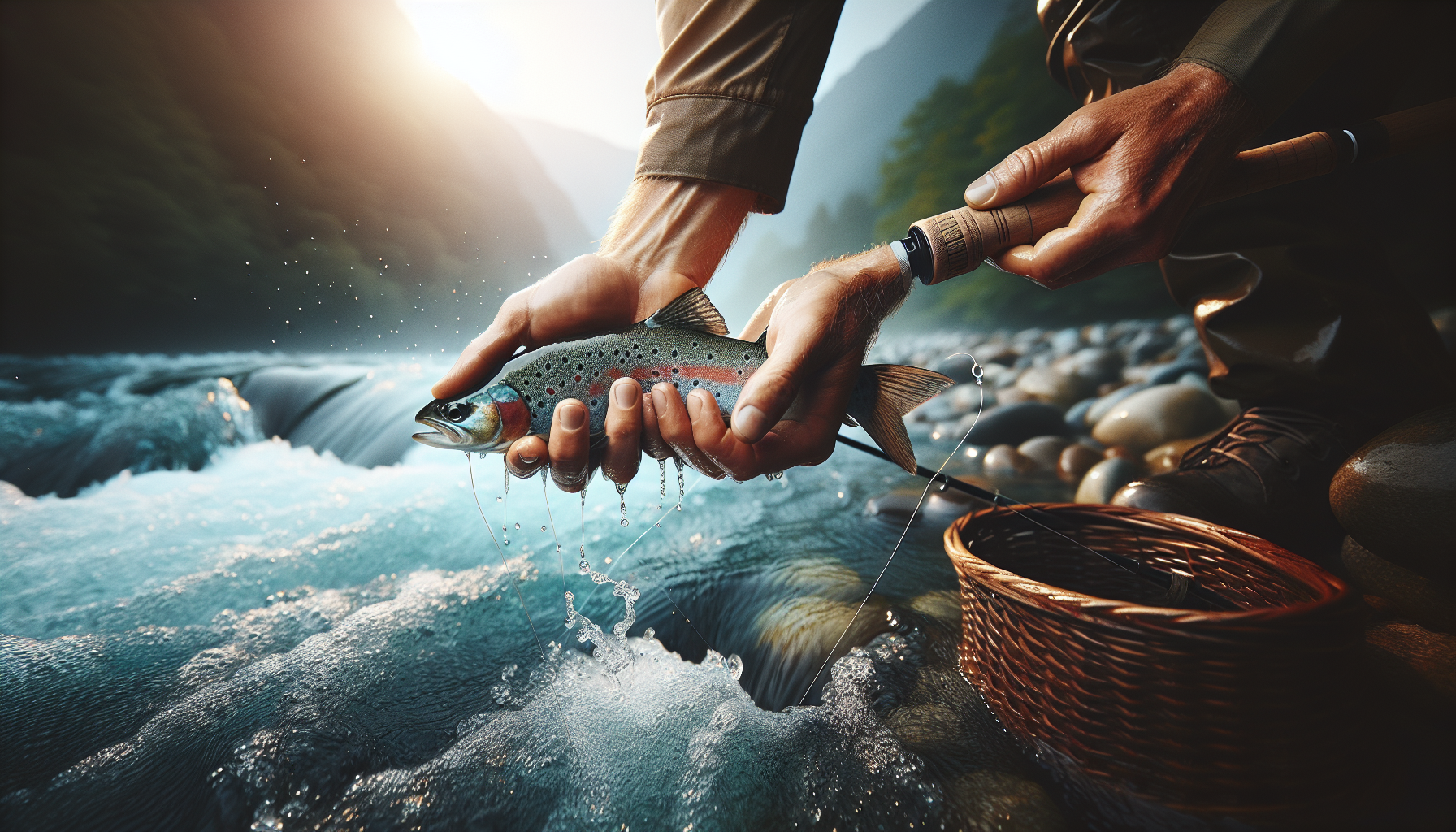
Hook choice matters too. Barbless hooks generally speed release and reduce tissue damage, though they do not guarantee zero harm. Deep hooking is less common with artificial flies than with bait, but it still occurs, especially with small flies or when fish are allowed extra time to turn. Rubber or knotless landing nets reduce scale loss compared with abrasive mesh. Best practice is straightforward: land fish quickly, keep them in the water, wet hands before contact, avoid touching gills, and skip hero shots when conditions are stressful. Ethical fish handling is one of the most effective ways to lower the environmental impact of fly fishing immediately.
Gear, Materials, and Pollution
Fly fishing gear looks durable and refined, but every product has a lifecycle. Rod blanks require energy-intensive manufacturing. Reels use machined aluminum and global supply chains. Waders and jackets rely on synthetic laminates, water-repellent treatments, neoprene, rubber, and complex adhesives that are difficult to recycle. Flies combine steel hooks, synthetic fibers, resins, foams, and historically, feathers or fur sourced through long trade networks. The environmental impact of fly fishing includes extraction, production, packaging, shipping, repairability, and disposal.
Line and tippet waste is one of the clearest pollution issues anglers directly control. Monofilament, fluorocarbon, and fly line coatings can persist in the environment for years. Lost tippet entangles birds, mammals, and fish. Discarded leaders collect in streamside branches and access sites, creating a visible but preventable problem. I routinely carry a small waste tube on my pack because most line litter comes from tiny offcuts, not dramatic breakoffs. When enough anglers do not pack those scraps out, the cumulative effect becomes obvious.
Lead is another concern. Some regions restrict or ban lead split shot because waterfowl and other animals can ingest it. Non-lead alternatives such as tin or tungsten generally reduce toxic risk, though they differ in density and cost. Chemical treatments also matter. Durable water repellent finishes have improved in recent years, but older long-chain fluorinated chemistries raised significant persistence concerns. Responsible purchasing now means asking whether products are repairable, free of unnecessary packaging, and built to last rather than replaced every season.
| Impact area | Common source in fly fishing | Lower-impact choice |
|---|---|---|
| Line litter | Tippet and leader offcuts left bankside | Carry a line container and pack out every scrap |
| Toxic materials | Lead split shot or lead wraps | Use tungsten, tin, or other non-lead weights |
| Short product lifespan | Cheap waders or boots replaced frequently | Buy repairable gear and patch before replacing |
| Transport emissions | Frequent long-distance destination trips | Fish local water more often and consolidate travel |
Travel, Access, and the Carbon Footprint of Angling
For many anglers, the largest environmental impact of fly fishing is not on the riverbank but on the road or in the air. A local day trip has a modest footprint compared with a lodge-based international trip involving flights, transfers, motorized boats, imported food, and energy-intensive accommodations. Destination travel supports local economies and can fund habitat protection, but from a carbon perspective aviation dominates the ledger. This is especially relevant because modern fly fishing culture often celebrates remote, aspirational travel through media and marketing.
Vehicle use at the regional scale also adds up. Popular fisheries may see hundreds of shuttle miles per week from drift boat anglers, guide fleets, and dispersed access driving. Congestion near access points leads to informal parking expansion, vegetation loss, dust, and runoff. On some western rivers, management agencies now face a transportation problem as much as a fishery problem. Better shuttle coordination, carpooling, and seasonal limits can reduce pressure without reducing angling opportunity.
Motorized access on lakes and saltwater adds fuel use, noise, and wake impacts. Outboards and jet boats are valuable tools for safety and access, but they can disturb shallow habitat and wildlife if used carelessly. Human-powered alternatives are not impact-free either; poorly launched rafts or kayaks can damage banks and spread invasive organisms between waters. The practical takeaway is not that anglers must stop traveling. It is that frequency, distance, and mode of travel are major parts of the environmental impact of fly fishing and should be weighed alongside on-water behavior.
Invasive Species, Disease, and Ecological Transfer
Fly anglers move constantly between watersheds, and that mobility creates biosecurity risks. Felt-soled boots were restricted in some jurisdictions partly because they can retain moisture and organic matter that help transport invasive species and fish pathogens. Today the larger lesson remains: waders, boots, nets, boats, anchors, and even fly boxes can move zebra mussel larvae, didymo cells, New Zealand mudsnails, whirling disease spores, and aquatic plant fragments. A single contaminated item may not start an invasion, but repeated vectors across many users absolutely increase risk.
The most effective standard is simple: clean, drain, and dry equipment thoroughly between waters. Hot water decontamination, complete drying times, and disinfectant protocols may be recommended depending on the organism and region. Anglers should follow local agency guidance because requirements differ. What works for a drift boat moving between reservoirs may not be enough for gear used in trout hatcheries or highly sensitive native fish waters. Guides and outfitters have an especially important role because they contact multiple clients and multiple access points at high frequency.
Ecological transfer also includes baitfish issues, stocking interactions, and moving fish without authorization. While this article centers on fly fishing, any angling culture can unintentionally normalize harmful shortcuts. Introducing nonnative species, relocating fish to create private opportunity, or fishing immediately below hatchery release points can reshape food webs and genetics for years. Responsible fly fishing means protecting the integrity of native ecosystems, not just minimizing litter or improving release technique.
Why Fly Fishing Can Also Be a Conservation Force
The environmental impact of fly fishing is not solely negative. In many countries, anglers have been among the most effective defenders of rivers, wetlands, estuaries, and public access. License fees, excise-tax models, guide associations, local clubs, and nonprofit groups have funded habitat restoration, barrier removal, flow advocacy, and water-quality monitoring. Some of the healthiest trout fisheries I know exist not because they are untouched, but because engaged angling communities pushed for better science, stronger rules, and long-term stewardship.
Catch-and-release norms, when paired with proper handling and seasonal restraint, can maintain quality fisheries with lower harvest pressure. Angler observations also contribute valuable field intelligence. Guides notice temperature spikes, fish kills, illegal discharges, and invasive spread early because they are on the water constantly. Citizen science programs increasingly use angler data to track hatches, habitat conditions, and species distribution. That local presence matters, especially where agency budgets are thin.
There is also a cultural benefit that should not be dismissed. People protect what they value, and fly fishing often creates durable emotional connections to rivers. Those connections can become political support for dam removal, minimum flow protections, mine cleanup, riparian fencing, and public-land defense. The key point is balance: fly fishing earns its conservation credibility only when anglers confront the sport’s downsides honestly and reduce them in practice.
Best Practices for Reducing Harm on the Water
Anglers who want to reduce the environmental impact of fly fishing should focus on the highest-leverage behaviors. Fish during safe temperature windows. Avoid spawning areas and visible redds. Use appropriate tackle to shorten fight times. Keep fish in the water whenever possible. Pack out all line, leaders, and refuse. Decontaminate gear between watersheds. Respect access rules, stay on established trails, and support hardened access where use is heavy. If boating, launch only at suitable sites and avoid scarring shallow habitat.
Gear choices can reinforce these habits. Buy fewer, better products and repair them. Choose non-lead weights where possible. Replace disposable habits with durable systems, such as reusable tippet containers and patch kits for waders. Consider the footprint of travel and make local fisheries part of your routine rather than treating them as placeholders between flights. For guides, clubs, and brands, education is part of the job. Client briefings on fish handling and invasive species prevention should be standard, not optional.
This hub page should serve as the starting point for every deeper discussion under environmental impact. Each subtopic—habitat disturbance, fish handling, travel emissions, gear sustainability, invasive species prevention, and restoration funding—deserves focused study. The main lesson is clear: fly fishing is neither automatically sustainable nor inherently destructive. Its environmental impact depends on choices, management, and honesty about tradeoffs. If you fish, audit your own habits, improve one high-impact behavior first, and let conservation shape how you pursue the sport.
Frequently Asked Questions
Is fly fishing really a low-impact outdoor activity?
Fly fishing is often considered lower impact than many motorized or extractive outdoor activities, but it is not impact-free. Its environmental footprint depends heavily on how, where, and how often it is practiced. On the positive side, fly fishing usually involves relatively little direct habitat alteration compared with activities that require heavy equipment, shoreline development, or intensive harvest. Many anglers also practice catch-and-release, which can reduce pressure on fish populations when done correctly. However, low impact should not be confused with no impact. Wading through spawning areas can disturb eggs and aquatic vegetation, repeated access to riverbanks can contribute to erosion, and improper fish handling can increase post-release mortality even when fish swim away. In addition, travel to remote destinations, the production of rods, waders, synthetic lines, and apparel, and the disposal of damaged gear all add to the broader environmental cost.
What makes fly fishing environmentally responsible or harmful is usually the combination of small decisions. An angler who stays on established access paths, avoids redds and sensitive habitat, uses barbless hooks, minimizes air exposure during release, and fishes locally may have a very modest footprint. By contrast, frequent long-distance travel, careless handling, and repeated use of fragile ecosystems can significantly raise that impact. So the most accurate answer is that fly fishing can be a relatively low-impact way to enjoy nature, but only when it is practiced with ecological awareness and restraint.
How does catch-and-release affect fish and aquatic ecosystems?
Catch-and-release is widely promoted as a conservation-minded practice, and in many situations it does help protect fish populations by reducing harvest. Still, releasing a fish does not automatically mean the fish is unharmed. The process of being hooked, played, landed, and handled creates stress that can affect survival, feeding behavior, reproduction, and vulnerability to predators. Factors such as water temperature, fight time, hook placement, and how long the fish is held out of the water all matter. In cold, well-oxygenated water, many fish recover well when handled properly. In warm water or during periods of low flow, however, even careful catch-and-release can become significantly more harmful because fish are already under environmental stress.
There are also ecosystem-level considerations. Repeatedly catching popular fish in heavily pressured waters can alter normal behavior patterns, pushing fish away from prime feeding lanes or spawning areas. If anglers target fish during vulnerable periods, such as spawning runs or thermal stress events, the cumulative effect may be more serious than a single encounter suggests. Best practices include using tackle strong enough to land fish quickly, keeping fish in the water whenever possible, wetting hands before contact, avoiding squeezing the body or gills, and not fishing when water temperatures are dangerously high for the species. In that sense, catch-and-release is a valuable conservation tool, but it works best when paired with species-specific knowledge and careful technique.
What parts of fly fishing equipment have the biggest environmental footprint?
The environmental footprint of fly fishing gear comes from both materials and manufacturing. Modern equipment often relies on carbon fiber, fiberglass, aluminum, plastics, rubber, neoprene, and chemically treated fabrics. Rods, reels, fly lines, waders, boots, packs, and technical clothing all require energy, raw materials, global shipping, and packaging before they ever reach the water. Fly lines and many synthetic apparel products can also shed microplastics over time, adding another layer of environmental concern. Waders and waterproof garments may involve durable water repellent treatments and laminated materials that are difficult to recycle. Even small items such as tippet spools, strike indicators, foam flies, and plastic packaging can accumulate into a meaningful waste stream if they are frequently replaced.
Among the biggest hidden impacts are durability and consumption habits. A high-quality item used for many years often has a lower long-term footprint than cheaper gear that fails quickly and must be replaced. The same principle applies to fast-changing trends in apparel and accessories. From an environmental standpoint, repairing waders, maintaining reels, buying less, choosing durable products, and supporting companies with transparent sourcing and take-back or recycling initiatives can make a substantial difference. Lost monofilament, split shot, and abandoned flies are especially important to manage because they can directly harm wildlife through entanglement or ingestion. In short, the environmental impact of gear is not just about what it is made from, but how long it lasts, how responsibly it is used, and how it is disposed of at the end of its life.
Can fly fishing damage riverbanks, streambeds, and wildlife habitat?
Yes, fly fishing can damage habitat when angler access and behavior are not managed carefully. The most visible effects often occur along shorelines and riverbanks. Repeated foot traffic to popular access points can wear away vegetation, compact soil, and increase erosion, which in turn sends sediment into the water. Excess sediment can reduce water clarity, cover spawning gravel, and affect aquatic insects and fish eggs. Wading can also disturb streambeds directly. In some cases, anglers unintentionally step on redds, which are nests where fish such as trout and salmon deposit eggs. Disturbing these areas can reduce reproductive success even when no fish are harvested.
The impact extends beyond fish. Riparian zones, the green corridors along rivers and lakes, are critical habitat for birds, amphibians, insects, and mammals. Frequent trampling can fragment these areas and reduce their ecological function. Boating access, anchor damage, and movement through shallow flats or estuaries can also disrupt sensitive habitat in coastal settings. The good news is that many of these impacts are preventable. Using designated entry points, avoiding fragile banks, staying out of obvious spawning habitat, respecting seasonal closures, and learning to identify sensitive areas all help reduce damage. Habitat harm from fly fishing is usually not as dramatic as industrial disturbance, but because many fisheries are heavily visited, small repeated impacts can add up over time.
How can fly anglers reduce their environmental impact and support conservation?
The most effective way for fly anglers to reduce their environmental impact is to combine low-impact personal habits with active support for fishery stewardship. On the water, that means following local regulations, avoiding fishing during high water temperatures or spawning periods, using responsible fish handling techniques, packing out all waste, and preventing the spread of invasive species by cleaning and drying gear between watersheds. Choosing local or regional trips more often can lower the carbon footprint associated with travel, and buying fewer, longer-lasting products can reduce demand for resource-intensive gear production. Small choices matter, especially when multiplied across a large angling community.
Beyond personal behavior, fly anglers can play a meaningful conservation role because fishing communities often have direct influence on habitat protection and restoration. Purchasing licenses and excise-taxed equipment helps fund management in many regions. Joining watershed groups, supporting river restoration projects, participating in cleanups, advocating for water quality protections, and backing science-based fishery regulations can all produce benefits far beyond an individual outing. Anglers are often among the first to notice changes in stream flow, pollution, invasive species, or declining insect life, which means they can be important observers and advocates for ecosystem health. Ultimately, understanding the environmental impact of fly fishing is not about deciding whether the sport is simply good or bad. It is about recognizing that anglers are part of the ecosystem and that informed choices can either increase pressure on natural systems or help protect them for the future.