Catch and release is the practice of capturing a fish, handling it briefly, and returning it to the water with the goal of survival and continued reproduction. In conservation and ethics, it sits at the intersection of biology, angling technique, and fishery management. The idea sounds simple, yet the science behind catch and release is anything but simple. Whether a released fish lives depends on physiology, water conditions, hook placement, fight time, and the angler’s behavior during a few critical seconds.
For anglers, guides, and fishery managers, understanding catch and release matters because release mortality can silently undermine conservation goals. A fish that swims away is not always a fish that survives. In field work and on the water, I have seen trout revive quickly in cold current while warmwater bass rolled over after long fights in summer heat. Those outcomes were not random. They reflected measurable stress responses: elevated lactate, depleted energy reserves, impaired gill function, and increased vulnerability to predation and infection after release.
This makes catch and release a core ethical issue, not just a technique choice. It can protect spawning fish, maintain trophy fisheries, and reduce harvest on pressured waters. It can also fail when used carelessly or treated as a license to overplay fish for sport. Good practice requires knowing what happens inside the fish’s body, which species and seasons create higher risk, and which gear and handling methods consistently improve survival. When anglers understand those mechanisms, they can release fish in ways that genuinely support conservation rather than simply appearing conscientious.
At its best, this approach is evidence-based. Fisheries biologists evaluate post-release survival with telemetry, holding studies, and tagging programs. Agencies such as NOAA Fisheries, state fish and wildlife departments, and provincial ministries routinely use these findings to shape regulations, from seasonal closures to gear restrictions. This hub article explains the science behind catch and release, the variables that most affect outcomes, the ethical tradeoffs, and the practical standards that make release more effective across trout, bass, salmon, pike, muskellunge, and saltwater species.
What Happens to a Fish During Catch and Release
The central scientific question is straightforward: what physiological stress does capture impose, and can the fish recover from it? During the fight, fish rely heavily on burst swimming powered by white muscle. That effort produces lactate and causes metabolic acidosis, much like extreme exertion in other animals. At the same time, stress hormones such as cortisol rise, blood chemistry shifts, and oxygen demand increases. If water temperature is high or dissolved oxygen is low, recovery becomes much harder because the fish cannot repay that oxygen debt efficiently.
Hooking location adds another layer. A fish hooked in the jaw often has a much better prognosis than one hooked in the gills, tongue, esophagus, or stomach. Deep hooking can cause severe bleeding, tissue damage, and delayed mortality even when the fish initially appears strong. Air exposure is another major stressor. Fish gills are designed to extract oxygen from water; out of water, delicate filaments collapse, gas exchange stops, and carbon dioxide clearance is impaired. Research on salmonids, bass, and reef fish repeatedly shows that longer air exposure increases mortality, especially when paired with exhaustive exercise.
Physical handling also matters. Dry hands, hot boat carpet, and abrasive nets can strip mucus and damage scales, creating entry points for pathogens. Compression injuries occur when fish are squeezed around the abdomen or suspended vertically without support. Larger fish are especially vulnerable because their internal organs are not meant to hang unsupported in air. The result may be spinal strain, jaw injury, or delayed impairment that is not obvious at release.
In practical terms, catch and release success depends on minimizing cumulative stress. Every additional burden, long fight, deep hook, warm water, rough handling, and prolonged photography, compounds the biological challenge. The fish does not experience these factors separately; it experiences them all at once.
Primary Factors That Determine Post-Release Survival
Anglers often ask which single factor matters most, but survival is usually driven by a combination of variables. Water temperature is one of the strongest predictors because it affects both oxygen availability and metabolic demand. Coldwater species such as trout and salmon are especially vulnerable once temperatures climb into stressful ranges. For many trout fisheries, managers begin urging caution or impose restrictions when water temperatures approach the upper 60s Fahrenheit, because mortality can rise sharply even with careful handling.
Fight time is another major variable. Tackle that is too light extends the fight, increases exhaustion, and raises lactate accumulation. That does not mean heavy tackle should be used crudely; it means gear should be matched so fish can be landed efficiently. Hook type matters as well. Circle hooks often reduce gut hooking in bait fisheries, while barbless hooks generally shorten unhooking time and reduce tissue damage. Net selection is not trivial either. Rubberized landing nets are consistently better than knotted nylon because they reduce fin fraying, scale loss, and tangling.
The table below summarizes the most important factors and the practical implication of each.
| Factor | Why It Affects Survival | Best Practice |
|---|---|---|
| Water temperature | Higher temperatures increase metabolic stress and lower dissolved oxygen | Avoid fishing during heat, especially for trout and salmon |
| Fight time | Long fights elevate lactate, exhaustion, and recovery time | Use tackle strong enough to land fish quickly |
| Hook location | Gill or deep hooking can cause lethal bleeding and organ damage | Use hook types and methods that favor jaw hookups |
| Air exposure | Stops gill function and worsens stress after exercise | Keep fish in water as much as possible |
| Handling surface | Dry, rough surfaces remove protective slime and scales | Use wet hands and rubber nets; avoid decks and rocks |
| Revival and release site | Fish released into fast current, surf, or predator zones may fail to recover | Release in calm, oxygenated water when possible |
Species differences are significant. Largemouth bass often tolerate brief handling better than trout, but deep-hooked bass on live bait can suffer substantial mortality. Muskellunge may swim off strongly and still experience delayed mortality if fight times are excessive in warm water. Reef fish add another complication: barotrauma from rapid ascent can impair buoyancy and survival even when handling is otherwise careful. Effective catch and release is never one-size-fits-all.
Gear, Techniques, and Handling Standards That Improve Outcomes
The most effective catch and release methods are practical, repeatable, and based on reducing stress at each stage of the encounter. Start with hooks. Artificial-lure anglers often choose single hooks or barbless configurations because they simplify removal. In bait fishing, non-offset circle hooks are widely supported by evidence for reducing deep hooking in species ranging from striped bass to billfish. Pliers, hemostats, and line cutters should be accessible before the cast, not buried in a pack while the fish is suffocating at boatside.
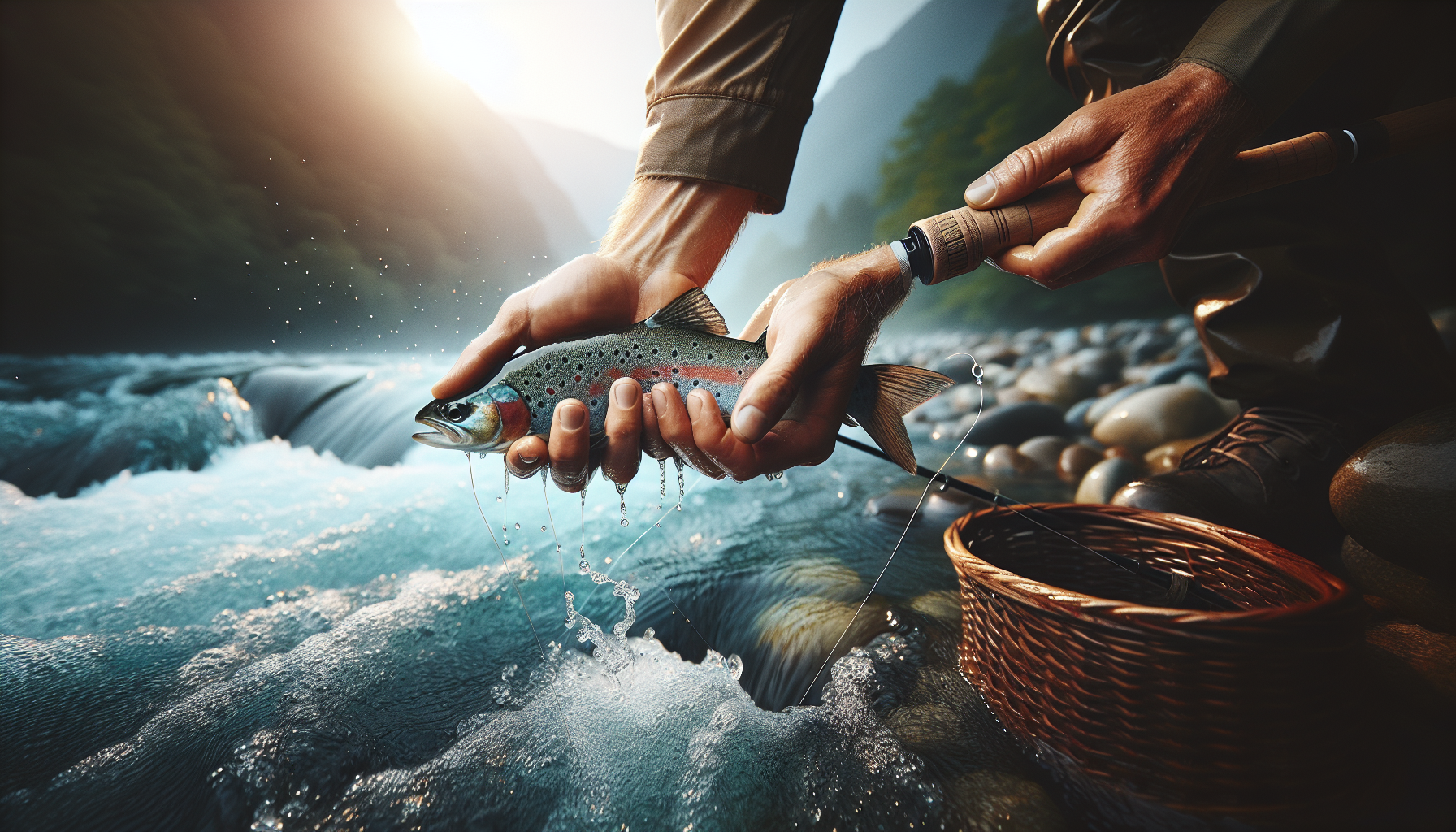
Landing technique matters as much as terminal tackle. Beaching a fish on dry sand, dragging it over gravel, or bouncing it on a dock can do substantial damage. A rubber-coated net supports the fish while keeping it partly submerged. When lifting is necessary for a quick photo or measurement, wet hands first and support the fish horizontally, one hand at the tail wrist and the other under the belly. Never insert fingers into gills, and avoid hanging heavy fish vertically from the jaw for extended periods.
Hook removal should be decisive. If a hook is deeply embedded, cutting the line close to the hook is often better than aggressive extraction that tears tissue. Many studies and agency guidelines support this approach, especially when the hook is in the throat or stomach and removal would increase bleeding. For fish showing signs of severe stress, loss of equilibrium, flared opercula, weak tail kicks, release should happen immediately after the shortest possible in-water recovery. Holding a fish upright in moderate current can help, but forcing it back and forth is counterproductive because it pushes water the wrong way across the gills.
Photography is where many well-intentioned releases go wrong. The safest standard is to have camera ready, lift for a few seconds if necessary, and return the fish promptly. A useful field rule is simple: if the fish is out of water, the clock is running. I advise anglers to think in single digits, not half-minutes. On difficult days, hot weather, tournament pressure, or repeated catches from the same area, skipping the hero shot is often the most ethical choice.
Species, Seasons, and Situations That Raise Ethical and Biological Risk
Some fisheries are naturally more compatible with catch and release than others. Cold, well-oxygenated rivers during moderate weather generally offer better release conditions than shallow reservoirs in midsummer or offshore fisheries involving rapid depth change. Seasonal stress is especially important. Summer trout angling can become high risk when water warms, because trout already operate near their thermal ceiling. Fall salmon on spawning runs may survive release physically yet still suffer reduced reproductive success if repeatedly disturbed on redds or in staging pools.
Spawning fish deserve special attention. Catching and releasing visible spawners can remove them from nests, expose eggs to predation, and alter behavior even if the adults survive. This is one reason many agencies close spawning areas or dates. Another overlooked issue is repeated capture. In heavily pressured urban ponds or famous tailwaters, the same fish may be hooked multiple times in a season. Sublethal stress can accumulate, mouth injuries can affect feeding, and learned avoidance can alter fish distribution and catchability.
Saltwater fisheries present additional complexities. Species such as tarpon, bonefish, permit, redfish, and striped bass may be handled successfully under good conditions, but temperature, shark predation, and fight duration can sharply change outcomes. Shark depredation on released fish is not merely anecdotal in some areas; it is an increasing management concern. Reef species caught from depth may suffer barotrauma, where expanding gases cause stomach eversion, bulging eyes, and buoyancy loss. Descending devices and venting tools are part of the solution, but proper use and species-specific guidance are essential.
Ethically, the key question is not whether release is possible, but whether release is responsible under current conditions. If mortality risk is predictably high, the most conservation-minded choice may be to stop fishing, switch species, move to cooler water, or fish at dawn instead of late afternoon.
How Fisheries Management Uses Catch and Release Science
Modern fisheries management treats catch and release as a measurable tool, not a moral slogan. Agencies estimate total fishing mortality as the sum of harvest mortality and release mortality. That distinction matters because a fishery with strict harvest limits can still decline if catch rates are high and release survival is poor. Creel surveys, tagging studies, radio telemetry, acoustic tracking, and controlled holding experiments all help managers estimate what proportion of released fish die immediately or later.
Those findings shape regulations in concrete ways. Mandatory circle hooks in some bait fisheries were adopted to reduce deep hooking. Seasonal closures on warm trout streams protect fish during periods of thermal stress. Restrictions on treble hooks, bait, or handling in certain waters are usually responses to documented mortality patterns, not arbitrary preferences. Tournament formats have also changed. Many bass events now use rapid weigh-in procedures, aerated livewells, fizzing guidance where legal and appropriate, and release boats when needed. In some fly fisheries, managers encourage or require barbless hooks and prohibit targeting fish on spawning beds.
Catch and release also supports population structure. Large, older fish often contribute disproportionately to reproduction through greater fecundity, superior genetics for local conditions, or timing advantages. Protecting those fish can sustain quality angling and ecological resilience. Still, management is nuanced. In some systems, selective harvest of abundant smaller fish may be beneficial, while universal release can contribute to density-dependent stunting. That is why local regulations, species biology, and population goals must guide behavior.
The science behind catch and release leads to one clear conclusion: releasing fish is only conservation when the fish has a strong chance of surviving and functioning normally afterward. Survival depends on a chain of decisions, from hook choice and tackle strength to water temperature, handling time, and release conditions. Done well, catch and release protects breeding adults, supports high-quality fisheries, and reduces unnecessary harvest. Done poorly, it can mask significant mortality behind the illusion of a healthy swim-away.
For anglers, the practical standard is straightforward. Land fish quickly, keep them wet, minimize air exposure, avoid high-risk temperatures, use fish-friendly nets and hooks, and adapt methods to the species in front of you. If conditions make survival doubtful, change tactics or stop fishing. That mindset is the ethical center of catch and release and the reason it belongs within conservation, not just sport.
Use this hub as your foundation for the broader catch and release topic, then apply its principles on the water with discipline. Better decisions in those brief moments after the strike can protect individual fish and improve the future of the fishery you value.
Frequently Asked Questions
What does the science of catch and release actually focus on?
The science behind catch and release focuses on one central question: what determines whether a fish survives after it is released? Researchers study a combination of fish physiology, environmental conditions, angling methods, and post-release behavior to answer that question. Survival is not based on a single factor. Instead, it is shaped by how exhausted the fish becomes during the fight, where the hook is lodged, how long the fish is exposed to air, how it is handled, and the temperature and oxygen levels of the water it returns to.
At the physiological level, fish experience stress during capture much like any wild animal under extreme exertion. When a fish struggles on the line, it burns energy, accumulates metabolic byproducts such as lactate, and can lose its normal balance of blood chemistry. If the stress is severe enough, the fish may appear to swim away but later die from delayed effects. That is why scientists often distinguish between immediate mortality and delayed mortality. A release may look successful in the moment, but true success depends on whether the fish is able to recover normal respiration, orientation, and feeding behavior over time.
Researchers also examine sublethal impacts, which are injuries or stress responses that do not kill a fish outright but may reduce its long-term fitness. These include damage to the mouth or gills, loss of protective slime, infection risk, altered spawning behavior, and increased vulnerability to predators after release. In some cases, a fish survives but is less likely to reproduce successfully. From a conservation perspective, that matters just as much as simple survival rates.
In practical terms, catch-and-release science helps shape recommendations and regulations. It informs guidance on tackle choice, hook design, fish handling, seasonal restrictions, and when certain fisheries should be closed because conditions are too stressful for safe release. So while catch and release may seem like a straightforward ethical choice, the science reveals that successful release depends on a chain of biological and behavioral decisions, many of which are in the angler’s control.
Why do some released fish die even when they swim away strongly?
A fish that swims away after release is not necessarily fully recovered. One of the most important insights from fisheries science is that post-release mortality is often delayed. A fish can leave the angler’s hands under its own power yet still die hours or even days later from the cumulative effects of stress, injury, or environmental conditions. This is one reason why catch-and-release studies frequently use tagging, holding experiments, or telemetry rather than relying only on visual observation at the moment of release.
The struggle during capture can push a fish beyond its normal physiological limits. As it fights, it uses intense muscular effort that may lead to exhaustion, oxygen debt, and acid-base imbalance. If the fish is then exposed to warm, low-oxygen water or too much air during handling, its ability to recover is further compromised. In species that are especially sensitive, even a short period out of the water can significantly impair gill function and cardiovascular recovery. The fish may swim off initially because escape behavior is strong, but that does not mean its body has stabilized.
Injury is another major cause of delayed mortality. Hook placement in the gills, eyes, throat, or deeper digestive structures can lead to bleeding, tissue damage, or infection. Even mouth-hooked fish may suffer if they are handled roughly, squeezed, dropped, or placed on hot, dry surfaces. The loss of the protective mucus layer can increase disease risk, and damaged fins or impaired swimming performance can make released fish easier targets for predators.
Environmental conditions often determine whether a fish can recover from the stress of capture. Cold, well-oxygenated water generally improves the odds. Warm water, by contrast, raises metabolic demand while often holding less dissolved oxygen, creating a difficult recovery environment. In rivers and lakes during summer heat, even properly released fish may face elevated mortality simply because the water is too stressful. This is why responsible anglers and fishery managers pay close attention to temperature thresholds and seasonal conditions, not just release intent.
How do fight time, air exposure, and handling affect a fish’s chances of survival?
Fight time, air exposure, and handling are three of the most important variables an angler can control, and each one has a direct scientific link to survival. Longer fight times generally mean greater exhaustion. When anglers use tackle that is too light for the species or play fish for extended periods, the fish experiences more severe physiological stress. It may accumulate higher levels of lactate, suffer more disruption to normal blood chemistry, and take longer to regain equilibrium after release. In general, landing a fish quickly and efficiently reduces the intensity of this stress response.
Air exposure is especially harmful because fish are adapted to extract oxygen from water through their gills, not from air. Once out of the water, gill filaments can collapse, gas exchange is interrupted, and recovery from exercise stress becomes more difficult. Scientific studies have repeatedly shown that even relatively short periods of air exposure can increase post-release mortality, particularly when combined with exhaustive fights or warm water. The risk becomes even greater if the fish is held out of the water for photos, measuring, or prolonged hook removal. A good rule supported by science is that if a fish must be lifted at all, it should be kept out of water only briefly and handled with a clear plan already in mind.
Handling quality matters because physical contact can either protect or compromise the fish’s body. Wet hands or rubberized nets reduce abrasion and help preserve the mucus coating that serves as a defense against pathogens. By contrast, dry hands, rough mesh, carpet, rocks, docks, or boat decks can strip mucus and damage scales or skin. Fish should also be supported properly. Hanging larger fish vertically by the jaw can strain internal tissues, the spine, or the jaw itself. Supporting the body horizontally is generally safer, especially for heavier fish.
The best outcomes come from treating the entire release sequence as a single process. Use appropriate tackle to shorten the fight, keep the fish in the water whenever possible, remove the hook efficiently with the right tools, minimize air exposure, avoid rough surfaces, and release the fish only when it shows signs of orientation and strong equilibrium. Individually, each step helps. Together, they can dramatically improve survival rates.
Do hook type and hook location really make a difference in catch-and-release survival?
Yes, both hook type and hook location can have a major influence on post-release outcomes. The most consistently important issue is where the fish is hooked. Fish hooked in the lip or jaw usually have better survival prospects than fish hooked in the gills, tongue, eye area, or deep in the throat or stomach. Sensitive areas contain vital tissues and blood vessels, so injuries there can cause severe bleeding, impaired feeding, or long-term infection risk. Deep-hooked fish are often harder to unhook quickly, which can increase handling time and tissue damage at the same time.
Hook design also matters because it influences both hooking patterns and ease of removal. Circle hooks, for example, are often recommended in certain bait fisheries because they tend to lodge in the corner of the mouth rather than being swallowed deeply. Barbless hooks or hooks with crushed barbs can also reduce handling time and tissue damage because they are easier to remove cleanly. That does not mean every hook type performs the same in every fishery, but the broader scientific takeaway is clear: tackle choices affect injury rates, and injury rates affect survival.
Bait type can indirectly change hook location as well. Fish that take natural bait are sometimes more likely to swallow the hook deeply, especially if the angler delays the hookset. Artificial lures often result in more visible, mouth-based hook placements, although exceptions certainly occur. This is why some regulations require or encourage specific hook styles or restrict bait use in catch-and-release waters. These rules are often based on evidence showing lower mortality under certain gear combinations.
When a fish is deeply hooked, the safest option is not always to force the hook out. In many cases, cutting the line close to the hook is less damaging than prolonged digging or tearing tissue to remove it. Research in several fisheries has shown that some fish can survive with an embedded hook, especially if it is small and non-stainless and the injury is not catastrophic. The key point is that the goal is not simply hook removal at all costs. The goal is minimizing total injury and stress so the fish has the best chance to recover.
What are the most science-based best practices for anglers who want released fish to survive?
The most effective catch-and-release practices are grounded in reducing stress, limiting injury, and matching angling behavior to environmental conditions. First, use tackle strong enough to land fish efficiently. Prolonged battles increase exhaustion, especially in warm water or fast current. Second, prepare before landing the fish. Have pliers, hook removers, and cameras ready so there is no delay once the fish is in hand or in the net. Planning ahead can cut down dramatically on air exposure and unnecessary handling.
Whenever possible, keep the fish in the water during unhooking and recovery. A knotless, rubberized landing net can help control the fish while reducing abrasion and scale loss. Wet your hands before touching it, avoid squeezing the body, and never place it on dry or hot surfaces. If you want a photo, make it quick and deliberate rather than prolonged and