Catch and release for trophy fish sits at the intersection of angling skill, conservation ethics, and fisheries science. In simple terms, catch and release means landing a fish and returning it to the water alive; trophy fish are unusually large, old, or genetically valuable individuals that often contribute disproportionately to spawning success. I have spent enough time around guides, biologists, and serious anglers to know that these fish are more than personal milestones. They are breeding capital for a fishery, public symbols of wild abundance, and often the reason a destination develops a global reputation. When anglers handle them carelessly, the damage extends beyond a single fish. When they release them correctly, they protect the age structure and reproductive potential that keep populations resilient.
This matters because large fish are not simply scaled-up versions of smaller fish. A ten-pound bass, forty-inch pike, or hundred-pound tarpon has survived years of predation, environmental stress, and fishing pressure. In many species, larger females produce more eggs, and their offspring may have better survival odds. Fisheries managers call these “big old fat fecund female fish,” or BOFFFFs, and the principle applies across freshwater and saltwater systems. A trophy fish may also carry genetics for fast growth, disease resistance, or successful migration timing. Removing too many of these individuals can shift population structure toward smaller, younger fish. That is why many regulations now include slot limits, seasonal closures, circle-hook rules, and mandatory release policies for vulnerable species.
Ethical catch and release is not a slogan. It is a chain of decisions that starts before the cast and ends only when the fish swims away strongly. Gear choice, hook style, fight time, water temperature, air exposure, landing tools, handling technique, and release method all affect post-release survival. The central question is not whether a fish can swim away. Many mortally stressed fish swim off and die later from exhaustion, infection, or impaired equilibrium. A more honest standard is whether your method gives that fish a high probability of surviving, recovering, and spawning again. For a conservation and ethics hub, that distinction is essential, because responsible release depends on understanding biology, not just intention.
Catch and release also carries tradeoffs. It is usually far better than harvest for protecting trophy-class fish, but it is not harmless. Mortality rates vary by species, water temperature, depth, hook location, and handling quality. Deep-caught reef fish can suffer barotrauma. Trout released in warm water may die from cumulative stress. Muskies handled on hot summer days can crash after apparently clean releases. Ethical anglers accept these realities and adjust. Sometimes the most conservation-minded decision is to stop fishing, change tactics, fish another species, or avoid a vulnerable area entirely. Good ethics means matching effort to conditions rather than assuming release alone makes every choice acceptable.
Why Trophy Fish Deserve Special Protection
Trophy fish deserve special protection because size and age create outsized biological value. In many fisheries, older females produce not only more eggs but also higher-quality eggs with richer energy reserves. Large male fish can be equally important where nest defense, territorial breeding, or migration timing influence recruitment. In practical terms, a lake full of two-pound bass does not function like a lake that still grows eight-pound bass. The latter system usually reflects stronger forage, better habitat, and a healthier age structure. The same pattern holds for permit on flats, giant trevally on reef edges, and mature brown trout in tailwaters. Trophy fish indicate ecological continuity.
There is also a social and economic dimension. Destination fisheries often rise or fall on the presence of exceptional fish. Think of tarpon in Florida, Atlantic salmon rivers in eastern Canada, taimen waters in Mongolia, or catch-and-release peacock bass operations in the Amazon. These fisheries support guides, lodges, tackle retailers, and local communities. Once trophy size structure erodes, it can take years or decades to rebuild, especially in slow-growing species. I have seen waters where anglers still catch numbers, but the true giants are gone; local confidence disappears long before official data fully captures the decline. Protecting large fish is therefore both ecological stewardship and long-term fishery management.
Regulations increasingly reflect this science. Slot limits protect mid-sized harvest while preserving top-end breeders. Maximum size limits, mandatory release zones, and seasonal spawning protections aim to keep mature fish in the system. Yet regulations set the floor, not the ceiling. Ethical anglers go further by minimizing stress even when the law would allow rougher handling. If a fishery depends on repeat spawning from trophy individuals, then every angler becomes part of the management equation. That is especially true on heavily pressured waters where cumulative release stress can become a meaningful source of mortality.
Gear and Tackle Choices That Improve Survival
The best catch and release technique begins with using gear heavy enough to land fish quickly. Many anglers mistakenly believe lighter tackle is always more sporting, but prolonged fights increase lactate buildup, reduce blood pH, and leave fish vulnerable to delayed mortality. For trophy fish, that risk is magnified because larger bodies require more oxygen recovery after exertion. A balanced setup means a rod with enough backbone, a reel with smooth drag, and line strong enough to turn the fish before exhaustion becomes severe. For largemouth bass around cover, braided main line with an appropriate fluorocarbon leader can shorten fights. For tarpon or striped bass, leader strength must match both fish size and handling conditions.
Hooks matter just as much. Non-offset circle hooks are the standard for many natural-bait fisheries because they reduce deep hooking when used correctly. They are now widely required in billfish, reef, and striped bass fisheries for good reason. In artificial presentations, single hooks are often easier to remove than trebles, and crushed barbs speed release while reducing tissue damage. Treble hooks still have legitimate uses, especially on some hard baits, but replacing oversized factory trebles with fewer or barbless options can materially improve outcomes. High-quality split-ring pliers, long-nose pliers, side cutters, and jaw spreaders for appropriate species belong in every serious release kit.
Landing tools should support the fish, not injure it. Rubberized knotless nets reduce scale loss and fin abrasion compared with old nylon mesh. Large landing cradles or slings are essential for muskies, pike, and oversized catfish. Lip-gripping tools can help control certain species briefly, but they should never be used to suspend a heavy fish vertically for photos. That posture can strain jaws, vertebrae, and internal organs. A proper setup allows the fish to remain in the water while hooks are removed and the camera is readied. The highest-survival release is usually the one that looks the least dramatic.
| Gear choice | Best practice | Why it helps trophy fish |
|---|---|---|
| Rod and line | Use tackle matched to fish size and cover | Shortens fight time and reduces exhaustion |
| Hook style | Use circle hooks with bait; consider singles on lures | Lowers deep-hooking and speeds hook removal |
| Net | Choose a rubberized knotless net or cradle | Protects slime coat, scales, fins, and gills |
| Tools | Carry pliers, hook cutters, and dehookers | Lets anglers remove hooks fast and cut embedded hooks safely |
| Photography setup | Prepare camera before lifting fish | Minimizes air exposure during release |
Landing, Handling, and Photographing a Trophy Fish
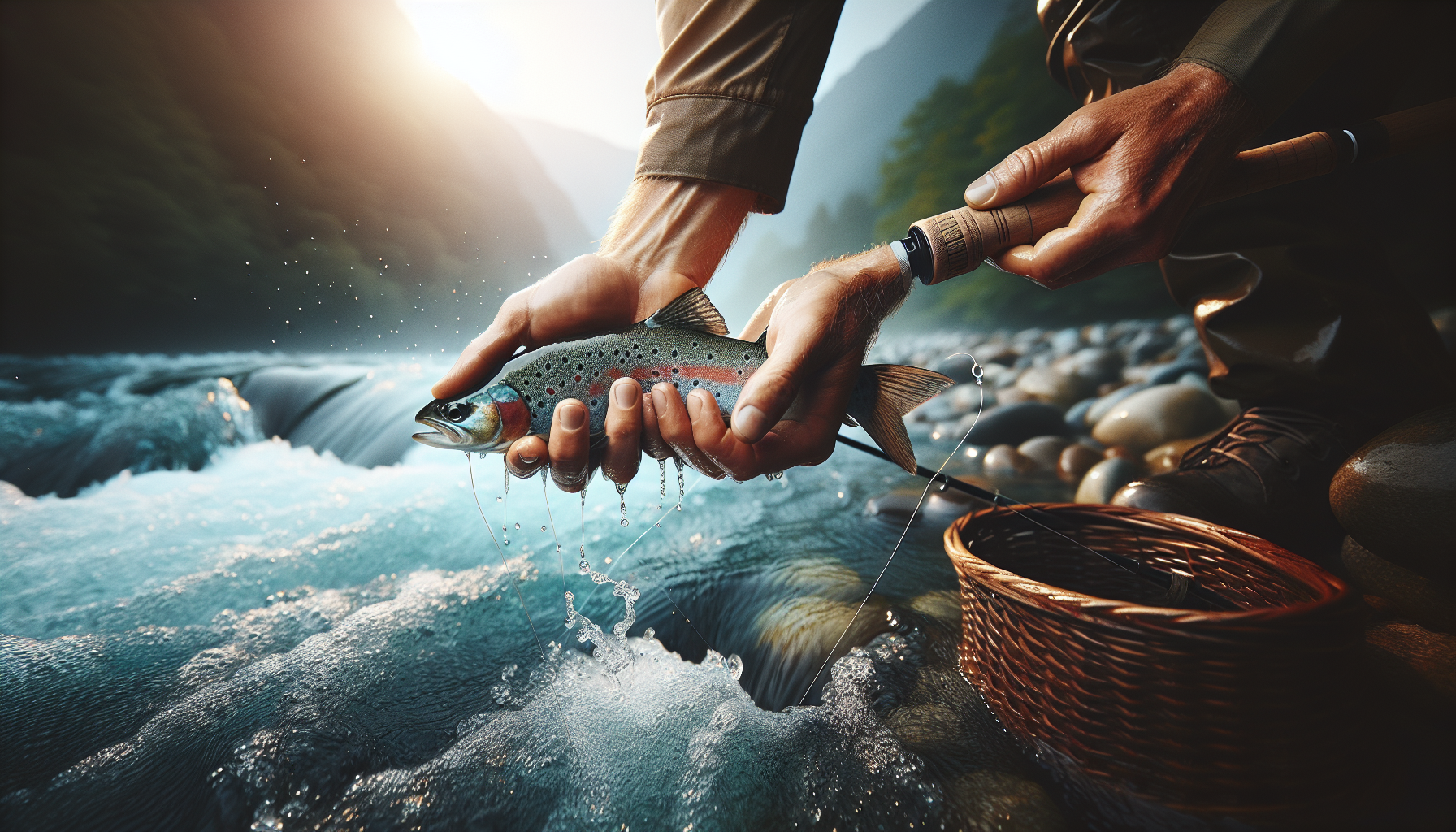
Once a trophy fish is close, discipline matters more than excitement. Keep the fish in the water as long as possible while assessing hook placement and organizing the release. Wet your hands before touching the fish. Avoid dry boat carpet, hot sand, gunwales, and docks, all of which strip the protective mucus layer that helps prevent infection. Never insert fingers into gills or lift a fish by the operculum. Support the body horizontally with two hands when a brief lift is necessary: one near the wrist of the tail and the other under the belly or pectoral area. This is especially important for large trout, snook, salmon, and muskellunge.
Air exposure is one of the clearest controllable risk factors. A useful field rule is “keep them wet,” but the more precise goal is to reduce total air exposure to a few seconds, not repeated long lifts for multiple photos. Research on several species shows that air exposure after exhaustive exercise can dramatically increase mortality. Prepare the camera, choose the angle, lift once, take the shot, and return the fish immediately. If you want measurements, use a floating ruler, bump board designed for fish-friendly use, or estimate length from the net. Girth and length formulas can provide weight estimates without hanging the fish from a scale.
For boatside handling, position the fish upright in current or calm water with the head submerged and the body fully supported. Do not pump the fish back and forth aggressively. Fish ventilate effectively when water moves naturally across the gills; forcing reverse flow can be harmful. Instead, hold the fish steady facing into current, or idle slowly with caution only when local guidance supports that method for a species such as tarpon. Watch for signs of recovery: stronger tail kicks, upright balance, and purposeful attempts to swim. Release only when the fish can maintain position and leave under its own power.
Species-Specific Considerations and Seasonal Risks
Not all trophy fish should be handled the same way. Trout and salmon are especially sensitive to warm water because higher temperatures reduce dissolved oxygen while increasing metabolic stress. On many rivers, experienced anglers stop targeting large trout when water temperatures climb above the high sixties Fahrenheit, and some use a stricter cutoff around 68 degrees. Warmwater predators such as bass tolerate heat better, but deep-hooking, fizzing errors, and livewell crowding during tournaments can still produce delayed mortality. Muskies and pike require oversized nets, long tools, and fast releases because prolonged handling can be disastrous, particularly in midsummer.
Saltwater species add more complexity. Tarpon often need extended boatside revival, yet overhandling can attract sharks in some regions, turning a release into predation. For reef fish such as snapper and grouper, barotrauma from rapid ascent can cause bulging eyes, stomach eversion, and buoyancy loss. Descending devices are now a best practice and, in some U.S. fisheries, effectively mandatory because they return fish quickly to capture depth where pressure normalizes. Billfish and tuna require heavy tackle and coordinated crews to shorten fight duration. Sharks demand strict attention to legal handling rules, hook type, and personal safety. Dragging large sharks ashore for photos is indefensible and illegal in many jurisdictions.
Season also changes the ethical equation. Spawning fish are vulnerable because energy reserves are committed to reproduction and repeated disturbance can disrupt nesting, pairing, or migration. Catching bedding bass may be legal, but ethical anglers should recognize that even released fish can leave nests exposed to predators. Cold water poses fewer oxygen constraints, yet freezing air can damage fish eyes and gills if exposed during winter captures. High summer, low flows, algae blooms, and post-storm low-oxygen events all increase stress. The right question is always situational: under today’s conditions, is releasing this fish likely to result in real survival?
Building an Ethical Catch and Release Mindset
Ethical catch and release for trophy fish is ultimately a mindset of restraint and preparation. Measure success by fish condition, not just by the photo. Fish with tackle that ends battles efficiently, use proven tools, and learn species-specific release methods before you need them. Respect regulations, but do not hide behind them when conditions are poor. If water is too warm, if spawning fish are unusually vulnerable, or if release mortality is clearly rising, change plans. Share accurate practices with newer anglers, because one well-taught habit—wet hands, horizontal support, a ready camera—can save countless fish over time.
As a conservation and ethics hub, catch and release should connect to every decision anglers make on the water: harvest choices, fish handling, seasonal timing, and fishery advocacy. Trophy fish are valuable precisely because they are rare, old, and productive. Releasing them well protects genetics, spawning output, and the possibility that the next angler encounters the same fish in even better condition. If you want healthier fisheries and more truly memorable catches, treat every large fish as a renewable resource with limits. Start by auditing your own gear, tightening your handling routine, and committing to releases that give trophy fish the strongest possible chance to survive.
Frequently Asked Questions
Why is catch and release especially important for trophy fish?
Catch and release matters for all sport fish, but it becomes especially important with trophy fish because these individuals are often the oldest, largest, and most genetically valuable members of a population. A true trophy fish is not just a bigger version of an average fish. In many fisheries, large females produce far more eggs than smaller fish, and those eggs are often of higher quality. Large males may also play an outsized role in breeding success, territory defense, and overall population structure. When anglers release these fish in good condition, they help preserve the reproductive engine of the fishery rather than removing it.
There is also a broader ecological and management reason behind the ethic. Trophy fish are usually rare by definition. It can take many years, sometimes decades, for a fish to reach exceptional size. If those fish are harvested at a high rate, the fishery loses not only immediate spawning potential but also the age structure that supports resilience. Older fish can buffer a population against poor environmental conditions, variable year classes, and changing habitat quality. From a conservation standpoint, protecting large fish helps maintain both abundance and quality.
For anglers, catch and release is also about stewardship. Landing a once-in-a-lifetime fish can be deeply rewarding, but returning it alive allows another angler to encounter that same fish in the future and allows the fish to continue contributing to the gene pool. That is why many guides, biologists, and experienced anglers view trophy catch and release not as a trendy preference, but as a practical way to sustain fisheries that produce exceptional fish over the long term.
Does catch and release actually work, or do many trophy fish die after being released?
Catch and release can work very well, but it is not automatically harmless. The outcome depends on species, water temperature, fight time, handling, hook placement, and the condition of the fish at release. When anglers use appropriate gear, land fish efficiently, minimize air exposure, and handle the fish carefully, post-release survival can be quite high in many fisheries. However, poor technique can significantly increase delayed mortality, even if the fish appears to swim away strongly.
Trophy fish deserve extra caution because larger, older fish may be more vulnerable to physiological stress. A long fight can lead to severe exhaustion, lactic acid buildup, and reduced ability to recover, especially in warm water or low-oxygen conditions. Deeply hooked fish, excessive time out of water, rough treatment on dry surfaces, and lifting a heavy fish vertically by the jaw can all create injuries that compromise survival. In some cases, the fish may not die immediately but may become more susceptible to infection, predation, or reproductive failure.
The practical takeaway is that catch and release is effective when done intentionally and correctly. It is not enough to simply decide not to keep the fish. Ethical release means using tackle heavy enough to shorten the fight, choosing hooks that reduce injury, keeping the fish wet, supporting its body properly, and reviving it only as long as needed before release. In difficult conditions such as very warm water, it may even be more ethical to stop targeting trophy fish altogether until survival odds improve. Good catch and release is a skill set, not just a slogan.
What are the best techniques for safely landing and handling a trophy fish?
The safest release begins before the fish is even hooked. Use tackle matched to the size and power of the fish so you can land it efficiently. Many anglers mistakenly think lighter gear is more sporting, but for trophy catch and release, overly light tackle often prolongs the fight and increases stress. Strong line, a properly set drag, and rods suited to the species help reduce exhaustion and improve the fish’s chances of recovery.
Once the fish is close, use fish-friendly landing methods. A large rubber or coated net is generally preferable to abrasive mesh because it protects the slime coat and reduces fin damage. If local conditions allow, keeping the fish in the water while unhooking it is ideal. Wet your hands before touching the fish, avoid dry boat decks or shoreline rocks, and never squeeze the body. For large fish, body support is critical. Support the fish horizontally with one hand near the head and the other under the belly or tail wrist, depending on species. Avoid hanging a heavy fish vertically by the jaw, especially for photos, because that can damage the jaw, gills, spine, or internal organs.
Hook removal should be quick and deliberate. Long-nose pliers, hemostats, and hook cutters are essential tools. If a hook is deeply embedded, cutting the hook may be better than tearing tissue to remove it. When it comes to photos, prepare everything in advance. Have the camera ready, lift the fish only briefly, and return it to the water immediately. A good rule many experienced anglers follow is “lift, photo, release” in a matter of seconds, not minutes. The less time the fish spends out of water, the better.
Revival should also be done correctly. Hold the fish upright in the water, facing into gentle current if available, and allow it to regain balance and strong tail movement. Do not force the fish back and forth aggressively, as that can hinder normal gill function. Release the fish only when it can maintain its posture and swim away under its own power. With trophy fish, every detail matters because the stakes are higher and the fish has taken years to become what it is.
What gear choices help reduce harm when practicing catch and release for trophy fish?
Thoughtful gear selection is one of the most effective ways to improve release outcomes. Hooks are a major factor. Barbless hooks or hooks with pinched barbs are widely favored because they are easier and faster to remove, reducing tissue damage and handling time. Circle hooks are often a smart choice when using natural bait because they tend to hook fish in the corner of the mouth rather than deep in the throat or gut. For species and techniques where treble hooks are common, many conservation-minded anglers swap to single hooks when possible to reduce injury and simplify release.
Rod, reel, and line setup matter just as much. Tackle should be strong enough to control a large fish efficiently without dramatically prolonging the fight. That does not mean overpowering the fish carelessly; it means avoiding unnecessary exhaustion. Quality drags, abrasion-resistant line, and leader material appropriate for the species all help land trophy fish quickly and cleanly. In heavy cover or current, underpowered gear can turn a manageable fight into a dangerous one for the fish.
Landing and handling equipment should also be chosen with release in mind. A roomy rubberized net supports the fish better and causes less abrasion than traditional knotted mesh. Hook-removal tools, line cutters, and hook cutters should be within easy reach before you start fishing. If you plan to measure the fish, use a wet bump board or measuring device and work efficiently. If you weigh fish, do so only with proper support systems designed to distribute weight safely, and avoid unnecessary weighing when a length estimate and photo will do. Many anglers now prioritize quick measurements and a clean photo over elaborate weighing routines.
Finally, environmental conditions are part of the “gear equation” too. Even the right tackle cannot fully overcome poor release conditions such as high water temperatures. In those situations, anglers may need to switch tactics, fish during cooler periods, target different species, or pause fishing entirely. Ethical catch and release is as much about judgment as equipment, and the best gear is most effective in the hands of someone willing to adapt to what the fishery can safely support.
Are there times when anglers should avoid targeting trophy fish for catch and release?
Yes. One of the most responsible decisions an angler can make is knowing when not to fish for trophy fish, even with the intention of releasing them. Warm water is one of the biggest red flags. As water temperatures rise, dissolved oxygen often decreases and fish experience greater physiological stress during and after a fight. A release that might be successful in cool conditions can become much riskier in summer heat or during prolonged warm spells. Many species-specific fisheries now encourage or require reduced fishing pressure during high-temperature periods for exactly this reason.
Spawning periods can also require special restraint. Trophy fish often play an outsized reproductive role, and disturbing them on spawning beds, staging areas, or migration routes can reduce spawning success even if the fish survives release. In some fisheries, targeting large breeding fish at certain times is legal but ethically questionable because the fish are especially vulnerable and biologically important. Serious anglers should pay attention not only to regulations but also to the biological context of the season.
Other situations call for caution as well, including low-flow conditions, algae blooms, poor water quality, severe crowding, and fisheries where fish are known to suffer high post-release mortality. If a fish is unlikely to recover because of environmental stress, the ethical answer may be to stop targeting that fish altogether. Conservation-minded angling is not just about what happens after the fish is caught; it is about whether the fish should have been targeted under those conditions in the first place.
That is ultimately the heart of trophy fish ethics. Respect for these fish means recognizing that they are not just personal achievements or photo opportunities. They are long-lived animals, important breeders, and often the most valuable individuals in the water. Choosing not to fish under high-risk conditions is not a loss of sporting opportunity