Science shapes modern fly fishing conservation by turning good intentions into measurable results, guiding anglers, guides, biologists, and land managers toward decisions that protect fish, rivers, and fishing opportunities over the long term. In practical terms, science means structured observation, repeatable testing, reliable monitoring, and evidence-based management rather than guesswork or anecdote. Fly fishing conservation refers to the policies, habitat work, ethical standards, stocking decisions, harvest regulations, and education efforts designed to sustain wild fish populations and healthy aquatic ecosystems. As someone who has worked with monitoring reports, stream restoration plans, and angler behavior studies, I have seen the same pattern repeatedly: when conservation programs are grounded in hydrology, fisheries biology, and population data, they are far more likely to produce durable improvements than programs driven only by sentiment.
This matters because trout, salmon, grayling, char, bass, and other sport fish are tightly linked to water temperature, dissolved oxygen, streamflow timing, spawning access, invertebrate abundance, and riparian condition. Small environmental changes can quickly alter survival, growth, migration, and recruitment. Climate warming is pushing summer temperatures upward in many coldwater watersheds, while drought, wildfire, sedimentation, invasive species, and fragmented habitat add compounding stress. At the same time, angling pressure is increasing in many destination fisheries due to social media exposure and easier travel. Science helps answer the core questions every conservation-minded fly angler should ask: Which fish populations are most at risk, what is causing decline, which regulations actually work, where should funding go first, and how should anglers change behavior when conditions deteriorate? A strong conservation hub page must therefore connect habitat science, fish physiology, regulations, restoration, hatcheries, monitoring, and ethics into one practical framework.
Why fisheries science is the foundation of fly fishing conservation
Fisheries science provides the baseline for effective conservation because it identifies population status, limiting factors, and management thresholds. Biologists do not protect fish simply by counting how many anglers care about them; they protect fish by estimating abundance, age structure, survival, recruitment, and habitat capacity. Common methods include electrofishing surveys, redd counts, mark-recapture studies, PIT tagging, snorkel surveys, radio telemetry, creel surveys, genetic analysis, and macroinvertebrate sampling. Each method answers a different question. Electrofishing can estimate relative abundance in wadable streams. PIT tags reveal movement through barriers and seasonal refuges. Genetic testing distinguishes wild native stocks from hatchery influence and identifies population fragmentation. Creel surveys measure angler effort, catch rates, and harvest. Together, these tools let managers move from broad concern to targeted action.
One of the most important concepts is limiting factors analysis. A river may appear fishable yet still produce weak year classes because summer thermal stress kills juveniles, fine sediment smothers eggs, or culverts block access to spawning tributaries. Without science, managers can spend years improving the wrong problem. I have seen waters where anglers blamed overharvest, but the real issue was poor overwinter habitat after channel simplification. In other systems, catch-and-release was already high, yet mortality rose during warm afternoons because fish were fought too long in low-oxygen water. Science clarifies those distinctions. It also prevents simplistic thinking. A fishery can have plenty of adult fish one season and still be in trouble if recruitment fails for several years. Short-term observations are not enough; trend data matters.
Science also underpins credibility. Agencies such as state fish and wildlife departments, the U.S. Geological Survey, NOAA Fisheries, Fisheries and Oceans Canada, and university cooperative research units rely on peer-reviewed methods because policy decisions affect public trust, local economies, and native biodiversity. When a river receives emergency hoot-owl restrictions, when a stocking program is reduced, or when a dam removal is proposed, the strongest case comes from documented temperature records, survival estimates, and habitat assessments. Conservation succeeds when anglers understand that regulations are not arbitrary obstacles. They are tools built from evidence about what fish need to survive and reproduce.
Habitat science: protecting rivers, tributaries, and riparian corridors
Habitat is the physical template of every fishery, and habitat science shows why conservation must extend far beyond the channel where anglers cast. Healthy fly fishing waters depend on connected floodplains, stable banks, shaded riparian areas, clean spawning gravel, groundwater exchange, woody structure, and natural flow variability. Trout streams, for example, often rely on riparian canopy to moderate solar heating, while salmon rivers depend on unobstructed migration corridors from ocean to headwaters. A stream can look scenic and still function poorly if sediment from roads fills interstitial spaces in gravel, depriving eggs of oxygen. Likewise, removing large wood to “clean up” a river often reduces cover, slows pool formation, and lowers juvenile survival.
Modern restoration uses geomorphology and watershed analysis instead of cosmetic projects. Effective practitioners study bankfull dimensions, sediment transport, floodplain connectivity, channel incision, and thermal inputs before placing boulders or logs. The goal is process-based restoration, meaning the river regains the capacity to sort sediment, create habitat complexity, and reconnect side channels on its own. Beaver-based restoration is a strong example. In suitable watersheds, beaver dam analogs can increase water storage, slow runoff, raise local water tables, improve late-season baseflow, and create rearing habitat for juvenile salmonids. Riparian planting has similar long-term value, especially where livestock access, wildfire, or historic clearing removed streamside shade. Willows, cottonwoods, and alders stabilize banks, filter runoff, and cool the water over time.
Tributaries deserve special attention because many iconic fisheries depend on small feeder streams for spawning and juvenile rearing. Protecting a famous mainstem while ignoring road crossings, irrigation withdrawals, and grazing impacts in tributaries is a common management failure. Science-based watershed conservation treats the drainage as a system. Water quality metrics such as turbidity, nutrient loading, dissolved oxygen, pH, and conductivity reveal where land use is degrading aquatic conditions. In practice, the best fly fishing conservation efforts map problems at the watershed scale, then prioritize high-gain actions like culvert replacement, riparian fencing, instream flow protection, and barrier removal.
Fish physiology, angling pressure, and ethical handling
Conservation ethics become stronger when anglers understand fish physiology. Catch-and-release is not automatically harmless. A fish experiences exercise stress, lactic acid buildup, and potential injury, and the severity depends on water temperature, dissolved oxygen, handling time, hooking location, and gear choice. Research on salmonids consistently shows mortality rises as water warms, especially when temperatures push into the upper tolerance range and oxygen availability declines. That is why many coldwater fisheries adopt afternoon closures or full-day restrictions during heat events. These rules are supported by physiology, not preference.
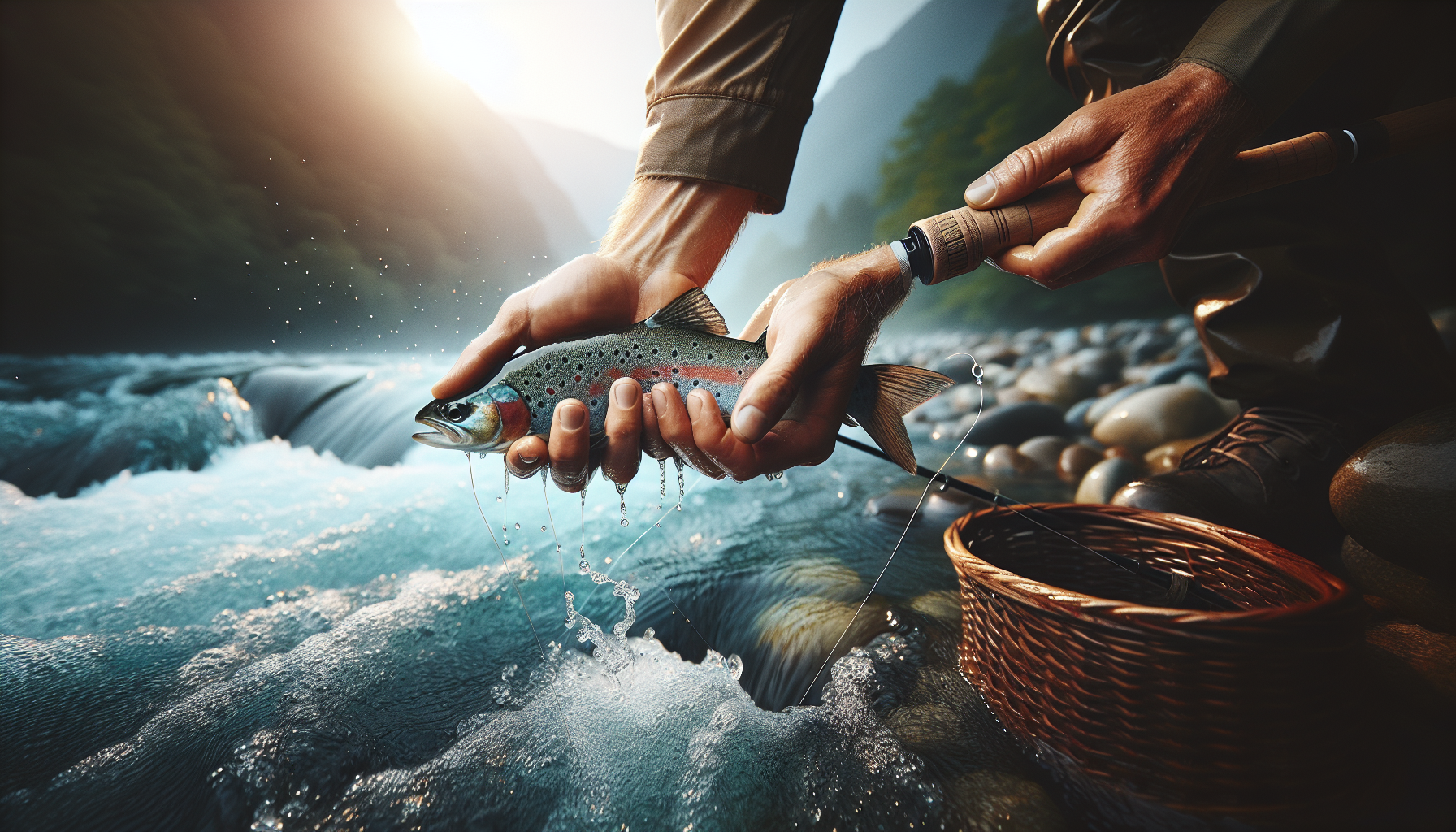
Practical handling guidance follows directly from science. Use barbless hooks or pinch barbs to shorten release time. Fight fish firmly with tackle matched to the species instead of prolonging exhaustion on undersized gear. Keep fish in the water during release. Wet hands before contact to protect the mucus layer. Avoid squeezing the abdomen or gills. Do not beach fish on hot rocks or dry gravel. For migratory species, especially during spawning runs, minimizing air exposure is critical. Scientific studies vary by species and conditions, but the overall direction is clear: shorter fight times and minimal handling reduce sublethal stress and delayed mortality.
Pressure management is another science-driven issue. Social media can concentrate anglers on fragile reaches, increasing trampling, bank erosion, redd disturbance, and repeated capture of the same fish. Managers increasingly use permit systems, seasonal closures, walk-in access design, and educational campaigns to spread use and protect vulnerable stocks. On heavily pressured fisheries, creel and effort data can justify limiting commercial guiding days, adjusting stocking densities, or setting sanctuary areas around thermal refuges. Ethical fly fishing conservation therefore includes behavior change. Science tells anglers not just whether a fish can be caught, but whether it should be targeted under current conditions.
Regulations, hatcheries, and wild fish management
Regulations are often the most visible conservation tool, but their effectiveness depends on matching the rule to the biological problem. Bag limits reduce harvest where harvest is the main pressure. Slot limits protect large, fecund fish while still allowing some take. Seasonal closures protect spawning fish or vulnerable post-spawn recovery periods. Gear restrictions, including artificial flies and single-hook rules, can reduce deep hooking and simplify enforcement. Yet no regulation works in isolation. If habitat is degraded, stricter harvest rules alone may not rebuild a fishery. Science-based management pairs regulations with monitoring so agencies can see whether changes improve abundance, size structure, or recruitment.
Hatcheries require particular caution. They can support put-and-take opportunities, supplement collapsed runs under narrow conditions, and reduce pressure on some wild stocks, but they also bring tradeoffs. Extensive hatchery influence may reduce wild genetic fitness, increase competition, spread disease risk, and mask underlying habitat problems. The consensus among wild fish managers is straightforward: hatcheries are not substitutes for intact habitat and self-sustaining reproduction. In trout and salmon management, the most successful long-term conservation programs typically prioritize wild fish, native strain protection, and reconnection of historical habitat. Where stocking continues, managers should use clear objectives, genetic safeguards, marking programs, and post-release evaluation rather than assuming more fish in a truck means a healthier fishery.
| Conservation tool | Primary purpose | Best use case | Key limitation |
|---|---|---|---|
| Bag and size limits | Control harvest pressure | Fisheries with sustainable but vulnerable take | Weak if habitat is the main bottleneck |
| Seasonal closures | Protect spawning or heat-stressed fish | Redd protection and summer thermal events | Requires compliance and clear communication |
| Habitat restoration | Improve survival and reproduction | Streams with sediment, warming, or disconnection issues | Benefits may take years to fully appear |
| Hatchery stocking | Provide angling opportunity or short-term supplementation | Urban fisheries or tightly managed recovery contexts | Can undermine wild fish goals if misused |
Wild fish management is ultimately about resilience. Wild populations adapt to local hydrology, food webs, predators, and seasonal extremes. When conservation plans protect life-history diversity, such as resident and migratory forms within the same system, they preserve the biological flexibility that helps fisheries survive droughts, floods, and ocean variability. For fly anglers, supporting wild fish management often means backing harder decisions today in exchange for healthier fisheries tomorrow.
Climate change, invasive species, and the next generation of conservation efforts
The future of fly fishing conservation is increasingly defined by climate adaptation. Coldwater species face shrinking thermal habitat, altered snowpack, earlier runoff, longer low-flow periods, and more severe wildfire impacts. Science helps managers identify climate refugia, the spring-fed tributaries, deep pools, shaded reaches, and groundwater-influenced segments that remain cool enough for survival during heat waves. Protecting these areas is one of the highest-value actions available. Agencies now deploy continuous temperature loggers, remote sensing, and hydrologic modeling to find vulnerable reaches and prioritize restoration. In my experience, the best climate response plans are specific: secure instream flows, reconnect floodplains, restore riparian shade, remove migration barriers, and trigger temporary closures when thresholds are exceeded.
Invasive species add another layer of complexity. New Zealand mudsnails, didymo, whirling disease, zebra mussels, and nonnative fish can alter food webs and undermine native populations. Science informs both prevention and response. Cleaning gear, drying waders, avoiding felt soles where prohibited, and following decontamination protocols are not symbolic acts; they reduce spread risk. Managers also use eDNA sampling to detect invasive species before they become widespread, giving agencies a chance to act earlier and more cheaply. Native fish conservation in the American West, for instance, often depends on barrier strategies, selective removal of nonnative trout, and careful broodstock management to protect cutthroat lineages.
Conservation efforts work best when anglers are active participants in data collection and stewardship. Citizen science programs, redd counts, insect monitoring, river cleanups, and watershed group volunteering can expand agency capacity, especially where budgets are limited. The key is structure. Useful volunteer data follows standardized protocols, quality checks, and clear reporting methods. Anglers should also support organizations that operate at watershed scale, including trout and salmon habitat groups, land trusts, and local river alliances. If this hub page has one central lesson, it is that conservation and ethics are inseparable from science. Strong fisheries come from evidence-based habitat protection, responsible regulations, wild fish priorities, careful hatchery use, climate adaptation, and everyday angler choices rooted in biology. The most effective next step is simple: learn the science of your home water, follow condition-based ethics, and invest time or funding in conservation efforts that measure outcomes rather than intentions.
Frequently Asked Questions
Why is science so important in fly fishing conservation?
Science is important in fly fishing conservation because it replaces assumptions with evidence. Anglers, guides, biologists, and land managers may all care deeply about fish and rivers, but good intentions alone do not always lead to the best outcomes. Science provides structured observation, repeatable testing, long-term monitoring, and measurable benchmarks that help conservation efforts focus on what actually works. Instead of relying on anecdote, tradition, or isolated experiences on the water, managers can use data on fish populations, water temperature, streamflow, insect abundance, spawning success, and habitat condition to make smarter decisions.
In practical terms, science helps answer essential questions. Are trout populations increasing or declining? Is a stream section producing wild fish naturally, or is it being artificially supported by stocking? Are warmer summer temperatures stressing fish enough to justify seasonal closures? Is a habitat restoration project improving spawning habitat, or simply changing the look of the river without meaningful biological benefit? These are not questions that can be answered well through guesswork. Scientific methods help identify causes, measure results, and refine management over time.
Science also improves accountability. When conservation groups, agencies, and communities invest time and money into habitat restoration, access improvements, fish passage projects, or regulation changes, they need to know whether those actions are delivering real ecological gains. Data-driven conservation makes it possible to compare conditions before and after a project, track trends over multiple years, and adjust strategies if expected results do not appear. That kind of adaptive management is one of the biggest reasons science plays such a central role in modern fly fishing conservation.
How do biologists use science to protect fish populations and river ecosystems?
Biologists use science by collecting field data, analyzing patterns, and translating what they learn into practical management actions. Their work often begins with monitoring fish populations through surveys such as electrofishing, netting, tagging, spawning counts, and population estimates. These methods help reveal how many fish are present, which species are thriving or struggling, how different age classes are represented, and whether fish are reproducing successfully in the wild. When these surveys are repeated over time, they show trends that can guide regulation changes, restoration priorities, and watershed planning.
River ecosystems are more than just fish, so biologists also study the broader environmental conditions that support healthy fisheries. They measure water temperature, dissolved oxygen, sediment loads, nutrient levels, streamflow, habitat complexity, riparian vegetation, and aquatic insect communities. If a trout stream begins to lose quality, the root cause may not be obvious at first. Science helps identify whether the issue is warming water, reduced flows, blocked migration routes, bank erosion, excess sediment, pollution, disease, or degraded spawning habitat. Once the main stressors are understood, managers can target solutions more effectively.
Biologists also use scientific modeling and long-term datasets to anticipate future risks rather than simply reacting to damage after it happens. For example, they may use climate data to forecast thermal stress on coldwater fisheries, or genetic studies to determine whether isolated fish populations are losing resilience. In many watersheds, science informs decisions about stream restoration design, dam removal, culvert replacement, land-use planning, and harvest regulations. The end goal is not just to maintain fish numbers for the next season, but to sustain functioning ecosystems that can support wild fish populations over the long term.
What role does science play in decisions about catch-and-release, regulations, and angling ethics?
Science plays a major role in shaping responsible fishing practices by showing how fish respond to angling pressure under different conditions. Catch-and-release is often promoted as a conservation tool, but scientific research helps clarify when it is highly effective and when it may offer less protection than anglers assume. Studies on hooking injury, fight time, handling stress, water temperature, and air exposure have shown that released fish usually survive best when they are landed quickly, kept in the water as much as possible, handled gently, and released during cooler conditions. That research has directly influenced best-practice guidance for fly anglers.
Regulations are also stronger when they are based on biological evidence. Size limits, seasonal closures, gear restrictions, bag limits, and special management zones are not just policy choices; ideally, they are responses to measurable ecological conditions. If spawning fish are vulnerable during certain months, science may support a temporary closure. If high summer water temperatures increase post-release mortality, agencies may implement hoot owl restrictions or time-of-day limits. If a river supports a fragile wild trout population, barbless-only rules or catch-and-release sections may be justified by monitoring data rather than general preference.
Science also strengthens angling ethics by giving them a factual foundation. Ethical norms in fly fishing are often discussed in terms of respect for fish and rivers, but research helps define what respectful behavior looks like in practice. For example, anglers may choose to stop fishing during extreme heat, avoid targeting fish concentrated on redds, or limit repeated pressure on stressed populations because scientific evidence shows the consequences of those actions. In that sense, science does not replace ethics; it makes ethical choices more informed, specific, and effective.
How does science influence habitat restoration and watershed management in fly fishing conservation?
Science influences habitat restoration by helping conservationists understand what a river needs biologically, not just what looks appealing visually. Effective restoration starts with diagnosis. Before adding woody structure, stabilizing banks, reconnecting floodplains, planting riparian vegetation, or improving fish passage, managers need to understand the underlying causes of degradation. A stream may be suffering from excessive sediment, altered flow patterns, channelization, poor floodplain connection, livestock impacts, warming temperatures, or barriers that prevent migration. Scientific assessment helps identify the main limiting factors so restoration money is spent on actions that address root problems rather than symptoms.
Watershed management benefits from science because rivers function as connected systems. A productive trout reach may still decline if upstream land use increases runoff, if road crossings block migration, or if water withdrawals reduce summer flow. Scientific watershed analysis helps managers see those connections across the entire landscape. Hydrology, geomorphology, fisheries biology, and water-quality monitoring all contribute to a clearer picture of how the watershed is functioning and where intervention will have the greatest benefit. This broad perspective is especially important because local fixes often fail when larger watershed-scale pressures remain unaddressed.
Science also helps evaluate whether restoration projects are actually successful. A riverbank planting project may look good immediately, but real success depends on measurable outcomes such as cooler water, increased insect production, improved juvenile fish survival, stronger spawning recruitment, or greater habitat complexity over time. Post-project monitoring is essential. It allows biologists and conservation groups to compare conditions before and after restoration, learn from setbacks, and adapt future work based on results. In fly fishing conservation, the strongest restoration efforts are not one-time construction projects; they are ongoing, science-guided commitments to healthier watershed function.
Can science help balance fishing opportunity with long-term conservation?
Yes, and that balance is one of science’s most valuable contributions to fly fishing conservation. Healthy fisheries management is not simply about restricting angling whenever concerns arise, nor is it about maximizing access without regard for ecological limits. Science helps managers find the middle ground by identifying how much pressure a fishery can sustain, when fish are most vulnerable, and which management tools can protect populations while preserving meaningful fishing opportunities. This is especially important in popular trout, salmon, and steelhead waters where social, economic, and ecological interests all overlap.
For example, scientific monitoring can show whether a fishery is driven by strong wild reproduction, dependent on stocking, or stressed by warming water and declining flows. Those distinctions matter. A river with robust natural recruitment may support different regulations than a river where wild fish are struggling. In some cases, science supports more conservative rules, such as seasonal closures or reduced harvest. In others, it may show that habitat improvements, flow management, or targeted regulation changes can maintain both fish health and quality angling access. The point is not to treat every fishery the same, but to tailor management to actual conditions.
Science also supports long-term resilience, which ultimately protects fishing opportunity rather than limiting it. When agencies and conservation groups use evidence-based management, they are better able to anticipate problems like climate stress, habitat fragmentation, disease outbreaks, and overuse before those problems trigger severe declines. That forward-looking approach helps sustain fisheries for future generations of anglers. In the broadest sense, science allows fly fishing conservation to move beyond reactive crisis management and toward thoughtful stewardship that keeps rivers fishable, fish populations healthy, and public trust strong over time.