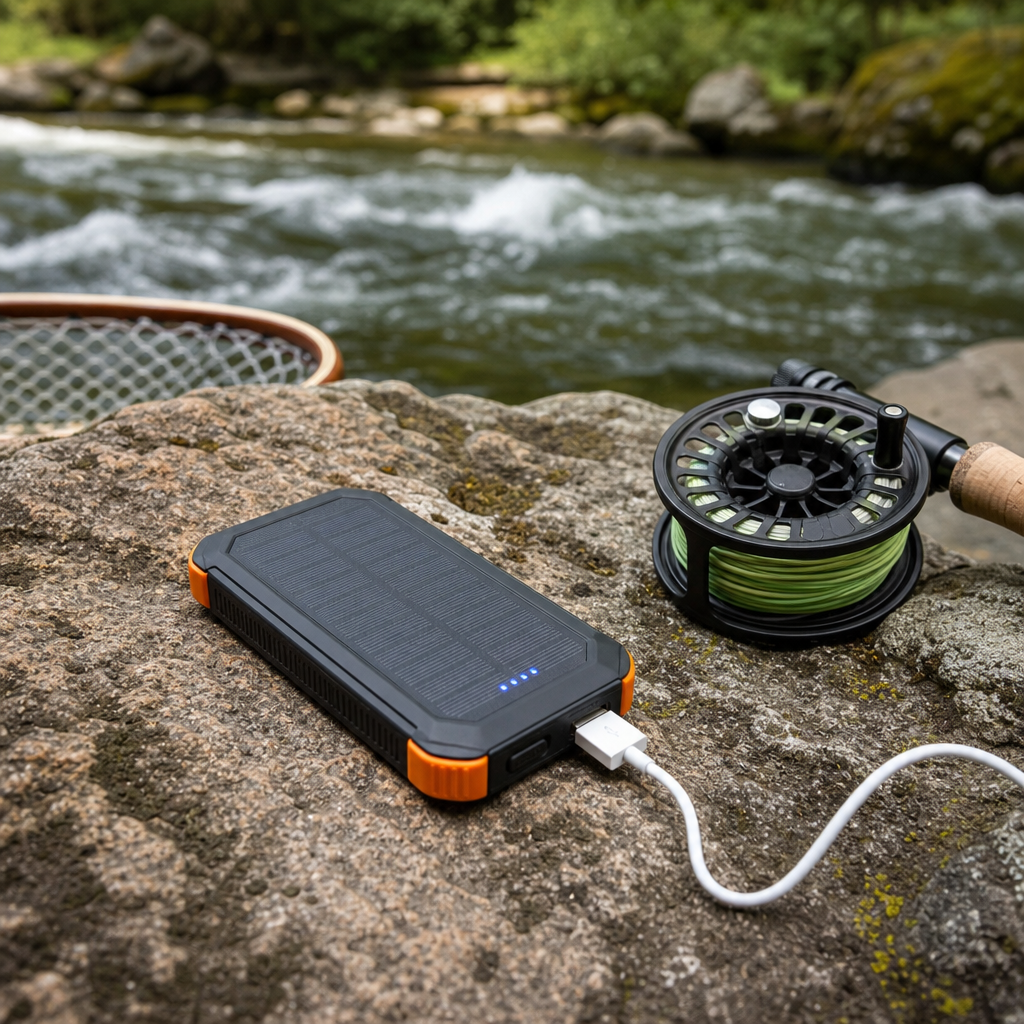
Reliable portable power has become part of modern fly fishing, especially for anglers who carry phones for navigation, action cameras for footage, rechargeable headlamps for dawn launches, and heated layers for late-season wading. A review of the top fly fishing power banks is no longer just a gadget roundup; it is a practical guide to keeping essential electronics running in wet, remote, and often cold conditions. In this technology reviews hub, the focus is not simply battery capacity on a box. The real question is which power banks perform well on the river, in drift boats, at backcountry camps, and during full-day sessions when charging options are limited.
For fly anglers, a power bank is a portable rechargeable battery pack with output ports, usually USB-A, USB-C, or both, that can recharge other devices away from mains electricity. The best fly fishing power banks balance milliamp-hour capacity, output wattage, weather resistance, weight, recharge speed, and packability. Capacity tells you roughly how much energy the bank stores, though real-world delivered power is lower because of voltage conversion losses. Output determines whether the bank can fast-charge a phone, run a camera, or support higher-draw devices such as some heated vests. Durability matters because river use introduces moisture, grit, shock, and temperature swings that quickly expose weak construction.
I have tested battery packs in chest packs, raft bags, truck kits, and camp setups, and the biggest mistake anglers make is buying only by advertised capacity. A 20,000mAh unit sounds ideal until it weighs a pound, charges slowly, and lacks sealing around ports. On the other hand, tiny 5,000mAh packs disappear into a sling bag but may barely cover a phone and a headlamp during a long float. This article matters because dependable power supports safety, communication, navigation, and content capture. It also serves as the central guide within product reviews and recommendations, connecting the broader technology reviews category to the gear choices most useful on the water.
Good power-bank selection starts with understanding the demands of typical fly fishing electronics. Most smartphones have batteries between roughly 3,000mAh and 5,000mAh, action cameras often run under 2,000mAh per battery, GPS communicators sip power but may need topping up over several days, and modern USB-rechargeable headlamps vary widely. Cold weather lowers battery efficiency, while wet storage can corrode poorly protected ports. Because of that, the best review criteria include real charging efficiency, USB-C Power Delivery support, pass-through limitations, IP-rated resistance when available, and the manufacturer’s reputation for cell quality and safety circuitry. Those details separate a trustworthy field tool from an inexpensive accessory that fails when the weather turns.
What Makes a Power Bank Good for Fly Fishing
The best fly fishing power bank is compact enough to carry all day, powerful enough to charge your most important devices, and rugged enough to tolerate the river environment. In practice, that means prioritizing 10,000mAh to 20,000mAh capacity for most anglers, USB-C output of at least 18W for modern phones, and a case design that resists scratches and minor impacts. If you fish in skiffs, rafts, or kayak setups, textured housings and covered ports help because gear is constantly shifting, bouncing, and getting splashed. If you hike to alpine streams, every ounce matters, so a slimmer 10,000mAh model may outperform a heavier high-capacity brick simply because you will actually carry it.
Charging speed deserves special attention. A power bank with USB-C Power Delivery can top up an iPhone, Android phone, or satellite communicator noticeably faster than older low-output packs. I have seen many anglers bring a large battery that technically works yet takes so long to recharge devices that they never fully recover between morning and evening use. Fast input matters too. A bank that accepts 18W or higher input can be recharged overnight in a motel, from a truck inverter, or during a lunch stop, whereas older micro-USB models can be frustratingly slow. For a hub article on technology reviews, this is the baseline feature set every later, model-specific review should evaluate.
Top Fly Fishing Power Banks Compared
Several brands consistently stand out for anglers because they combine proven battery management with practical field design. Nitecore is popular among ounce-conscious backcountry users. Anker remains the safest all-around recommendation for broad availability, reliable electronics, and strong warranty support. BioLite appeals to anglers who also camp and want integrated utility features like area lighting on select models. Goal Zero has a strong outdoor reputation, though some units trade compactness for campsite versatility. Dark Energy targets ruggedness and impact resistance, which matters for rough boat decks and travel-heavy use. The right choice depends on whether your priority is ultralight carry, all-day capacity, or durability first.
| Model | Best Use | Typical Strength | Main Tradeoff |
|---|---|---|---|
| Anker 523 PowerCore Slim 10K PD | Day trips | Balanced size and fast phone charging | Limited reserve for multi-device weekends |
| Anker 325 Power Bank 20K | Long floats and travel | High capacity at reasonable price | Heavier in a vest or sling |
| Nitecore NB10000 Gen 2 | Backcountry hikes | Very low weight with strong output | Higher cost for capacity |
| BioLite Charge 40 PD | Camp-based fishing | Good capacity and outdoor-friendly build | Bulkier than ultralight options |
| Dark Energy Poseidon Pro | Wet, rough environments | Rugged construction and water resistance | Usually heavier and pricier |
The Anker 523 PowerCore Slim 10K PD is one of the easiest recommendations for anglers who fish day trips and need dependable fast charging in a slim package. It typically supports USB-C Power Delivery around 20W, enough for most phones, and its form factor slides neatly into a chest pack pocket. In my experience, this class of battery comfortably handles a phone recharge plus smaller accessories such as a headlamp or camera battery charger. The limitation is reserve capacity. If you use your phone constantly for maps, photos, and emergency communication, 10,000mAh may feel tight by the end of a cold day.
The Anker 325 20K class is better for drift-boat guides, road-trip anglers, and anyone carrying multiple devices. Its advantage is simple: more stored energy for roughly two to four smartphone charges depending on phone size and efficiency losses. It is not elegant in a minimalist pack, but it is dependable in truck kits and waterproof duffels. The Nitecore NB10000 Gen 2 takes the opposite approach. It is exceptionally light, using carbon-fiber-reinforced construction to cut weight dramatically versus many competitors. For anglers hiking miles into backcountry water, that difference is real. You pay more per unit of capacity, but for mobile fishing, low weight can be the decisive feature.
BioLite’s Charge-series packs fit anglers who blend fly fishing with camping and general outdoor travel. They are typically intuitive to use, charge reasonably fast, and come from a brand that understands camp electronics rather than only office accessories. Dark Energy’s Poseidon line is aimed squarely at abuse resistance. While no power bank should be treated as a dive-rated device unless specifically certified for that purpose, reinforced bodies and stronger seals reduce the chance of failure after rain, spray, or accidental drops. If you regularly fish from saltwater skiffs, jet boats, or rafts where gear gets hammered, ruggedness can outweigh sleek design or marginally better charging speed.
How to Match Capacity and Features to Your Fishing Style
Capacity should be chosen around trip length and device load, not marketing appeal. For local sessions lasting a few hours, 5,000mAh to 10,000mAh is usually enough if the goal is emergency phone power. For full-day walk-and-wade trips with navigation, photography, and USB headlamp use, 10,000mAh is the practical minimum. For weekend camp fishing, guide work, or travel with multiple devices, 20,000mAh makes more sense. Beyond that, larger banks can be useful at base camp, but they become cumbersome on your person. When I pack for remote trout water, I usually separate carry power from camp power rather than forcing one oversized solution into both roles.
Ports and protocols matter as much as raw size. USB-C is now the standard to prioritize because it simplifies cables and usually supports faster input and output. A power bank with both USB-C and USB-A remains useful if you charge older accessories like some lanterns or camera docks. Wireless charging sounds convenient, but for fishing it is often inefficient and awkward because phones need stable placement. Built-in cables can help, yet they can also fail first and are harder to replace. For a technology reviews hub, the plain recommendation is this: choose known brands, USB-C PD support, clear battery indicators, and a case you can grip with wet hands.
Field Testing Factors: Water, Cold, Weight, and Safety
River conditions expose power banks to stresses that spec sheets rarely explain. Water resistance ratings, where provided, are useful but should be interpreted carefully. An IP rating may cover splashes or brief exposure, not prolonged soaking with ports open. I always keep power banks inside a zip pouch or waterproof pocket even when the manufacturer markets them as rugged. Cold is another major factor. Lithium-ion cells lose effective performance as temperatures drop, so a bank that seems ample in summer can underdeliver during winter steelhead trips. Keeping the battery inside an inner pocket or insulated bag preserves output better than leaving it in an external pack compartment.
Weight affects use more than many anglers expect. A heavy 20,000mAh bank is fine in a raft bag, but in a chest pack it shifts load, swings while wading, and competes with fly boxes or water. On technical streams, I prefer lighter power banks paired with a disciplined charging plan, such as topping off my phone at lunch. Safety also deserves direct attention. Reputable banks include protections against overcharge, over-discharge, overcurrent, and overheating. That is not optional. Cheap, no-name battery packs can have inconsistent cell quality and poor thermal management. For travel, remember that most airlines limit lithium battery transport by watt-hours, so check current carrier and regulatory rules before flying with large packs.
Best Buying Advice and Where This Hub Fits
If you want one recommendation for most anglers, buy a 10,000mAh to 20,000mAh USB-C PD power bank from Anker, Nitecore, BioLite, or another proven outdoor-friendly brand, then protect it with a dry pouch. Choose 10,000mAh if you hike far and carry only a phone, headlamp, and small camera. Choose 20,000mAh if you guide, travel, camp, or charge multiple devices. Spend extra for rugged design when fishing from boats or in consistently wet climates. Do not overspend on extreme capacity you will resent carrying, and do not underspec output if your phone or communicator depends on fast recovery during short charging windows.
As the hub article for technology reviews under product reviews and recommendations, this page should anchor deeper coverage of related gear: rechargeable headlamps, solar panels for base camp, USB fly-tying lights, satellite communicators, action-camera batteries, and waterproof charging accessories. Internal links from those topic pages should point back here when readers need a central framework for evaluating portable power. The main takeaway is straightforward: the best fly fishing power banks are not the biggest or the cheapest. They are the models that reliably deliver enough fast, safe power in wet, cold, mobile conditions. Use this guide to shortlist the right battery pack, then match the final choice to how and where you actually fish.
Frequently Asked Questions
What should anglers look for first when choosing a fly fishing power bank?
The most important starting point is not raw capacity alone, but how well the power bank matches real fly fishing conditions. On the water, anglers need a battery that can handle moisture, temperature swings, rough handling, and long hours away from a vehicle or outlet. Capacity still matters, of course, but it should be weighed alongside durability, weather resistance, recharge speed, weight, port selection, and reliability in cold environments. A power bank with a huge advertised mAh rating is not automatically the best choice if it is bulky, poorly sealed, or struggles to deliver stable output when temperatures drop.
For most fly fishing use, a practical range is one that can recharge a phone at least one to three times while still supporting accessories such as a headlamp, GPS device, action camera, or heated vest. Port options are also critical. USB-C Power Delivery is especially useful because it can charge modern phones and some larger devices more efficiently than older USB-A outputs. If an angler carries multiple electronics, it helps to have at least two output ports and enough total wattage to run them without severely slowing charge times.
Build quality deserves close attention. Banks intended for outdoor use should have a sturdy shell, secure port covers if advertised as water-resistant, and a shape that packs easily into a sling, boat bag, or waterproof pouch. A textured exterior can help with grip when hands are wet or cold. Indicators showing remaining battery percentage are usually more helpful than simple four-light systems because they make trip planning easier. In practice, the best fly fishing power bank is one that balances enough usable power with dependable outdoor performance rather than simply winning on paper specifications.
How much battery capacity is actually useful for a full day or weekend of fly fishing?
The right capacity depends on what an angler is powering, but for many day trips a 10,000mAh to 20,000mAh power bank is the sweet spot. A smaller 5,000mAh unit may be enough as an emergency backup for a phone, but once navigation apps, photos, video recording, Bluetooth accessories, and rechargeable lighting enter the mix, that size can feel limited very quickly. A 10,000mAh model is often a solid minimum for anglers who want dependable backup without adding much bulk, while a 20,000mAh model gives far more flexibility for longer outings or for charging more than one device.
It is also important to understand that advertised capacity is not the same as usable delivered power. Energy is lost during voltage conversion and charging, so anglers should expect real-world output to be somewhat lower than the number on the label suggests. In cold weather, effective performance can drop further. That is especially relevant in late fall, winter, or high-elevation fisheries, where both phones and power banks tend to drain faster. If a trip involves filming with an action camera, using maps all day, or running heated gear, moving up in capacity is often the smarter choice.
For weekend fly fishing trips without dependable access to wall charging, many anglers will appreciate the security of a 20,000mAh class bank, especially if they also need to top off a partner’s phone or recharge multiple accessories overnight. The tradeoff is added size and weight. Ultralight wade anglers may prefer a compact bank for mobility, while boat anglers or those fishing from a camp can carry larger units more comfortably. In short, choose capacity based on usage habits, not just the longest possible runtime claim.
Are waterproof or rugged power banks necessary for fly fishing, or is a standard model enough?
A fully rugged or water-resistant power bank is not mandatory for every angler, but it is often a very smart choice for fly fishing. This sport regularly places gear around spray, rain, river crossings, muddy banks, drift boat floors, and damp packs. Even if a battery never gets submerged, repeated exposure to moisture and grit can shorten the life of a standard consumer model. That is why many anglers prefer power banks designed for outdoor use or, at minimum, pair a standard high-quality bank with a waterproof dry bag or protective case.
That said, “waterproof” marketing should be read carefully. Some products are only splash-resistant, while others may have a tested ingress protection rating. A ruggedized shell, sealed seams, and covered ports can add real durability, but those features do not guarantee that the bank can survive full immersion or extended use in heavy rain while plugged in. In fact, charging in wet conditions is generally a bad idea regardless of rating, because moisture at the cable connection can interfere with safe power delivery and damage both the bank and the device being charged.
For many fly fishers, the ideal setup is a power bank with above-average toughness combined with disciplined storage habits. Keep it in an internal pocket, a sealed pouch, or a dry storage compartment, and only charge devices when conditions are relatively dry. If an angler frequently fishes from kayaks, rafts, skiffs, or in consistently wet climates, paying more for a truly rugged unit makes more sense than it might for a fair-weather trout angler. The key is matching the product to the environment rather than assuming all fishing situations require the same level of protection.
How do cold weather and remote fishing conditions affect power bank performance?
Cold weather can have a major impact on battery performance, and this matters more in fly fishing than many buyers realize. Lithium-based batteries do not perform as efficiently in low temperatures, so both the power bank and the devices it charges may show reduced runtime. A bank that feels more than adequate in summer may deliver noticeably less usable power during steelhead season, winter tailwater trips, or alpine mornings. This is one reason article reviews that focus only on capacity numbers can miss what anglers actually experience in the field.
In remote settings, reliability becomes just as important as capacity. A power bank may be the only backup source for a phone that doubles as map, safety tool, camera, weather station, and communication device. If an angler is miles from the nearest road, a weak battery system becomes more than an inconvenience. It can compromise navigation and trip safety. That is why dependable output, strong battery retention, and the ability to recharge devices efficiently matter so much in fly fishing reviews.
To improve cold-weather performance, anglers should store power banks close to the body or inside an insulated pack pocket rather than leaving them exposed on a boat deck or in an outside pouch. Charging devices during warmer parts of the day can also help. Cables should be checked carefully, because stiff or low-quality cords often become a weak point in cold conditions. For truly remote trips, many anglers prefer carrying a little more battery reserve than they think they need. In the field, extra margin is often worth far more than shaving a few ounces from the pack.
Can a fly fishing power bank safely charge phones, cameras, headlamps, and heated gear on the same trip?
Yes, a good power bank can safely support multiple device types on the same trip, but only if its output specifications match the devices being used. Phones, action cameras, rechargeable headlamps, and GPS units are usually straightforward loads for a modern battery pack. Heated vests, hand warmers, or other power-hungry wearables can be more demanding, especially if they require higher wattage or sustained output over a longer period. Before assuming one bank can do everything, anglers should check both the supported charging protocols and the maximum wattage available from each port.
USB-C Power Delivery is especially valuable here because it improves compatibility and charging speed for many modern devices. Some power banks can charge a phone quickly but provide much slower output from secondary ports, which becomes noticeable when multiple accessories are connected. Others may split available wattage across ports, reducing charging efficiency. For anglers carrying several electronics, a review should examine not just how many ports a bank has, but how well it performs when more than one device is connected at the same time.
Safety also depends on using quality cables and avoiding charging in soaked conditions. Most reputable power banks include protections against overcharging, short circuits, overheating, and excessive current draw, but that does not replace common sense on the water. Keep connections dry, avoid stuffing an actively charging bank into a sealed space where heat can build up, and do not rely on a lightweight emergency battery to run high-drain gear for extended periods. In real-world fly fishing use, the best power banks are the ones that deliver stable, predictable charging across the devices anglers actually bring, not just the ones with the biggest numbers on the package.