Best fly fishing solar chargers solve a simple problem that becomes critical on the water: keeping essential electronics powered when outlets are far away, daylight shifts quickly, and wet conditions punish cheap gear. In fly fishing, a solar charger usually means a portable panel, a power bank with integrated panels, or a panel-and-battery kit that can recharge phones, headlamps, GPS units, cameras, satellite messengers, and fish-finding accessories during multiday trips. The best models for anglers are not just compact. They must balance charging speed, weather resistance, packability, attachment options, and battery compatibility. That matters because modern fly fishing increasingly depends on technology. I have tested chargers clipped to drift boat frames, lashed to raft coolers, and spread across gravel bars during lunch breaks, and the wrong unit always fails in the same ways: weak output in partial sun, poor cable management, fragile ports, or unrealistic advertised wattage. A strong charger reduces risk, extends time on the water, and supports safer trip planning. This hub article covers the core technology reviews every angler should understand before buying. It explains charger types, panel performance, battery pairings, durability factors, and use-case recommendations so you can choose confidently and connect to deeper product reviews across this equipment category.
What Makes a Solar Charger Good for Fly Fishing
A good fly fishing solar charger converts limited daylight into reliable, usable power without adding unnecessary bulk. For this category, five criteria matter most: true wattage, output options, portability, weather protection, and charging stability. True wattage refers to how much power a panel can actually deliver in field conditions, not just the maximum figure printed on the box. A 20-watt folding panel from a reputable brand such as Goal Zero, BioLite, BigBlue, or Anker often outperforms a no-name 28-watt panel because better cells, better voltage regulation, and lower conversion losses matter more than marketing numbers. In practical use, anglers should expect slower charging than home wall adapters. Cloud cover, panel angle, summer heat, and shadows from canyon walls all cut performance.
Output options determine compatibility. USB-A still works for many accessories, but USB-C with Power Delivery is becoming the best standard because newer phones, batteries, and emergency communicators charge faster and more efficiently through it. Some larger panels include DC barrel outputs for dedicated power stations, but most fly anglers do better with USB charging into a rugged power bank. Portability is more nuanced than weight alone. A charger that folds flat and straps securely to a pack can be more useful than a lighter panel that flaps in wind. On-stream durability also matters. IP ratings, sealed junction boxes, reinforced grommets, and abrasion-resistant fabric make a measurable difference after repeated exposure to spray, mud, and boat decks.
Charging stability is the feature many buyers overlook. Cheap chargers disconnect and reconnect constantly when clouds pass, forcing phones to stop charging or wake repeatedly. Better panels maintain steadier voltage and pair well with pass-through-capable battery packs that buffer inconsistent sunlight. For most anglers, the ideal setup is a 15- to 28-watt folding panel combined with a 10,000 to 20,000 mAh power bank. That system weighs less than a large power station, survives travel more easily, and keeps core electronics running for a weekend or longer.
Types of Fly Fishing Solar Chargers and Who Should Buy Them
There are three main product types in this technology review category, and each fits a different style of fly fishing. First are integrated solar power banks. These devices combine a battery and tiny solar panel in one housing. They look convenient, but I rarely recommend them as a primary charging tool for anglers. The built-in panels are too small to recharge the battery meaningfully in a day. They work best as emergency backup batteries that can trickle charge in prolonged sun, not as serious energy harvesters. If you fish local water, want one compact item in a sling pack, and only need to top up a phone for maps or photos, an integrated model can be adequate.
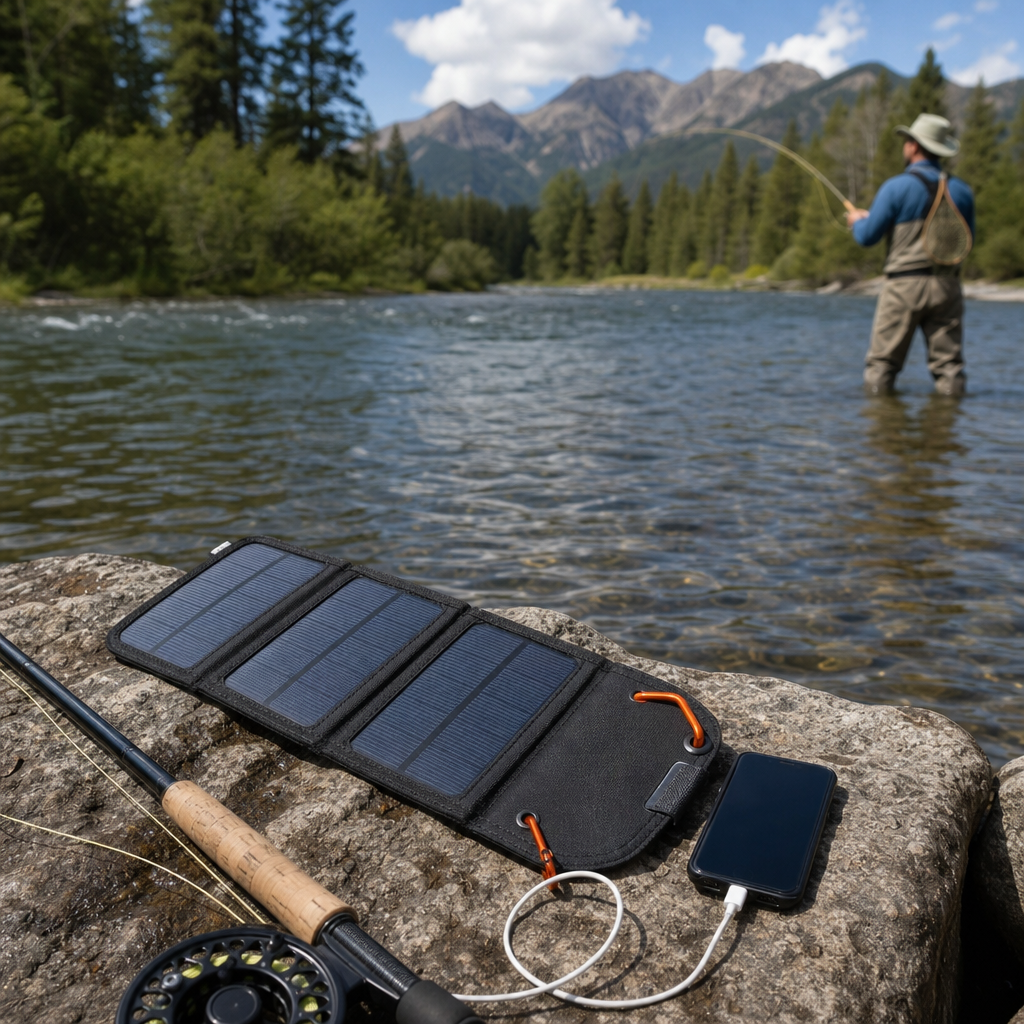
Second are folding solar panels. These are the best fit for most anglers because they collect far more energy and remain easy to pack. A quality 20-watt panel can charge a phone directly in strong sun or replenish a power bank while you hike or stop for lunch. This style suits walk-and-wade anglers, backcountry anglers, and traveling fly fishers who value low weight and flexibility. Many fold into book-style formats with carabiners or loops that attach to packs, rafts, or camp tables.
Third are panel-plus-battery systems, sometimes built around larger battery banks or compact power stations. These make sense for float trips, base camps, or content-heavy anglers carrying cameras, drones, action cams, and satellite communicators. The benefit is energy buffering. Instead of depending on perfect midday sun, you store power when conditions are good and use it later. The drawback is cost and bulk. For technical trout anglers hiking several miles into alpine water, this category is often excessive. For guided trips, overland camp setups, or multi-angler boat days, it can be the most dependable option.
| Charger Type | Best For | Main Advantage | Main Limitation |
|---|---|---|---|
| Integrated solar power bank | Day trips, emergency backup | One compact device | Very slow solar recharge |
| Folding solar panel | Most fly anglers | Better real charging speed | Needs separate battery for best results |
| Panel plus battery system | Float trips, base camps, media-heavy travel | Highest reliability and stored energy | More weight and cost |
How Solar Panel Performance Actually Works on the Water
Solar charger performance depends on more than wattage. Cell quality, controller design, panel temperature, sun angle, and shading all affect results. Most portable chargers use monocrystalline cells because they offer higher efficiency than older polycrystalline designs. In field conditions, however, efficiency claims can be misleading. A panel rated at 23 percent conversion efficiency may still underperform if the USB regulator is poor or the fabric frame prevents optimal orientation. On the water, orientation is a major variable. Laying a panel flat on a raft or backpack captures less energy than angling it directly toward the sun. Even a small angle adjustment can noticeably improve output during early morning or late afternoon.
Heat also reduces efficiency. Panels in full summer sun get hot, and electrical output drops as temperature rises. That is why a ventilated panel mounted with slight airflow can outperform one lying flat on a dark dry bag. Shade is worse. A small shadow across one section of a folding panel can dramatically cut current. In narrow river canyons, tree-lined banks, or drift boat interiors, this is a common reason charging seems disappointing. USB charging standards matter too. A panel may technically output five volts, but if current fluctuates sharply, phones may slow charge or reject the source. Reputable panels use smarter controllers to stabilize output under changing light.
Real-world expectations should be specific. In strong summer sun, a quality 20-watt panel can often add a meaningful phone charge over a long lunch break or refill a 10,000 mAh battery across several good daylight hours. In broken clouds, performance may drop below half. During shoulder seasons with low sun angles, output falls again. The practical takeaway is simple: buy more panel than your minimum estimate suggests, and rely on the panel to charge a battery first. That buffer turns unpredictable sunlight into more dependable power at camp and on the river.
Battery Pairing, Ports, and Charging Strategy
The best fly fishing solar chargers are only half of the system. The other half is the battery you pair with them and the charging habits you follow. For most anglers, a rugged 10,000 mAh or 20,000 mAh power bank offers the best balance of weight and useful capacity. A 10,000 mAh bank usually covers a phone, headlamp, and satellite messenger for a weekend if used carefully. A 20,000 mAh bank gives more margin for cold weather, frequent photo use, or multiple devices. I recommend choosing a bank from a trusted manufacturer with USB-C input and output, low-current mode for smaller electronics, and clear battery-level indicators.
Pass-through charging can be helpful but should not be overvalued. Some batteries allow simultaneous charging from the panel while powering another device. In principle that sounds efficient. In practice, constant power fluctuations from sunlight can stress poorly designed banks or interrupt device charging. Better strategy is staged charging: charge the battery during peak daylight, then charge devices from the battery later. This minimizes disconnects and protects your electronics from unstable input.
Port selection matters more than many anglers realize. USB-C Power Delivery improves charging speed for modern phones and some GPS devices. USB-A remains useful for older headlamps, action cameras, and accessories. If you carry an inReach, phone, watch, and GoPro, count ports and cable types before buying. Also consider cable durability. Short braided cables with reinforced strain relief perform better in packs and boats than long bargain cables that kink or corrode. A waterproof pouch for cords and adapters is worth carrying because many charging problems blamed on panels are really caused by damaged connectors, wet ports, or low-quality cables.
Battery chemistry and cold weather behavior deserve attention too. Lithium-ion banks lose effective performance in low temperatures, and dawn starts in mountain environments expose that weakness quickly. Keep the battery in a jacket pocket or sleeping bag overnight, not clipped outside your pack. The charger can stay out in the sun; the battery should be protected from extreme cold and moisture whenever possible.
Durability, Weather Resistance, and Mounting in Fishing Conditions
Fly fishing is harder on electronics than many general outdoor reviews admit. Water exposure is obvious, but the bigger threats are repeated dampness, silt, impact, UV exposure, and constant packing and unpacking. A charger that survives a weekend car-camping trip may fail quickly in a drift boat or on a remote walk-and-wade route. When I evaluate solar chargers for anglers, I check stitch quality, hinge strength on folding panels, reinforcement around grommets, and how ports are protected when not in use. Port covers help, but they are only useful if they seal tightly and stay attached after repeated opening.
Weather resistance should be viewed realistically. Many portable panels are marketed as weather-resistant rather than fully waterproof. That distinction matters. A brief splash or light rain usually is fine; submersion or hours of driving rain are not. For fly fishing, you should assume the panel can operate in damp conditions but still needs sensible handling. Mounting choices can extend lifespan. Secure attachment to a pack, raft frame, or camp chair prevents bending stress and abrasion. Avoid letting the panel whip in wind; that damages fabric seams and cable junctions over time.
Weight distribution matters on long approaches. A charger mounted high on a backpack can improve sun exposure but may snag brush or shift balance. On boats, deck placement increases exposure but invites stepped-on corners and wet connectors. A better setup is often temporary deployment during breaks combined with protected storage while actively fishing. This is especially true for premium panels whose electrical components are excellent but whose fabric exteriors still wear under rough treatment.
Named standards and design cues provide useful signals. ETFE lamination generally resists wear better than older PET surfaces. IPX4 or similar splash resistance is better than no stated protection, though not equivalent to a waterproof battery case. Corrosion-resistant port housings, integrated storage pockets, and reverse-current protection are features worth paying for because they address failure modes that anglers encounter repeatedly.
Best Use Cases and Buying Recommendations by Trip Style
The best fly fishing solar charger depends on how and where you fish. For day trips, skip solar unless you regularly depend on your phone for navigation, photography, or emergency communication. A small conventional power bank is usually enough. For anglers wanting solar on day trips anyway, a compact folding panel around 15 watts paired with a 10,000 mAh battery is the most practical solution. It gives emergency flexibility without becoming dead weight.
For weekend walk-and-wade trips, a 20-watt folding panel and a 10,000 to 20,000 mAh battery is the sweet spot. This setup supports a phone, headlamp, GPS watch, and communicator with room for moderate camera use. For backcountry trout fishing, prioritize low weight, strong attachment points, and stable USB-C output over oversized watt claims. For raft, canoe, or drift boat trips, move up to a 20- to 28-watt panel and a larger battery bank. Boats offer more room, but they also expose gear to more splash and impact, so durability rises in importance.
For destination travel, choose chargers from brands with established warranty support and documented output testing. Airline rules generally allow power banks in carry-on luggage, but capacity limits and airline policies should always be checked in advance. Folding panels are easier to pack than rigid ones and less likely to trigger frustration at camp because they fit around other gear. If you create content on the water, run mapping apps continuously, or carry a satellite messenger for safety, do not buy the cheapest charger available. Consistent output is worth more than a theoretical extra few watts.
This hub page should guide your next step across the broader product reviews and recommendations section. Use it to narrow the technology class you need, then compare detailed reviews by wattage, battery capacity, port selection, and durability. The right charger keeps your phone alive for maps, your emergency communicator ready, your camera powered, and your trip less dependent on luck. Choose a quality folding panel, pair it with a reliable battery bank, and test the system before your next river day. That simple preparation turns solar charging from a gimmick into dependable fishing equipment.
Frequently Asked Questions
What should I look for in the best fly fishing solar charger?
The best fly fishing solar charger should match the way you actually fish, not just look impressive on a spec sheet. Start with charging type. Some anglers do best with a folding solar panel that charges a separate power bank, while others prefer an all-in-one solar power bank for simplicity. A panel-and-battery kit is often the most practical setup for multiday trips because it lets you collect solar energy during the day and store it for use after dark, when you are most likely charging a phone, headlamp, GPS unit, or satellite messenger.
Durability matters just as much as power output. Fly fishing environments are rough on electronics, with spray, rain, mud, sand, and repeated packing and unpacking. Look for weather-resistant materials, reinforced stitching, covered USB ports, and a design that can handle being strapped to a pack, raft, or boat bag. Lightweight construction is helpful for walk-in access points, but not at the expense of build quality. Cheap panels often advertise high wattage but perform poorly in real-world conditions, especially with partial cloud cover or inconsistent sun angles.
You should also pay close attention to battery capacity, output options, and charging speed. If you only need occasional top-offs for a phone, a smaller setup may be enough. If you are powering a headlamp, action camera, fish finder accessory, or emergency communication device over several days, a larger battery bank and a more efficient panel are worth the extra size and cost. USB-A and USB-C outputs are now standard expectations, and anglers using newer phones or battery packs should strongly prefer USB-C input and output for faster, more reliable charging. In short, the best model combines dependable solar collection, safe storage, water-friendly construction, and practical portability for long days on the water.
Are solar chargers reliable enough for multiday fly fishing trips?
Yes, but only if you choose the right type of charger and use it with realistic expectations. Solar chargers can be very reliable on multiday fly fishing trips when they are treated as part of a complete power strategy rather than a magic solution. Bright sun, long summer daylight, and open river corridors can make portable solar highly effective, especially for maintaining charge on low-to-moderate draw devices like phones, GPS units, headlamps, and satellite messengers. However, tree cover, canyon walls, shifting weather, and short winter days can dramatically reduce performance.
The most reliable setup for anglers is usually not a tiny power bank with built-in solar panels. Those integrated panels are often too small to generate meaningful power quickly. They can be useful for emergency trickle charging, but they are usually not the best primary power source for serious fly fishing trips. A better choice is a dedicated folding panel paired with a quality battery bank. That combination allows you to harvest energy whenever the sun is available and then charge devices later from stored power, which is far more dependable than plugging a phone directly into a panel while light conditions change.
To make a solar charger reliable in the field, think in terms of energy budget. Know what devices you need, how often you use them, and how much battery each one consumes per day. Keep devices in airplane mode when possible, reduce screen brightness, and top things off before they get critically low. If you depend on navigation or emergency communication, always carry some backup power already charged before the trip. Solar is excellent for extending runtime and reducing dependence on wall outlets, but for critical safety electronics, the smartest approach is solar plus stored battery reserve.
How much solar charging power do I need for phones, GPS units, cameras, and other fishing electronics?
The answer depends on how many devices you carry, how long your trip lasts, and whether you are trying to maintain battery levels or fully recharge equipment every day. A casual angler bringing just a smartphone and headlamp may be fine with a modest setup, especially if both devices are used sparingly. A backcountry angler carrying a phone for photos and maps, a dedicated GPS, a satellite messenger, an action camera, and rechargeable lighting will need significantly more solar collection and battery storage.
As a practical guideline, many fly anglers do well with a mid-capacity power bank and a compact folding panel in the roughly 10W to 25W range. That size is often enough to keep common personal electronics running over several days, provided there is decent sunlight and charging habits are efficient. If you are bringing higher-drain gear, recording lots of video, or fishing for a week or more without access to outlets, stepping up in both panel output and battery size makes sense. Real-world solar performance is almost always lower than lab-rated output, so it is wise to buy with headroom rather than assuming ideal conditions.
It also helps to separate charging needs by priority. Devices tied to safety and navigation come first. Phones used for communication, downloaded maps, weather updates, and emergency contact should always have reserved power. Next come headlamps and GPS units, then cameras and convenience electronics. Fish-finding accessories or USB-powered tools may add load quickly, so check their battery requirements before your trip. The best fly fishing solar charger is not necessarily the biggest one; it is the one that consistently covers your actual daily power use with a margin for cloudy weather and unexpected delays.
Can I use a solar charger in wet, cold, or variable weather while fly fishing?
You can, but you need to choose equipment designed for outdoor use and understand its limits. Water resistance is extremely important because fly fishing gear gets exposed to splashes, rain, condensation, and wet hands even on calm days. Many quality solar panels and battery banks are built with rugged fabrics, sealed seams, rubberized port covers, and impact-resistant housings, but “weather-resistant” does not always mean fully waterproof. A charger may survive light rain and spray while still being vulnerable if dropped in the river or left soaking in a boat overnight.
Cold weather affects performance too. Batteries generally lose efficiency in low temperatures, which means your power bank may not deliver its full rated capacity and charging speed may drop. Solar collection can still work in cold air if sunlight is strong, but winter sun angles, shorter days, and overcast conditions often reduce output. In changing mountain weather, one of the best habits is to charge opportunistically. Set up the panel whenever the sun appears, even for short periods, and store collected energy in a battery bank rather than relying on direct charging.
Protection and placement make a big difference. Keep battery packs in a dry bag or protected compartment, and only expose the panel itself when charging. Use short, durable cables and avoid putting stress on ports. If you are hiking to remote water, strap a folding panel to the top of your pack where it can catch sunlight without getting scraped by brush. On a raft or drift boat, secure it so it will not slide, bend, or take on standing water. In variable conditions, the best solar chargers are the ones that combine efficient energy capture with tough materials and smart field handling.
Is a solar power bank or a separate solar panel better for fly fishing?
For most serious fly fishing use, a separate solar panel paired with a standalone power bank is the better option. It is usually more efficient, more flexible, and more dependable over multiday trips. Dedicated folding panels are larger and better at collecting sunlight than the tiny integrated panels found on many solar power banks. That means they can generate useful power in a realistic timeframe, especially when positioned correctly in direct sun. A separate battery bank then stores that energy safely so you can recharge devices at night, in camp, or during poor weather.
Integrated solar power banks do have a place. They are simple, compact, and convenient for day trips, backup kits, or anglers who want one item instead of multiple components. If your needs are minimal and you mainly want emergency charging for a phone or headlamp, an all-in-one unit can be perfectly adequate. The downside is that many built-in panels charge very slowly, which leads buyers to overestimate how much power they can realistically collect during a fishing day. In many cases, the battery bank itself is useful, but the solar portion is more of a supplemental feature than a primary charging method.
If you fish often, camp overnight, or depend on electronics for safety and navigation, the separate-panel approach is usually worth it. It scales better, works faster, and gives you more control over setup. You can choose the panel size that fits your trip length and pair it with a battery capacity that matches your device load. For anglers who want the best balance of performance, reliability, and long-term value, a high-quality folding panel plus a rugged power bank is generally the strongest overall choice.