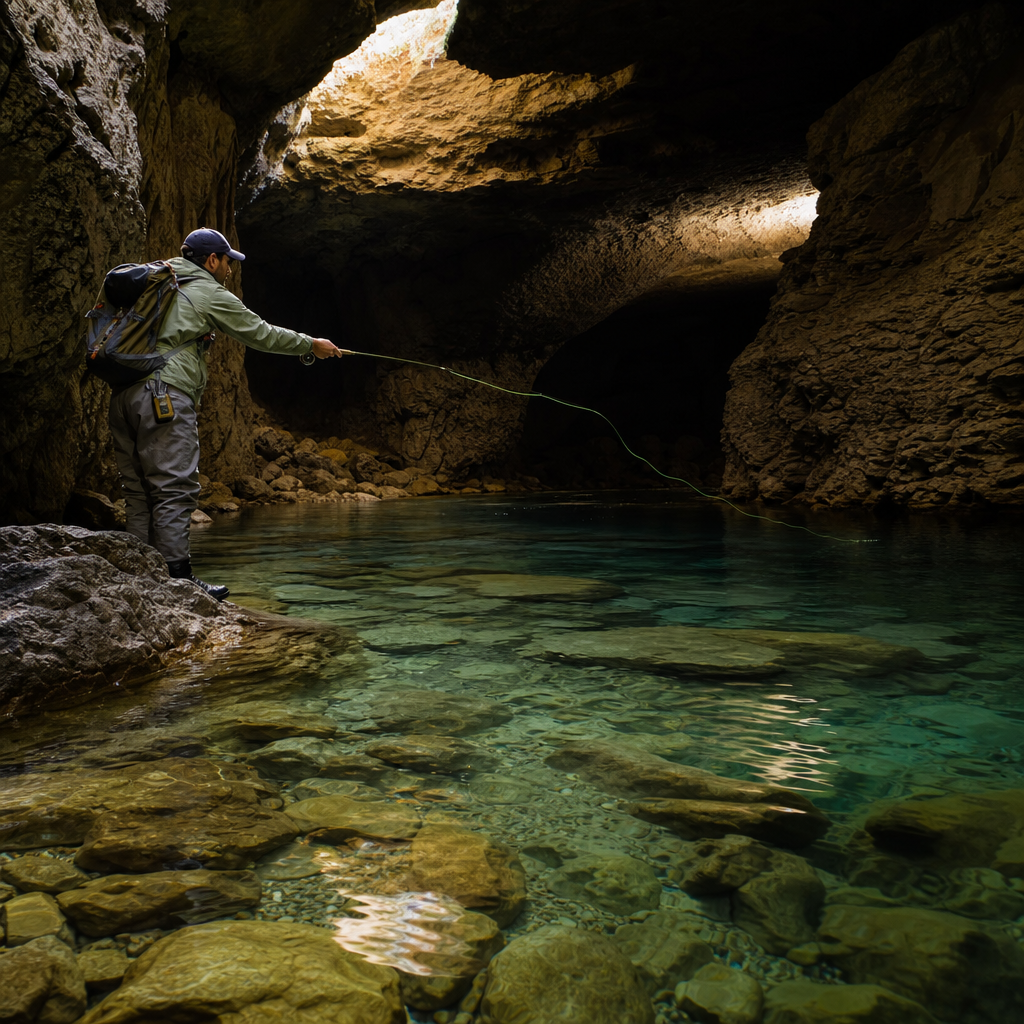
Fly fishing in subterranean rivers combines technical angling, cave travel, and environmental awareness in a setting where normal river instincts only partly apply. In this context, subterranean rivers are flowing waters that run through caves, lava tubes, karst systems, mine adits, or partially enclosed rock passages where daylight is limited or absent. Special conditions refers to the unusual factors that shape success and safety in these waters: darkness, compressed casting space, cold stable temperatures, mineral-rich flows, slick footing, and fish that respond differently from trout in open freestone streams. As a hub within the broader seasons and conditions topic, this guide explains the core techniques, gear, hazards, and decision-making principles that connect all special-condition fly fishing articles.
I have approached cave-fed creeks, spring tunnels, and short underground reaches where fish held beneath limestone roofs, and the first lesson was immediate: standard river habits fail fast underground. You cannot count on long back casts, visual drift tracking, or easy route finding. You must read current by feel, sound, and headlamp angle, control line in confined space, and protect both yourself and a fragile ecosystem that can be permanently damaged by careless movement. That matters because subterranean fisheries are often small, sensitive, and legally restricted, yet they can hold trout, char, sculpin, cave-adapted forage species, and in some regions landlocked salmon or introduced browns using underground refuge during heat, floods, or bright daylight.
Understanding this niche is important for three reasons. First, fish use underground water as thermal shelter, low-light cover, and feeding lanes, especially where surface conditions are harsh. Second, the skills transfer to other demanding situations, including high-water pocket fishing, winter nymphing, and tight-quarter brush streams. Third, risk is real. Carbon dioxide pockets, sudden rise events, unstable rock, deep slots, and disorientation make poor preparation unacceptable. If you want a reliable framework for fly fishing subterranean rivers, start with access law, hydrology, fish behavior, compact presentation methods, and a deliberately conservative gear system built for darkness and wet rock.
What Makes Subterranean Rivers a Special Condition
Subterranean rivers differ from open rivers because the environment changes the physics of casting, seeing, wading, and fish response. Light levels are the obvious difference, but flow character is equally important. Many cave streams run through polished limestone, basalt shelves, or gravel seams interrupted by plunge pools and siphon-like constrictions. Water temperature often stays far more stable than surface tributaries, commonly hovering near annual groundwater averages. In karst regions, that can mean cold water through summer and comparatively moderate water through winter. Stable temperature supports year-round occupancy, but food supply may be inconsistent, so fish often station where drifting invertebrates, drowned terrestrials, or inflowing surface food enters from skylights, sinkholes, side springs, or cave mouths.
Water clarity can be extreme in spring-fed systems, yet visibility to the angler remains poor because darkness compresses your field of view. Fish often feel secure in low light and may hold surprisingly shallow, especially near seam edges, boulder shadows, and inflow tongues. At the same time, they detect pressure waves and clumsy footfalls readily because enclosed chambers amplify vibration. In practice, this means stealth matters as much as in low, clear spring creeks, while presentations often resemble short-line Euro nymphing or bow-and-arrow casts used on overgrown brook trout streams.
Subterranean rivers also involve legal and ecological constraints that are stricter than many anglers expect. Some cave systems are closed to protect bats from white-nose syndrome, preserve archaeological resources, or prevent sediment disturbance that harms blind fish, salamanders, and macroinvertebrates. Private ownership is common where navigability law does not apply underground. Responsible fly fishing begins with confirmed access, local cave guidance, and a willingness to walk away if conditions, permissions, or conservation rules are unclear.
Fish Behavior in Cave Water and Transitional Zones
The best subterranean fly fishing usually happens in transitional water rather than the deepest fully dark reaches. Fish concentrate where three things overlap: oxygen, food delivery, and manageable current. Cave mouths, twilight zones, skylight chambers, and spring resurgence pools consistently outperform featureless black corridors. Trout in these zones often feed by silhouette and lateral line, taking drifting nymphs, soft hackles, and streamers that move at the speed of the current. In my experience, the first thirty to one hundred yards inside a cave entrance can fish exceptionally well during hot afternoons, because browns and rainbows use the shade as overhead cover while still intercepting food washed in from the surface.
Deep interior reaches can still hold fish, especially where a sink stream connects to a productive surface watershed, but behavior changes. Fish may become more territorial, less willing to move far, and more dependent on concentrated feeding windows linked to flood pulses or invertebrate drift from upstream openings. Expect lower density and more exact holding lies. Pools below vertical drops, constricted chute tails, and the downstream side of large breakdown boulders are prime. In systems with sculpin, crayfish, or baitfish, stripped streamers can be effective, but the retrieve should stay short and controlled; long aggressive strips create slack tangles and snag risk in darkness.
Season still matters even though temperature is stable. In summer, underground refuge becomes more attractive when surface streams warm above trout comfort ranges. In winter, cave mouths can stay comparatively moderate, drawing fish during cold snaps. After heavy rain, however, subterranean rivers can become lethal and unfishable within minutes. Rising stain, floating debris, and a sudden cool surge from sink inputs are immediate exit signals. Fish may feed aggressively before a surge, but no catch is worth gambling against flash flooding in a confined passage.
Techniques That Work When Casting Room Disappears
The fundamental technique underground is short-range control. Most successful anglers fish within one rod length to twenty-five feet, prioritizing contact, depth, and drift over distance. High-stick nymphing is the anchor method because it keeps line off conflicting currents and reduces false casting. A compact leader with a tight sighter, one or two weighted nymphs, and enough split shot or tungsten mass to tick bottom briefly is often the most dependable setup. In smooth glides, use lighter weight and longer tippet sections to avoid unnatural bounce. In plunge pockets, use more weight and lead the flies slightly slower than surface speed so they enter the strike window fast.
Bow-and-arrow casts are indispensable where ceilings are low or formations block back casts. Pinch the fly, load the rod, and release on a flat trajectory into pockets, under rock lips, or along wall seams. Roll casts and water-loaded flips also work when there is enough surface tension to anchor the line. For slightly larger chambers, a Belgian-style oval cast reduces wall contact by keeping the rod tip moving continuously on an off-plane path. I avoid overhead false casting underground unless the passage opens dramatically; one clipped stalactite or jagged roof edge can end a leader, a fly line, or worse, your balance.
Strike detection relies on touch more than sight. In darkness, takes often register as a dull stop, a tiny acceleration, or unexpected lightness when a fish lifts the fly. Keep rod angle high, maintain connection, and set with a short firm lift rather than a violent trout strike. For streamers, quartering swings and short strips outperform broadside bomb casts. Let the current animate marabou, rabbit, or sparse baitfish patterns. In many cave streams, a black streamer with a tungsten cone works because it creates a strong silhouette and reaches depth quickly.
| Condition | Best Technique | Typical Fly Choice | Why It Works |
|---|---|---|---|
| Low ceiling, pocket water | Bow-and-arrow cast with tight-line drift | Tungsten pheasant tail or perdigon | Delivers accurately without back cast and sinks fast |
| Twilight entrance pool | Short streamer swing | Black woolly bugger or sculpin pattern | Strong silhouette in low light triggers ambush fish |
| Smooth limestone glide | High-stick nymphing with light contact | Soft hackle dropper above small jig nymph | Natural drift avoids spooking fish in clear water |
| Deep plunge below drop | Vertical tuck cast | Heavy stonefly nymph with anchor fly | Gets flies down before current sweeps them away |
Gear for Darkness, Wet Rock, and Tight Quarters
A specialized gear system makes subterranean fly fishing safer and more efficient. Rod choice should emphasize control over reach. A 9-foot 3-weight to 5-weight can work near entrances, but many anglers do better with rods from 7 feet 6 inches to 10 feet depending on passage size and method. For tight-line nymphing, a 10-foot 3-weight offers sensitivity if the chamber allows it. In cramped tunnels, a shorter 7-foot 6-inch to 8-foot 6-inch rod prevents constant roof contact. Reels matter less for drag than for line management, though a full frame helps prevent thin line from slipping around the spool in cold water.
Lines should be simple. A standard weight-forward floating line handles most situations, while a Euro-style mono rig excels when room is minimal. Leaders are usually shorter than on open rivers because casting distance is short and turnover must be decisive. Carry fluorocarbon tippet in 4X through 6X for nymphs and 3X through 4X for small streamers. Fly selection should center on impressionistic confidence patterns: perdigons, pheasant tails, hare’s ears, Walt’s worms, zebra midges, soft hackles, small leeches, woolly buggers, and compact sculpins. Dark colors, flash kept modest, and tungsten beads are practical defaults.
Safety gear is nonnegotiable. Use a climbing-style helmet or a caving helmet, not just a cap. A primary headlamp rated for water resistance, plus two backup lights, is standard cave discipline because light failure underground is an emergency, not an inconvenience. Sticky rubber boots with carbide or aluminum traction help on polished rock, although metal can skate on some smooth limestone, so test carefully. A wading staff is valuable in larger passages, but in crawl spaces it becomes clutter. Layer with synthetic or wool insulation; groundwater can chill you steadily even in summer. Keep essentials in waterproof pouches: phone or satellite communicator where signal strategy allows, map or route notes, whistle, first-aid kit, and dry gloves.
Safety, Access, and Conservation Standards
The first rule of fly fishing subterranean rivers is simple: if you would not enter the space as a cautious caver, do not enter it as an angler. Check weather across the entire recharge basin, not just at the cave mouth. Rain falling miles away can flood a karst system rapidly. Tell someone your route and turnaround time. Never fish unknown underground water alone. Many experienced cavers follow a three-source light rule, helmet requirement, and conservative turnaround based on energy, battery reserve, and water trend. Anglers should do the same.
Access and ethics are equally important. Decontaminate boots, nets, and waders to reduce transport of invasive organisms and fish pathogens. In bat-sensitive regions, follow closures and gear cleaning protocols recommended by wildlife agencies and the National Speleological Society. Avoid touching formations, trampling bank sediments, or stirring fine silt in shallow nursery water. Use rubber nets, minimize fight times, and release fish in the water. Many cave-associated populations are small and slow to recover from repeated stress. If a reach contains blind fish, salamanders, or protected invertebrates, leave it alone completely.
This sub-pillar on special conditions connects directly to other demanding scenarios anglers face through the year. The same decision framework applies: evaluate hydrology first, adapt presentation to visibility and space, and let safety overrule opportunity. If you are building your own seasons and conditions plan, pair subterranean river knowledge with resources on winter flows, floodwater edges, spring seeps, night fishing, and summer thermal refuge. Together, those topics create a more complete understanding of where fish go when ordinary water is uncomfortable, crowded, or biologically unproductive.
Fly fishing in subterranean rivers rewards precision, restraint, and preparation more than heroics. The most productive water is usually transitional, not extreme; the best methods are short-line nymphing, compact casts, and controlled streamer work; and the most important gear is often a helmet and reliable lighting rather than an expensive reel. Fish use underground water for shelter, stable temperature, and feeding advantage, but those same conditions make mistakes costly for anglers and ecosystems alike.
If you remember three points, make them these. First, treat access, flood risk, and cave safety as part of fishing, not separate concerns. Second, simplify your tackle so every cast, drift, and landing happens cleanly in confined space. Third, protect these habitats aggressively, because they are smaller and more fragile than most surface fisheries. Use this guide as your hub for special-condition fly fishing, then apply its principles across the rest of the seasons and conditions series. Plan carefully, fish conservatively, and you will find that some of the most overlooked water in angling can also be among the most technically satisfying.
Frequently Asked Questions
What makes fly fishing in subterranean rivers different from fishing a normal surface river?
Fly fishing in subterranean rivers is fundamentally different because the angler is not just adapting to fish behavior, but also to a cave-like environment that changes how movement, casting, line control, visibility, and safety all work. In a normal river, anglers rely heavily on visual cues such as current seams, surface disturbances, insect activity, light penetration, and open casting lanes. In subterranean rivers, many of those cues are reduced, distorted, or completely absent. Darkness or low light limits your ability to read water in the usual way, while low ceilings, walls, rock shelves, and uneven footing make standard overhead casting impractical or impossible.
The fish themselves may also behave differently in these enclosed systems. In stable, cold water with little daily temperature swing, fish often hold in predictable current refuges, oxygen-rich inflows, ledges, undercuts, and transition zones where food drifts through confined channels. Because subterranean rivers often have less obvious insect hatches and less surface feeding activity, anglers usually need to focus more on subsurface presentations, precise drifts, and depth control than on classic dry-fly scenarios. Sound, vibration, and light discipline can also matter more, since enclosed spaces amplify disturbances and can make fish wary even when visibility is poor.
Just as important, subterranean fly fishing demands a hybrid mindset that combines technical angling with cave travel awareness. It is not enough to know how to mend line or match a hatch. You also have to manage moisture, slick rock, confined access, limited escape routes, and the possibility of sudden flow changes in a system where getting in and out may be slower than expected. That means every fishing decision is tied to risk management. In practical terms, subterranean river fishing is less about covering water quickly and more about deliberate movement, compact techniques, environmental awareness, and disciplined gear choices.
What fly fishing techniques work best in caves, lava tubes, mine adits, and other enclosed river systems?
The most effective techniques in subterranean rivers are compact, controlled, and heavily focused on subsurface presentation. In tight quarters, anglers usually do best with short-line nymphing, high-stick drifts, bow-and-arrow casts, roll casts, tuck casts, and careful dappling rather than long overhead casts. These methods let you place flies accurately under low ceilings, beside rock walls, into plunge pockets, and along narrow channels without constantly hanging up on the surroundings. In many enclosed systems, keeping more line off the water is valuable because conflicting currents can be hard to read in low light, and extra slack is difficult to manage when visibility is limited.
Nymphing is often the primary tactic because subterranean fish commonly feed below the surface where drifting food is concentrated. Weighted nymphs, small streamers, and attractor patterns tend to outperform delicate dry-fly work in these settings, especially when insect activity is sparse or impossible to observe. A two-fly rig can be productive if the space allows, but in especially confined environments a single-fly setup is often safer and easier to control. Split shot, tungsten beads, and tight-line methods can help achieve the depth needed to get flies into deeper slots, undercut troughs, or current tongues running between boulders and walls.
Stealth and pacing matter more than many anglers expect. In an enclosed river passage, fish may key in on repeated disturbances from wading vibrations, clacking gear, or erratic headlamp use. It often pays to stop, study the current with your light held low, identify likely holding water, and fish each short section thoroughly before moving on. Presentations should be compact and efficient, with an emphasis on first-drift success. In practical terms, the best technique is the one that preserves balance, avoids snags overhead and behind you, and keeps the fly in the strike zone for as much of the drift as possible.
What gear is most important for fly fishing in subterranean rivers safely and effectively?
In subterranean rivers, the most important gear is the gear that supports both fishing performance and personal safety. A shorter fly rod is usually the best starting point, often in the 6- to 8-foot range depending on how tight the passage is. Shorter rods are easier to maneuver under rock ceilings and around walls, and they reduce the risk of accidental impact in cramped casting lanes. A moderate to medium-fast action can be helpful because it loads well at short distances and handles compact casts cleanly. Weight-forward floating lines are generally the most versatile, while leaders should be kept practical rather than overly long, since close-range control usually matters more than delicate distance presentation.
For flies and terminal tackle, emphasize subsurface tools: beadhead nymphs, perdigons, small streamers, and durable patterns that can handle abrasion from rock and repeated short drifts. Carry enough split shot, indicators if you use them, tippet spools, forceps, nippers, and a streamlined fly box, but avoid overloading yourself. The more clutter hanging from your vest or pack, the more likely it is to catch on rock, snag line, or throw off your balance. Many anglers prefer a minimalist chest pack or sling adjusted tightly so nothing swings when crawling, climbing, or wading through narrow sections.
Safety gear is non-negotiable. A helmet is essential in any environment with low rock ceilings, sharp projections, or unstable walls. Reliable lighting is equally critical: use a primary headlamp and carry backup lights with fresh batteries, because total darkness changes a minor inconvenience into a serious hazard immediately. Studded boots or specialized soles may improve traction on wet rock, but local regulations and the sensitivity of the cave environment should guide footwear choices. Layering for cold, stable temperatures is also important, since subterranean waters and air can drain body heat quickly. Depending on the setting, a wading staff, waterproof pack, whistle, map or route notes, and communication plan may be as important as the rod itself. In these rivers, good gear is not the fanciest gear; it is the gear that stays compact, works reliably in moisture and darkness, and supports controlled movement at all times.
How should anglers handle lighting, movement, and safety in special subterranean river conditions?
Lighting, movement, and safety should be treated as a unified system, not as separate concerns. In subterranean rivers, darkness affects everything: your footing, your ability to judge current depth, your casting angle, your knot tying, your exit timing, and your awareness of changing conditions. The best practice is to use consistent, dependable light without flooding every pool with harsh beam movement. A headlamp keeps both hands free, but many experienced anglers intentionally angle their beam downward or diffuse it when approaching fishable water to reduce abrupt flashes on the surface. Backup lights should always be immediately accessible, not buried deep in a pack.
Movement has to be slower and more deliberate than on open rivers. Slick stone, hidden drop-offs, mud, uneven ledges, and confined passages mean every step matters. Before crossing or repositioning, check your landing points carefully and think about what happens if you slip. In a subterranean system, a minor stumble can lead to rod breakage, injury, a soaked light source, or loss of access to the route you used to enter. Anglers should avoid fishing alone whenever possible, let someone outside know their plan, and establish clear turnaround times. In mine adits, lava tubes, and cave systems, route finding can be deceptively simple on the way in and surprisingly confusing on the way out.
Water awareness is also essential. Subterranean rivers may appear stable, but they can respond to upstream rainfall, snowmelt, dam releases, or drainage surges from areas you cannot see. Because escape options can be limited in enclosed passages, anglers should research hydrology and weather before entering and remain alert to rising flow, increased turbidity, louder current noise, or narrowing safe margins along the bank. A good rule is that if conditions force rushed decisions, the situation has already become unsafe. Safe subterranean fly fishing depends on discipline: compact gear, redundant light, head protection, route awareness, conservative wading, and a willingness to leave fish behind if the environment starts dictating bad choices.
How can anglers protect fragile cave and subterranean river ecosystems while fly fishing?
Protecting subterranean river ecosystems starts with recognizing how sensitive and slow to recover they can be. Caves, karst waters, lava tubes, and mine-influenced passages often support specialized biological communities adapted to darkness, stable temperatures, and limited nutrient input. Even when the target fish are the main focus, anglers are moving through habitats that may include delicate formations, spawning areas, unique invertebrates, bat roost zones, microbial films, or rare aquatic species. The confined nature of these systems means a small amount of disturbance can have an outsized effect. Mud stirred from one careless step, for example, can reduce clarity through an entire reach and alter feeding conditions or habitat quality well beyond the spot you are standing in.
Low-impact behavior is therefore essential. Stay on durable surfaces where possible, avoid touching formations or walls unnecessarily, and do not break, chip, or move rock to create casting space or improve access. Wading should be minimized in especially fragile stretches, and fish should be played and released quickly to reduce stress in cold, stable environments where recovery may be slower than