Conservation and fly fishing competitions can work together when organizers build rules, venues, scoring, and education around fish welfare, habitat protection, and measurable stewardship outcomes. In practice, that means treating tournaments not simply as sporting events, but as carefully managed conservation platforms that reduce angling pressure, support science, and model ethical behavior on the water. For clubs, guides, riverkeepers, and destination managers, this topic matters because competitive fly fishing now reaches waters that are biologically sensitive, socially contested, and economically important. A well-run event can fund restoration, improve handling standards, and introduce anglers to watershed realities. A poorly designed event can crowd spawning reaches, stress trout in warm water, and undermine public trust.
In my experience helping plan and evaluate catch-and-release events, the difference comes down to systems. Conservation efforts are not a slogan added to a poster after permits are issued. They begin with a clear understanding of carrying capacity, seasonal fish behavior, dissolved oxygen risk, disease transmission, riparian impacts, and the incentives created by scoring. Key terms shape every decision. Catch-and-release is the practice of returning fish alive after capture, but survival depends on air exposure, water temperature, handling time, and hook placement. Fish welfare refers to reducing injury, physiological stress, delayed mortality, and sublethal effects such as impaired spawning success. Habitat protection covers bank stability, spawning gravels, woody structure, aquatic vegetation, invertebrate communities, and water quality. Conservation efforts include direct actions such as restoration funding, invasive species prevention, temperature closures, volunteer monitoring, and data sharing with agencies.
As the hub page for conservation efforts within conservation and ethics, this guide explains the best practices that make fly fishing competitions defensible and genuinely useful. It covers event design, fish care, habitat safeguards, science partnerships, sponsor standards, and post-event accountability, with examples that apply to rivers, stillwaters, and managed beats. The central principle is simple: competition should never outrun ecological limits. When organizers set conservative thresholds, train participants thoroughly, and document outcomes, the event can showcase how modern angling supports the places and species it depends on.
Build conservation into event design from the start
The strongest conservation efforts are decided before registration opens. Start with a fishery assessment that asks four direct questions: Is the stock healthy enough to support concentrated effort, is the timing compatible with seasonal vulnerability, can access absorb foot traffic, and will agency staff or local stewards support the format? On wild trout rivers, the right answer is often to avoid peak spawn, fry emergence, and extended warm-water periods. Brown trout fisheries may need autumn exclusions near redds, while tailwaters with summer temperature spikes may need midday stoppages or full cancellations. For stillwaters, evaluate shoreline trampling risk, nesting birds, and boat ramp biosecurity.
Permit conditions should reflect resource protection, not just liability. I recommend writing measurable operating thresholds into the event plan: maximum acceptable water temperature, mandatory cessation triggers, sector rotation limits, participant caps, and no-entry zones around spawning habitat or restoration sites. Many organizers use 68 degrees Fahrenheit as a hard stop for trout, but that should not be treated as universal. Species, elevation, dissolved oxygen, fight duration, and fish size all matter. Native char, for example, may require more conservative handling expectations than stocked rainbows in a cool, highly oxygenated system. The event director should designate one person with authority to stop competition immediately if thresholds are exceeded.
Scoring drives behavior, so conservation-friendly scoring is one of the most important design tools. Formats that reward quantity at any cost encourage rushed handling and repeated pressure on obvious holding water. Better systems emphasize measured fish, cap the number of fish counting in a session, assign no bonus for marginal size differences, and prohibit practices known to increase injury. Time penalties for improper handling can be more powerful than generic sportsmanship language because they change angler decisions in real time. Barbless-only rules, minimum tippet standards that shorten fight time, and boundaries that distribute effort across beats all reduce biological impact without eliminating competition.
Protect fish welfare with handling standards that are taught and enforced
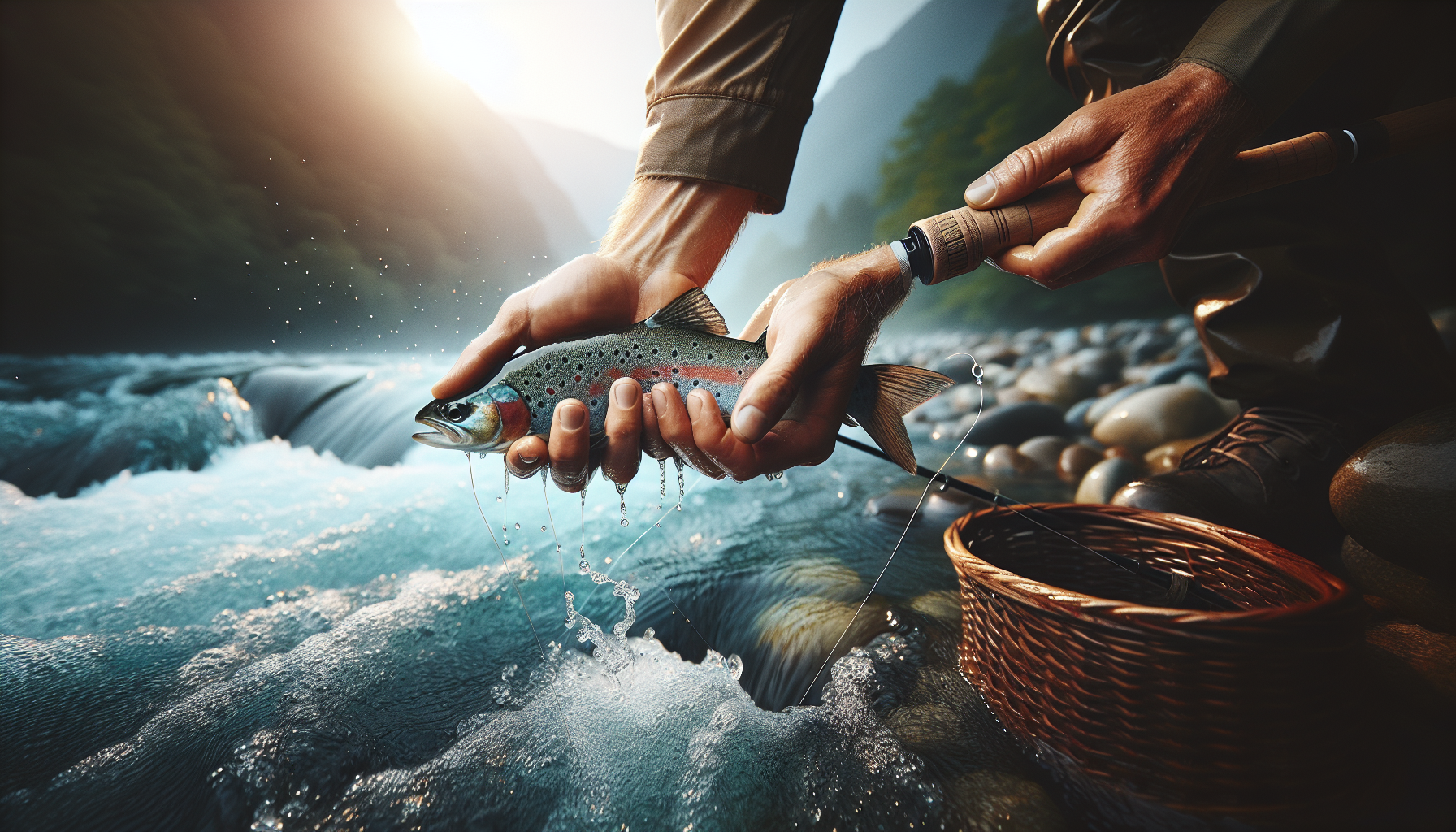
Fish welfare in fly fishing competitions is operational, not abstract. Every competitor should receive mandatory pre-event instruction on landing, netting, unhooking, measuring, and release. The best briefings are practical and specific: keep the fish submerged, prepare tools before touching the fish, wet hands, support the body horizontally, avoid squeezing, and limit air exposure to a few seconds if a photograph is even allowed. In many of the events I have observed, simply requiring in-water measurement and banning hero shots reduces handling time dramatically. Rubberized knotless nets, hemostats, and line cutters should be standard equipment, not suggestions.
Hook and fly regulations matter because they influence both hooking location and release time. Single barbless hooks are the baseline best practice for trout, grayling, and most catch-and-release formats. Multiple flies can increase tangles and handling delays, especially with less experienced competitors, while weighted systems may elevate snagging risk in some venues. Bait is generally incompatible with conservation-focused competition because deep hooking rates rise and release outcomes worsen. Organizers should also be realistic about angler skill. If a field includes novices, rules need to be even simpler and fish-care supervision more visible.
Enforcement must be consistent. Marshals or controllers should watch for fish dragged onto dry rocks, excessive air exposure, unsafe fish grips, and prolonged photo sessions. Penalties should escalate from warning to score deduction to disqualification. That may sound strict, but it creates trust with landowners, agencies, and noncompetitive anglers who are watching closely. It also protects competitors who already fish carefully and do not want to lose to someone cutting corners. Good welfare policy includes contingency planning for deeply hooked fish, exhausted fish, and accidental mortalities. Events should require immediate reporting, record the species and approximate size, and review whether conditions or tactics contributed to the incident.
Reduce habitat damage and crowding on the water
Habitat protection often receives less attention than fish handling, yet repeated foot traffic and poorly managed access can cause long-term damage. Fly fishing competitions concentrate anglers in time and space, so organizers need beat rotations, bank-use rules, and access maps designed around sensitive habitat. Spawning redds should be identified before the event and marked as exclusion zones. Side channels used by juveniles, undercut banks vulnerable to collapse, and recently planted riparian areas also deserve protection. On spring creeks and small streams, even a modest event can degrade vegetation if everyone enters and exits at the same obvious points.
Practical controls work. Use hardened access points, assign parking away from fragile banks, prohibit streamside vehicle movement, and require wading practices that avoid trampling vegetation and redds. Boat-based competitions should set no-wake zones near shallow flats, nesting areas, and erodible shorelines. Decontamination is equally important. Invasive species and pathogens move on felt, fabric, trailers, and bilge water. Many fisheries now discourage or prohibit absorbent felt soles because they can retain moisture and organisms. A competition committed to conservation efforts should publish cleaning protocols for boots, nets, anchors, and boats, and provide disinfection stations when zebra mussels, didymo, whirling disease, or New Zealand mudsnails are regional concerns.
| Risk area | Best practice | Why it matters |
|---|---|---|
| Warm water stress | Set temperature triggers and shorten sessions | Reduces post-release mortality |
| Spawning habitat | Create mapped exclusion zones around redds | Prevents egg loss and nest disturbance |
| Bank erosion | Use fixed access points and rotate beats | Limits trampling and sediment input |
| Invasive species spread | Require gear cleaning and boat inspection | Protects entire watersheds, not just event water |
| Poor fish handling | Train anglers and enforce barbless-only rules | Shortens release time and lowers injury |
Crowding affects social sustainability as much as ecology. Competitions that monopolize public water create resentment, even if biological impacts are controlled. Reserve enough open water for nonparticipants, communicate schedules early, and avoid high-use holiday windows. On iconic rivers, rotating venues across beats and dates can spread economic benefits without creating the perception that a private event has displaced the public. Conservation and fly fishing competitions succeed when local communities see order, restraint, and respect rather than entitlement.
Use competitions to generate useful science and funding
One of the strongest arguments for fly fishing competitions is that organized effort can support conservation science when data are collected responsibly. Catch records, effort logs, water temperature readings, macroinvertebrate observations, and location-specific notes can all help managers understand seasonal patterns, angler pressure, and fish distribution. However, tournament data are only useful if methods are standardized. Species identification must be reliable, lengths should be measured consistently, and location reporting should be coarse enough to avoid exposing sensitive holding water. Where native fish are vulnerable, public-facing reports should summarize by beat or reach, not GPS coordinates.
Partnerships with agencies, universities, and watershed groups add legitimacy and value. I have seen events fund PIT tag antenna maintenance, riparian fencing, culvert replacement, redd counts, and temperature logger networks. Those projects matter more than symbolic donations because they address limiting factors directly. If an event raises money, publish where every dollar goes and what outcomes are expected. For example, ten thousand dollars directed to willow planting and bank stabilization on a degraded meadow stream can be tied to reduced erosion, cooler margins, and better juvenile cover. Sponsors should be invited to support those projects publicly, not just provide prizes.
Citizen science can also improve stewardship literacy among competitors. When anglers record water temperature before sessions, they begin to understand why afternoon closures exist. When they attend a briefing from a fisheries biologist on flow management, they connect fish behavior to reservoir releases, irrigation withdrawals, and thermal refuges. This educational role is underrated. Competitions gather committed anglers in one place, making them an efficient venue for spreading best practices that later influence everyday fishing behavior across the region.
Set sponsor, media, and ethics standards that match conservation goals
Conservation efforts fail when messaging rewards the wrong behavior. Sponsor alignment matters because brands influence angler expectations, event visuals, and product use. Organizers should favor partners that support habitat work, low-impact access, durable gear, and responsible fisheries policy. If a sponsor’s marketing encourages high-volume grip-and-grin imagery, overcrowded hotspot exposure, or casual treatment of wild fish, that conflict will surface quickly. Written sponsor standards help: no imagery of fish on dry ground, no handling that violates event rules, no promotion of restricted locations, and no claims that exaggerate sustainability outcomes.
Media plans should protect both fish and places. Real-time posting from sensitive water can intensify pressure immediately after the event, especially on small rivers and stillwater shoals. Delayed posting, generalized location references, and educational captions are better choices. Instead of highlighting exact pools, explain why the event used temperature cutoffs, beat rotations, and barbless regulations. This turns visibility into outreach. It also improves credibility with readers who increasingly expect outdoor events to justify their environmental footprint.
Ethics standards should extend beyond the rules sheet. Competitors must respect private property, other anglers, local guide operations, and indigenous or community connections to the watershed. On some waters, the most ethical choice is not to host a competition at all, particularly when runs are depressed, access disputes are active, or enforcement capacity is weak. A cancellation or relocation can be the clearest demonstration that conservation comes first. That decision is difficult financially, but it protects long-term access and reputation.
Measure outcomes and improve every year
The best conservation and fly fishing competitions treat each event as a managed experiment. After the final session, review temperature trends, incident reports, handling violations, mortality records, beat pressure, habitat observations, participant feedback, and funds raised for conservation efforts. Compare planned safeguards with what actually happened. Did anglers cluster in thermal refuges despite guidance? Did one access point show obvious vegetation loss? Were marshals numerous enough to enforce fish-care rules? These details determine whether the next event should be expanded, redesigned, or retired.
Transparent reporting is essential. Publish a post-event summary that states participation numbers, conservation measures used, any stoppages or rule changes, and the projects funded. If there were problems, say so plainly and explain the correction. Trust grows when organizers show restraint and self-critique. Over time, this reporting creates institutional memory. New volunteers understand why felt soles were banned, why the schedule changed, or why a beat was removed after redd mapping. That continuity is especially important for clubs and destination events where leadership turns over frequently.
The core lesson is straightforward: conservation efforts must be built into fly fishing competitions at every level, from venue selection to scoring to after-action review. When fish welfare standards are strict, habitat safeguards are visible, science partnerships are real, and funding is tied to concrete restoration, competition can strengthen the waters that support it. When those elements are missing, the event becomes hard to defend. Use this hub as the starting point for every decision in the conservation and ethics category, then apply the same discipline to your local fishery. Review your rules, talk with biologists, and make the next event a model of responsible angling stewardship.
Frequently Asked Questions
How can fly fishing competitions be designed to support conservation rather than harm fisheries?
The best competitions are structured from the beginning as conservation-first events, not simply as tournaments with a few environmental rules added later. That starts with venue selection. Organizers should choose waters that can handle temporary angling pressure, avoid sensitive spawning periods, and work closely with fishery managers, biologists, landowners, and riverkeepers before confirming dates or formats. A well-designed event also limits angler density by spreading participants across beats, rotations, or sessions so fish are not repeatedly targeted in the same runs and holding water.
Rules are equally important. Conservation-oriented events typically prioritize catch-photo-release or steward-verified release systems over traditional weigh-ins, because prolonged handling and transport can increase fish stress and mortality. Tackle restrictions matter as well: single barbless hooks, limits on fighting time, prohibitions on bait where appropriate, and fish handling standards all reduce injury rates. Organizers should also build in weather and water-condition safeguards, such as delaying or shortening sessions during high water temperatures, low flows, or other periods of elevated fish stress.
Perhaps most importantly, the competition should create measurable conservation value. That can include entry-fee allocations for habitat restoration, invasive species control, culvert replacement, riparian planting, temperature monitoring, or youth stewardship programs. Some events also partner with scientists to collect non-lethal fisheries data, such as fish distribution observations, water temperature readings, macroinvertebrate surveys, or angler pressure information. When these elements are integrated into the event model, the competition becomes more than recreation; it becomes a managed platform for education, funding, and long-term fishery stewardship.
What fish handling and catch-and-release best practices should competitors follow during an event?
Fish welfare depends on reducing stress at every stage of the encounter, from hook-up to release. Competitors should land fish as quickly as practical using tackle strong enough to avoid prolonged fights, because exhaustion can significantly reduce post-release survival, especially in warm water or low-flow conditions. Once the fish is close, it should be guided into a knotless, rubberized landing net that supports the body and minimizes scale loss, fin damage, and slime removal. Dragging fish onto rocks, beaches, or dry boat decks should never be permitted.
Handling should be brief, gentle, and ideally performed with the fish kept in the water. Wet hands before contact, avoid squeezing the body, and never insert fingers into the gills. If a fish must be lifted momentarily for identification or a quick photo under event rules, that moment should be measured in seconds, not extended for celebration or repeated camera angles. Many well-run competitions set clear standards such as “net, measure, photograph, release” with strict time limits and penalties for mishandling. These standards help normalize responsible behavior under the pressure of competition.
Hook removal is another critical point. Barbless hooks simplify release and reduce tissue damage, and anglers should carry forceps or hemostats for efficient unhooking. Deeply embedded hooks should be handled according to local fishery guidance, but in many cases cutting the tippet is better than aggressive extraction that causes additional trauma. Organizers should also educate participants about species-specific risks. For example, trout and salmon may be especially vulnerable in warm water, while migratory fish may require extra protection during staging or spawning movements. The strongest competition rules are the ones that make best fish-care practices simple, standardized, and enforceable.
What competition rules help reduce habitat damage and pressure on the water?
Habitat protection requires more than asking anglers to be careful. The event format itself should be built to prevent concentrated impact. Rotational beat systems, capped field sizes, session limits, and rest periods between angling blocks can all reduce repeated disturbance to the same holding water. On rivers with fragile banks, spawning gravel, or vulnerable riparian vegetation, organizers should designate access points, prohibit trampling in closed areas, and mark exclusion zones around side channels, redds, wetlands, and restoration sites. Clear maps and mandatory pre-event briefings are essential so no one can claim confusion about boundaries or protected areas.
Wading and boat-use rules also matter. Competitions can reduce physical disturbance by limiting wading depth, prohibiting anchoring in sensitive habitat, restricting motorized access, and requiring decontamination protocols to prevent the spread of invasive species and fish pathogens. “Clean, drain, dry” or equivalent inspection systems should be standard where participants travel between watersheds. In some fisheries, organizers may also need to prohibit certain gear types, split shot materials, or weighted techniques that create excess bottom disturbance or pose contamination risks.
Another effective practice is adaptive management. Conditions on the water can change quickly, so organizers should be ready to modify boundaries, shorten sessions, or cancel portions of the event if water temperatures spike, flows drop, or fish show signs of stress. Good rulebooks include contingency thresholds and decision-making authority in advance, rather than improvising under pressure. This protects both the resource and the credibility of the event. Competitors are far more likely to respect restrictions when they see that conservation standards are objective, transparent, and consistently enforced.
How can fly fishing tournaments produce measurable conservation outcomes instead of just good intentions?
Measurable outcomes begin with specific goals. Rather than saying an event “supports conservation,” organizers should define what success looks like before the competition begins. That might mean raising a set amount for a named habitat project, restoring a targeted length of streambank, funding a season of water-quality monitoring, purchasing native plants for riparian work, or supporting fish-passage improvements. When the conservation objective is concrete, participants, sponsors, and local communities can see exactly how the tournament contributes beyond the competition itself.
Data collection and reporting are also powerful tools. Events can track metrics such as participant compliance with fish-handling rules, number of fish landed and released, temperature-triggered session changes, invasive species inspections completed, volunteer hours generated, or dollars directed to local conservation partners. More advanced competitions may collaborate with fisheries agencies, universities, or nonprofits to gather observations that support management decisions, provided the methods are scientifically appropriate and do not increase stress on fish. Even simple monitoring can be valuable when it is consistent, transparent, and tied to management needs.
Post-event accountability is what turns these efforts into real conservation practice. Organizers should publish a summary that explains what was funded, what was learned, and what will change next time. If fish stress indicators were higher than expected, that should lead to rule adjustments. If angler movement caused crowding in specific reaches, beat rotation can be redesigned. If a fundraising goal was exceeded, the additional money should be publicly allocated. Over time, this kind of reporting builds trust with regulators, local residents, sponsors, and anglers. It also helps establish the event as a credible conservation platform rather than a marketing exercise.
Why is education so important in conservation-focused fly fishing competitions?
Education is what turns event rules into lasting behavior change. A competition may last one weekend, but the habits anglers take home can influence fisheries for years. When organizers explain not only what the rules are, but why they matter, participants are more likely to buy in and apply those standards elsewhere. For example, a mandatory briefing on water temperature stress, proper net use, redd avoidance, invasive species prevention, and low-impact access etiquette can dramatically improve on-the-water decision-making. It also creates a shared culture in which ethical conduct is expected, visible, and reinforced by peers.
Education is especially valuable because competitions bring together a wide range of people: experienced anglers, newcomers, guides, club members, youth participants, sponsors, media, and local officials. That audience creates a rare opportunity to demonstrate best practices at scale. Workshops, pre-event materials, beat steward conversations, signage, and post-event recaps can all be used to teach practical stewardship skills. Some of the most effective events include short clinics with biologists, conservation groups, or river managers so participants hear directly from resource professionals rather than only from organizers.
From an SEO and public credibility standpoint, education also strengthens the story around the event. Competitions that openly teach fish welfare, habitat ethics, and stewardship outcomes are easier for clubs, destination managers, and conservation partners to defend and promote. They show that the event is not merely extracting recreational value from a fishery, but reinvesting knowledge, money, and care back into the resource. In that sense, education is not a side feature of a conservation-minded competition. It is one of the main mechanisms that makes the entire model work.