Choosing the best fly fishing video cameras for underwater footage is not just about buying the newest action camera. It is about matching imaging technology, waterproof design, mounting options, battery behavior, and underwater color performance to the way anglers actually fish. After testing cameras on drift boats, wading rivers, and stillwater float tubes, I have learned that the camera that looks impressive on a retail shelf can fail quickly when glare, current, and cold water enter the equation.
In this technology reviews hub for product reviews and recommendations, underwater fly fishing video cameras refers to compact cameras, action cameras, and specialized fishing cameras that can capture fish movement, fly presentation, hookups, releases, and underwater habitat. For fly anglers, underwater footage matters because it reveals details you cannot see from above: how a streamer tracks, how trout inspect a nymph, how light changes at depth, and how fish react before the take. That information improves both storytelling and fishing technique.
The market now includes premium models from GoPro, DJI, Insta360, and purpose-built underwater systems from brands such as Water Wolf and Aqua-Vu. Each category serves a different need. Some anglers want cinematic 4K or 5.3K video for YouTube. Others need rugged reliability, long recording times, and simple controls that work with wet hands. A good buying decision depends on understanding sensor size, bit rate, stabilization, field of view, waterproof rating, and low-light capability. This guide explains those factors in plain terms, compares leading options, and shows which cameras make the most sense for different fly fishing situations.
What Makes a Camera Good for Underwater Fly Fishing
The best underwater fly fishing camera must deliver usable footage in moving water, not just impressive specifications on paper. In practice, five features matter most: waterproofing, image quality, stabilization, battery life, and mounting flexibility. Waterproofing is the baseline. A camera rated to 10 meters without a housing is usually adequate for shallow stream work, but repeated dunking, sandy banks, and cold-weather seal contraction make a protective housing a smart upgrade even when it is not mandatory.
Image quality underwater depends less on headline resolution and more on sensor performance, lens sharpness, and color rendering. Water absorbs red wavelengths quickly, which is why footage can look blue or green. Cameras with better dynamic range and manual white balance options recover more natural-looking scenes. I have found that a clean 4K file with strong color control is more valuable than an overstated 8K mode with noisy shadows and heavy crop.
Stabilization also matters because fly fishing footage is rarely static. Wading over cobble, leaning from a raft, or fighting a fish produces constant micro-movements. Effective electronic stabilization keeps clips watchable, but aggressive stabilization can crop the frame and reduce low-light performance. Battery life tends to drop sharply in cold water environments, so removable batteries remain a major advantage for serious anglers. Finally, mounting flexibility is critical. A chest mount, net mount, hat clip, rod mount, or submerged extension arm can completely change what kind of story the camera tells.
Top Camera Types and Where Each One Excels
For most anglers, action cameras are the default choice because they combine waterproof construction, wide-angle lenses, compact size, and strong stabilization. The GoPro HERO12 Black and HERO13 Black are leading examples. They produce detailed footage, offer excellent accessory support, and work well above and below the surface. DJI Osmo Action models are strong alternatives, especially for anglers who value front screens, easy menus, and very good stabilization at a slightly lower price point.
The second category is 360 cameras, especially the Insta360 X3 and X4. These are useful when the priority is capturing everything around the angler and reframing later. For underwater fly fishing, however, 360 cameras are more specialized. Stitching can be disrupted by water droplets, and image quality in dim rivers is usually less consistent than with a traditional action camera. They shine for boat coverage and mixed above-water adventure footage more than for pure submerged strike sequences.
The third category is dedicated underwater fishing cameras such as the Water Wolf series or Aqua-Vu systems. These are designed to show fish behavior rather than create polished cinematic content. In clear lakes they can reveal schooling patterns, fly tracking, and bottom composition effectively. Their drawbacks are bulk, cable management in some systems, narrower use cases, and generally weaker audio, stabilization, and editing flexibility. They are research tools first and content tools second.
Finally, compact waterproof cameras exist, but this category has shrunk. Olympus Tough models built a reputation for durability, and they remain useful for still photos and occasional clips. For most serious underwater video work, modern action cameras outperform them on frame rates, mounting ecosystems, and workflow speed.
Best Fly Fishing Video Cameras for Underwater Footage Compared
If you want one direct answer, the best overall choice for most anglers is a recent GoPro flagship because it balances underwater image quality, stabilization, accessory availability, and proven durability. The best value option is often a DJI Osmo Action model, which gives up little in real-world river use. The best specialized fish-behavior camera is a Water Wolf system, especially for trolling or stillwater observation. The best all-angle creative option is an Insta360 camera when your editing workflow can take advantage of reframing.
| Camera | Best For | Main Strength | Main Limitation |
|---|---|---|---|
| GoPro HERO12/HERO13 Black | All-around fly fishing footage | Excellent stabilization and accessory ecosystem | Battery drains faster in cold conditions |
| DJI Osmo Action 4/5 series | Value-conscious anglers | Strong low-light performance and easy interface | Accessory ecosystem smaller than GoPro |
| Insta360 X3/X4 | Boat, travel, and reframe-heavy edits | Capture every angle in one take | Less ideal for murky or low-light underwater work |
| Water Wolf | Fish behavior observation | Purpose-built underwater perspective | Less cinematic and less versatile overall |
| Aqua-Vu systems | Stationary scouting and lake structure viewing | Detailed subsurface inspection | Bulky for active wading scenarios |
In practical use, I recommend GoPro for anglers building a content system, DJI for anglers seeking nearly premium performance at a better value, and dedicated fishing cameras for those studying how fish interact with flies underwater. That distinction prevents a common mistake: buying a specialized camera when what you really need is a general-purpose action camera with good underwater settings.
Image Quality, Resolution, and Frame Rate in Real Water
Resolution matters, but not in the way many buyers assume. For YouTube, websites, and social clips, 4K is already more than sufficient when exposure, focus, and color are correct. A higher-resolution mode can help with cropping, but underwater footage often loses sharpness because of suspended particles, low contrast, and housing distortion. In other words, clear 4K beats muddy 5.3K every time.
Frame rate should match the scene. I normally shoot 4K at 30 frames per second for general storytelling because it preserves detail and manages file sizes well. For strike shots, fish releases, and streamer movement, 60 frames per second is worth using because it allows smooth slow motion during editing. Going to 120 frames per second can be useful for brief action moments, but low-light performance drops and shutter demands increase. In shaded rivers at dawn or dusk, that tradeoff can be costly.
Bit rate and codec are the less glamorous but equally important variables. Higher bit rates preserve detail in splashing water and textured fish patterns. Efficient codecs such as H.265 reduce file size, but they can be harder on older editing systems. If your workflow includes quick edits on a laptop after a trip, choose settings you can process easily rather than the most extreme mode available.
Low-Light Performance, Color, and Underwater Settings
Underwater footage challenges every camera because water reduces light and shifts color. In clear mountain rivers, the problem is usually contrast and glare. In tannic streams or deep lakes, it is outright darkness. This is why larger sensors and cleaner noise handling matter. DJI’s larger-sensor action cameras have earned praise for low-light performance, and recent GoPro models remain competitive when exposure settings are controlled carefully.
The most useful settings for underwater fly fishing are often simple. Locking white balance prevents color pulsing as the camera moves between sky reflections and darker water. Limiting ISO helps control noise. Using a flatter color profile can preserve highlight and shadow detail for later grading, though anglers who want fast posting may prefer a standard profile with modest in-camera sharpening. If your camera supports lens corrections or underwater color modes, test them before a trip rather than trusting defaults.
A red or magenta filter can improve color in certain saltwater or blue-water conditions, but in many freshwater fly fishing situations it is not essential and can reduce light. For rivers under mixed shade, manual correction in post usually works better. The key is consistency. Clips from the same sequence should share exposure and color settings so your edit does not look chaotic.
Mounting, Workflow, and Durability on the Water
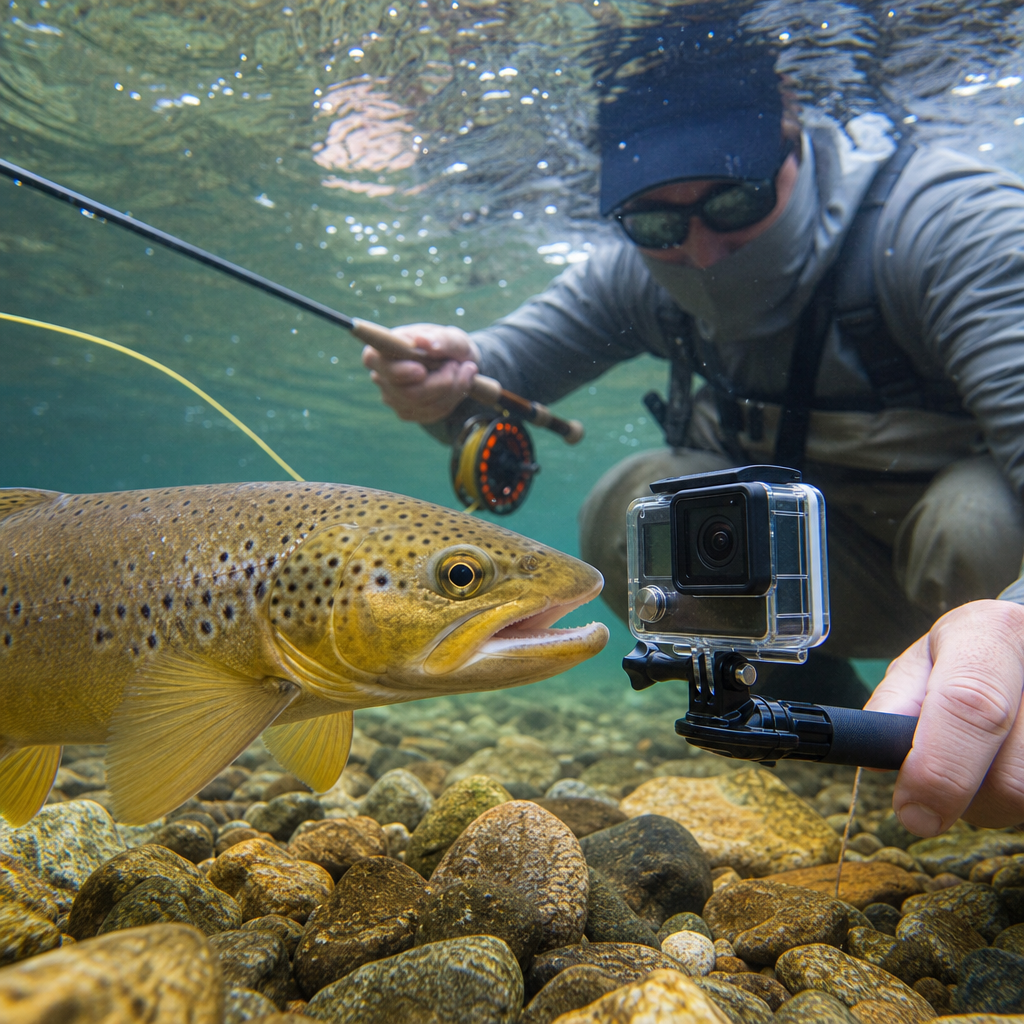
Mounting determines whether footage feels immersive or random. Chest mounts are reliable for casting, stripping line, and landing fish. Net mounts create dramatic release footage, especially when a fish rests briefly before swimming off. Short extension poles help place the camera just below the surface for tracking shots. Rod mounts can work, but they often produce too much vibration and a less intuitive angle unless used sparingly for specific moments.
Durability is about more than waterproof depth. Buttons must work with cold fingers. Lens covers should be replaceable. Doors and seals must tolerate grit, sunscreen, and repeated opening on wet riverbanks. This is one reason action cameras dominate. Their accessory ecosystems include float grips, anti-fog inserts, bite mounts, spare batteries, magnetic mounts, and hard cases, all of which solve real field problems.
Workflow matters too. If transferring footage is slow or battery charging is awkward, you will film less often. I strongly recommend carrying at least three batteries for full-day trips, using high-end microSD cards from SanDisk Extreme or Lexar Professional lines, and rinsing gear in fresh water after silty use. Good habits protect footage as much as good hardware does.
How to Choose the Right Camera for Your Budget and Fishing Style
If you fish small rivers on foot and want one camera for everything, buy a flagship action camera first. It gives the broadest return on investment. If your budget is tighter, a midrange DJI or older GoPro model can still produce excellent underwater footage when paired with smart settings and clean water conditions. Do not overspend on resolution while neglecting mounts, spare batteries, and memory cards; those accessories affect success more than marketing suggests.
Lake anglers who want to study fish behavior around chironomids, leeches, or baitfish patterns may benefit more from a dedicated underwater camera than from a premium action camera. Guides and creators producing regular destination content should prioritize reliability, color consistency, and editing speed. In that case, staying inside one ecosystem, such as GoPro mounts and batteries, simplifies life.
Think honestly about your end use. If you are publishing cinematic edits, stabilization and dynamic range matter most. If you are learning how fish react to your presentation, continuous recording time and underwater visibility matter more. The best fly fishing video camera for underwater footage is the one that matches your water, your habits, and your editing ambitions. Compare a few current models, test them in familiar conditions, and build a kit that helps you fish smarter and tell better stories.
Frequently Asked Questions
What features matter most when choosing a fly fishing video camera for underwater footage?
The most important features are not always the ones highlighted in marketing copy. For underwater fly fishing footage, image stabilization, true waterproofing, lens performance, low-light capability, and color accuracy matter far more than flashy frame-rate claims alone. Rivers and lakes create difficult shooting conditions because light changes constantly, suspended particles reduce clarity, and fish often move quickly through uneven current. A camera that performs well on dry land may struggle badly once it is submerged or mounted low near the waterline.
Start with waterproof reliability. A camera that requires a separate housing can still work well, but every extra seal, latch, and hinge creates another possible failure point. If you regularly wade deep, fish from a float tube, or film releases at the net, a rugged camera with strong native waterproofing is usually more dependable in real fishing conditions. Next, look at stabilization. Underwater footage gets shaky fast because current, hand movement, and rod motion all amplify vibration. Strong stabilization helps keep footage watchable without making it look overly digital or cropped.
Lens quality also matters more than many anglers expect. A wide-angle lens can capture the whole scene, but if it distorts badly or struggles with glare and contrast, underwater footage will look muddy and flat. Good cameras preserve detail in highlights and shadows, which is critical when filming fish under bright surface reflections. Battery behavior is another practical issue. Cold mornings, long drifts, and repeated recording sessions drain batteries faster than expected, so a camera with swappable batteries or dependable power management is often a better choice than one that only looks impressive in short test clips.
Finally, consider mounting flexibility. The best fly fishing camera is one you can actually position where the action happens, whether that is on a chest mount, net mount, boat frame, hat brim, or a short extension pole for release shots. In real-world fly fishing, the best camera balances image quality with field durability and ease of use, because if it is awkward to deploy, you will miss the shot that mattered.
Do I need a dedicated underwater housing, or is a waterproof action camera enough for fishing footage?
For many anglers, a waterproof action camera is enough, but the right answer depends on how deep, how often, and how aggressively you plan to film underwater. If your underwater footage mostly involves quick submersions at the boat side, release clips in shallow current, or occasional underwater drift shots, a quality waterproof camera can be more than sufficient. These cameras are faster to use, lighter to mount, and less cumbersome when you are already managing a rod, net, and fish.
That said, a dedicated housing still has real advantages. It adds a second layer of protection against leaks, impact, sand, and repeated pressure changes. If you fish around abrasive gravel bars, bounce gear around in a drift boat, or spend a lot of time in cold water where seals can become less forgiving, a housing can dramatically extend the life of your camera. It can also improve confidence when you are dunking the camera repeatedly during a long day on the river. Many anglers underestimate how much abuse a fishing camera takes compared with casual recreational use.
The tradeoff is bulk and complexity. Housings can make buttons harder to access, affect audio quality above water, fog if not prepared properly, and add another piece of equipment that needs cleaning and maintenance. They can also change the way a camera handles on compact mounts. For anglers who want a quick draw-and-shoot setup, that extra layer can become inconvenient enough that they stop using the camera consistently.
A good rule is this: if your footage is mostly shallow, brief, and frequent, a rugged waterproof action camera is usually the most practical choice. If you are planning repeated underwater filming, extended submersion, rough transport, or any situation where equipment failure would be especially costly, a dedicated housing is worth serious consideration. In fly fishing, convenience matters, but reliability matters more when your camera is inches from current, rocks, and fish.
Why does underwater footage often look dull, blue, or muddy, and how can I improve color quality?
Underwater footage often looks dull because water changes light very quickly. As soon as the camera goes below the surface, colors begin to shift and disappear, with reds and warmer tones fading first. Add surface glare, depth, algae tint, tannic water, bubbles, and suspended sediment, and even expensive cameras can produce flat-looking footage. In fly fishing environments, this problem is even more noticeable because streams and lakes rarely provide the clean tropical-water conditions that many camera ads are based on.
To improve color quality, start by filming in the clearest water and best natural light available. Midday can create harsh glare above the surface, but it often provides stronger underwater visibility than early dawn or late evening. Try to keep the lens just below the surface rather than plunging too deep unless the water is exceptionally clear. The farther you are from the subject, the more the water column degrades contrast and color. Close-range shots of fish, flies, and releases almost always look better than distant underwater scenes.
Camera settings matter too. If your camera allows flat color profiles, white balance adjustment, or underwater color modes, use them carefully. Automatic settings often get confused by shifting reflections and can produce footage that pulses in brightness or skews too blue or green. Locking white balance when possible can make results more consistent. Some anglers also use color-correcting filters, but these are most useful in predictable water conditions and can hurt image quality if the light changes rapidly.
Post-processing is often the final step that makes footage look polished. Even strong raw clips usually benefit from contrast, warmth, shadow, and clarity adjustments. The goal is not to create unnatural colors, but to restore what the eye saw and the camera sensor muted. In practical terms, the best underwater fishing footage comes from combining decent water clarity, close subject distance, stable framing, and a camera that preserves enough image data to grade cleanly afterward.
How important are battery life and cold-weather performance in a fly fishing camera?
Battery life is extremely important, and cold-weather performance is one of the most overlooked factors when comparing cameras for fly fishing. On paper, many cameras seem to offer enough runtime, but real fishing days are very different from controlled manufacturer tests. Recording in high resolution, using stabilization, reviewing clips, connecting wireless features, and repeatedly starting and stopping the camera all reduce battery life. Add cold air, cold water, and long days on the river, and runtime can drop faster than most anglers expect.
Cold weather affects battery chemistry directly. Even a camera that performs well on a summer lake can behave unpredictably during spring runoff, fall streamer season, or winter trout trips. Batteries may drain faster, shut off suddenly, or show inaccurate charge levels. This becomes a real problem when the best footage often happens during short, unpredictable windows, such as a fish eating near the net or a clean release in clear current. If the camera dies in that moment, resolution specs do not matter.
For this reason, cameras with replaceable batteries usually give anglers more flexibility than sealed-battery models. Carrying two or three extras in a dry pocket can be far more valuable than choosing a camera with slightly better advertised image specs. It also helps to keep spare batteries warm inside a jacket until needed. If you fish from a drift boat, kayak, or stillwater setup where charging options are available, external power can help, but for wading anglers, portability and battery swapping remain the more useful advantages.
Power management features are worth paying attention to as well. Efficient standby behavior, quick startup, and reliable one-button recording reduce wasted battery drain and make it easier to capture short fishing moments. In the real world, the best camera is not just the one that records the best-looking clip; it is the one that still has power when the fish of the day slides into view.
What is the best way to mount a camera for fly fishing underwater shots without getting unusable footage?
The best mounting method depends on the kind of underwater footage you want, but the key is balancing stability, angle, and accessibility. Many anglers assume a head mount or chest mount will solve everything, yet underwater footage usually requires a much lower and more intentional perspective. If the goal is to film fish in the net, release shots, or a fly underwater beside the angler, handheld short-pole mounts and net mounts often produce the most controlled and visually interesting results.
A short extension grip works especially well because it allows you to place the camera at water level or just below the surface with much better framing control than a fixed body mount. This is ideal for quick hero shots, underwater release clips, and close-up sequences where you want to follow the fish naturally. Net mounts can also be effective, particularly when an angler wants hands-free footage during the landing process, but they need to be secure and positioned carefully so they do not interfere with fish handling or tangle with gear.
Boat and frame mounts are useful for drift boats, rafts, and stillwater setups, especially when filming general action around the waterline. However, they often struggle to capture compelling underwater detail unless the camera is placed very low and the water is calm enough to avoid constant spray and shake. Chest mounts can work for point-of-view footage, but they usually produce