Reviewing the best fly fishing action cameras means judging more than image quality. On the water, a camera has to survive immersion, capture fast strikes, handle glare, mount securely on a chest pack or drift boat, and keep recording when the weather turns. In practical terms, fly fishing action cameras are compact, rugged video devices designed to document casting, hook sets, fish fights, and scenery while keeping the angler hands-free. For anglers researching technology reviews under product reviews and recommendations, this category matters because one poor hardware choice can mean missed footage, dead batteries, fogged lenses, or a lost camera somewhere below a riffle. I have tested cameras on wade trips, raft floats, and windy flats days, and the same lesson keeps repeating: the best unit for fly fishing is the one that balances stabilization, waterproofing, battery life, mounting flexibility, and workflow simplicity. This hub article covers the leading camera options, the features that actually matter on the river, and the practical tradeoffs between flagship models, budget picks, and specialty setups. If you want clean footage of eats, releases, and casting sequences without turning your fishing day into a production shoot, choosing the right action camera is the first decision that counts.
What makes an action camera good for fly fishing
The best fly fishing action camera must do five things well. First, it needs reliable stabilization. Walking over slick rocks creates constant micro-vibrations, and poor stabilization makes footage unusable. Systems such as HyperSmooth from GoPro and RockSteady from DJI materially improve chest-mounted and head-mounted clips. Second, true waterproofing matters. Many cameras claim water resistance, but fly anglers routinely dunk gear while landing fish or crossing current. A camera rated for submersion without an external housing is more practical because housings add bulk, lens fog risk, and awkward button access.
Third, battery performance has to be judged in cold, wet conditions, not lab conditions. Lithium batteries drain faster in spring tailwater temperatures and alpine mornings. Fourth, mounting options are critical. A great sensor does little good if the camera shifts on a hat clip or swings from a chest harness during a double haul. Fifth, footage management must be simple. Fast transfer to a phone, straightforward editing apps, and dependable file handling matter because anglers often want to post a same-day trout release or archive full-day footage for later review.
Field of view is another important specification. Ultra-wide modes capture rod tip, line path, and surrounding water, which is ideal for perspective shots. Narrower digital lens options help when you want the fish larger in frame. Resolution should not be confused with usefulness. For many anglers, 4K at 30 or 60 frames per second is the sweet spot because it preserves detail without overwhelming storage or battery capacity. Higher frame rates like 120 fps become valuable for slow-motion strike analysis and casting breakdowns.
Best overall action cameras for fly fishing
For most anglers, the best overall choice remains the GoPro Hero lineup, especially the recent Black models. GoPro still leads this category because its stabilization is class-leading, accessory support is unmatched, and waterproofing is proven in real fishing conditions. The latest Hero Black cameras offer strong horizon leveling, sharp 4K and 5.3K footage, front and rear screens, and a broad ecosystem of chest mounts, bite mounts, magnetic clips, and floating hand grips. On drift boats and while wading, that accessory depth matters as much as sensor quality.
DJI Osmo Action models are the strongest direct alternative. In repeated side-by-side use, DJI cameras have impressed me with excellent stabilization, bright dual screens, and intuitive menus that are easier to navigate with wet fingers than some older competitors. DJI also tends to offer strong battery efficiency and quick charging, which helps on long float days when power banks are the only backup. Color rendering is often slightly punchier straight out of camera, which many anglers like for green banks, silver fish, and blue-sky river shots.
Insta360 action cameras deserve inclusion because they serve a different kind of angler. Traditional action models from Insta360 compete capably on stabilization and image quality, while the company’s 360-degree cameras let you reframe after the fact. That means a missed camera angle at the moment of a take can sometimes be rescued in editing. For solo anglers who cannot constantly reposition a camera, that flexibility is genuinely useful. The tradeoff is more editing time, more battery use, and, in many cases, slightly more complexity than a straightforward point-and-record setup.
Top camera options compared
Choosing between brands is easier when you match features to fishing style. The table below summarizes the strengths that matter most on the water.
| Camera | Best For | Key Strengths | Main Tradeoff |
|---|---|---|---|
| GoPro Hero Black | All-around fly fishing use | Excellent stabilization, broad accessory ecosystem, dependable waterproofing | Premium price and moderate battery drain in cold weather |
| DJI Osmo Action | Value-focused anglers wanting premium performance | Dual screens, strong battery life, easy interface, solid stabilization | Smaller accessory ecosystem than GoPro |
| Insta360 Ace or ONE RS class | Creators who edit heavily | Flexible shooting modes, strong app tools, good image quality | Workflow can be more complex |
| Insta360 X series | Solo anglers wanting reframeable 360 footage | Capture everything around you, creative perspectives, effective stabilization | More power use and longer editing time |
If your goal is dependable fishing documentation with minimal fuss, GoPro remains the safest recommendation. If you want nearly flagship performance at a more aggressive value, DJI is often the better buy. If storytelling and creative edits matter as much as raw convenience, Insta360 becomes more compelling. None is universally best. The right choice depends on whether your day centers on fishing efficiency, social clips, long-form YouTube edits, or guided content production.
Mounting setups that actually work on the water
Mount choice can improve footage more than upgrading from one premium camera to another. For fly fishing, chest mounts are usually the most useful because they show rod movement, line management, and fish handling from a natural perspective. They also avoid the exaggerated head motion that makes head-strap footage tiring to watch. I use chest mounts most often when wading for trout because they keep the horizon reasonably stable and leave hats, buffs, and rain hoods unobstructed.
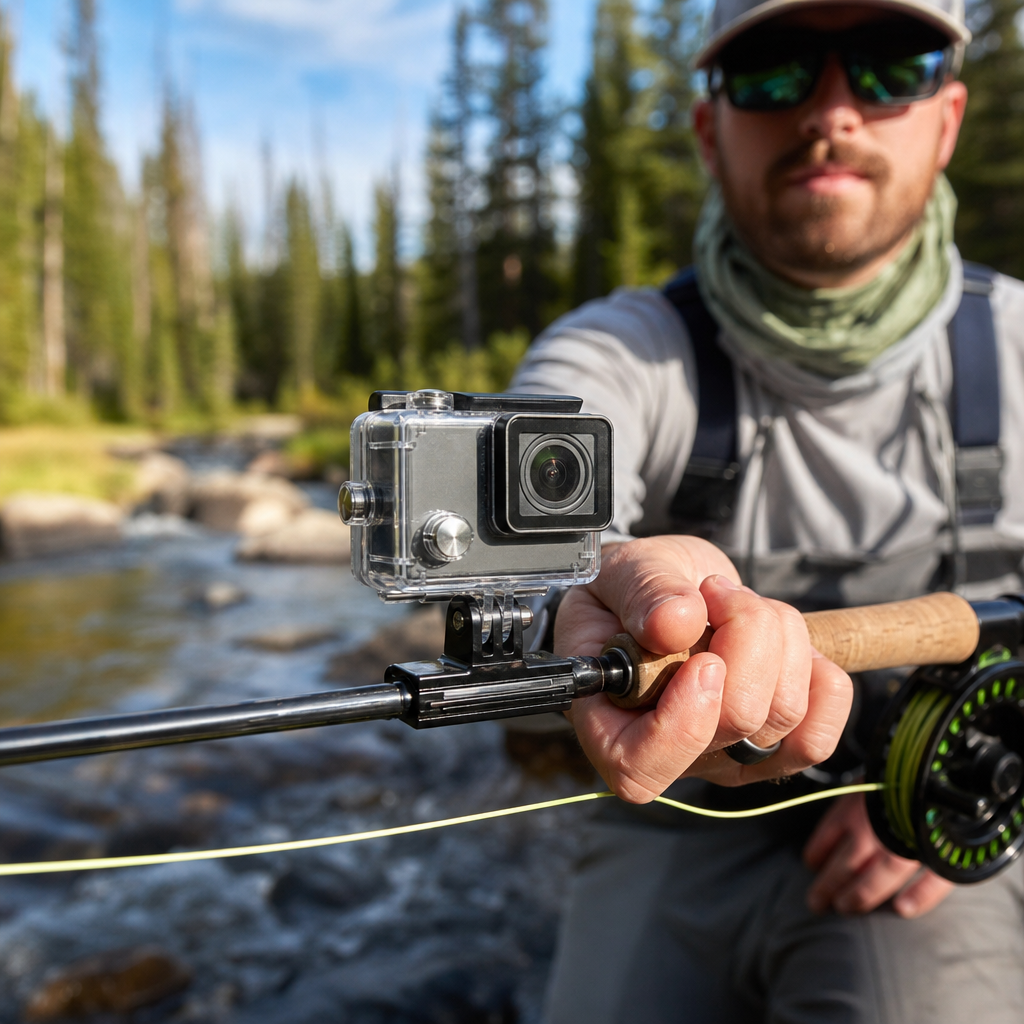
Hat clips and magnetic clips work well for quick social clips, especially on boats, but they are less stable while scrambling along banks. Head mounts can be effective for instructional content because viewers see exactly what the angler sees, yet they tend to amplify every glance at fly boxes, feet, or the bank. For streamer fishing or sight fishing on flats skiffs, a short extension pole or stern-mounted clamp can add context and make fish fights look more dynamic. On drift boats, fixed mounts aimed at the casting deck create some of the best B-roll because they document both angler movement and netting sequences.
Security matters. Always use a tether in current, and choose rust-resistant hardware. A floating grip is cheap insurance when filming releases from knee-deep water. If you frequently switch mounts, quick-release buckles save time and reduce the temptation to skip a secure setup. In my experience, anglers lose more cameras from hurried mount changes than from outright equipment failure.
Video quality, audio, and low-light performance
Sharp video is important, but in fishing footage, exposure control and dynamic range are often more noticeable than pure resolution. Rivers create hard visual conditions: bright sky, dark banks, reflective water, and moving subjects. Cameras with better dynamic range preserve detail in whitewater and fish markings at the same time. Newer premium models from GoPro, DJI, and Insta360 all perform credibly here, but settings matter. Locking exposure compensation slightly lower can protect highlights on bright days, and using flat color profiles can help when you plan to grade footage later.
Low-light performance becomes relevant during dawn hatches, evening streamer sessions, and forested creeks. Small-sensor action cameras are not miracles in dim light. Even the best models show noise and reduced detail as ISO rises. If low-light recording is a priority, record at lower frame rates like 30 fps rather than 60 fps to allow more light per frame. Keep expectations realistic: no action camera will match a larger-sensor mirrorless body at dusk.
Audio is often overlooked. Wind can ruin otherwise excellent fish footage. Many modern action cameras offer improved internal microphones and wind reduction algorithms, but they still struggle in open boats or gusty canyon rivers. For spoken reviews, consider a media mod or wireless microphone system when conditions allow. For pure fishing sequences, natural sound mixed with music in post usually works better than trying to preserve every shouted hook set through heavy wind noise.
Battery life, storage, and reliability in harsh conditions
Battery life is where many fly fishing camera setups succeed or fail. Recording at 4K60 with stabilization enabled is demanding, and cold water environments make that harder. I advise anglers to budget for at least three batteries for a full day, plus a waterproof pouch and a compact power bank for boat charging. Enduro-style batteries and newer high-capacity packs perform meaningfully better in cold temperatures than older cells. Keep spare batteries warm in a jacket pocket rather than exposed in a pack.
Storage reliability is equally important. Use reputable microSD cards from lines specifically rated for high-bitrate video, such as SanDisk Extreme, Lexar Professional, or Samsung Pro Plus. Cheap cards are one of the most common causes of corrupted files and random recording stops. Format cards in-camera after backing up footage, and replace cards that show intermittent errors. A lost brown trout clip because of a failing card is preventable.
Lens maintenance deserves attention too. Water droplets on an ultra-wide lens can spoil a perfect release shot. Hydrophobic lens protectors help, and a quick wipe with a clean microfiber cloth before filming fish photos makes a difference. In freezing weather, moving the camera repeatedly between warm and cold environments can create condensation. Let the device acclimate and avoid sealing moisture into a housing or case.
Who should buy which camera
Beginners should focus on simplicity and value. A midrange DJI Osmo Action or a previous-generation GoPro Hero Black often delivers more than enough quality for fish clips, travel footage, and basic instructional recording. You do not need the highest resolution to document a weekend float. What you need is a camera you will actually carry, mount, and use consistently.
Serious content creators, guides, and anglers building a channel should lean toward current flagship models. The improved stabilization, better dynamic range, stronger app support, and more dependable battery systems justify the cost when footage is part of your business or brand. Guides can also benefit from dual-camera setups: one chest-mounted unit for first-person action and one fixed boat camera for client reactions and net shots. That combination creates far more complete storytelling.
Solo anglers who fish remote water and want flexibility should consider 360 cameras despite the editing overhead. Being able to reframe a strike after the fact is valuable when no second person is filming. Budget shoppers should not chase bargain-bin cameras from unknown brands. In this category, poor app support, weak stabilization, and exaggerated waterproof claims quickly erase any upfront savings.
The best fly fishing action cameras are the ones that keep working when conditions get wet, cold, bright, and chaotic. For most anglers, a recent GoPro Hero Black remains the top all-around recommendation because it combines class-leading stabilization, durable waterproof design, and the deepest mount ecosystem. DJI Osmo Action cameras are the strongest value alternative, often delivering premium features with excellent usability and battery performance. Insta360 models stand out when reframing flexibility or creative storytelling is the priority, especially for solo anglers.
As this technology reviews hub within product reviews and recommendations, the main takeaway is simple: buy for your fishing style, not just the headline specification. Prioritize stabilization, waterproofing, battery strategy, secure mounting, and an editing workflow you can maintain after a long day on the river. A camera that records every take but is annoying to charge, mount, or transfer will stay in the truck. A camera that fits your routine will capture more memorable fish, cleaner instruction, and better travel stories.
If you are comparing models now, start with how and where you fish, then narrow your list to the camera system that matches those realities. That approach leads to better footage and fewer regrets on the water.
Frequently Asked Questions
What features matter most when choosing the best fly fishing action camera?
For fly fishing, the best action camera needs to do much more than record sharp video. Image quality still matters, especially if you want clean footage of rises, hook sets, and scenic river shots, but durability and usability on the water are just as important. A strong fly fishing camera should be waterproof or highly water resistant, able to handle splashes, rain, and the occasional full dunk without failing. It should also have reliable image stabilization, because casting, wading, rowing, and fighting fish all create constant motion that can make footage shaky and hard to watch.
Mounting flexibility is another major factor. Fly anglers often use chest mounts, hat clips, shoulder straps, boat mounts, or net mounts, so a good camera should work with multiple accessories and stay secure while moving through current or brush. Battery life is also critical. Cold mornings, long float trips, and all-day fishing sessions can expose weak battery performance very quickly, so cameras with efficient power use or swappable batteries usually offer more practical value than models that only perform well in short test clips.
You should also pay attention to how the camera handles glare and contrast. Water reflects sunlight aggressively, and many cameras struggle to balance bright skies with shaded banks or under-hat facial shots. A camera with strong dynamic range and adjustable exposure settings will usually perform better in real fishing conditions. Finally, simple controls matter more than many anglers expect. When your hands are wet, cold, or busy with a fish, a camera that starts recording quickly and reliably is far more useful than one loaded with features you will never use on the river.
Is waterproofing enough, or should fly anglers also look for ruggedness and weather resistance?
Waterproofing is essential, but it is only one part of what makes an action camera truly suitable for fly fishing. On the water, cameras are exposed to more than immersion. They get knocked against drift boat frames, dropped onto gravel bars, splashed with muddy water, exposed to wind-driven rain, and used in hot sun one day and cold spray the next. A camera may technically survive submersion to a certain depth, but still perform poorly if its housing scratches easily, its buttons become unreliable when wet, or its seals wear down quickly after repeated use.
Ruggedness matters because fly fishing environments are unpredictable. A good camera should have a solid build, dependable door latches, durable lens protection, and mounts that do not loosen under vibration or movement. Weather resistance is equally important, especially for anglers who fish in changing conditions. Morning fog, sudden storms, and cold-weather condensation can affect electronics in ways that simple waterproof depth ratings do not fully explain.
In practical terms, the best fly fishing action cameras combine waterproof performance with a tough exterior and dependable operation in real-world conditions. If you regularly fish from a raft, drift boat, kayak, or in rough wading situations, it is smart to prioritize cameras known for both physical durability and consistent performance in wet, dirty, and cold environments. A camera that survives a laboratory water test is one thing. A camera that keeps recording after repeated exposure to river abuse is the one anglers can trust.
How important is video stabilization for recording casting, strikes, and fish fights?
Video stabilization is extremely important for fly fishing footage, and for many anglers it can be the difference between useful video and clips that are frustrating to watch. Fly fishing naturally involves constant movement: false casts, line mends, quick hook sets, stepping over rocks, rowing through chop, and turning to follow a running fish. Without strong stabilization, even high-resolution footage can look jerky and chaotic, which makes it harder to see what actually happened during a strike or fight.
For chest-mounted or hat-mounted filming, stabilization helps smooth the small body movements that happen all day on the river. This is especially valuable when recording wading sessions, where every step creates bounce and vibration. In a drift boat or raft, stabilization helps reduce the visual shake caused by current, oar strokes, and boat movement. It also improves scenic footage, making the video feel more immersive and professional instead of rough and distracting.
Good stabilization does have tradeoffs. Some cameras crop the frame to stabilize the image, which can slightly narrow your field of view. Others perform better in bright light than in low light. That said, for the fly fishing use case, stabilization is usually worth prioritizing over having the highest possible resolution on paper. A smooth 4K or even stabilized 1080p clip that clearly shows the cast, eat, and landing sequence is often more valuable than ultra-detailed footage ruined by excessive shake. When reviewing fly fishing action cameras, stabilization should be treated as a core performance category, not just a bonus feature.
What is the best way to mount an action camera for fly fishing?
The best mounting setup depends on how you fish and what kind of footage you want, but hands-free, stable placement is usually the top priority. Chest mounts are among the most popular options because they provide a natural point of view, capture rod angles well, and keep the camera fairly stable during casting and fish handling. They also tend to work better than head mounts for showing what is happening directly in front of the angler, especially during hook sets and netting.
Head or hat mounts can create a more immersive first-person angle, but they are often more sensitive to rapid head movement. That can make footage feel jumpy if you constantly scan water, check your line, or look down while tying knots. Shoulder-strap or pack mounts can offer a nice middle ground, especially for anglers who wear chest packs, sling packs, or vests. For boat anglers, fixed mounts attached to a drift boat frame, console, or stern can add a useful secondary angle that shows casting, rowing, and the overall fight from a wider perspective.
Security matters as much as camera angle. Any mount used for fly fishing should stay locked in place when wet, resist slipping on fabric or rails, and avoid interfering with casting or line management. It is also wise to consider snag risk. Bulky mounts and poorly positioned arms can catch fly line at the worst moment. The most effective setup is often a simple, low-profile mount that gives a clean view while staying out of the way. Many anglers ultimately get the best results by combining one body-mounted camera with one boat or fixed-position angle, but even a single well-placed chest mount can produce excellent footage if the camera has a wide enough field of view and reliable stabilization.
How do battery life, storage, and recording controls affect real-world fly fishing use?
These practical factors have a huge impact on whether an action camera is enjoyable to use on the water. Battery life is especially important because fly fishing days are often long, and many memorable moments happen unexpectedly. If a camera only performs well in short bursts or drains quickly in cold weather, it may miss the one fish or hatch you most wanted to record. Cameras with removable batteries are often more convenient for anglers because they let you swap in a fresh battery during lunch or between spots instead of shutting down your filming day early.
Storage matters because high-resolution footage, especially 4K with high frame rates, fills memory cards quickly. A day of filming multiple drifts, fish catches, and scenic clips can consume more space than many first-time users expect. Reliable support for high-capacity, fast memory cards is important, and so is stable file handling. The last thing an angler wants is corrupted footage after a standout day on the river. Good cameras also make it easier to review, transfer, and organize clips without wasting time.
Recording controls may be the most underrated factor in all. On the water, you need a camera that can start, stop, and confirm recording quickly. Physical buttons, voice commands, front-facing status screens, and clear indicator lights all help, especially when your hands are wet or you are wearing gloves. If the interface is confusing or the camera frequently fails to register commands, it becomes a distraction instead of a tool. In fly fishing, the best action camera is not just the one with the strongest specifications. It is the one that reliably powers on, records when needed, and keeps working through a full day of changing light, moving water, and fast action.