Trophy fishing sits at the center of one of angling’s hardest debates: whether pursuing the biggest, rarest, and oldest fish can ever align with responsible stewardship of wild waters. In practical terms, trophy fish are unusually large specimens of a species, often distinguished by weight, length, girth, age, or record-book status. Ethical fishing practices are the standards anglers use to reduce unnecessary harm, respect ecosystems, comply with regulations, and make decisions that hold up even when no one is watching. I have spent enough time around charter docks, muskie boats, salmon rivers, and bass tournaments to know this issue is never as simple as “catching fish is bad” or “all catch-and-release is harmless.” The real question is how intent, method, handling, biology, and local conservation goals interact.
This matters because trophy fish are not just large individuals. In many species, they are disproportionately important breeders, repositories of valuable genetics, and social symbols that shape angler behavior. A forty-inch redfish, a giant blue catfish, a mature tarpon, or an old female largemouth bass may produce far more eggs than smaller fish, and in some fisheries older females produce higher-quality offspring. Removing or mishandling those fish can affect a population more than harvest of younger size classes. At the same time, trophy angling can support guides, license revenue, habitat funding, and advocacy for clean water. The ethics of fishing for trophy fish therefore involves balancing animal welfare, population health, cultural tradition, and economic reality.
For a hub article on ethical fishing practices, the useful approach is not moral posturing but a framework anglers can apply on the water. That framework starts with a simple principle: just because a catch is legal does not mean it is ethical. Regulations set a floor, not a ceiling. Ethical trophy fishing asks additional questions. Is the target species vulnerable during spawning? Is the water temperature high enough to make release mortality likely? Are the tackle, hooks, landing tools, and photo practices minimizing stress? Is keeping a record fish consistent with the fishery’s long-term health? When anglers answer those questions honestly, the debate becomes more concrete and more responsible.
Why Trophy Fish Deserve Special Ethical Consideration
Trophy fish deserve separate ethical consideration because their biological and ecological roles differ from average-size fish. Fisheries science has repeatedly shown that large, old fish can contribute disproportionately to reproduction. The concept often discussed as “big, old, fat, fecund female fish” is especially relevant in species such as rockfish, snook, striped bass, and many marine predators. Larger females produce more eggs, and research in several fisheries has shown egg and larval quality can improve with age. Even in freshwater systems, the loss of top-end spawners can change population age structure, reduce resilience to environmental swings, and shift angling quality downward over time.
Large fish also shape ecosystems through predation and competition. A mature pike, lake trout, or muskellunge influences prey distribution differently than juvenile fish. In rivers, giant catfish and sturgeon occupy ecological niches developed over many years. From an ethical standpoint, pursuing these fish for challenge is not inherently wrong, but it creates a higher duty of care because the consequences of mortality are amplified. One dead twelve-year-old fish is not equivalent to one dead two-year-old fish. That is why selective harvest, slot limits, maximum size protections, and immediate release rules are increasingly common in well-managed trophy fisheries.
There is also a cultural dimension. Trophy fish drive tourism, magazine covers, social media posts, and sometimes unhealthy competition. When an angler’s primary goal becomes validation, corners get cut. Fish stay out of the water too long for photos, are weighed on inaccurate devices, dragged onto hot boat carpet, or fought on tackle too light to land them quickly. I have seen anglers insist they “released it fine” after a prolonged fight in eighty-degree water, even though the fish rolled at boatside and drifted off. Ethical fishing practices begin by admitting that a release is not the same thing as survival.
Is Catch-and-Release Always Ethical?
Catch-and-release is often presented as the ethical answer to trophy fishing, but that claim is only partly true. Release avoids direct harvest, which is significant, yet released fish can suffer injury, stress, infection, exhaustion, and delayed mortality. Ethical catch-and-release depends on species biology, environmental conditions, and angler technique. For example, black bass generally tolerate brief handling reasonably well when landed quickly and released in moderate temperatures, but deep-hooked fish, fish angled from deep water, or fish caught during severe summer heat can die later. Trout and salmon are particularly vulnerable in warm water because low dissolved oxygen and elevated metabolic stress reduce recovery.
Some species are notoriously fragile after release. Tarpon may die from shark predation after a long fight. Deepwater reef fish can suffer barotrauma when reeled up quickly, causing organ damage unless recompression tools or descending devices are used. Bonefish handled with dry hands or taken onto abrasive surfaces can lose protective slime and develop infections. Ethical fishing practices require anglers to know these species-specific limits before they fish, not after posting a photo. Organizations such as the American Fisheries Society, Keep Fish Wet, Bonefish & Tarpon Trust, and many state agencies have published handling guidance based on survival studies and field observations.
The most ethical answer is conditional: catch-and-release is appropriate when it is done with methods proven to minimize harm and when the fishery can support it. It becomes ethically weak when anglers target vulnerable fish during thermal stress, spawning aggregations, or migration bottlenecks simply because release provides moral cover. If a fish is unlikely to survive the encounter, “I let it go” is not a defense. In some situations, the ethical choice is to stop fishing, change target species, fish only during cooler hours, or avoid a location entirely until conditions improve.
Best Practices for Ethical Trophy Fishing
Ethical trophy fishing starts before the first cast. Use tackle heavy enough to land fish efficiently. Long fights increase lactate buildup, reduce oxygen recovery, and elevate release mortality. Circle hooks are strongly preferred for many natural-bait fisheries because they reduce gut hooking when used correctly. Barbless or de-barbed hooks can speed release and reduce tissue damage, especially in catch-and-release trout, salmon, and fly fisheries. Knotless rubber landing nets are better than abrasive nylon because they protect fins, scales, and slime coating. Wet hands before touching fish, support the body horizontally, and never hang heavy fish vertically by the jaw for prolonged periods.
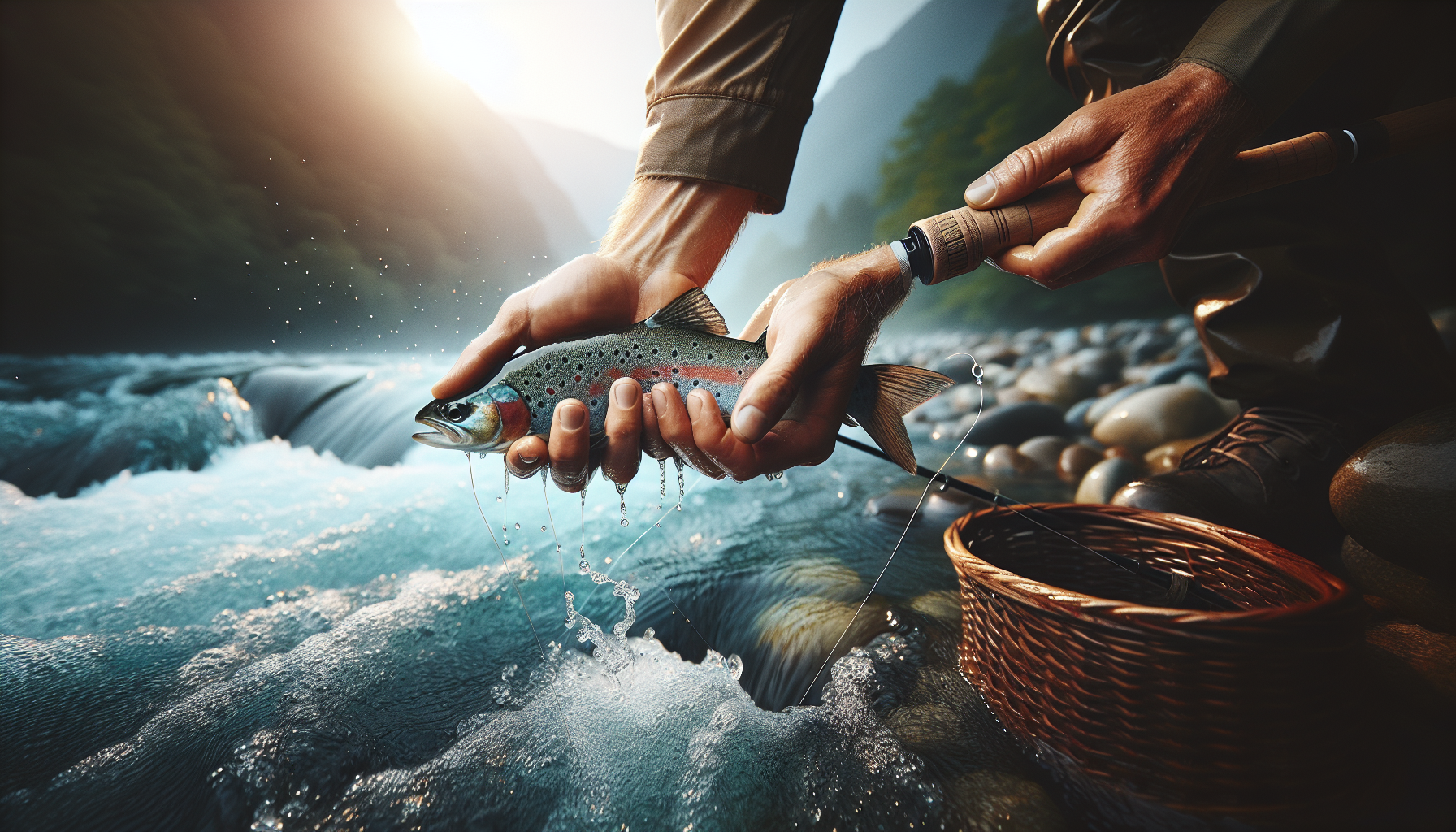
Time out of water should be measured in seconds, not minutes. A practical rule I use is to have camera, pliers, and measuring board ready before lifting the fish. If you are still organizing gear after the landing, the process is already too slow. For large fish, keep the head submerged while removing hooks whenever possible. Revive only when necessary and only by supporting the fish upright in moving water or beside the boat; do not pump fish backward aggressively, because that can damage gills. In boatside releases, wait until the fish kicks away under its own power.
| Practice | Why It Matters | Better Choice |
|---|---|---|
| Using ultralight tackle on big fish | Extends fight time and stress | Match rod, reel, and line to species size |
| J-style bait hooks for release fisheries | Higher chance of deep hooking | Inline circle hooks where regulations allow |
| Nylon knotted net | Removes slime and frays fins | Rubberized knotless landing net |
| Vertical lip hold for heavy fish | Can injure jaw and spine | Horizontal support with both hands |
| Long photo sessions | Increases hypoxia and handling harm | One or two fast shots, then release |
| Fishing hot water closures anyway | High delayed mortality | Respect closures and temperature advisories |
Boat and shore practices matter too. Do not beach trophy fish on rocks, dry sand, or boat decks. If measuring is necessary, use a wet bump board. If weighing is necessary, use a proper sling for large fish rather than a jaw gripper alone. Record-chasing creates some of the worst ethical outcomes because official weights may require extended retention or transport. Many modern anglers choose certified length-and-girth estimates, replica mounts, and digital documentation instead of killing exceptional fish. That shift preserves both the memory and the breeder.
Harvest, Records, and the Question of Keeping a Trophy
The ethics of keeping a trophy fish depends on local population status, regulations, species life history, and purpose. Blanket statements fail here. In some systems, harvesting an occasional large fish may be legal and biologically sustainable. In others, especially where recruitment is weak or fish mature slowly, keeping a top-end fish is difficult to justify. Species such as muskellunge, giant trout in small waters, large breeder red drum, and mature groupers often carry high ecological and social value alive. That is why many fisheries managers support harvest of smaller, more abundant fish while protecting the biggest individuals through slot limits or maximum length restrictions.
Record programs complicate the issue. Traditional all-tackle records have historically encouraged dead-fish weigh-ins, but many organizations and state programs now recognize catch-and-release categories. Replica mounts have further reduced the need for skin mounts. A high-quality fiberglass replica built from length, girth, and photos can look better than a preserved original and avoids removing a rare fish from the gene pool. From my perspective, if your pride in a catch depends on hanging the actual fish on a wall, you should at least confront the biological cost honestly rather than pretending the fish “would not have made it anyway.”
Food ethics also matters. Harvesting fish to eat can be defensible if the species is abundant, the harvest is within science-based regulations, and the fish is used well. Keeping a giant old fish primarily for display is harder to defend than harvesting a smaller fish with better table quality and less reproductive value. Ethical fishing practices are often rooted in restraint: keep what a fishery can spare, release what it needs, and do not confuse entitlement with tradition.
Seasonal Closures, Spawning Fish, and Environmental Stress
One of the clearest tests of angling ethics is what happens when fish are easiest to catch but most vulnerable to harm. Spawning periods are the classic example. Bedding bass can be aggressively territorial and easy to provoke, yet repeated capture may reduce nest defense and increase predation on eggs or fry. Salmon and steelhead stacked in low-water pools are concentrated targets under severe stress. Tarpon during migration, permit on spawning aggregations, and reef fish gathered to reproduce all present similar ethical questions. Even when regulations allow fishing, targeting these concentrations can undermine conservation goals.
Temperature and dissolved oxygen are just as important. Many trout fisheries now issue hoot-owl restrictions or recommend fishing only during cooler mornings when water warms into the upper sixties Fahrenheit. Striped bass release mortality rises sharply in warm water, which is why several Atlantic states have promoted careful handling and reduced out-of-water time. In saltwater, summer heat and low oxygen in estuaries can make even short fights dangerous for redfish, snook, and tarpon. The ethical angler tracks water temperature, not just weather, and treats advisory thresholds as actionable information rather than suggestions.
Environmental context includes habitat condition. Fighting a fish to exhaustion near heavy current, shark-rich inlets, or seal colonies can turn a nominal release into a predictable predation event. Fishing from elevated piers without a drop net can leave large fish dangling by the jaw. Ethical fishing practices account for these situational risks. If you cannot land, handle, and release the fish properly from your platform, you should not target it there.
The Role of Guides, Tournaments, and Media in Setting Standards
Guides, tournament directors, and fishing media shape ethics more powerfully than most regulations. Clients copy what guides normalize. If a guide celebrates fast releases, proper support, and seasonal restraint, those habits spread. If a guide drags giant fish onto decks for hero shots, clients assume that is acceptable. The same is true in tournaments. Competitive formats can encourage conservation when they use immediate-release boats, in-water judging, penalties for dead fish, and livewell standards that control temperature and oxygen. Bass circuits have improved dramatically over the decades, but summer events on stressed fisheries still raise legitimate welfare questions.
Media has its own responsibility. Social platforms reward spectacle, and spectacle often means prolonged handling and unsafe stunts. Responsible communicators explain context: water temperature, hook type, release method, and why a fish was or was not harvested. They avoid geotagging fragile fisheries where crowds can overwhelm habitat. They also show newcomers that ethical fishing practices are not anti-fishing. They are how angling keeps public trust and a future resource base.
For a conservation and ethics hub, the key takeaway is clear. Trophy fishing is most defensible when anglers place the long-term welfare of the fishery above the short-term status of the individual catch. That means knowing the species, using gear and handling methods that minimize harm, respecting closures and environmental stress, and recognizing that large fish often matter more alive than dead. Ethical fishing practices are not a niche concern for purists. They are the operating standard that separates stewardship from extraction. If you fish for trophy species, review your methods honestly, update your gear and habits where needed, and make every catch a decision you would be comfortable defending in front of biologists, guides, and the next generation of anglers.
Frequently Asked Questions
What makes trophy fishing an ethical issue in the first place?
Trophy fishing raises ethical questions because it focuses on the largest, oldest, and often most reproductively valuable fish in a population. These fish are not simply bigger versions of average individuals. In many species, large fish can contribute disproportionately to spawning success, genetic diversity, and population stability. Removing them from a fishery, or even handling them poorly during catch-and-release, may have consequences that reach beyond a single animal. That is why the debate is not only about personal preference or sporting challenge, but about stewardship, ecological responsibility, and the long-term health of wild fisheries.
The ethical concern becomes sharper when anglers pursue fish primarily for status, records, or photographs rather than food or conservation outcomes. Critics argue that intentionally targeting vulnerable, high-value breeders can conflict with the obligation to minimize harm. Supporters of trophy fishing often counter that, when done under strict regulations and with best handling practices, the activity can coexist with conservation and even help fund it through licenses, habitat programs, and angler advocacy. The core issue is whether the pursuit itself is compatible with respect for the fish and the ecosystem, not merely whether the activity is legal.
In practice, ethical trophy fishing depends on context. Species biology, water temperature, fight time, release survival, seasonal stress, and local population status all matter. A practice that may be defensible in a robust, well-managed fishery could be irresponsible in a fragile or declining one. That is why the most credible ethical standard is not a blanket yes or no, but a careful evaluation of impact, intent, and restraint.
Is catch-and-release trophy fishing always ethical if the fish survives?
No. Survival alone is not the only ethical benchmark. A fish may swim away after release and still experience significant physiological stress, injury, reduced spawning success, or delayed mortality. Larger fish can be especially susceptible to handling damage because they are harder to land, harder to support properly, and sometimes brought up from depths or fought in warm water conditions that reduce recovery. Ethical catch-and-release is therefore not just about release, but about how the fish was targeted, landed, handled, photographed, and returned.
There are several reasons catch-and-release can still be ethically questionable. If an angler uses gear that is too light, the fight may be prolonged to the point of exhaustion. If the fish is held vertically by the jaw, dragged onto hot rocks, kept out of the water for extended photos, or caught during a period of extreme heat or spawning vulnerability, the likelihood of harm rises considerably. In those situations, the fact that the fish was not harvested does not automatically make the encounter responsible. Ethical angling requires minimizing unnecessary suffering and reducing the chance that a released fish will die later or suffer lasting impairment.
That said, catch-and-release can be part of an ethical trophy fishing approach when it is done with discipline. Anglers should use appropriately strong tackle, barbless or less damaging hooks where suitable, rubberized nets, quick landing techniques, in-water unhooking whenever possible, and minimal air exposure. They should also avoid targeting fish during periods when release mortality is known to be high. The most ethical anglers are willing to stop fishing when conditions make safe release unlikely, even if the law still allows them to continue.
Do large trophy fish play a special role in the ecosystem and reproduction?
Yes, in many fisheries they do. Large, old fish are often ecologically important because they can produce more eggs, higher-quality offspring, or spawn across multiple seasons and environmental conditions. In some species, older females contribute disproportionately to recruitment because their eggs may be larger or more resilient. Large predators can also shape food webs by influencing prey abundance and behavior. As a result, trophy fish may represent more than a memorable catch; they may be key components of a healthy, functioning system.
This is one reason many biologists and fisheries managers support protective measures such as slot limits, maximum size restrictions, seasonal closures, or special handling rules. These policies are designed to protect the fish that contribute most to future generations or maintain ecological balance. Ethical anglers should understand that the biggest fish in a system may also be the most valuable alive. Keeping one legally may still deserve a serious moral pause if the local population is under pressure or if conservation goals prioritize preserving older age classes.
It is also important to recognize that not every fishery functions the same way. Species differ in growth rates, reproductive strategies, habitat use, and resilience to angling pressure. A responsible ethical judgment should be informed by regional science rather than assumptions. The strongest position is one grounded in humility: learn how the target species reproduces, how local regulations were developed, and whether large fish are being protected for sound biological reasons. That knowledge should shape angling choices far more than personal ambition.
When does pursuing trophy fish cross the line from challenging sport to irresponsible behavior?
The line is crossed when the pursuit places ego, records, or social media validation above fish welfare and ecosystem health. Trophy fishing becomes irresponsible when anglers knowingly target stressed fish under poor conditions, ignore handling best practices, pressure spawning aggregations, fish deep for species prone to barotrauma without mitigation, or repeatedly target rare individuals simply because they are famous or unusually vulnerable. It also crosses an ethical line when people exploit legal loopholes, dismiss local conservation concerns, or treat a released fish as proof that no harm was done.
Another warning sign is when the method of pursuit creates avoidable risk. For example, intentionally using ultralight tackle on oversized fish for sport, staging lengthy photo sessions, transporting fish for weigh-ins that are not essential, or targeting species with high post-release mortality can all undermine claims of responsible stewardship. Legality is not the same as ethics. Regulations set minimum standards, but ethical conduct often requires stricter self-imposed limits based on knowledge, skill, and conditions on the water.
Conversationally speaking, a good test is this: would a thoughtful fisheries biologist, experienced guide, or conservation-minded angler look at the full encounter and conclude that the fish’s welfare was taken seriously? If the honest answer is no, the pursuit likely veered into irresponsibility. Ethical trophy anglers should be willing to pass up opportunities, change tactics, or leave the water entirely when the cost to the fish is too high.
How can anglers pursue trophy fish more responsibly if they choose to do so?
Responsible trophy fishing starts long before the cast. Anglers should study the target species, understand local regulations, know whether the fishery is healthy, and pay attention to seasonal concerns such as spawning periods, low flows, high water temperatures, or other stressors. Choosing the right equipment is essential. Heavier, species-appropriate tackle can shorten fight times and improve release outcomes. Hooks should be selected to reduce deep hooking, and landing tools such as knotless, rubberized nets can help protect slime coat and fins.
On the water, the goal should be efficiency and restraint. Fight the fish firmly, land it quickly, keep it in the water as much as possible, wet your hands before touching it, and support its body horizontally rather than hanging it by the jaw. Limit photography to a few seconds if the fish must come out of the water at all, and avoid elaborate measuring or filming when conditions are poor. If deep-water species are being targeted, anglers should use proven release tools where appropriate and avoid depths or conditions associated with high mortality. Just as important, anglers should be prepared to stop fishing when water temperatures, crowding, or fish behavior indicate elevated risk.
Responsibility also includes mindset. Ethical trophy anglers do not measure success only by records, likes, or wall mounts. They see themselves as temporary participants in a living system. That means accepting uncertainty, respecting no-take or protective rules, supporting habitat and science-based management, and sometimes choosing not to target trophy fish at all. In the end, the most defensible form of trophy fishing is one shaped by humility, conservation literacy, and a willingness to put the well-being of the fishery ahead of personal achievement.