Catch and release regulations and guidelines shape how anglers enjoy fishing while protecting fish populations, habitat quality, and the future of the sport. In practice, catch and release means landing a fish and returning it to the water alive, but the concept is more demanding than simply letting a fish go. Effective catch and release requires legal compliance, species knowledge, proper equipment, careful handling, and an understanding of how stress, temperature, and air exposure affect survival. I have seen excellent intentions fail on the bank when anglers used the wrong tackle, held fish too long for photos, or released exhausted fish into water too warm to support recovery. Good policy and good technique must work together.
The legal side varies by state, province, and waterbody, yet the goals are consistent: conserve spawning adults, maintain age structure, protect vulnerable species, and spread fishing opportunity across seasons. Regulations may include mandatory release seasons, slot limits, gear restrictions, bait bans, closed areas, and species-specific handling rules. Guidelines go further by explaining best practices that reduce delayed mortality, a term fisheries managers use for fish that swim away but die later from physiological stress or injury. That distinction matters because a release only counts as successful if the fish survives and can feed, migrate, and reproduce. For conservation-minded anglers, this article serves as a practical hub for understanding catch and release rules, applying proven handling methods, and recognizing when conditions make release risky enough that fishing should stop.
Why Catch and Release Regulations Exist
Catch and release regulations exist because fisheries are biological systems with limits. Even in productive waters, fish populations can decline when harvest pressure, habitat loss, high water temperatures, invasive species, or poor year classes reduce resilience. Managers use release rules to keep enough fish in the system, especially larger breeding fish that produce more eggs and often higher-quality offspring. On trout streams, for example, special regulation sections may require artificial lures and release-only fishing to preserve wild fish in heavily used reaches. On bass lakes, seasonal release requirements often protect fish during the spawn, when nest-guarding males are easy to catch and removing them even briefly can expose eggs or fry to predators.
These regulations also respond to species biology. Muskellunge, steelhead, bonefish, sturgeon, striped bass, and many native trout can be particularly sensitive under certain conditions. A rule that seems restrictive usually reflects a known risk. Circle hook requirements in some saltwater fisheries reduce deep hooking. Single-hook artificial-only rules can lower injury rates compared with treble-hook baits fished with bait scent. Seasonal closures around spawning runs protect fish concentrated in shallow or current-bound areas. In my own experience guiding and fishing mixed-regulation waters, the anglers who understand the biological reason behind the rule comply more consistently and handle fish more carefully. The law sets the minimum standard; informed anglers should aim higher when conditions demand it.
Core Catch and Release Rules Every Angler Should Check
Before any trip, check the current regulations published by the state fish and wildlife agency or equivalent authority. Printed summaries are useful, but in-season emergency orders, low-flow closures, wildfire restrictions, and heat-related fishing bans are often posted online first. Never assume last year’s rules still apply. The essentials to verify are species identification, season dates, daily limits, minimum and maximum lengths, slot limits, legal gear, bait restrictions, and area closures. On some rivers, one reach may allow harvest while the next is release-only. In coastal fisheries, federal and state jurisdiction can overlap, and size rules may differ for the same species depending on location.
Barbless hook rules deserve special attention. Some waters require barbless hooks; others merely recommend them. Either way, barbless or de-barbed hooks speed release and reduce tissue damage, especially with trout, salmon, and char. Many anglers ask whether using bait is acceptable for catch and release. Legally, it may be, but biologically it often increases deep hooking, particularly with species that inhale food quickly. Another common point of confusion is whether a fish can be removed from the water for a photo. Some species-specific regulations prohibit it entirely, especially for threatened fish. If the rule is silent, best practice is still to minimize air exposure. Read the definitions section too, because terms such as “snagging,” “possession,” “artificial fly,” and “immediately release” can have technical meanings that matter during enforcement.
Best Practices That Improve Fish Survival
Successful catch and release starts before the strike. Use tackle heavy enough to land fish quickly. Long fights build lactate, deplete energy reserves, and reduce post-release survival, especially in warm water. Match rod, reel, leader, and drag settings to the species and current. Replace old nets with rubber or knotless bags, which remove less slime and reduce fin abrasion. Carry long-nose pliers, hemostats, hook cutters, and a measuring device ready to use. If you plan to photograph fish, decide where the camera or phone will be before you cast. Preparation shortens handling time, and shorter handling time is one of the strongest predictors of a good release outcome.
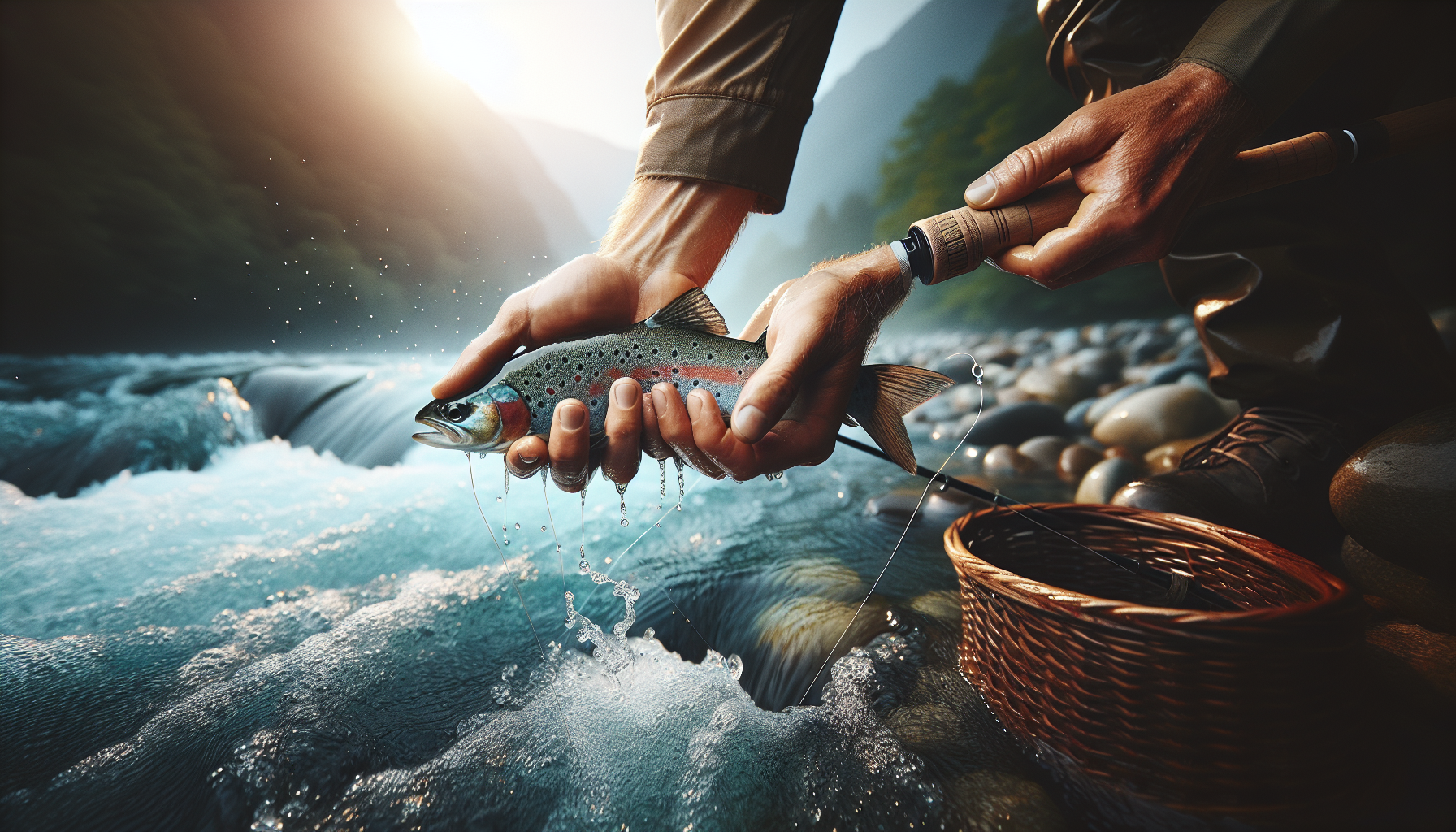
When the fish is landed, keep it in the water whenever possible. Wet your hands before touching it. Support the fish gently under the belly or at the wrist of the tail; never squeeze, and never hold large fish vertically by the jaw alone. Jaw-lipping can dislocate tissue in species such as bass, while unsupported vertical holds can injure heavier fish. Remove the hook quickly and calmly. If the hook is deep, cutting the line close to the hook is often better than tearing it out. Studies on several species have shown that retained hooks can corrode or encapsulate, while rough extraction causes immediate damage. Revive fish only as needed, facing them into gentle current without pumping them backward, which can damage gills. Release the fish when it can maintain balance and swim under its own power.
| Practice | Why it matters | Better choice |
|---|---|---|
| Using light tackle on large fish | Extends fight time and stress | Use heavier line and firm drag |
| Dry hands or rough gloves | Removes protective slime | Wet bare hands or soft wet gloves |
| Net with knotted mesh | Causes fin and scale damage | Rubber or knotless landing net |
| Holding fish out for long photos | Increases air exposure and mortality | Keep fish submerged; lift briefly only if legal |
| Pulling out deep hooks | Tears gills or throat tissue | Cut the line close to the hook |
| Fishing in very warm water | Reduces oxygen and recovery ability | Stop fishing or go early in cooler conditions |
Species, Water Temperature, and Seasonal Considerations
Not all fish respond to catch and release in the same way. Coldwater species such as trout and salmon are especially vulnerable when water temperatures rise. Many experienced trout anglers use 68 degrees Fahrenheit as a practical caution point and stop fishing entirely when temperatures approach or exceed 70 degrees, though agency guidance can vary by watershed. Warmwater fish such as bass and pike tolerate higher temperatures better, but they still suffer from prolonged fights, deep hooking, and rough handling. In saltwater, species like tarpon, bonefish, red drum, and striped bass present their own challenges, including shark predation after release, handling stress in surf or boatside conditions, and rapid exhaustion during heavy current or heat.
Season matters just as much as species. Fish caught during spawning may be physiologically stressed and behaviorally important to the population. A released fish that survives physically may still lose reproductive success if it abandons a redd, nest, or spawning position. Winter fishing creates different hazards. Fish can freeze to dry surfaces, and ice anglers sometimes expose gills and eyes to subfreezing air for too long during photos or unhooking. Summer low-flow periods compound temperature stress with reduced dissolved oxygen. I have become more conservative over time: if fish are taking too long to recover, if they roll after release, or if multiple fish show signs of severe exhaustion, I stop fishing. Ethical catch and release is conditional, not automatic, and conditions can shift within a single day.
Ethics, Enforcement, and Building a Conservation Culture
Catch and release is both a management tool and an ethic. Regulations can require release, but they cannot force careful handling or good judgment. That is where angling culture matters. Experienced anglers set the tone by modeling restraint, correcting misinformation politely, and explaining why fish should not be dragged onto hot rocks, gripped through the gills, or carried around for hero shots. Boat captains can prepare clients before lines go in. Parents can teach children to celebrate quick releases as much as catches. Guides, clubs, and tackle shops play an outsized role because they translate rule books into habits. The most conservation-minded fisheries I know are not just heavily regulated; they are supported by local norms that make poor handling socially unacceptable.
Enforcement still matters. Conservation officers rely on clear rules, visible compliance, and accurate species identification. If an angler cannot distinguish a wild steelhead from a hatchery fish, or a protected native trout from a stocked cousin, unintentional violations become likely. Many agencies now provide identification cards, mobile apps, and emergency closure alerts that make compliance easier. Reporting poaching, foul-hooking, over-limit possession, or intentional mishandling protects the resource and the reputation of anglers as a whole. The best long-term approach combines enforceable regulations with education, habitat restoration, creel surveys, and adaptive management. Catch and release works best when it is part of a broader conservation system, not a stand-alone slogan.
Regulations and guidelines for catch and release ultimately aim at one result: more fish surviving to sustain healthy, fishable populations. The strongest approach is simple but disciplined. Learn the current rules for your exact water. Identify species correctly. Use tackle that shortens the fight. Keep fish wet, handle them minimally, cut deep hooks when necessary, and avoid fishing when heat or other conditions make recovery unlikely. These practices are not optional details. They are the difference between a fish that truly survives and one that merely disappears from sight after release.
As the hub page for catch and release within conservation and ethics, this topic connects directly to gear selection, water temperature, species identification, handling techniques, seasonal closures, and angler responsibility. If you want to improve both your compliance and your impact, review your local regulations before every trip and build a release routine you can repeat under pressure. Better catch and release is not complicated, but it does require intention. Fish for the next cast, the next season, and the next generation of anglers by making every release count.
Frequently Asked Questions
What does catch and release actually require beyond simply putting a fish back in the water?
Catch and release is more than the act of letting a fish go after it is landed. In regulatory and practical terms, it means handling the fish in a way that gives it the best possible chance of survival after release. That starts with following local fishing laws, including open seasons, protected species rules, size restrictions, gear requirements, and area-specific release mandates. In many fisheries, anglers are legally required to release certain fish immediately, and in some waters there are rules about the types of hooks, bait, or tackle that may be used to reduce injury.
From a best-practices standpoint, responsible catch and release also involves minimizing fight time, keeping the fish in the water as much as possible, wetting your hands before touching it, avoiding contact with the gills and eyes, and using tools such as rubberized landing nets and hemostats or pliers for quick hook removal. The goal is to reduce physical damage, stress, and exhaustion. A fish that swims away is not always a fish that survives, so proper technique matters. Water temperature, depth, species sensitivity, and air exposure all affect post-release survival, which is why ethical anglers treat catch and release as a full process, not a final moment.
Are catch and release regulations the same everywhere, or do anglers need to check local rules each time they fish?
Anglers should always check local regulations before every trip, because catch and release rules vary widely by state, province, country, waterbody, and species. There is no single universal standard. One lake or river may allow catch and release year-round, while another may have seasonal closures to protect spawning fish. Some waters require immediate release of fish outside a narrow size slot, and others may classify certain species as catch-and-release only. It is also common to see special regulations in areas managed for conservation, trophy fisheries, native species recovery, or habitat restoration.
Rules can also extend beyond whether a fish may be kept. They may govern hook type, number of hooks, use of live bait, methods of landing fish, and whether fish may be removed from the water for photographs or measurement. In some fisheries, barbless hooks are required because they make release easier and reduce injury. In others, specific species must not be targeted at certain times of year due to heat stress or spawning vulnerability. Because regulations can change from year to year, relying on memory or old information is risky. The most reliable approach is to review the current regulations published by the relevant fish and wildlife agency, and if needed, confirm details for the exact body of water you plan to fish.
What equipment and handling practices give released fish the best chance of survival?
The best catch and release setup is designed to land fish efficiently and release them quickly with minimal injury. Circle hooks or single hooks are often preferred, especially when natural bait is used, because they can reduce deep hooking. Barbless hooks or hooks with pinched barbs can make removal much faster and less traumatic. A rubber or silicone-coated landing net is also a strong choice because it is gentler on scales, skin, and the fish’s protective slime layer than traditional knotted nets. Long-nose pliers, forceps, hook removers, and line cutters should be easy to reach so handling time stays short.
Proper technique matters just as much as gear. Use tackle heavy enough to bring the fish in without an excessively long fight, since prolonged exertion increases lactic acid buildup and stress. Wet your hands before touching the fish, support its body properly, and never squeeze the abdomen or hold a larger fish vertically by the jaw alone unless the species and size make that safe and appropriate. Keep the fish in the water whenever possible during hook removal. If a quick photo is taken, prepare everything in advance and limit air exposure to only a few seconds. If the fish is deeply hooked, cutting the line may be better than trying to force the hook out and causing major damage. When release time comes, hold the fish upright in the water and allow it to recover naturally until it can swim away with strength and balance.
How do water temperature, stress, and air exposure affect catch and release success?
These factors have a major impact on survival, and they are often the difference between a successful release and a delayed mortality. Fish experience intense physiological stress during capture. The struggle on the line can deplete energy reserves and disrupt normal breathing and recovery. When water temperatures are high, dissolved oxygen levels are often lower, and fish have a harder time recovering from that stress. Warm-water conditions can be especially dangerous for species that prefer cold, oxygen-rich environments, such as trout and salmon. That is why some fisheries impose seasonal restrictions, time-of-day closures, or no-targeting recommendations during hot weather.
Air exposure adds another layer of risk. When a fish is held out of the water, its gills can collapse or dry, making it harder to exchange oxygen once released. Even short periods out of the water can significantly reduce survival, especially when combined with a long fight or warm conditions. Fish that appear to recover at release may still die later if stress was severe. For that reason, many experienced anglers follow a simple rule: if the fish must come out of the water, do it briefly and only when everything is ready. Reducing handling time, avoiding contact with hot or dry surfaces, and releasing fish quickly in suitable water conditions all improve the odds. In periods of extreme heat or low flows, the most conservation-minded decision may be to avoid targeting vulnerable species altogether.
Can a fish be legally released but still handled unethically, and what should anglers do to avoid that?
Yes. Legal compliance is the baseline, but ethical catch and release often asks more of anglers than the law requires. A fish may be released in accordance with regulations and still suffer unnecessary harm if it is played too long, dropped on the bank, held by the gills, exposed to the air for extended photos, or targeted repeatedly under poor environmental conditions. Ethical angling focuses on the fish’s actual chance of survival, not just whether the release technically occurred. That means making choices that reduce injury and stress from the moment the fish strikes to the moment it swims away.
To avoid unethical handling, anglers should learn the vulnerability of the species they are targeting, match tackle to conditions, and decide in advance how they will land and release fish. They should keep fish in the water when possible, skip hero shots if conditions are harsh, and never continue fishing for a species that is clearly struggling to survive release in warm or low-oxygen water. It also helps to stay informed about conservation advisories, local voluntary closures, and fishery management goals. In short, good catch and release combines knowledge, preparation, restraint, and respect. When anglers understand that their decisions affect fish populations, habitat quality, and the long-term future of the sport, they are much more likely to fish responsibly and help sustain healthy fisheries.