Catch and release in warm water demands more care, faster handling, and better judgment than many anglers realize, because elevated water temperatures change fish physiology, reduce dissolved oxygen, and sharply narrow the margin between a healthy release and delayed mortality. In practical terms, warm water usually means conditions above a species’ comfort range, not just a hot day on the calendar. For trout, that can begin in the upper 60s Fahrenheit. For bass, pike, musky, redfish, and many warmwater or saltwater species, the threshold is different, but the biological pattern is the same: as water warms, fish need more oxygen while the environment supplies less. That mismatch is why catch and release in warm water is not simply a lighter version of normal angling. It is a distinct conservation problem.
I have seen this firsthand on midsummer rivers and shallow flats. Fish that looked strong at boatside rolled minutes after release when they were fought too long, held up for photos, or revived in stagnant shoreline water. The lesson is blunt: if your goal is ethical catch and release, warm-water strategy begins before the first cast. It includes deciding whether to fish at all, selecting tackle that shortens fight time, handling fish with wet hands and proper nets, and recognizing when air exposure becomes the most dangerous part of the encounter. This matters because released fish support future fisheries, preserve larger breeding fish, and uphold the social license anglers depend on. A catch only counts as responsible if the fish actually survives.
Catch and release is the practice of returning a fish to the water after capture rather than harvesting it. In conservation terms, success is measured not by release itself but by post-release survival and the fish’s ability to resume normal behavior, avoid predators, and spawn later. Warm water adds stress through lactic acid buildup during the fight, impaired gill function, increased metabolic demand, and lower oxygen availability. Those factors interact with tackle choice, hook placement, species sensitivity, and handling time. This article serves as a hub for catch and release under the broader conservation and ethics topic, giving you the core principles needed to make sound on-the-water decisions and connect them to more detailed guidance on gear, fish handling, seasonal closures, and species-specific best practices.
Why warm water makes catch and release riskier
The central issue is oxygen. Warm water holds less dissolved oxygen than cold water, yet fish metabolism rises as temperature increases. A fish that fights hard on a line in August is effectively sprinting while breathing through a restricted system. During the fight, muscular exertion produces carbon dioxide and lactic acid, and recovery requires time, water flow across the gills, and adequate oxygen. When oxygen is limited, recovery slows and mortality risk rises. This is why fish often swim off strongly yet die later. Immediate release behavior can be misleading.
Species tolerance varies, but no game fish is immune to stress. Trout are the classic example, which is why many agencies recommend anglers stop targeting them once water temperatures approach 68 degrees Fahrenheit. Smallmouth bass often tolerate heat better, yet they can still experience serious stress when played too long in low-flow summer rivers. Muskellunge anglers have learned a similar lesson during heat waves: big fish in very warm water can be especially vulnerable because larger bodies require longer recovery and often come from already stressed systems. In saltwater, tarpon, snook, striped bass, and bonefish all show increased post-release risk when fought hard in hot, low-oxygen conditions.
Other environmental factors stack the odds against fish. Low flows reduce current over the gills. Algal blooms can create daily oxygen swings, especially near dawn. Deep-water species face barotrauma if pulled rapidly from depth, and warm surface layers can intensify the problem by adding heat stress after capture. Even the landing zone matters. A fish released into a shallow marina basin with poor circulation may fare worse than one released in moving main-channel current. Good catch and release in warm water therefore requires reading the system, not just the thermometer.
When to fish, when to stop, and how to decide
The most ethical strategy is often timing. Fish at daybreak, after cool nights, or during periods of stronger flow and cloud cover. Avoid late afternoon in midsummer, when water temperatures usually peak and oxygen conditions are poorest. Carry a reliable stream or surface thermometer and use it, because assumptions based on air temperature are often wrong. Groundwater-fed reaches may remain cool while impoundments, backwaters, and flats heat quickly. In my own summer planning, a thermometer changes destination choices more than lure color ever does.
There are also times when stopping is the right call. If multiple fish require prolonged revival, if released fish fail to maintain balance, or if temperatures exceed agency guidance for the species, end the session. Voluntary restraint is a core part of conservation-minded angling. Many fisheries managers use seasonal closures, hoot-owl restrictions, or thermal refuge protections for this reason. Following those rules is the baseline; respecting the spirit behind them is better. If fish are concentrated at coldwater inflows, springs, or tributary mouths, leave them alone. Those refuges are survival habitat, not convenient targets.
Good decisions balance intent and outcome. Anglers sometimes argue that because they release every fish, their impact is negligible. In warm water, that assumption can be false. A single badly stressed brood fish can matter more than several harvested smaller fish in a tightly managed system. Ethical catch and release means treating conditions as part of the equation. If conditions are poor, switching species, changing waters, or choosing another activity is not giving up; it is successful stewardship.
Tackle, hooks, and landing systems that improve survival
The right gear reduces fight time and handling damage. Use tackle heavy enough to land fish quickly. That does not mean horsing fish recklessly; it means matching rod power, reel drag, and line strength to the species and cover so the fish reaches the net before exhaustion compounds. For largemouth bass in vegetation, braided line and a stout rod are often more humane than ultralight gear. For redfish around oysters, a properly set drag on medium-heavy tackle shortens the fight and prevents repeated runs. For salmonids or striped bass, many experienced guides upsize leaders during warm periods specifically to reduce stress.
Hook choice matters. Single hooks generally remove faster than trebles, and barbless or de-barbed hooks reduce tissue damage and air exposure because unhooking is quicker. Circle hooks are a major advantage when fishing natural bait for species prone to deep hooking, including striped bass, snook, tarpon, and red drum. Inline single hooks on hard baits are increasingly popular because they maintain hooking efficiency while reducing injury compared with stock trebles. The goal is not simply to hook fish, but to hook them in places from which they can recover.
Nets and release tools are part of the system. Rubberized, knotless nets protect slime coat and fins better than abrasive nylon. Long-nose pliers, hemostats, hook cutters, jaw spreaders for appropriate species, and line snips should be accessible before the fish is landed. If you have to search through a hatch while the fish thrashes on hot decking or dry grass, your process is already failing. Boat anglers should clear the cockpit before the first cast. Wading anglers should stage tools on retractors or a chest pack. Warm-water catch and release rewards preparation more than improvisation.
| Decision area | Better practice in warm water | Why it works |
|---|---|---|
| Fight time | Use heavier tackle matched to species and cover | Reduces exhaustion and lactic acid buildup |
| Hooks | Barbless singles or circle hooks where appropriate | Speeds release and lowers deep-hooking risk |
| Landing | Rubberized knotless net, fish kept in water | Protects slime coat, fins, and gill function |
| Handling | Wet hands, minimal contact, no dry surfaces | Limits abrasion and infection risk |
| Photos | Pre-plan, one quick shot, seconds not minutes | Cuts air exposure during peak stress |
| Revival | Hold fish upright in current until it swims away | Supports recovery without forcing water backward through gills |
Landing, handling, and photo practices that matter most
The most consistent rule is simple: keep the fish in the water whenever possible. Gill filaments are delicate, and air exposure during warm conditions is especially damaging. Research across multiple species has repeatedly shown that longer air exposure increases post-release impairment and mortality. If you want a practical standard, think in single-digit seconds, not “just a minute.” Prepare the camera, communicate with your partner, cradle the fish horizontally, and return it immediately. If conditions are marginal, skip the hero shot entirely.
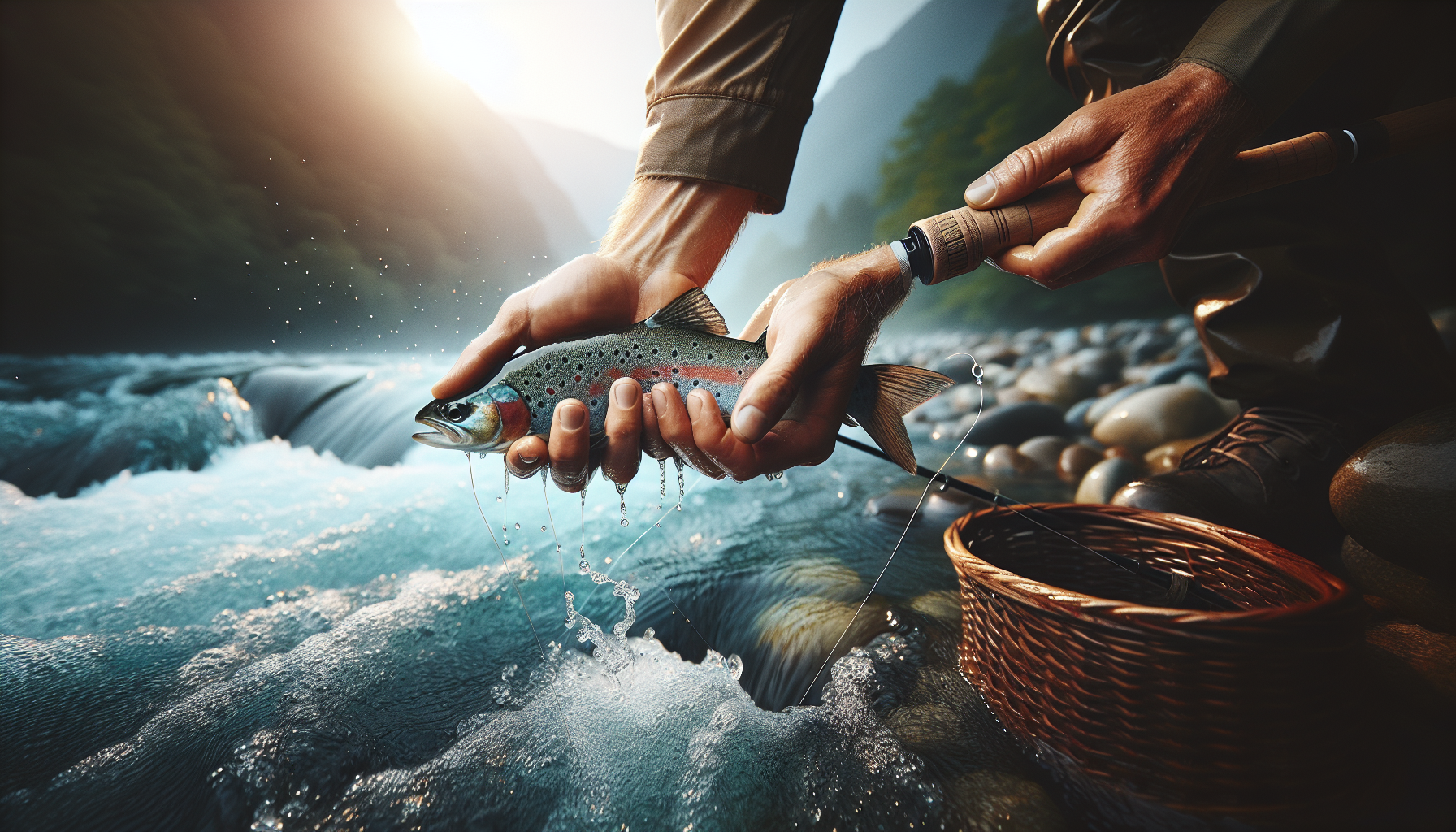
Handling technique should protect both anatomy and protective coating. Wet your hands before touching the fish. Never squeeze the abdomen. Support larger fish horizontally under the belly and near the tail wrist rather than hanging them vertically by the jaw. Jaw holds can be acceptable for brief control of some species, especially black bass, but they become harmful when combined with twisting, long suspension, or heavy fish. For pike, musky, and similar fish, proper support is essential because spinal and internal injuries are easy to cause. Avoid laying fish on carpet, sand, rocks, or aluminum decks, all of which remove slime and can damage fins and eyes.
Unhook efficiently. If the hook is visible and accessible, remove it with steady pressure. If a fish is deeply hooked and extraction will cause major trauma, cutting the line close to the hook may be the better option; many hooks corrode or encapsulate over time, though outcomes vary by material and placement. For fish with treble hooks in awkward locations, cutting a hook point or split ring often shortens handling dramatically. I carry compact bolt cutters for that reason. The best release is usually the one that looks least dramatic: no prolonged gripping, no unnecessary measuring, and no fish carried around for admiration.
Reviving fish correctly and recognizing when release may fail
Revival is not about pumping a fish back and forth. Forcing water backward through the gills can damage structures designed for one-way flow. Instead, face the fish into gentle current or move the boat slowly enough that water passes naturally through the mouth and over the gills. Support the fish upright until it can maintain equilibrium and swim away under its own power. In still water, hold the fish calmly and allow normal ventilation. The goal is stability, not theatrics.
Watch for warning signs. A fish that cannot stay upright, flares gills excessively, rolls on its side, or darts only to collapse is severely stressed. Predation risk also rises after release, especially in clear water where birds, seals, dolphins, or larger fish key on disoriented prey. In some fisheries, shark depredation has changed catch and release decisions entirely because hooked fish may not survive the encounter even if technically released. Likewise, releasing a fish into bathtub-warm slack water beside the boat can undo careful handling. If possible, move the fish to cooler, better-oxygenated current before letting go.
There are limits to revival. Some fish are simply too stressed, too deeply injured, or too compromised by temperature and fight duration. Where regulations allow and the fish is legal to keep, harvest may be the more responsible choice than pretending a doomed release is ethical. This is not a license for convenience; it is an acknowledgment that conservation requires honesty about outcomes. The principle is straightforward: minimize harm, assess reality, and act within the rules.
Species-specific considerations and conservation ethics in practice
Different species call for different thresholds. Trout and salmon generally require the greatest caution in warm freshwater because their oxygen demands remain high while tolerance to heat is limited. Black bass are more resilient, but during spawning they present another ethical issue: even if adults survive release, prolonged removal from nests increases egg and fry predation. Pike and musky are vulnerable in hot summer periods because they are coolwater fish often caught incidentally or by anglers pushing the season. In saltwater, species such as tarpon and billfish may survive the hook removal yet remain susceptible to shark predation after exhaustive fights.
Ethics also extend beyond the individual fish. Repeated pressure on the same schools, thermal refuges, spawning sites, and shallow nighttime feeding zones can magnify cumulative stress. Guides and tournament anglers have special responsibilities because volume matters. Many tournament organizations now use improved livewell standards, fizzing rules where permitted, immediate release boats, and penalty systems for dead fish, but no format fully erases warm-water stress. The same is true for social media culture. If content creation lengthens handling, delays release, or encourages targeting fish in vulnerable conditions, the ethical cost is real.
As a hub for catch and release within conservation and ethics, the core message is consistency. Responsible anglers check temperature, choose gear that lands fish fast, favor hook systems that reduce injury, keep fish wet, limit air exposure, revive them correctly, and stop when conditions cross the line. Those practices protect future fishing more effectively than slogans do. Review your setup before the next trip, carry a thermometer, and make release decisions that give every fish its best real chance to survive.
Frequently Asked Questions
What counts as “warm water” for catch and release, and why does it matter so much?
In catch-and-release fishing, “warm water” is not just a summer label or a reference to air temperature. It means water temperatures that are pushing beyond a fish species’ ideal comfort range and beginning to create physiological stress. That threshold varies by species. For trout, problems can begin when water temperatures climb into the upper 60s Fahrenheit, with risk increasing quickly as temperatures continue to rise. For warmwater and saltwater species such as bass, pike, musky, and redfish, the exact number may differ, but the principle stays the same: as water warms, dissolved oxygen levels drop, while the fish’s metabolic demand for oxygen rises. That is a bad combination during and after a fight.
When a fish is hooked, it experiences intense exertion. In cool, oxygen-rich water, many fish can recover relatively well if they are handled properly. In warm water, however, the recovery window narrows sharply. A fish may swim off strongly and still suffer delayed mortality hours later because of oxygen debt, acid buildup, loss of equilibrium, or cumulative stress from the fight and handling. That is why experienced anglers treat warm-water catch and release as a serious fish-care issue rather than a minor seasonal adjustment.
The most important takeaway is that anglers should think in species-specific terms, not generic ones. A water temperature that is acceptable for one species may be dangerous for another. If you are targeting trout, for example, monitoring temperatures becomes essential once flows drop and summer heat builds. For bass or redfish, the concern may be less about an absolute shutdown point and more about reducing fight time, air exposure, and handling stress during hot conditions. In all cases, elevated temperature means less margin for error, so every part of the release process needs to become faster, cleaner, and more deliberate.
How should I change my fishing approach when water temperatures are high?
The smartest approach is to shift from “Can I catch fish?” to “Can I release them responsibly under these conditions?” That mindset change leads to better decisions on timing, tackle, fish-fighting strategy, and even whether to fish at all. Start by checking water temperatures before and during your trip, not just weather forecasts. Early mornings often provide the coolest and safest window, while late afternoon may bring the highest stress conditions, especially on shallow lakes, slow rivers, flats, and low-flow tailwaters.
Tackle selection matters more than many anglers realize. In warm water, fish should be landed as quickly as practical. That does not mean overpowering them carelessly, but it does mean avoiding ultralight setups that prolong the fight. Use gear appropriate to the species and the cover so you can bring fish in efficiently. Heavier tippets for trout, stronger leaders for pike and musky, and rods with enough backbone for bass or redfish all help reduce exhaustion. Barbless or debarbed hooks can also make a major difference because they shorten release time and minimize tissue damage, especially when fish are landed hot and need immediate recovery.
Presentation and fish selection should also change. If fish are holding deep and bringing them up would expose them to severe temperature or pressure stress, it may be wiser not to target them. If schooling fish are feeding aggressively but surface temperatures are extremely high, consider whether repeated catches are adding unnecessary stress to a concentrated population. In some cases, the best strategy is to stop fishing entirely once temperatures cross a known danger threshold for the species. Ethical anglers understand that choosing not to fish can be the most responsible catch-and-release technique available.
What is the best way to land, handle, and release a fish in warm water?
Everything should be organized around speed, control, and minimal stress. Before you make a cast, be ready for the release. Have pliers accessible, your net prepared, and your camera put away unless a quick photo can be taken without compromising the fish. A rubberized landing net is one of the best tools you can use because it supports the fish, reduces scale and slime loss, and allows you to keep the fish in the water while removing the hook. Knotless rubber bags are especially valuable for species that are vulnerable to abrasion.
Once the fish is hooked, fight it firmly and efficiently. Avoid long, drawn-out battles that leave the fish completely spent. When the fish is close, keep it in the water as much as possible. Wet your hands before touching it, avoid squeezing the body, and never grip the gills or eyes. For larger fish, support the body horizontally rather than hanging it vertically by the jaw. In warm water, air exposure is one of the most preventable sources of added stress, so keep “hero shots” to an absolute minimum. A good rule is that if you want a photo, have the shot framed in advance, lift the fish briefly, and return it immediately.
Hook removal should be decisive and gentle. If a fish is deeply hooked, especially if extraction will take too long or cause major bleeding, cutting the line or leader close to the hook is often the better option. Once the fish is unhooked, hold it upright in the water if needed, facing into gentle current or moving water naturally through its gills if you are in still water. Do not aggressively push it back and forth, which can interfere with gill function. Release the fish only when it can maintain balance and swim away under its own power. Even then, remember that a strong kick is not a guarantee of survival in hot conditions, which is why reducing the total stress load from the start is so important.
Are there times when I should stop fishing altogether instead of practicing catch and release?
Yes. One of the most important warm-water catch-and-release skills is knowing when not to fish. Catch and release is not automatically harmless, and in high-temperature conditions it can become a practice with unacceptably high delayed mortality. If water temperatures exceed known safe ranges for your target species, if fish are showing signs of severe stress, or if low flows and stagnant conditions are limiting oxygen availability, the responsible choice may be to end the trip or switch species and locations.
This is especially true for coldwater fish such as trout. In many fisheries, anglers use self-imposed cutoffs or follow local guidance once temperatures reach the upper 60s Fahrenheit, because survival declines rapidly above that range. Some rivers and tailwaters now have voluntary or mandatory afternoon closures during summer heat for exactly this reason. These measures are not overreactions; they reflect a better understanding of post-release mortality and the cumulative pressure fisheries face during heat stress events.
Even for more temperature-tolerant species, there are practical red flags that should tell you to back off. Fish that take an unusually long time to recover, repeated deep-hooking incidents, fish floating or rolling after release, very hot shallow water, algae-heavy or poorly circulated areas, and long handling times caused by crowded conditions all increase risk. Conservation-minded anglers do not wait for regulations to force every decision. If conditions are bad enough that careful release is unlikely to be effective, stopping is not a failure. It is responsible fishing.
What mistakes cause the most release-related mortality in warm water, and how can I avoid them?
The biggest mistakes are usually the simplest ones: fighting fish too long, exposing them to air for too long, handling them roughly, using gear that is too light, and continuing to fish when water temperatures are already beyond a safe range. In warm water, these errors stack on top of one another. A fish may survive one stressor, but not several. A prolonged fight creates exhaustion and acid buildup. A long photo session adds oxygen deprivation. Rough contact removes protective slime and damages tissue. Poor recovery technique may then finish off a fish that otherwise might have lived.
Another common mistake is assuming that if a fish swims away, it is fine. That is not always true in warm conditions. Delayed mortality can occur well after release, especially when water is warm, oxygen is limited, and the fish has been heavily stressed. This is why best practices focus on reducing total impact rather than judging success by the fish’s immediate departure. Anglers also underestimate the value of preparation. Searching for pliers, setting up a camera after landing the fish, or laying the fish on a hot boat deck or dry bank all waste precious recovery time and create avoidable harm.
To avoid these problems, build a repeatable release routine. Check temperatures. Fish during cooler periods. Use tackle that lands fish quickly. Favor single hooks or barbless setups when practical. Keep fish in the water during unhooking. Wet your hands. Skip unnecessary photos. Cut the line on deeply embedded hooks if removal would be traumatic. And most importantly, be willing to stop when conditions suggest releases are no longer likely to be successful. Warm-water catch and release is less forgiving than many anglers think, but with informed decisions and disciplined handling, you can significantly improve the odds that released fish truly survive.