Fly fishing depends on a simple promise: rivers, trout, salmon, grayling, bass, and the insects they feed on must remain healthy enough to support both wild ecosystems and human enjoyment. Balancing conservation and recreation in fly fishing means managing that promise deliberately, so anglers can fish today without reducing the quality of fisheries tomorrow. In practical terms, sustainable practices include catch-and-release done correctly, habitat protection, responsible access, gear choices that minimize injury, seasonal restraint during spawning or heat stress, and participation in science, advocacy, and restoration.
This balance matters because fly fishing is not a low-impact activity by default. Wading can crush redds, poor fish handling can increase post-release mortality, discarded tippet can entangle wildlife, and concentrated pressure can alter fish behavior even when fish are released. At the same time, anglers fund conservation through license fees, excise taxes under the Dingell-Johnson framework, nonprofit memberships, guided-trip economies, and volunteer labor. I have seen both sides firsthand on heavily fished tailwaters and small freestone streams: one reach improved after anglers organized invasive plant removal and bank stabilization, while another declined because social media exposure pushed traffic beyond what the access site and fish population could absorb.
For a sub-pillar hub on sustainable practices, the key idea is straightforward: ethical recreation is a management approach, not just a personal attitude. It combines fish welfare, habitat stewardship, community norms, and compliance with regulations. When anglers understand carrying capacity, water temperature thresholds, selective harvest rules, aquatic invasive species prevention, and low-impact travel, they become part of the solution. The goal is not to discourage fishing. The goal is to fish in a way that protects biodiversity, sustains public access, and preserves the conditions that make fly fishing worth doing in the first place.
What sustainable fly fishing actually means
Sustainable fly fishing is the practice of pursuing fish while keeping ecological damage, fish stress, and social conflict below levels that impair the resource. That definition includes three linked dimensions. First is biological sustainability: fish populations must reproduce successfully, maintain age structure, and retain enough genetic diversity to withstand drought, floods, disease, and warming water. Second is habitat sustainability: streambanks, riparian vegetation, spawning gravel, macroinvertebrate communities, and water quality must remain functional. Third is social sustainability: access points, crowding levels, private-land relationships, and local economies must remain workable for landowners, agencies, guides, and the public.
Many anglers reduce sustainability to catch-and-release, but that is only one piece. A river where every trout is released can still decline if summer angling continues through dangerous water temperatures, if fine sediment smothers spawning gravel, or if anglers move invasive mudsnails between watersheds on boot soles and boat trailers. Conversely, some fisheries remain sustainable with regulated harvest, especially put-and-take systems or abundant warmwater species, when managers set slot limits, creel limits, and seasons based on population data. Good ethics align with fishery type, regional conditions, and agency objectives rather than a single slogan.
As the hub for sustainable practices, this page connects the major decisions every fly angler makes before, during, and after a trip. Those decisions include where to fish, when to stop, how to handle fish, what gear to carry, how to move through habitat, and how to support long-term stewardship. Each choice seems small in isolation, but cumulative effects drive outcomes. On popular rivers, a thousand minor impacts become major pressure. Sustainable fly fishing is therefore about repeated, disciplined choices that protect both the fish and the places they live.
Protecting fish during capture, fight, and release
The most immediate conservation question in fly fishing is whether a released fish survives and remains capable of feeding, avoiding predators, and spawning. Survival depends on hooking location, fight duration, water temperature, handling time, and air exposure. Studies on salmonids routinely show that warmer water and longer air exposure raise mortality, while deep hooking and exhaustive fights worsen injury. In plain terms, a trout that is played too long in 68 to 72 degree water, lifted repeatedly for photos, and squeezed with dry hands faces much higher risk than a trout landed quickly, kept in the water, and released without delay.
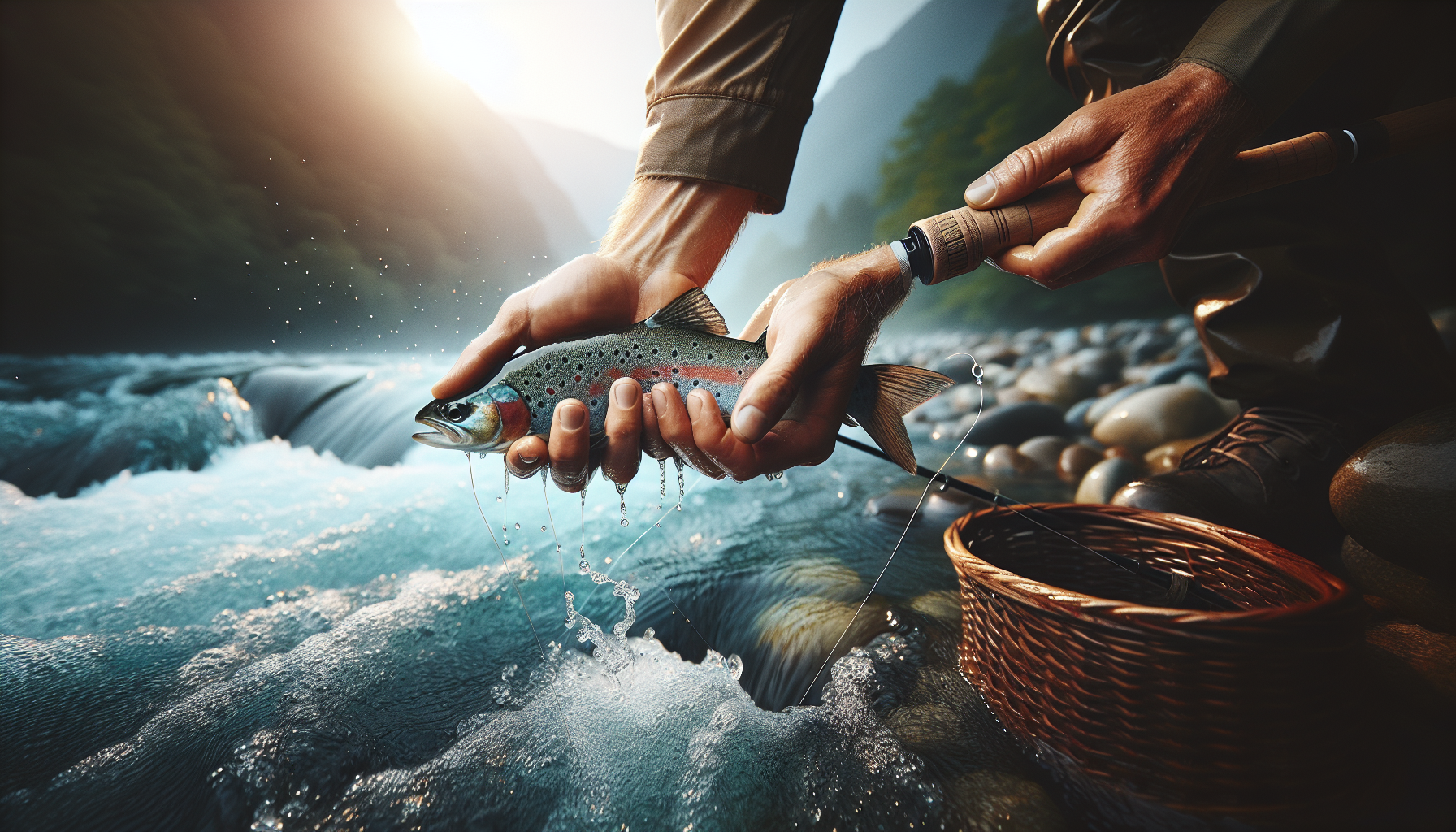
Best practice starts with tackle matched to the fishery. Use a tippet strong enough to shorten the fight. On trout streams, that often means not under-gunning fish with ultralight leaders just for sport. Pinching barbs simplifies hook removal and usually reduces tissue damage, especially with small dry flies, nymphs, and streamers. Rubberized landing nets are preferable to coarse nylon because they reduce fin fraying and slime loss. Wet your hands before touching fish, support the body without squeezing the abdomen or gills, and avoid beaching fish on rocks, dry grass, or hot boat decks. If a fish needs recovery, hold it upright in moderate current until it maintains balance and kicks away under its own power.
Photography requires discipline. I advise anglers to prepare the camera first, keep the fish submerged while positioning, then lift for one quick shot lasting only a second or two. The often-cited “keep them wet” principle is sound because gill lamellae are delicate and collapse in air. If a hook is buried deeply, cutting the leader may be better than aggressive extraction. Not every fish can be saved, and some mortality is unavoidable, but skilled handling materially lowers harm. That is why fish care is the core sustainable practice in any fly fishing conservation strategy.
Timing, temperature, and seasonal restraint
Knowing when not to fish is one of the clearest signs that recreation and conservation are in balance. Water temperature is central because fish are ectotherms, and dissolved oxygen declines as water warms. Trout and salmon become especially vulnerable during summer heat, low flows, and drought. Many agencies and conservation groups recommend heightened caution once temperatures approach 66 to 68 degrees Fahrenheit, with voluntary closures or full “hoot owl” restrictions on some rivers when afternoon temperatures climb higher. Exact thresholds vary by species and region, but the principle does not: if fish are already stressed by environmental conditions, angling adds another burden.
Spawning periods also require restraint. Wading through shallow gravel in fall or spring can crush eggs in redds, the nests cut by trout and salmon in clean substrate. On many rivers, redds appear as lighter, recently disturbed patches of gravel, often in tailouts and shallow riffles. Avoid stepping on them, and avoid targeting visibly spawning fish. Even where regulations allow fishing, pressure on staging or paired fish can disrupt reproduction and reduce recruitment. The same logic applies to post-spawn fish that are depleted and vulnerable.
Runoff, ice-out, and flood recovery matter as well. Fishing immediately after destructive events can increase bank erosion and stress fish already displaced from cover. Sustainable anglers watch stream gauges, temperature graphs, and agency advisories rather than forcing a trip because the calendar says it is time. USGS gauges, state natural resource departments, and local fly shops provide reliable decision support. In my own practice, I cancel or shift to cold tailwaters, warmwater species, or stillwaters when conditions on a favorite trout stream cross clear stress thresholds. Flexibility is conservation in action.
Habitat stewardship on the water and at the access point
Healthy fisheries begin with healthy habitat, and anglers affect habitat every time they drive, park, launch, wade, or walk a bank. Riparian zones are especially important because streamside vegetation stabilizes banks, shades water, filters sediment, and contributes insects and woody debris. Repeated trampling at informal paths can widen trails, collapse banks, and send fine sediment into spawning gravels. The fix is simple but often ignored: use established access points, enter and exit at durable surfaces, avoid cutting switchbacks, and do not drag boats over vegetated banks when a ramp or gravel edge is available.
Wading technique matters too. Shuffle carefully, avoid spawning gravels, and do not bulldoze through undercut banks and submerged vegetation just to reach a marginally better casting angle. In small streams, fish from downstream and limit repeated passes through the same run. On spring creeks and meadow streams, one careless crossing can muddle a section for everyone and damage fragile margins. Pack out monofilament, split shot, food wrappers, and cigarette butts. Lead from lost shot remains a concern for waterfowl in some systems, so non-toxic alternatives such as tin or tungsten deserve serious consideration where practical.
Habitat stewardship also extends beyond the day’s fishing. Volunteer days for willow planting, fencing livestock out of riparian corridors, culvert replacement, and large woody material installation often deliver measurable gains in fish survival and stream complexity. Groups such as Trout Unlimited, local watershed councils, and state conservation districts regularly organize this work. Anglers who contribute labor gain a more realistic understanding of how much effort it takes to repair a stream reach. That experience usually changes behavior on the water for the better.
Gear choices and field practices that reduce harm
Not all fly fishing gear has the same conservation footprint. The right equipment can lower fish injury, reduce habitat damage, and limit the spread of invasive species. The wrong equipment can do the opposite. Felt soles, for example, were popular because they grip slick rocks, but many agencies and biologists raised concerns that felt can retain moisture and organisms longer than other materials, increasing transfer risk between waters. Many anglers now use rubber soles with studs where legal, then clean and fully dry boots and nets between trips. Waders, boats, anchor ropes, and stripping baskets need the same attention.
Fly selection and rigging also affect outcomes. Heavily weighted rigs can increase bottom contact in sensitive spawning areas, while oversized streamers with multiple hooks may raise injury risk in some situations. Single hooks are generally easier to remove than trebles, and circle hooks have applications in some warmwater or saltwater fly patterns where bait is not involved. Leaders and tippets should be inspected frequently; break-offs leave fish trailing flies and line, and that is avoidable with routine knot checks. Polarized glasses are conservation gear too because they help anglers spot redds, navigate safely, and avoid stepping on fish holding in shallow water.
| Practice | Conservation benefit | Plain-language example |
|---|---|---|
| Barbless hooks | Faster release, less tissue damage | A trout hooked in the lip is unpinned quickly without tearing the mouth |
| Rubber landing net | Protects slime coat and fins | The fish stays supported in water while the hook is removed |
| Stronger tippet | Shorter fight time | A large fish is landed quickly instead of exhausted on light gear |
| Rubber or studded soles | Lowers invasive transfer risk | Boots dry faster and carry fewer organisms between rivers |
| Thermometer | Prevents fishing during heat stress | An angler stops at 68 degrees instead of continuing through the afternoon |
These choices are not complicated, but they are cumulative. A thermometer clipped to a pack, a spool of appropriate tippet, and a net with a rubber basket can make the difference between responsible catch-and-release and unnecessary mortality. Sustainable practices become durable when they are built into the kit, not left to intention alone.
Access ethics, crowding, and the role of community norms
Conservation is social as much as biological. Many fisheries degrade not because one angler behaves terribly, but because too many people use a place without shared norms. Crowding can lead to bank trampling, conflict at boat ramps, trespass on private land, and repeated pressure on small pools that fish cannot leave. Sustainable recreation requires etiquette that spreads effort and protects relationships. Give other anglers space, rotate through runs when appropriate, avoid low-hole behavior, keep noise down near homes and camps, and respect posted boundaries even if mapping apps suggest a legal gray area.
Digital behavior now matters too. Exact geotagging of small, fragile waters can overwhelm them overnight. I have watched obscure creeks go from lightly used to heavily trafficked in a single season after a burst of online exposure. A better approach is to share techniques, ethics, and regional context without naming every sensitive access point. Public water should remain public, but publicity should be calibrated to a fishery’s resilience, parking capacity, and local management concerns. On robust, well-known rivers, broad sharing may be fine. On tiny native trout streams, discretion is often the more conservation-minded choice.
Local fly shops, guides, clubs, and agency biologists help establish these norms. They know which reaches are under restoration, which boat launches are capacity-limited, and which temporary closures need respect. Listening to that local knowledge prevents avoidable damage. Sustainable access is built on courtesy, restraint, and the understanding that preserving a fishing opportunity often depends on preserving goodwill first.
From individual ethics to long-term stewardship
The strongest conservation outcomes happen when anglers move beyond private ethics and support durable institutions. License purchases fund management and enforcement. Commenting on proposed regulations, attending public meetings, and joining watershed groups influence how rivers are protected. Water policy, dam operations, instream flow rights, hatchery strategy, native fish recovery, and land-use planning all affect fly fishing far more than any single day of perfect catch-and-release. If anglers want sustainable fisheries, they must participate where those decisions are made.
Stewardship also means understanding tradeoffs. Habitat restoration can temporarily close access. Native fish recovery may limit harvest or require gear restrictions. In some waters, hatcheries support harvest opportunity; in others, they can complicate wild fish genetics and competition. Beaver reintroduction may improve summer flows and habitat complexity while changing access and casting lanes. Mature conservation thinking accepts these tensions and asks which option best protects long-term ecosystem function. That mindset is more useful than reacting only to short-term inconvenience.
As a hub for sustainable practices within conservation and ethics, the message is clear. Balance in fly fishing comes from informed restraint, skilled fish handling, habitat protection, low-impact gear and travel, respectful access, and active civic involvement. None of these practices eliminates recreation; each one improves its future. Start with a thermometer, barbless hooks, and better fish handling. Then expand outward: clean your gear, protect spawning habitat, support restoration, and learn your local regulations deeply. Sustainable fly fishing is not a separate version of the sport. It is the standard that keeps the sport alive.
Frequently Asked Questions
Why is balancing conservation and recreation so important in fly fishing?
Balancing conservation and recreation is essential because fly fishing only remains enjoyable when fish populations, aquatic insects, water quality, and habitat stay healthy over the long term. Anglers rely on functioning rivers, lakes, and estuaries, not just for the chance to catch trout, salmon, grayling, or bass, but for the full experience of being in a living ecosystem. If fishing pressure becomes too intense, fish are handled poorly, spawning areas are disturbed, or banks and streamside vegetation are damaged, the resource can decline quickly. Once that happens, both the ecological value and the recreational quality of the fishery suffer.
Good conservation-minded recreation is really about protecting the conditions that make fly fishing possible in the first place. Healthy riparian zones keep water cooler, reduce erosion, and support insect life. Strong fish populations allow fisheries to remain productive without relying too heavily on stocking or constant intervention. Responsible angling practices also help maintain public trust, which matters when access decisions, regulations, and land-use policies are being made. In other words, conservation is not separate from recreation in fly fishing; it is the foundation that keeps recreation viable for future seasons and future generations.
What does responsible catch-and-release actually look like in practice?
Responsible catch-and-release goes far beyond simply letting a fish go. It means minimizing stress, injury, and recovery time from the moment the fish is hooked until it swims away strongly. In practice, that starts with using appropriate tackle so fish can be landed efficiently rather than fought to exhaustion. A rod and tippet setup that is too light for the species or water conditions can turn a manageable fight into a prolonged struggle, increasing lactic acid buildup and reducing the fish’s ability to recover after release.
Once the fish is close, careful handling matters. Wet hands before touching the fish to protect its slime coat, which acts as a barrier against infection. Keep the fish in the water as much as possible, and if a photo is taken, make it quick and controlled. Barbless hooks or pinched barbs can make hook removal faster and less damaging, especially for fish that are deeply or awkwardly hooked. Using a rubberized landing net also helps reduce scale and fin damage. During warm water conditions, when fish are already physiologically stressed, anglers should be even more cautious or stop fishing altogether if temperatures become unsafe for coldwater species.
Proper release technique is equally important. If a fish needs support, hold it upright in gentle current and allow it to recover on its own rather than forcing water through its gills. The goal is to release the fish only when it can maintain balance and swim off with strength. When anglers consistently follow these practices, catch-and-release becomes a legitimate conservation tool rather than a feel-good gesture that may still result in delayed mortality.
How can fly anglers protect habitat while still enjoying regular access to rivers and streams?
Protecting habitat while maintaining access starts with understanding that the route to the water is part of the fishery. Riverbanks, side channels, wetlands, and streamside vegetation are not just background scenery; they stabilize soil, filter runoff, shade the water, and provide shelter for insects and juvenile fish. When anglers repeatedly trample fragile banks, cut informal paths, park irresponsibly, or cross spawning areas without care, they can degrade the very places that support fish populations. Responsible access means using established trails, entry points, and boat launches whenever possible, and avoiding sensitive areas even if they appear convenient.
Anglers should also pay attention to timing and conditions. Walking through redds during spawning season can crush eggs and reduce recruitment in wild trout and salmon fisheries. Wading in low water can disturb juvenile fish holding in shallow margins. Even simple choices, such as closing gates, respecting private property boundaries, packing out litter, and avoiding the spread of invasive species on boots, waders, and boats, help preserve both habitat and access relationships. Landowners and managers are far more likely to support recreational use when anglers demonstrate consistent respect for the resource.
At a broader level, habitat protection also involves participation. Supporting stream restoration projects, riparian planting efforts, water conservation measures, and local watershed groups gives anglers a direct role in keeping fisheries healthy. Enjoying regular access does not have to conflict with conservation when anglers recognize that stewardship includes how they enter, move through, and leave a place, not just how they fish once they arrive.
Do gear choices really make a difference in sustainable fly fishing?
Yes, gear choices can have a meaningful impact on fish welfare, habitat disturbance, and overall sustainability. The most obvious example is hook design. Barbless hooks generally allow for quicker releases and less tissue damage, which is especially valuable in catch-and-release fisheries. Net choice matters too; rubber or knotless nets are gentler on fish than older abrasive mesh styles. Rod weight and reel setup also play a conservation role because appropriately matched gear helps anglers land fish faster and reduce exhaustion. Sustainable fishing is often shaped by these practical details more than people realize.
Beyond fish handling, equipment choices can affect the broader environment. Wading gear should provide traction without encouraging unnecessary damage to streambeds or the spread of invasive organisms between watersheds. Cleaning and drying boots, nets, and boats after use is an important biosecurity habit. Fly materials can also be considered through a conservation lens, especially when selecting durable patterns that reduce waste or avoiding products sourced irresponsibly. Even seemingly small decisions, such as carrying line clippings and tippet waste out of the river corridor, matter because discarded monofilament can injure wildlife.
Good gear does not have to mean expensive gear, but it should support ethical angling. The best setup is one that fits the target species, local regulations, and water conditions while helping the angler fish effectively with minimal unnecessary harm. Thoughtful gear choices reinforce the idea that sustainability in fly fishing is not just about intention; it is about using tools that align with conservation goals.
What role do regulations and angler behavior play in keeping fly fisheries healthy for the future?
Regulations and angler behavior work together to determine whether a fishery stays productive over time. Rules such as seasonal closures, bag limits, size restrictions, gear restrictions, and fly-fishing-only designations are designed to protect vulnerable life stages, prevent overharvest, and reduce avoidable harm. For example, closing a river during spawning periods can protect fish when they are most vulnerable, while restricting harvest on wild fish can preserve breeding populations. These regulations are not arbitrary obstacles to recreation; they are management tools intended to balance fishing opportunity with biological limits.
However, regulations alone are not enough if angler behavior does not support their purpose. Ethical anglers often go beyond the minimum legal requirement by avoiding excessive pressure on stressed fisheries, choosing not to fish during dangerously warm water periods, moving on from actively spawning fish, and reporting habitat damage or poaching when they see it. Courtesy toward other anglers matters too, because crowding, repeated pressure on small stretches of water, and competitive behavior can reduce both fish welfare and the quality of the experience. A healthy fishery depends as much on restraint and judgment as it does on enforcement.
In the long run, the strongest fly fisheries are usually those supported by an informed angling culture. When anglers understand why rules exist and treat stewardship as part of the sport, conservation and recreation stop feeling like competing interests. They become part of the same shared responsibility: keeping waterways healthy enough that wild fish can thrive and people can continue enjoying them without diminishing what makes them special.