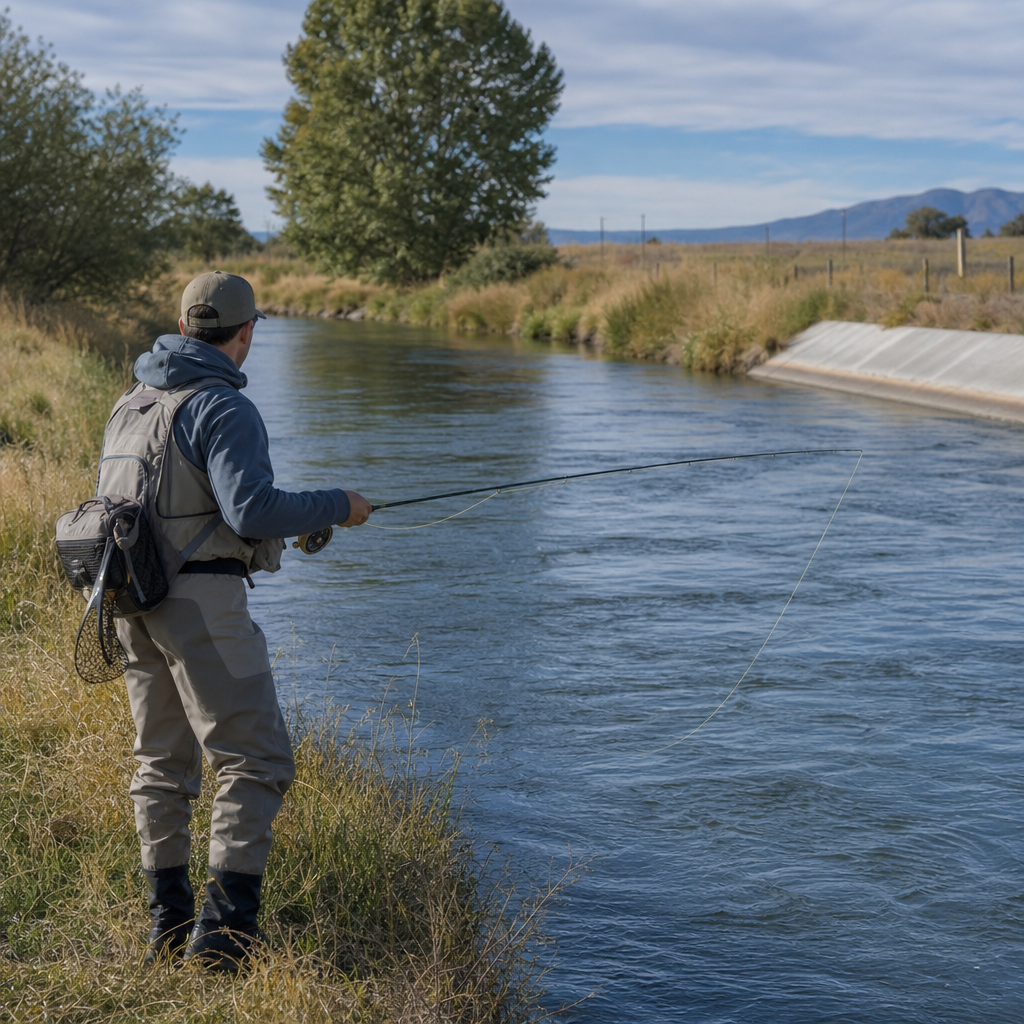
Fly fishing in irrigation canals demands a different mindset than river fishing, because the water is engineered for delivery first and fish habitat second. Anglers who treat canals like miniature trout streams usually struggle. The current is uniform, the banks are abrupt, access points are limited, and fish often hold in narrow feeding lanes that shift with water releases. Yet canals can fish remarkably well. In many agricultural regions, they carry cool tailwater, support dense insect life, and concentrate trout, bass, carp, panfish, and even migratory fish in predictable lies. For anglers focused on seasons and conditions, canals belong squarely under special conditions because success depends less on classic hatches and more on flow schedules, structure, safety, and stealth.
When I fish canals, I define the key variables before tying on a fly. Irrigation canal flow is the managed movement of water through a manmade channel. Turnouts are gates or diversions that alter current speed and depth. Drop structures oxygenate water and create the closest thing to natural pocket water. Riprap is the angular rock armoring along banks that provides shade, crayfish habitat, and ambush cover. Weed mats, culverts, siphons, and bridge aprons all create microstructure in otherwise simple water. Understanding those terms matters because canal fish position by hydraulics more than by scenery. If you can read where velocity softens, food funnels, and overhead danger decreases, you can fish canals confidently in spring runoff, summer drawdowns, autumn cooling, and winter low-clear conditions.
This hub article covers the full system: how fish use canals, what tackle works, which presentations produce under special conditions, and how to approach safety, legality, and conservation. It also serves as the foundation for more specific seasonal and species-focused pieces. If you want a practical answer to whether fly fishing in irrigation canals is worth your time, the answer is yes, provided you adjust expectations and tactics. Canal fish are often pressured, spooky, and selective in odd ways, but they are also concentrated, accessible, and consistent once you understand the pattern. The reward is not romance. It is efficiency, problem solving, and surprisingly technical fishing in water many anglers drive past.
Why Irrigation Canals Hold Fish and When They Fish Best
Fish live in canals for three basic reasons: food, temperature, and refuge. Food arrives constantly. Current sweeps in midges, caddis larvae, sow bugs, scuds, drowned terrestrials, and disoriented baitfish. In fertile systems, concrete and rock surfaces grow algae that support aquatic invertebrates. Temperature can also be favorable, especially where canals draw from cold reservoirs, spring creeks, or tailwaters. During summer heat, a deep canal may run cooler than nearby ponds. Refuge is the third factor. Fish tuck under undercut concrete edges, behind turnout lips, along riprap seams, beneath bridges, and beside weed walls where predators from above have a harder angle.
The best canal fishing often happens during transitions in water delivery. Early season openings can move fresh food and reposition fish aggressively. Midseason stable flows usually produce the most consistent feeding windows, especially early and late in the day. Late season drawdowns can concentrate fish but also make them extremely wary in skinny, clear water. Weather matters less than in broad natural rivers, though wind can improve fishing by breaking the surface and pushing terrestrial insects into the water. Cloud cover extends the bite in shallow canals. A sudden reduction in flow, on the other hand, commonly shuts fish down for several hours because lies disappear and birds exploit the exposed edges immediately.
Canals are not all equal. Earthen canals may have softer banks, weed growth, and more insect diversity, while lined canals are cleaner, faster, and more dependent on hard structure. Urban canals can hold stocked trout and warmwater species but require more attention to access rules. Agricultural canals may offer excellent fishing yet cross private land or irrigation district property. Before fishing any canal, verify whether public access exists and whether the water is legally classified as fishable. In western states, this varies widely by ownership and local regulation.
Reading Canal Water: The High-Percentage Lies
The biggest mistake anglers make is casting to the middle of featureless current. Most canal fish hold near edges or interruptions where they can spend less energy. Start by scanning for obvious current breaks: gate mouths, culvert inflows, bridge pilings, check structures, and bends where the outside bank scours deeper. Then look for subtle lies. A one-foot band of softer water along riprap can hold multiple trout. A shadow line under a concrete lip can hold carp or bass all afternoon. A weed edge with six inches of current difference can fish like a seam on a large river.
Drop structures deserve special attention because they create oxygen, depth variation, and food delivery. Fish may hold above the lip, in the plunge pool, or in the tailout below. I usually fish these spots in sequence. First, make short upstream drifts above the break with a nymph or small streamer. Next, swing or dead drift through the churn. Finally, cover the softer water below where stunned insects and minnows collect. If a canal has repeated checks or steps, each one acts like a station in a route, and fish often distribute predictably based on light and flow.
Bridges and siphons are also prime. Concrete shade reduces overhead threat, and maintenance debris often creates eddies. In low, clear conditions, these places can be the only spots where larger fish stay catchable after sunrise. In weedy canals, openings in the vegetation matter just as much as hard structure. Trout and panfish cruise lanes cut through coontail or pondweed, and carp tail on silty inside turns where current slackens. Polarized glasses are essential here because spotting before casting saves time and prevents lining fish in narrow water.
Gear for Canal Fly Fishing
Most canal fly fishing is close range, but tackle still needs enough control to handle abrupt banks, wind, and mixed species. A 9-foot 4-weight is excellent for small trout canals with light nymphs and dry flies. A 9-foot 5-weight is the most versatile all-around choice and the rod I carry most often. It throws indicator rigs, hopper patterns, and small streamers without feeling heavy. For canals with carp, bass, or larger trout near weeds and concrete, a fast-action 6-weight provides better lifting power and line control. Longer rods, such as 10-foot 4- or 5-weights, shine when high-sticking narrow seams from elevated banks.
Floating lines cover most situations. Weight-forward tapers help with quick, accurate casts in limited backcast space. Euro-nymph style mono rigs are effective in narrow channels where drag-free drifts are short and precise, though they become awkward in crosswinds. Leaders should match the job rather than follow a fixed formula. I use 9- to 12-foot leaders tapered to 4X or 5X for trout in clear water, 3X when fishing heavier nymphs near structure, and 0X to 2X for carp or bass around weeds. Fluorocarbon tippet helps with abrasion resistance against concrete and rock.
| Canal Condition | Recommended Rod | Line Setup | Typical Flies |
|---|---|---|---|
| Narrow trout canal, clear flow | 9-foot 4-weight | Floating line, 10-foot leader to 5X | Zebra Midge, Pheasant Tail, small Elk Hair Caddis |
| General mixed-species canal | 9-foot 5-weight | Floating line, 9-foot leader to 4X | Hare’s Ear, San Juan Worm, Woolly Bugger, hopper |
| Weedy canal with carp or bass | 9-foot 6-weight | Floating line, short stout leader to 1X | Carp crab, damselfly nymph, leech, baitfish streamer |
| Steep banks and technical drifts | 10-foot 4- or 5-weight | Mono rig or floating line with long leader | Perdigon, scud, sow bug, jig streamer |
Do not overlook landing tools and footwear. A long-handled net helps when banks are high and slippery. Felt soles are banned in some areas, so check regulations; rubber soles with studs are usually safer on algae-coated concrete. I also carry hemostats, a hook hone, and a compact pack because scrambling canal banks with too much gear is inefficient and unsafe.
Effective Presentations Under Special Conditions
Nymphing is the highest-percentage canal method because fish feed subsurface most of the time. In uniform current, the goal is not a long drift but an immediate, controlled drift through a precise lane. Use a small indicator or tight-line approach and make repeated short casts. Split shot is often necessary because canal currents, though even on the surface, can be deceptively strong near the bottom. Patterns that consistently produce include zebra midges, pheasant tails, hare’s ears, scuds, sow bugs, San Juan worms, and perdigons. In fertile tailwater-fed canals, size 18 to 22 midge patterns can outfish everything else.
Dry-fly fishing is less common but very real. Terrestrial falls are the main driver. Grasshoppers, beetles, ants, and crane flies blow into canals from berms and field edges, especially in late summer. Where caddis hatch around evening, fish may rise along foam lines and bank eddies. Because canals are narrow, fly placement matters more than perfect imitation. A single hopper or beetle dropped six inches off the riprap can trigger fish that ignore a cleaner drift in midchannel. Reach casts, slack-line presentations, and kneeling approaches all help reduce drag and visibility.
Streamer fishing excels during water color changes, at dawn, or around structures that hold predatory fish. Small woolly buggers, leeches, sculpin patterns, and baitfish imitations work well. Strip speed should match water temperature and species. Trout in cold canal water often prefer a slow hand-twist or swing. Bass and aggressive stockers may respond to short, sharp strips near weed edges. In some canals, simply letting a jig streamer sink beside a turnout and then lifting it through the seam is enough. The eat is usually immediate or absent.
Sight fishing for carp in canals deserves its own mention because it teaches discipline. Casts are short, fish are close, and drag starts instantly. Present slightly ahead of the fish, let the fly settle, and move it only enough to signal life. Carp in canals often feed on nymphs, worms, and plant-associated prey rather than on classic flats-style crustaceans, so rougher, buggy patterns frequently outperform elegant ones.
Seasonal Strategy, Safety, and the Limits of Canal Fishing
As a hub for special conditions, canal fishing has to be planned around season-specific behavior. In spring, opening flows dislodge worms, larvae, and debris, so brighter attractor nymphs and worm patterns can be excellent. Water may be cold, and fish often hold near the bottom or close to infrastructure that softens current. In summer, weed growth expands habitat and shade, while terrestrials become important. Early morning and last light are usually best, particularly in shallow systems. In autumn, cooling water can sharpen feeding windows, and streamer fishing improves around turnover points and drop structures. Winter canal fishing is highly regional. Some canals are drained entirely, while tailwater-fed systems stay productive with small midges and scuds.
Safety is not optional on irrigation canals. Current can be stronger than it looks, banks can crumble, and algae on concrete is extremely slick. Never wade unless you know the canal is shallow, legally accessible, and has a safe exit. Many canals have undercut edges or siphon pull that can pin an angler. Fish with a partner when possible, tell someone where you are going, and avoid stepping over control hardware or fences. Water releases can change without warning, so keep an eye on depth marks and shoreline exposure. If you fish near roads or farm operations, wear subdued but visible clothing and park well clear of gates.
There are also ecological and ethical limits. Some canals act as fish traps during maintenance drawdowns. Others serve as migration corridors that connect natural waters, which means moving fish or bait between systems is especially risky for disease and invasive species spread. Clean boots and nets, follow decontamination guidance for whirling disease and invasive mussels, and release fish quickly in warm water. If a canal is running above about 68 degrees Fahrenheit for trout, fight fish fast and consider targeting warmwater species instead.
Fly fishing in irrigation canals rewards anglers who like precision and adaptability. The core lesson is simple: engineered water still follows fish biology. Find oxygen, food, cover, and manageable current, and you will find fish. Match your gear to the bank height, wind, and species mix. Use short controlled drifts, accurate dry-fly placements, or compact streamer swings instead of river-style hero casts. Respect access rules, seasonal flow changes, and the very real safety hazards that canals present. As the central guide within special conditions, this article gives you the framework to approach canal water anywhere with a plan rather than guesswork.
If you have overlooked canals, start with one safe, legal stretch and fish the obvious structures first: gates, bridges, weeds, and drop pools. Keep notes on release schedules, light angles, and productive fly sizes. That record will shorten the learning curve faster than buying more gear. Done thoughtfully, canal fly fishing turns neglected water into a dependable option when rivers are crowded, reservoirs are slow, or seasonal conditions narrow your choices. Take this framework to your local canal, observe carefully, and make the first dozen casts count.
Frequently Asked Questions
How is fly fishing in irrigation canals different from fishing a river or creek?
Fly fishing in irrigation canals is different because the water was designed to move efficiently, not to create natural holding water for trout and other game fish. In a river, anglers usually look for classic structure like riffles, seams, plunge pools, undercut banks, and current breaks created by boulders or woody debris. In a canal, those features are often absent or much less obvious. The current may be steady and uniform for long stretches, the banks may be steep or armored, and the bottom may be featureless except for subtle depressions, weed growth, culverts, gates, or changes in depth.
That means success depends less on “reading water” in the traditional trout-stream sense and more on spotting small inconsistencies in an otherwise engineered system. Fish often hold in narrow feeding lanes, along weed edges, near inflows and outflows, below control structures, or in slightly slower water created by bends, silt deposits, or concrete transitions. These productive zones can change quickly when water releases increase or decrease, so canal anglers need to pay attention to flow timing and water management patterns. A stretch that looks lifeless in the morning may become excellent when fresh water arrives, oxygen levels rise, or drifting food increases.
Presentation matters too, but usually in a more compact and controlled way. Casting distances are often shorter, and the most effective drifts may be only a few feet long. Instead of working broad runs, anglers often make repeated, precise casts into tight lanes where fish are stationed. Stealth becomes especially important because canals are narrow, fish may be close to the bank, and clear water can make them wary. In short, canal fishing rewards observation, efficiency, and adaptability more than the classic “cover lots of beautiful water” approach used on natural streams.
Where should I look for fish in an irrigation canal?
The best places to look for fish in an irrigation canal are anywhere that breaks up the uniform flow or concentrates food. Start with obvious man-made features such as head gates, diversion structures, culverts, siphons, bridges, spill points, and check gates. These areas often create depth changes, current seams, oxygenation, and food funnels, all of which attract fish. The water immediately below a gate or discharge can be particularly productive because drifting insects, dislodged baitfish, and other food items get concentrated there.
Weed lines are another major clue. In many canals, aquatic vegetation creates some of the best fish habitat available. Fish may hold along the edges of weed beds where they can rest out of the strongest flow while watching food drift past. Narrow slots between weed growth and the bank can be excellent, especially if the current is just slow enough for fish to hold comfortably. Likewise, shaded sections, overhanging grass, deeper corners, and inside bends can all offer subtle advantages that fish use consistently.
Do not ignore abrupt bank transitions or places where the canal changes shape or material. A section that shifts from concrete to dirt, from narrow to wide, or from shallow to deep can create a meaningful difference in current speed. Even a small depression in the bottom may hold fish if it offers just enough relief from the main flow. In tailwater-fed canals, cooler water near inputs can also attract fish during warm periods. The key is to stop thinking only in terms of textbook trout lies and start looking for anything that creates efficiency for the fish: shelter, food delivery, overhead cover, or a break from the current. In canals, those opportunities may be subtle, but they are often very repeatable once you learn to identify them.
What fly fishing techniques work best in irrigation canals?
The most effective canal techniques are usually controlled, high-percentage presentations rather than long, elegant drifts. Tight-line nymphing, short-line indicator nymphing, and targeted dry-dropper rigs often work very well because fish in canals commonly feed in small lanes close to structure or vegetation. A short cast placed accurately along a weed edge, below a gate, or beside a depth change is often far more productive than covering the middle of the canal with repeated blind casts.
Nymphing is typically the most consistent method because canals support dense subsurface food such as midge larvae, mayfly nymphs, caddis larvae, scuds, sowbugs, worms, and other small invertebrates. Use enough weight to get down quickly, but not so much that your flies constantly hang in weeds or debris. Because many productive drifts are short, strike detection has to be immediate. Watch the leader, sighter, or indicator carefully and be prepared to set the hook on anything unusual. Fish in canals often eat subtly, especially in steady current where the take may feel like nothing more than a slight pause.
Streamer fishing can also be excellent, especially around culverts, deeper pockets, and low-light periods when predatory fish move more aggressively. Small baitfish patterns, leeches, and bugger-style flies can trigger larger fish that are using the canal as a feeding corridor. In some systems, terrestrials become important where grasshoppers, beetles, and ants regularly fall from the banks. Dry flies can produce very well during specific insect activity or where fish patrol surface lanes, but they are often situational rather than the default. Overall, the best canal anglers fish methodically, make repeated presentations to likely holding water, and adjust quickly when water level, clarity, or current speed changes during the day.
What gear should I bring for fly fishing in irrigation canals?
A practical canal setup usually starts with a versatile rod rather than a highly specialized one. For many trout-oriented irrigation canals, a 9-foot 4- or 5-weight rod is ideal because it can handle nymphs, dry-dropper rigs, and small streamers without feeling overbuilt. If the canal holds larger fish, heavier wind-resistant flies, or mixed species, a 6-weight can be a smart choice. Reels are less critical than in big rivers, but a smooth drag still matters if you hook a strong fish in tight quarters or near structure.
Fly lines should match the techniques you expect to use most. A standard weight-forward floating line is usually the most useful all-around choice. Leaders do not need to be overly complicated, but they should be adaptable. Many canal anglers do well with 9-foot leaders tapered to 4X or 5X for general trout fishing, then add tippet as needed based on water clarity, fly size, and fish behavior. If you are euro nymphing or tight-line fishing, a dedicated leader or sighter setup can improve strike detection and depth control in the canal’s narrow feeding lanes.
Flies should emphasize the food sources canals reliably produce. Carry small to medium nymphs such as pheasant tails, hare’s ears, zebra midges, perdigons, scuds, sowbugs, caddis patterns, and worm imitations. Add a selection of attractor nymphs, a few terrestrials, and compact streamers like woolly buggers, baitfish patterns, and leeches. Split shot, indicators, and tippet spools are essential because depth adjustment is often the difference between an average day and an excellent one. Polarized glasses are especially valuable for spotting fish, weeds, current lanes, and safe footing. Finally, do not overlook practical gear such as long-handled nets, sturdy boots with good bank traction, sun protection, and a compact pack. Canal environments can look simple, but efficient organization and the ability to adapt quickly are major advantages.
What safety, access, and etiquette issues should I keep in mind when fishing irrigation canals?
Safety and access are major parts of canal fishing and should never be treated as afterthoughts. Irrigation canals can be deceptively hazardous. Banks are often steep, muddy, undercut, or lined with slick concrete and riprap. Fast, uniform current can be surprisingly difficult to escape if someone falls in, especially near gates, siphons, or drop structures. Always watch your footing, avoid fishing too close to unstable edges, and be extremely cautious when landing fish or moving through overgrown access points. If flows are being actively managed, water levels and current speed may change much faster than anglers expect.
Access is equally important because many canals run through private agricultural land or utility-managed corridors. Never assume public access. Research local regulations, land ownership, and permission requirements before fishing. In some regions, the canal itself may be public water while the adjacent banks are private property, which creates legal complications if you are entering on foot. Respect fences, gates, roads, equipment, and crop areas, and avoid blocking access for landowners or maintenance crews. Good relationships with local landowners and irrigation districts can make a big difference in whether anglers continue to have access over time.
Etiquette matters because canal fishing often concentrates anglers into a limited number of obvious access points and productive structures. Give others plenty of space, especially below gates, culverts, and narrow runs where only one or two anglers can fish effectively at a time. Do not crowd in just because the canal looks linear and confined. If someone is working downstream methodically, ask before stepping in above or below them. Pack out trash, avoid damaging banks and vegetation, and be mindful that irrigation systems serve an agricultural purpose first. The best canal anglers understand that protecting access and fishing opportunities depends as much on