Best fly fishing trolling motors help anglers hold position, control drift, and move quietly enough to avoid spooking fish in shallow water. In fly fishing, boat control is not a minor convenience; it is a core part of presentation, line management, and safety. A trolling motor is a low-speed electric propulsion system mounted on the bow, transom, or stern of a boat, kayak, raft, or skiff. For fly anglers, the right model must do more than push a hull. It must deliver quiet thrust, precise steering, reliable battery efficiency, and compatibility with the kind of water you actually fish, whether that means windy lakes, broad reservoirs, tidal flats, or slow river systems.
I have tested trolling motors on jon boats, skiffs, and compact lake boats, and the pattern is consistent: the best choice depends less on maximum speed and more on how accurately the motor matches your platform and fishing style. A bass boat setup built for heavy electronics and all-day spot-locking may be wrong for a minimalist fly skiff. A kayak-ready transom motor can be excellent for short stillwater sessions, yet frustrating in strong wind. That is why a useful buying guide has to connect equipment reviews to real use cases, not just publish a list of product names.
This hub article covers equipment reviews for fly fishing trolling motors comprehensively. It explains what features matter, compares major motor categories, and highlights the tradeoffs between power, shaft length, battery chemistry, control systems, and durability. It also serves as a practical starting point for anglers researching product reviews and recommendations across this subtopic. If you want one answer up front, here it is: the best fly fishing trolling motor is the one that gives precise low-speed control, enough thrust for your loaded boat in wind, and battery endurance for a full session without adding unnecessary weight or complexity.
That definition matters because fly fishing exposes weaknesses quickly. A loud prop startup can push carp or redfish off a flat. Poor steering can ruin a drift line over trout structure. An undersized shaft can cavitate in chop. An oversized system can add cost, battery weight, and deck clutter that work against efficient casting. Understanding these variables will help you evaluate every review in this equipment category with more confidence.
What Makes a Trolling Motor Good for Fly Fishing
A good fly fishing trolling motor must be quiet, responsive, and controllable at very low speeds. Conventional product listings often emphasize peak thrust, integrated GPS, or smartphone connectivity. Those can be useful, but fly anglers usually benefit most from subtle control. You want the motor to make small corrections while you strip line, stand on a casting deck, or reposition a boat without a sudden surge. Digital variable-speed control is therefore more valuable than older stepped-speed systems, because it lets you fine-tune output and conserve battery power.
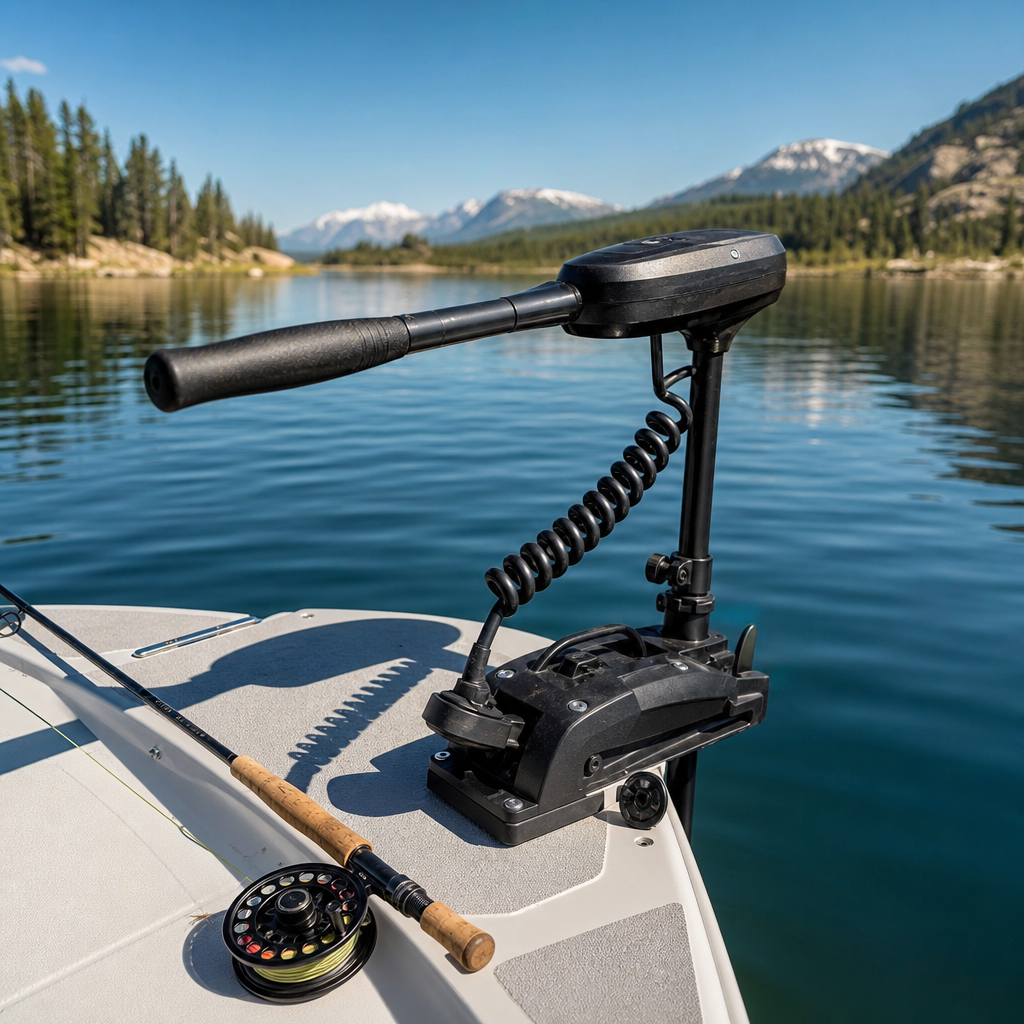
Mount style matters as well. Bow-mount motors generally provide the best control because they pull the boat instead of pushing it. That makes them ideal for stillwater trout boats, larger jon boats, and skiffs where precise orientation matters. Transom-mount motors are simpler, cheaper, and lighter, making them a strong choice for small boats, inflatables, and anglers who prioritize portability. Hand-control models suit compact platforms, while foot-control or remote-control systems free your hands for casting. In my experience, remote control is especially useful for solo fly anglers because it reduces the awkwardness of moving between rod handling and steering.
Durability is another deciding factor. Freshwater-only motors can perform very well on lakes and reservoirs, but tidal use demands corrosion resistance, sealed electronics, and marine-grade hardware. Saltwater-rated motors from Minn Kota Riptide and MotorGuide Xi series lines are built for this environment. If your fly fishing includes coastal marshes, bays, or estuaries, paying for saltwater protection is not optional. It is cheaper than replacing a motor damaged by corrosion after a season of neglect.
How Much Thrust, Shaft Length, and Battery Capacity You Need
The common rule for thrust is at least two pounds of thrust per 100 pounds of total boat weight, including passengers, gear, batteries, fuel, and cooler load. In practice, fly anglers should treat that as the floor, not the target. Wind is the real test. A lightly built 16-foot skiff or jon boat used on exposed lakes often needs 55 to 80 pounds of thrust for confident boat control. Heavier multi-angler rigs may need 80 to 112 pounds, especially if they rely on GPS anchoring. Small inflatables, canoes, and kayaks can work well with 30 to 45 pounds, but that assumes limited wind and short travel distances.
Shaft length is just as important. If the shaft is too short, the prop can ventilate when the bow rises in chop, causing loss of thrust and noisy cavitation. If it is too long, it becomes awkward in shallow water and harder to stow. A practical guideline is to measure from the bow mount location to the waterline and add roughly 16 to 22 inches for calm to moderate conditions, more if you fish rough lakes. Typical shaft lengths include 36, 42, 45, 52, and 60 inches. Many fly anglers in freshwater boats land comfortably in the 45- to 52-inch range.
Battery choice changes the entire ownership experience. Traditional AGM deep-cycle batteries remain widely used because they are durable and less expensive upfront, but lithium iron phosphate batteries now offer a major advantage for serious fly anglers. LiFePO4 batteries weigh far less, maintain voltage better under load, and usually deliver more usable capacity across a day of fishing. A 36-volt setup with lithium can transform a larger bow-mount motor from a burden into a practical all-day system. The tradeoff is cost, plus the need to confirm charger compatibility and battery management quality.
Top Motor Categories and Who They Fit Best
Instead of forcing every angler into one “best” product, it is more useful to match motor classes to fishing scenarios. The categories below reflect the setups that consistently perform well for fly fishing equipment reviews.
| Motor category | Best use case | Typical thrust | Main advantage | Main limitation |
|---|---|---|---|---|
| Small transom-mount freshwater motor | Canoes, kayaks, inflatables, small ponds and calm lakes | 30 to 45 lb | Affordable, light, easy to remove | Limited wind authority and steering precision |
| Mid-size transom or bow-mount motor | Jon boats, prams, compact stillwater trout boats | 45 to 55 lb | Good balance of control and portability | Can struggle on large exposed water |
| Advanced bow-mount with GPS anchoring | Lakes, reservoirs, flats skiffs, multi-angler boats | 55 to 112 lb | Excellent positioning, route control, hands-free fishing | Higher cost, more battery demand |
| Saltwater-rated bow-mount motor | Redfish, striper, and coastal fly fishing | 55 to 112 lb | Corrosion resistance and strong thrust | Heavier and often expensive |
For simple freshwater use, Minn Kota Endura C2 and Newport Vessels transom models remain common entry points. They are not glamorous, but for pond-hopping or short sessions on sheltered water, they are practical and easy to maintain. For more serious stillwater fly fishing, motors such as the Minn Kota Terrova, PowerDrive, or MotorGuide Xi3 offer stronger thrust, better steering, and available GPS anchoring. On coastal skiffs, saltwater models like the Minn Kota Riptide Terrova and Rhodan HD GPS Anchor have developed loyal followings because they hold a boat on flats edges and channel seams with far less noise than constant manual repositioning.
Each category also reflects deck space, installation complexity, and wiring requirements. A compact transom motor may need only a single 12-volt battery and basic marine connectors. A high-thrust bow-mount with advanced navigation features may require 24- or 36-volt wiring, breakers sized to manufacturer specifications, reinforced mounting, and battery trays positioned for hull balance. These are not minor details in equipment reviews; they shape long-term satisfaction.
Best Features to Prioritize in Equipment Reviews
When evaluating the best fly fishing trolling motors, start with noise, control, and battery efficiency, then move to convenience features. Quiet operation comes from a combination of motor design, prop balance, mount rigidity, and how hard the system must work. A properly sized motor running at lower output is usually quieter and more efficient than an undersized motor constantly pushed near maximum. Variable speed, rather than five-speed stepping, helps maintain stealth and avoid overcorrecting.
GPS anchoring has become one of the most important features in modern equipment reviews. Minn Kota calls it Spot-Lock, while other brands use similar terms. For fly fishing, its value is obvious: it can hold a boat near shoals, drop-offs, bridge seams, or flats edges while anglers cast without constantly resetting with an anchor or paddle. It is not perfect in heavy current or very shallow grass, but on open water it changes how efficiently you cover structure. Route recording and heading lock can also help follow a weedline or contour while keeping the casting angle consistent.
Control interface is another overlooked factor. Foot pedals are excellent for conventional bass techniques, yet they can crowd deck space and interfere with stripping baskets or loose fly line. Many fly anglers prefer handheld remotes or compact wireless controls because they keep the deck cleaner. Quick-release mounts matter if you trailer often or store your boat outside. So do composite shafts, breakaway brackets, and clear battery-status indicators. In my own reviews, the most appreciated features are rarely flashy; they are the ones that reduce interruptions on the water.
Leading Brands and Standout Models
Minn Kota remains the benchmark in most trolling motor conversations because its lineup covers nearly every use case, from simple Endura units to feature-rich Terrova, Ulterra, and Ultrex systems. For fly anglers, Terrova often hits the sweet spot. It combines reliable GPS anchoring, strong thrust options, and manageable installation without the premium price of the most specialized tournament models. PowerDrive is another viable midrange option, particularly for anglers who want core navigation features at lower cost.
MotorGuide has long been a credible alternative, and the Xi3 and Xi5 series are especially relevant for fly fishing boats. They are compact, responsive, and available with GPS functions that suit skiffs and smaller lake boats. Rhodan occupies a more specialized niche, particularly among saltwater flats anglers who value precise anchoring and waypoint control in coastal environments. Rhodan systems are not inexpensive, but on technical skiffs they have earned a reputation for strong station-keeping in wind and tide.
Garmin has also entered the market with Force and Kraken motors, bringing strong integration with chartplotters and modern brushless design. Brushless motors generally offer quieter operation, improved efficiency, and fewer wear components than brushed designs, though they raise the entry price. For anglers already invested in Garmin marine electronics, this integration can be a practical advantage. The best brand, however, still depends on local service support, available shaft lengths, mount fit, and how the motor behaves on your specific hull.
Common Buying Mistakes and How to Avoid Them
The most common mistake is buying by thrust alone. Anglers see a high number, assume more is always better, and overlook weight, voltage, shaft length, and mount compatibility. An oversized system on a small fly boat can create clutter, upset trim, and add battery mass that reduces draft advantage in shallow water. The second mistake is underestimating wind. If you fish broad western reservoirs, Great Lakes bays, or tidal marshes, choose more thrust and battery capacity than your calm-water assumptions suggest.
Another mistake is ignoring installation. Poor wiring causes voltage drop, heat buildup, and unreliable performance. Follow American Boat and Yacht Council practices, use marine-grade tinned copper wire, install the correct breaker, and protect all connections from moisture. Battery placement should preserve balance and casting room. Finally, do not treat every review as universal. A motor that excels on a 19-foot walleye boat may be a poor fit for a dedicated fly skiff. Match the review to your hull, water type, and casting style, then shortlist models accordingly.
Choosing among the best fly fishing trolling motors becomes much easier when you focus on boat control instead of marketing claims. The right motor is quiet, correctly sized, efficient with battery power, and suited to your water, hull, and casting routine. For small craft, a light transom-mount motor may be all you need. For larger stillwater or coastal boats, a bow-mount unit with GPS anchoring can dramatically improve positioning, reduce fatigue, and increase effective fishing time. Across this equipment reviews hub, those are the standards that matter most.
The strongest buying decisions come from matching real use conditions to real product strengths. Think about wind exposure, travel distance, saltwater risk, deck layout, and whether hands-free control will make you fish better. Then compare thrust, shaft length, voltage, and battery chemistry with those conditions in mind. Brands like Minn Kota, MotorGuide, Rhodan, and Garmin all offer credible options, but none is automatically best for every fly angler. The best model is the one that disappears into your workflow and lets you present flies precisely.
Use this hub as your starting point for product reviews and recommendations in the equipment reviews category. Build a shortlist, compare installation needs, and prioritize control, reliability, and quiet operation over hype. If you are upgrading this season, start by measuring your boat, estimating your loaded weight, and identifying the water you fish most often. Those three steps will narrow the field fast and lead you to a trolling motor that genuinely improves your fly fishing.
Frequently Asked Questions
What makes a trolling motor especially good for fly fishing?
A trolling motor that works well for fly fishing needs to do more than provide basic propulsion. In this style of fishing, boat control directly affects presentation, casting angles, line management, and how naturally a fly moves through the water. The best fly fishing trolling motors are quiet, responsive, and easy to fine-tune at low speeds so you can hold a seam, slip along a bank, or maintain a controlled drift without blowing past productive water.
Quiet operation is one of the most important factors. Fly anglers often target fish in shallow water, back bays, flats, weed edges, and river structure where noise can quickly put fish on alert. A good trolling motor should move the boat with minimal vibration and little prop noise. Variable speed control is also valuable because fly fishing rarely requires abrupt power. Instead, you usually need subtle adjustments to compensate for wind, current, or changing casting position.
Mount style matters too. Bow-mount motors generally offer the best directional control and are preferred on many larger boats because they pull the hull and allow precise steering. Transom-mount motors can be a strong choice for smaller skiffs, jon boats, and inflatables where simplicity and portability are priorities. Shaft length should match your boat setup and typical water conditions so the prop stays submerged without creating unnecessary drag.
For many anglers, GPS features such as spot-lock or anchor mode are a major advantage. These functions can help hold the boat in place while you work a bank, fish a shoal, or re-rig lines, and they can reduce the amount of manual correction needed in wind or current. In short, the best fly fishing trolling motor combines stealth, precision, and control in a way that supports better casting and more efficient fishing.
How much thrust do I need for a fly fishing trolling motor?
Choosing the right thrust depends on your boat size, total load, and the type of water you fish most often. A common rule of thumb is to have at least 2 pounds of thrust for every 100 pounds of fully loaded boat weight, including passengers, batteries, gear, fuel, and coolers. That said, fly anglers often benefit from sizing a little more generously because windy conditions, current, and repeated low-speed adjustments can demand more power than calm-water estimates suggest.
For kayaks, small rafts, and lightweight micro-skiffs, lower thrust models may be completely adequate, especially on sheltered lakes or slow-moving rivers. Small jon boats and compact skiffs often perform well with mid-range thrust motors. Larger aluminum fishing boats, bay boats, or heavily loaded skiffs generally need more thrust to maintain control without running the motor at maximum output all day. Running a properly sized motor at moderate power is usually quieter, more efficient, and easier on battery life than forcing an undersized unit to work constantly at full speed.
Water type should also influence your decision. On calm ponds and protected coves, you can often get away with less thrust. If you regularly fish tidal creeks, broad reservoirs, windy flats, or rivers with noticeable current, extra thrust can be the difference between controlled presentation and constant frustration. More thrust does not mean you must fish faster; it means you have more authority over the boat when conditions become challenging.
Voltage is connected to thrust as well. Many smaller motors run on 12-volt systems, while more powerful options may use 24-volt or 36-volt setups. Higher-voltage systems are common on larger boats because they deliver stronger performance and improved efficiency over long days. The best approach is to match thrust and voltage to your boat and fishing environment, not just the lightest conditions you hope for.
Are bow-mount or transom-mount trolling motors better for fly anglers?
Neither style is universally best, but bow-mount motors are often preferred for serious fly fishing because they provide superior control. A bow-mounted motor pulls the boat rather than pushing it, which makes tracking cleaner and helps the hull respond more predictably. That matters when you are trying to line up a drift, keep a casting lane open, or stay parallel to a shoreline while making repeated presentations.
Bow-mount systems also tend to offer more advanced features, including foot control, wireless steering, and GPS-enabled holding functions. These tools are especially useful in fly fishing because your hands are often busy with the rod, stripping line, or managing slack. Being able to make subtle boat corrections without interrupting your fishing rhythm can noticeably improve efficiency and reduce missed opportunities.
Transom-mount trolling motors still have a lot of value, particularly for smaller and simpler boats. They are usually more affordable, easier to install, and easier to remove for transport or storage. For solo anglers fishing compact skiffs, jon boats, canoes, or inflatables, a transom mount may be the most practical solution. They can work very well when used thoughtfully, though they may require more active steering input and may not feel quite as precise in wind or current.
Your boat layout should guide the decision. If you have a stable casting platform and enough room for a bow mount, that setup often delivers the best fly fishing control. If your boat is small, portable, or not designed for a front-mounted motor, a transom-mount model may be the smarter and more economical fit. The right choice is the one that gives you quiet, reliable maneuverability without complicating your fishing setup.
How important is battery life when choosing a fly fishing trolling motor?
Battery life is extremely important because fly fishing often involves long periods of subtle boat positioning rather than quick runs from spot to spot. A trolling motor may be used all day to hold against wind, ease along structure, or make constant micro-corrections during drifts. If your battery system is undersized, you may find yourself cutting a trip short or losing the precise control that makes the motor so useful in the first place.
The type of battery matters as much as capacity. Deep-cycle batteries are designed for the sustained discharge patterns common with trolling motors. Many anglers now choose lithium batteries because they are lighter, charge faster, provide more usable capacity, and maintain voltage better throughout the day. Traditional AGM or flooded lead-acid batteries can still be effective and more budget-friendly, but they are heavier and typically offer less usable energy for their weight.
Runtime depends on several factors: motor thrust, boat size, wind, current, fishing style, and how often you use higher power settings. A motor used occasionally for minor adjustments will draw much less power than one holding a skiff in current for hours. Features like GPS anchor mode can also increase consumption depending on conditions, since the motor may need to make frequent corrections to maintain position.
For the best results, think of the trolling motor and battery as one system. Match battery capacity to your motor voltage and your real fishing habits, not just ideal conditions. It is also wise to have a quality onboard charger and to monitor battery status during use. For fly anglers who spend full days on the water, dependable battery performance is not a luxury; it is what allows consistent, controlled fishing from first light to take-out.
Do I really need GPS and spot-lock features for fly fishing?
You do not absolutely need GPS and spot-lock features to fly fish effectively, but many anglers find them incredibly valuable once they start using them. These technologies can hold the boat in place automatically, maintain heading, or help repeat a controlled path along structure. For fly fishing, that can be a major advantage because it frees you to focus on casting, stripping, mending, and fighting fish instead of constantly correcting boat position.
Spot-lock, often described as a virtual anchor, is especially useful in wind, current, or tidal movement. Instead of dropping a physical anchor that may spook fish, snag bottom, or slow down repositioning, the motor can keep you near a target zone electronically. This is helpful when fishing points, drop-offs, shoals, current seams, or flats where staying in the right lane makes all the difference. It can also improve safety and efficiency while re-tying leaders, changing flies, or landing fish.
That said, not every fly angler needs these features. If you fish very small watercraft, simple ponds, protected coves, or highly budget-conscious setups, a basic trolling motor may be more than enough. Skilled anglers have been controlling boats effectively for years without GPS assistance. Simpler motors can also be lighter, less expensive, and easier to maintain.
The real question is whether these features match your fishing style. If you regularly deal with wind, current, or technical positioning demands, GPS functions can noticeably improve your control and reduce fatigue over a full day. If your fishing is more casual or your boat is minimal, you may prefer simplicity. GPS is not mandatory, but for many serious fly anglers, it is one of the most practical upgrades available.