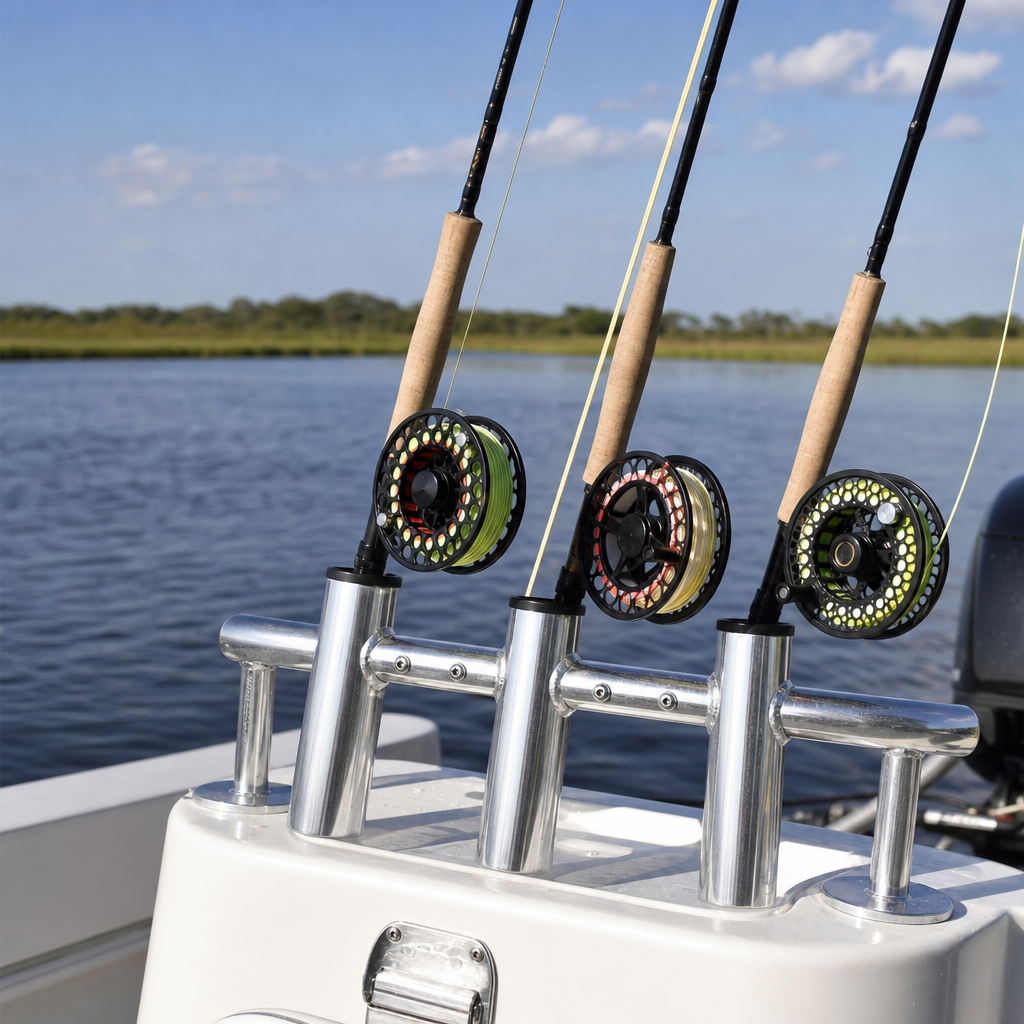
Best fly fishing rod holders for boats solve a problem every serious angler runs into: how to secure expensive rods on deck, keep lines clear, and move between rowing, motoring, and casting without damaging gear. A fly fishing rod holder is any mount, rack, tube, or clamp designed to stabilize a fly rod while a boat is underway or while the angler is handling a net, changing flies, or landing fish. On drift boats, skiffs, rafts, jon boats, and center consoles, the right holder protects graphite blanks, reduces deck clutter, and makes time on the water safer and more efficient.
I have tested rod storage systems on aluminum river boats, flats skiffs, and raft frames, and the lesson is always the same: fly tackle needs different support than conventional gear. A nine-foot fly rod with a large arbor reel, long leader, and stripping guides is awkward to stow in a short horizontal rack built for baitcasting outfits. Saltwater fly rods add another wrinkle because corrosion resistance matters as much as padding and access. A holder that works for trolling rods can crack a delicate fly tip, snag a welded loop, or leave line wrapped around a cleat at the worst possible moment.
This equipment reviews hub explains what makes a good fly fishing rod holder, which styles fit different boats, what materials last longest, and which products stand out for real use. It also helps readers compare flush-mount tubes, vertical racks, clamp-on frame holders, magnetic systems, and lockable storage. If you are outfitting a guide skiff, upgrading a drift boat, or trying to organize a multipurpose family boat, this page gives you the practical framework to choose well and links your buying decision to the larger category of boat fishing gear that must work together, not as isolated pieces.
What Makes a Great Fly Fishing Rod Holder for Boats
The best fly fishing rod holders for boats do three jobs at once: they protect the rod blank, control the reel, and prevent loose fly line from catching on hardware. Protection starts with geometry. Fly rods store best when the holder supports the butt section securely without forcing the rod tip into a tight bend. That is why deep tubes, padded cradles, and horizontal racks with multiple contact points usually outperform open rings designed for heavier conventional outfits. Reel clearance matters too. A fly reel is wider than many spinning reels and often sits lower relative to the rod, so the mount must leave space for the drag knob and handle without chafing.
Access is the second standard. A rod holder is only useful if an angler can grab the rod quickly with one hand and start fishing without unwinding line from a grab rail. On technical skiffs, vertical console-side racks are popular because they keep rods high, separate, and ready. On drift boats, side-mounted horizontal systems reduce tip exposure under overhanging trees. In rafts, frame-mounted tubes are often best because they keep rods off inflatable surfaces and away from anchor ropes. In every case, a good holder isolates fly line from sharp edges, bolts, cup holders, and rod guide feet from neighboring rods.
Durability is the third requirement. Marine-grade aluminum, anodized finishes, stainless fasteners, UV-stable polymers, and closed-cell foam all matter. Saltwater use raises the bar. I look for 6061 or 6063 aluminum with a hard anodized coating, stainless hardware that can be isolated from dissimilar metals, and liners that will not absorb water or turn abrasive with sand. Cheap powder-coated steel racks often look acceptable in a catalog, but after a season they chip, rust at welds, and stain decks. Trusted brands such as Smith Creek, Tite-Lok, Driftmaster, RAILBLAZA, and CE Smith have better reputations because they build around real marine wear points rather than only appearance.
Choosing the Right Holder Style for Your Boat Type
Boat type should drive the first buying decision. A flats skiff or bay boat benefits from vertical or angled gunwale and console storage because deck space is limited and rods must stay ready for sight-casting. Flush-mount rod holders can work if they are positioned carefully, but many are better for transport than for fly fishing because exposed reels and guides can knock against gelcoat. Horizontal under-gunwale racks are often the cleaner option for fly anglers since they spread support over more of the blank and keep rod tips inside the beam of the boat.
Drift boats and guide boats have different needs. Oars, anchor systems, clients moving around, and low bridges make horizontal side storage more practical than tall vertical tubes. Many guides prefer lockable or strap-retained rod trays that keep clients’ rods from bouncing free when the boat slides over shallow riffles. For rafts and catarafts, frame-mounted holders are the standard answer. Products from NRS-compatible and Scotty-style mounting ecosystems let owners clamp holders to pipe frames without drilling. That matters because inflatable platforms change layout often, and permanent holes reduce resale value and flexibility.
Multipurpose aluminum boats and center consoles sit in the middle. If the boat serves both fly and conventional fishing, modular holders make more sense than fixed fly-only racks. Adjustable-angle mounts can hold a spinning rod one day and serve as temporary fly rod parking the next, while dedicated horizontal fly racks can be added under a hardtop or along the interior sides. The key is to map actual movement on deck. Where do people step? Where does the net go? Where do stripping baskets, push poles, or trolling motors sit? The right style is the one that works with those routines, not just the one that photographs well.
Materials, Mounting Systems, and Corrosion Resistance
Materials determine whether a holder survives years of vibration, sun, and salt. Aluminum remains the premium choice for many permanent installations because it is strong, relatively light, and easy to fabricate into precise racks. Anodizing is more than cosmetic; it improves corrosion resistance and surface hardness. Stainless steel looks polished and lasts well, but it adds weight and can glare in bright conditions. High-quality polymers have improved dramatically. Glass-filled nylon and UV-stable composites used by brands like RAILBLAZA and YakAttack resist impact and avoid galvanic corrosion, making them excellent for removable systems.
Mounting method affects both performance and resale. Flush mounts require drilling and backing access, but they give the cleanest factory-style finish. Surface-mount racks are easier to install and often spread load better across thin gunwales when paired with backing plates. Clamp-on systems dominate raft and rail applications because they are adjustable and noninvasive. Track systems deserve special attention on modern boats. Gear tracks from YakAttack, Scotty, and similar brands allow rod holders to slide, rotate, and be removed for travel. For anglers still refining boat layout, tracks are usually the smartest first upgrade.
Corrosion control is where many buyers cut corners. Every fastener should be marine grade, but that alone is not enough. Bedding compounds, nylon washers, anti-seize on stainless threads, and regular freshwater rinsing all extend service life. On mixed-metal installations, galvanic isolation matters. I have seen anodized holders pit quickly where stainless bolts were overtightened directly against bare aluminum. In saltwater, inspect welds, drain holes, and foam inserts regularly. Sand trapped inside a tube acts like grinding paste on rod finishes. A holder should be easy to rinse and inspect; if it traps water and grit, it will eventually damage the gear it is supposed to protect.
Best Fly Fishing Rod Holder Options by Use Case
There is no single best fly fishing rod holder for every boat, so the most useful way to review the category is by use case. For skiffs and center consoles, CE Smith vertical and horizontal rod rack systems remain strong value picks because they are widely available, use marine-grade materials, and fit common boat layouts. For modular setups, RAILBLAZA Rod Holder II and related mounting bases offer excellent adjustability and broad compatibility, especially on boats where owners do not want a permanent install immediately. These are practical recommendations for anglers who need flexibility more than custom fabrication.
For drift boats and raft frames, many experienced anglers favor clamp-on tube holders or custom frame racks built around NRS pipe fittings, Scotty mounts, or Down River Equipment accessories. These systems are effective because they hold rods inside the footprint of the craft and can be repositioned around oar towers, dry boxes, and anchor controls. Smith Creek’s rod clip concepts are also useful as secondary retention, especially when combined with a horizontal storage track. They are not a full boat storage solution by themselves, but they help prevent accidental drops during transitions.
For premium custom skiffs, fabricated horizontal racks with foam-lined butt cups and bungee or magnetic tip retainers often outperform universal products. I have seen Beavertail, Maverick, and technical polling skiffs fitted with console-side racks that store four fully rigged fly rods securely enough for long runs. These setups cost more, but they address fly-specific problems directly: guide spacing, reel protection, and line management. If you fish hard and keep several specialized rods rigged, custom storage is often worth the spend because replacing one high-end fly rod costs more than upgrading the holder system.
| Use Case | Best Holder Type | Why It Works | Typical Tradeoff |
|---|---|---|---|
| Flats skiff | Horizontal console or gunwale rack | Protects long fly rods and keeps decks clear | Can require custom fitting |
| Drift boat | Side-mounted horizontal tray | Keeps tips low and secure under trees and bridges | Takes up interior side space |
| Raft or cataraft | Clamp-on frame tube holder | No drilling and easy to reposition | Usually less refined than hard-boat racks |
| Center console | Modular track-mounted holder | Adapts to mixed fly and spinning setups | May need removal in rough offshore runs |
Installation, Safety, and On-Water Use Tips
Installation quality matters as much as product quality. Before drilling anything, load the boat as if you were fishing and simulate rod movement. Open hatches, swing the net, clear the anchor rope, and walk from bow to stern carrying a rigged nine-foot rod. Mark every place where a tip can hit a windshield, T-top leg, or outboard cowling. Then check backing access. A beautifully placed holder is still a bad installation if the fasteners only bite thin fiberglass with no backing plate. On aluminum boats, use proper sealants and avoid crushing hollow sections by overtightening bolts.
Safety deserves emphasis because fly rods create hazards when stored poorly. A rod tip extending beyond the beam can hook dock lines, mangroves, or another angler’s clothing. Exposed flies are even worse. Holders should position hooks where they can be secured to a keeper or a dedicated foam patch, not left swinging beside a walkway. During runs in rough water, use retention straps, bungees, or locking rings. Even on calm days, vibration can walk a rod upward over time. I have watched expensive saltwater outfits launch overboard because someone assumed a snug fit was enough.
On-water efficiency improves when storage matches workflow. Keep the most-used rod in the fastest-access position and reserve deeper or more protected holders for backups. If you routinely switch between floating and sinking lines, dedicate separate slots so reels and line loops do not tangle. Rinse holders after every trip, especially if sand or shell fragments are present. Once a month, remove rods and inspect contact points for wear marks. A little prevention goes a long way. Small abrasions on rod finish often signal a holder edge, fastener head, or packed grit problem that should be fixed before it becomes a cracked blank.
How This Hub Fits the Broader Equipment Reviews Category
This page works as a hub because rod holders are connected to nearly every other boat-fishing equipment decision. The best holder for your boat depends on rod length, reel size, line management, net placement, anchor systems, cooler position, and whether the deck is optimized for sight-casting or for transport between spots. In a complete equipment reviews library, this topic should lead naturally into articles on fly fishing boat setup, skiff accessories, drift boat organization, rod and reel combos for boats, and marine hardware maintenance. Those supporting pages answer narrower questions, while this guide gives the overall framework.
That broader perspective matters because anglers often shop in the wrong sequence. They buy holders before deciding where spare rods will sit relative to push poles, electronics, or passengers. Then they blame the product when the real issue is layout. A strong review process evaluates compatibility, installation complexity, material quality, and serviceability together. It also separates temporary storage from travel storage. Some systems are excellent while poling shallow flats but inadequate for trailering at highway speeds. Others are secure for transport yet too slow for active fishing. Good equipment reviews explain that distinction clearly so buyers choose for actual use, not marketing photos.
For readers building out a boat over time, the smartest path is incremental. Start with the highest-risk problem, usually unsecured rods on deck, and solve that with a holder style matched to the boat. Then refine around it with stripping mats, line management accessories, gear tracks, and better hook keepers. As you compare products, prioritize proven marine materials, clean mounting geometry, and retention that protects both rod and angler. Best fly fishing rod holders for boats are not just storage accessories; they are part of a safer, faster, more organized fishing system. Use this hub as your starting point, then move into the specific equipment reviews that match your boat and fishing style.
Frequently Asked Questions
What type of fly fishing rod holder works best for different kinds of boats?
The best fly fishing rod holder depends heavily on the type of boat you fish from and how you move while on the water. On drift boats and rafts, anglers often prefer clamp-on or frame-mounted holders that can be positioned without permanent drilling. These are useful because they protect rods while rowing through shallow runs, navigating around structure, or stopping to change flies. On skiffs and center consoles, flush-mount or rail-mount holders are common because they offer a cleaner, more permanent setup and can handle higher travel speeds when the boat is under power. Jon boats often benefit from versatile bracket-style holders or removable racks that can be mounted along the gunwale without taking up too much deck space.
For fly fishing specifically, the holder should support longer rods without placing pressure on delicate graphite blanks or guides. Tube-style holders and racks with wide spacing tend to work better than generic spinning-rod holders because fly rods are longer, lighter, and easier to snag with fly line. If your fishing style involves frequent casting, landing fish, and switching positions quickly, the best setup is usually one that keeps the rod secure but still allows fast access. In short, there is no single best rod holder for every boat. The right choice is the one that matches your boat layout, fishing style, and need for either permanent security or removable flexibility.
How do rod holders protect expensive fly rods from damage on a boat?
A quality fly fishing rod holder protects your gear by controlling the two biggest causes of damage on a boat: impact and movement. Fly rods are expensive, and most modern models are built from lightweight graphite that performs beautifully but can be vulnerable to knocks, compression, and sudden bending at the wrong angle. When a rod is left loose on a deck, it can be stepped on, bounced against a console, slammed by a hatch, or tangled with another setup. A proper holder keeps the rod stabilized so it does not shift every time the boat changes direction, hits chop, or drifts into current seams.
The best holders also protect specific parts of the rod, not just the blank in general. They reduce stress on the reel seat, guides, and tip section by supporting the rod in a balanced position. Many well-designed fly rod holders use padded contact points, molded tubes, or soft inserts so the blank is not rubbing against bare metal or hard plastic. This matters even more when the boat is underway, because vibration over time can wear finishes and create unnecessary pressure points. A good holder also helps keep line under control, preventing flies from wrapping around cleats, trolling motors, anchor lines, or other rods.
Just as important, rod holders prevent those rushed moments that break gear. When you need both hands to row, net a fish, start the motor, or retie a leader, you should not have to drop a rod on the deck and hope nothing happens. A secure holder gives the rod a safe place to go immediately. That kind of protection is one of the main reasons serious anglers consider a rod holder an essential boat accessory rather than a convenience item.
Should I choose a permanent mounted rod holder or a removable clamp-on model?
That choice comes down to how you use your boat, how often you fish, and whether you want flexibility or a dedicated long-term setup. Permanent mounted rod holders are ideal for anglers who fish regularly from the same boat and want the most stable, integrated solution. They are especially popular on skiffs, bay boats, center consoles, and some jon boats because they stay in place, look cleaner, and usually offer stronger support at speed. If your boat sees frequent use in rough water or you routinely travel with rods rigged and stored, a permanent mount often delivers the best overall security.
Removable clamp-on rod holders are a smart option for anglers who want versatility. They work well on drift boats, rafts, rental boats, or multi-purpose setups where drilling holes is either not possible or not desirable. A clamp-on system also lets you test different positions before committing to a permanent installation. That can be a major advantage in fly fishing, where rod placement needs to account for backcasting space, line management, rowing access, and where anglers stand when fighting fish. If your boat serves different purposes throughout the season, removable holders can be taken off quickly to open up deck space.
There are trade-offs. Permanent mounts usually win in stability and clean integration, while clamp-on systems win in adaptability and ease of installation. The key is to choose a holder that stays secure under your real-world conditions. A poorly attached removable holder can shift, while a badly placed permanent mount can interfere with casting or boat movement forever. For many anglers, the best path is to start with a removable model, dial in the ideal position, and then decide whether a permanent upgrade makes sense.
What features should I look for in the best fly fishing rod holder for boats?
The most important feature is true compatibility with fly rods, not just general fishing rods. Fly rods are longer and often more delicate, so the holder needs to support them without pinching the blank, crushing guides, or leaving the tip exposed to unnecessary impact. Look for holders with enough depth or support length to stabilize the rod, along with soft or padded contact points to reduce abrasion. If the holder is tube-based, make sure it accommodates the reel and allows the rod to sit naturally without twisting. If it is a rack or cradle design, spacing matters so rods do not bang into one another.
Material quality is also critical. Marine-grade aluminum, stainless steel, and UV-resistant polymers tend to hold up best in wet, sunny, and corrosive environments. Cheap plastic may seem fine at first but often becomes brittle over time, especially on boats stored outdoors. Hardware matters too. Corrosion-resistant fasteners and sturdy clamps make a big difference in long-term reliability. For saltwater or brackish environments, this is especially important because lower-quality metal components can deteriorate quickly.
Beyond basic construction, think about how the holder fits your fishing workflow. A good rod holder should be easy to access with one hand, positioned where it does not interfere with casting, and secure enough to hold the rod while the boat is moving. Some anglers need horizontal storage along the gunwale, while others prefer vertical or angled mounting to keep rods out of the way. If you fish with multiple people, choose a setup that prevents crossed rods and tangled lines. The best rod holder is not just durable; it actively improves efficiency, keeps the deck organized, and makes it easier to transition between rowing, motoring, and casting without risking expensive gear.
Can I leave a fly rod in a holder while the boat is moving?
Yes, but only if the holder is designed for that purpose and the rod is positioned properly. Many anglers leave rods in holders while moving between spots, rowing through a stretch, or idling under power, but there is a big difference between controlled transport and careless storage. A fly rod holder should keep the rod from bouncing, twisting, or striking nearby surfaces as the boat moves. On slower drifts or calm water, this is usually straightforward. At higher speeds, especially in chop, the demands are much greater. The holder needs to secure the rod tightly enough that it cannot hop out or flex dangerously from repeated impact.
You also need to consider the length of the rod, the presence of a rigged fly, and where the tip is pointing. A long fly rod can catch on branches, dock hardware, T-tops, or other passengers if it is stored in a poor location. Loose fly line can also become a problem if it trails around the reel, wraps around mounts, or snags on deck fittings. Before moving, it is smart to check that the hook is secured, excess line is managed, and the rod is seated fully in the holder. On rough runs or when running at significant speed, many anglers prefer to break rods down or move them into a more enclosed rack for added safety.
So the short answer is yes, a fly rod can stay in a holder while the boat is moving, but only within reason. Match your transport habits to your speed, water conditions, and the quality of the holder itself. A secure marine-grade holder can make short moves and routine repositioning much safer, but no holder eliminates the need for common sense when protecting expensive fly gear.