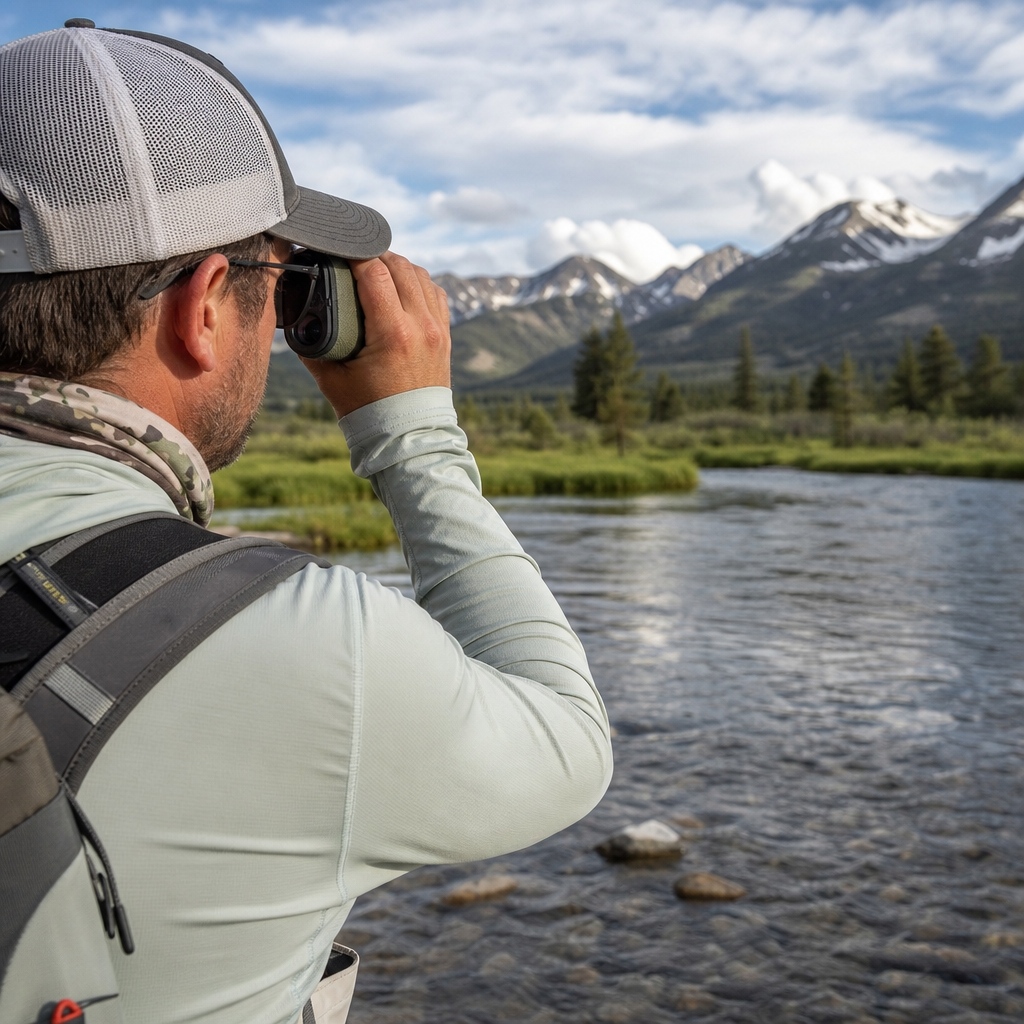
Choosing the best fly fishing rangefinders for accuracy is less about buying another gadget and more about making better decisions on the water. In fly fishing, distance control affects everything: whether a dry fly lands above a rising trout, whether a streamer crosses the strike zone at the right depth, and whether a cast into wind reaches the seam without dragging instantly. A rangefinder is a compact optical device that measures distance, usually with a laser, and some models add angle compensation, target-lock modes, waterproof sealing, and fast scan readings. For fly anglers, those features matter because river conditions change by the minute and casting windows are often small. I have used rangefinders while scouting western tailwaters, tight Appalachian streams, and stillwater shorelines, and the biggest benefit is not absolute precision to the inch. It is calibrated judgment. Once you know what 28, 36, or 52 feet actually looks like in varied light and terrain, your casting becomes more repeatable.
This technology review hub covers how rangefinders fit into practical fly fishing, which specifications genuinely improve accuracy, and which products make sense for different budgets and fisheries. It also helps readers evaluate adjacent gear by linking buying logic across optics, electronics, and field tools within a broader product reviews and recommendations strategy. Accuracy in this context means reliable readings on small targets, fast acquisition through brush or glare, and enough durability to survive spray, rain, sand, and cold hands. It also includes human accuracy: the rangefinder should simplify choices rather than distract from reading water. The strongest models combine clear glass, responsive laser return, intuitive controls, and weather resistance. The weakest look good on paper but struggle to pick up a boulder across moving water or misread reeds behind the actual target. Understanding those tradeoffs is essential before spending money, especially because many excellent rangefinders were originally built for golf or hunting and only some translate well to fly fishing use.
What makes a fly fishing rangefinder accurate
The best fly fishing rangefinders for accuracy share five core traits: dependable laser performance, fast target acquisition, optical clarity, usable ranging modes, and field-ready durability. Laser performance starts with beam divergence and return sensitivity. In plain terms, a tighter beam is better for isolating a midstream rock or undercut bank instead of grabbing background trees. Return sensitivity matters because water, wet stone, and low-contrast banks can reflect inconsistently. Fast acquisition is equally important. If a fish rises twice along a current seam, you need a reading in a second or two, not a device that hunts for target lock while the opportunity disappears. Good optics matter more than many buyers expect. Clear glass and a crisp display make it easier to pick precise aiming points in dawn light, glare, or drizzle.
Modes determine how the unit behaves in realistic fishing situations. Standard line-of-sight distance is enough for many anglers, but scan mode is highly useful for mapping several lies quickly along a bank or measuring from your position to successive landmarks before wading. Angle compensation, common in golf and hunting models, can help on steep banks or when casting from elevated shorelines, although line-of-sight distance is usually the more relevant number for fly casting. Durability is the other nonnegotiable. A useful fly fishing rangefinder should have at least water-resistant construction, grippy armor, and a simple button layout that works with wet fingers. If a battery door loosens, the eyepiece fogs, or the display washes out against bright water, the unit stops being accurate in any practical sense.
Key specifications buyers should compare before choosing
When comparing technology reviews in this category, start with realistic ranging distance rather than marketing maximums. A unit advertised to 1,000 yards may only consistently lock onto soft, small targets at a fraction of that range, and fly fishing rarely requires long-distance measurement anyway. Most anglers need clean readings from 10 to 80 yards, with especially strong consistency inside 25 yards. Minimum distance is therefore important. So is magnification. Six-times magnification is the current sweet spot because it balances detail with hand stability. Higher magnification can make the image shakier and slower to center on a small target. Display type matters too. A red OLED display often performs better in dim conditions, while a black LCD can be easier in bright sun depending on background contrast.
Water resistance should be read carefully. “Weather resistant” is not the same as waterproof, and river use exposes gear to splashes, immersion risk, temperature swings, and constant moisture. Battery type influences convenience; CR2 batteries remain common and offer good life, but replacement availability matters on travel trips. Weight and pocketability are easy to overlook until you are wearing a sling pack for eight hours. I generally recommend staying under eight ounces and favoring a shape that can be operated one-handed. Finally, assess how the brand handles target priority. Some models are tuned to prioritize the nearest object, which helps when aiming through streamside brush. Others can accidentally jump to reflective background objects, creating false confidence. In hands-on testing, this difference is often more important than the brochure’s maximum range claim.
Best fly fishing rangefinders for accuracy: top product categories and standout models
The most reliable buying approach is to choose by use case rather than by a generic “best overall” label. The Nikon COOLSHOT ProII Stabilized stands out for anglers who want premium performance. Its image stabilization reduces hand shake, which dramatically improves target acquisition on small rocks, bank edges, and pocket water targets. In practice, stabilization is not just comfort; it directly boosts ranging accuracy because the aiming reticle stays on the intended point. The Bushnell Tour V6 Shift is another strong option, especially for anglers who value fast lock and clear optics. Bushnell’s experience in laser optics shows in target response and display readability. For budget-conscious buyers, the TecTecTec KLYR or similar midrange golf-oriented models can work well, provided they offer quick scan mode and decent weather sealing.
Hunters who also fly fish often consider Leupold RX series rangefinders because Leupold optics are proven, and many models are rugged. The tradeoff is that some hunting-focused units emphasize long-distance ballistic features that add cost without improving fly fishing utility. Precision Pro NX10 is another model worth attention for its speed, compact form, and slope on/off capability. Anglers who fish from stillwater banks may appreciate that compact golf units excel at mapping casting lanes and drop-off markers around a lake margin. Those fishing tight streams should prioritize nearest-target logic and one-handed operation. If you want a single shortlist, premium buyers should look first at Nikon COOLSHOT ProII Stabilized, Bushnell Tour V6 Shift, and Leupold RX-FullDraw-class units; value buyers should compare TecTecTec and Precision Pro offerings after checking waterproofing and display quality.
| Use Case | Recommended Model Type | Why It Fits Fly Fishing | Main Tradeoff |
|---|---|---|---|
| Technical trout rivers | Stabilized premium golf rangefinder | Fast lock on small targets, clearer readings in shaky hand positions | Higher price |
| General wading and travel | Compact midrange golf rangefinder | Lightweight, simple controls, useful scan mode | Less durable sealing on some models |
| Stillwater banks and reservoirs | Fast-scan distance-first rangefinder | Easy mapping of shoreline markers and casting lanes | Can misread reeds if target logic is weak |
| Dual hunting and fishing use | Rugged hunting rangefinder | Strong weather resistance and dependable optics | Extra ballistic features add cost and complexity |
How to use a rangefinder without disrupting your fly fishing
A rangefinder should support your water reading, not replace it. The best method is to use it before the active fishing window or between productive drifts. On a new run, take three to five landmark readings: the near seam, the midstream boulder, the far bank grass line, and the tailout edge. That creates a mental distance map. Then put the device away and fish by feel. Over time, this trains your eye and makes the rangefinder a calibration tool rather than a crutch. I have found this especially effective with anglers who consistently undercast on broad western rivers. After a day of checking assumptions against measured distance, their line management improves because they understand how much line must be aerialized for a true 45-foot presentation.
Another effective approach is pre-trip practice. In a park or field, place markers at 25, 35, 45, and 60 feet, confirm them with the rangefinder, and cast repeatedly until those distances become automatic. This is one of the fastest ways to improve practical fly casting accuracy. It also reveals a common mistake: many anglers believe they are casting farther than they are. Onstream, use the rangefinder selectively for difficult cross-current presentations, high-bank casts, or stillwater sight-fishing where a few feet can determine whether the fly lands beyond the fish and is stripped naturally into view. Avoid obsessively re-ranging every target. Fish move, current speed changes, and presentation usually matters more than exact distance once you are inside an effective window.
Limitations, tradeoffs, and how to judge value in technology reviews
No rangefinder solves poor line control, weak drift management, or inaccurate rod tracking. It also cannot fully account for current speed, wind direction, backcast obstructions, or the way elevation and vegetation alter depth perception. Moving water can produce inconsistent returns, especially in flat light. Small, dark targets absorb more light and may be harder to read than pale rocks or reflective signs. These are not defects unique to one brand; they are part of laser ranging physics. That is why smart technology reviews should separate laboratory-style specifications from field performance. A model with modest published range but rapid lock on natural targets can outperform a more powerful unit that hesitates on soft surfaces.
Value should be measured by useful accuracy per dollar, not by feature count. If a $400 model delivers waterproof confidence, stabilization, and reliable nearest-target lock, it may be a better long-term investment than replacing two cheaper units that fog or fail. At the same time, many fly anglers do not need flagship pricing. If you fish smaller streams and mainly want a training tool for 20- to 50-foot calibration, a solid midrange unit can be enough. Read reviews that mention actual target types, weather, and response speed. Look for testing on rocks, tree trunks, grassy banks, and water-adjacent objects rather than only flags or reflective markers. That is the evidence that translates to real fishing performance.
How this hub guides your next product review decision
As a hub within product reviews and recommendations, this page should help narrow your next click. If you want premium optics and the most complete accuracy package, start with stabilized and high-end golf-derived models. If you need all-around value, focus on compact midrange units with scan mode, strong nearest-target behavior, and proven weather resistance. If you already own hunting optics, compare whether extra ballistic features justify the size and cost for fishing use. The larger point is that technology reviews are only useful when they connect specifications to actual outcomes on the water. For fly fishing, the outcome is simple: more precise casts, less guesswork, and faster adaptation to changing lies.
The best fly fishing rangefinders for accuracy are the ones that disappear into your process after they sharpen it. Choose a model with clear optics, fast target lock, and enough durability for wet environments. Use it to map water, train your eye, and verify casting assumptions. Then let skill take over. If you are building a smarter gear system, continue through related product reviews and recommendations in this technology reviews hub, compare models by fishery and budget, and shortlist the rangefinder that matches how you actually fish.
Frequently Asked Questions
What makes a fly fishing rangefinder accurate enough to be worth using on the water?
A fly fishing rangefinder is worth using when it gives fast, repeatable distance readings under real fishing conditions, not just in ideal testing environments. Accuracy on the water depends on several factors working together: laser precision, target acquisition speed, optical clarity, ranging consistency at short and medium distances, and the ability to read small or low-contrast targets such as seam lines, undercut banks, boulders, grass edges, and foam lanes. For fly anglers, the most useful distances are often much shorter than in hunting or golf, so a model that performs reliably from roughly 5 to 80 yards is usually more practical than one designed mainly for extreme long-range use.
Another key point is how well the rangefinder handles background interference. On a river, the device may accidentally pick up trees behind the target, glare off moving water, or brush along the bank. Better units offer target priority modes or scanning functions that help isolate the actual feature you want to cast to. That matters because fly fishing is about precision in presentation, not just raw distance. If you are trying to place a dry fly two feet above a feeding trout, being off by even a few yards can change drift quality, line control, and how naturally the fly behaves.
Good optical quality also matters more than many anglers expect. A bright, sharp image helps you identify the exact lane, pocket, or current seam you are measuring. Even if two devices claim similar yardage accuracy on paper, the one with clearer glass and a more readable display often performs better in practice because it lets you range faster and with more confidence. In short, the best fly fishing rangefinders for accuracy are the ones that consistently deliver precise readings on the kinds of short, tricky, water-adjacent targets anglers actually fish.
How does a rangefinder help improve casting accuracy in fly fishing?
A rangefinder improves casting accuracy by turning guesswork into measurable information. Many anglers think they are casting 35 feet when they are actually casting 45, or they assume a fish is 20 yards away when it is closer to 30. Those errors affect fly placement, leader turnover, mending strategy, and how much line you carry in the air. By measuring actual distance before making a cast, or by checking known landmarks during a session, anglers develop a much more realistic sense of range. Over time, this trains both visual judgment and muscle memory.
This is especially useful in situations where precision matters most. On spring creeks, technical tailwaters, and clear freestone rivers, trout often hold in narrow feeding lanes. A cast that lands short may never enter the strike zone, while a cast that lands long can line the fish or create immediate drag. With streamer fishing, distance also affects sink timing and swing angle. If you know a bank cut is 52 feet away instead of “about 40,” you can choose a more deliberate casting stroke, adjust your line carry, and start the retrieve at the proper moment. In windy conditions, measured distance helps determine whether you should change angle, add line speed, or reposition rather than forcing an inefficient cast.
Rangefinders are also excellent training tools away from active fish. You can range rocks, logs, bank edges, or markers and then practice delivering casts to those exact distances. That feedback loop is valuable because it connects what you feel during the cast with what the distance truly is. Over time, anglers become more efficient, waste fewer shots, and make better first presentations. In fly fishing, first-cast accuracy often matters more than making repeated corrections, and that is where a rangefinder can provide a real advantage.
Do you really need angle compensation for fly fishing, or is standard distance measurement enough?
For most fly fishing situations, standard distance measurement is enough, but angle compensation can still be useful in specific environments. Traditional horizontal distance matters most when you are casting across relatively flat water or from positions close to the same elevation as the target. That covers a large percentage of trout fishing, especially on rivers, creeks, and gentle bank access points. In those scenarios, a simple, reliable rangefinder that reads distance quickly is often the smarter choice than a more feature-heavy model.
Angle compensation becomes more relevant when you fish from elevated positions, such as bluffs, high banks, drift boat decks above steep edges, bridges where legal, or mountain streams with strong vertical relief. In those cases, line travel and effective horizontal distance are not always the same. If you are casting down into a plunge pool or across a canyon-like run, understanding the adjusted distance can help with fly placement and line control. The same is true if you are trying to judge how much line will remain off the water during the drift, or how quickly a nymph rig or streamer will reach productive depth after landing.
That said, angle compensation should be viewed as a secondary feature for fly anglers, not the main reason to buy a rangefinder. Waterproofing, short-range accuracy, fast acquisition, readable optics, and pocket-friendly portability usually matter more. If a model includes angle compensation without sacrificing those core strengths, it can be a nice bonus. But if choosing between a rugged, easy-to-use standard rangefinder and a more complicated unit with angle features you may rarely use, most anglers will benefit more from simplicity and dependable performance.
What features should you prioritize when choosing the best fly fishing rangefinder for accuracy?
The best features to prioritize are fast and reliable short-range performance, clear optics, a bright and readable display, water resistance, compact size, and easy one-handed operation. Fly fishing is dynamic. You may be balancing on slick rocks, crouching behind streamside cover, or trying to measure distance quickly before a fish changes position. A rangefinder that takes too long to lock onto a target, struggles with glare, or requires fiddly menu navigation can become more frustrating than helpful. Accuracy is not just about the internal laser specification; it is also about how effectively the unit performs in the hands of an angler.
Scan mode is one of the most useful features for fishing because it allows you to move the reticle across multiple current seams, bank cuts, boulders, or likely holding lies and get continuous readings. This helps build a mental map of the water before you cast. Optical magnification should be useful but not excessive. Moderate magnification is usually enough to identify targets without making hand shake too noticeable. A crisp display is equally important, particularly in low light or over reflective water, where cheap displays can wash out or become hard to read.
Durability matters as much as optics. Fly fishing exposes gear to spray, rain, mud, sand, and accidental drops. A weather-resistant or waterproof housing, solid grip texture, and dependable battery compartment are practical features, not luxuries. Weight and packability also count because the rangefinder may live in a sling pack, chest pack, or jacket pocket all day. Finally, look for a model with a reputation for consistency rather than one overloaded with specialty modes you may never use. In fly fishing, the most effective tool is usually the one that delivers simple, repeatable distance information every time you need it.
When should you use a rangefinder while fly fishing, and when is it better to rely on instinct?
A rangefinder is most useful before the cast, between drifts, or while scouting water rather than during every second of active fishing. It shines when you want to calibrate your eye, map out likely targets, and make more informed decisions about positioning and presentation. For example, before stepping into a run, you can range the near seam, the far bank, a midstream boulder, and the tailout line. That gives you reference points for how much line to carry, where your back cast space may be limited, and how far your fly needs to travel to reach productive water. It is also very helpful in windy conditions, on broad rivers where distance can be deceptive, and when practicing to improve real-world casting precision.
It is better to rely on instinct when constant measuring would interrupt timing, awareness, or stealth. If trout are actively rising and changing lanes, stopping to range every presentation can slow you down and pull your attention away from reading current, watching fish behavior, and managing drift. Fly fishing is still a feel-based sport. Distance is only one variable among many, along with angle, drag, depth, speed, and approach. Once you have used a rangefinder enough to calibrate your perception, the goal is not to become dependent on it but to sharpen your natural judgment.
The best anglers tend to use rangefinders selectively. They rely on them to confirm difficult distances, learn unfamiliar water, and train casting accuracy, then let experience take over in fluid situations. In that way, a rangefinder becomes less of a crutch and more of an educational tool. It helps bridge the gap between what looks right and what actually is right, allowing you to fish with more confidence while still preserving the intuitive decision-making that makes fly fishing effective and enjoyable.