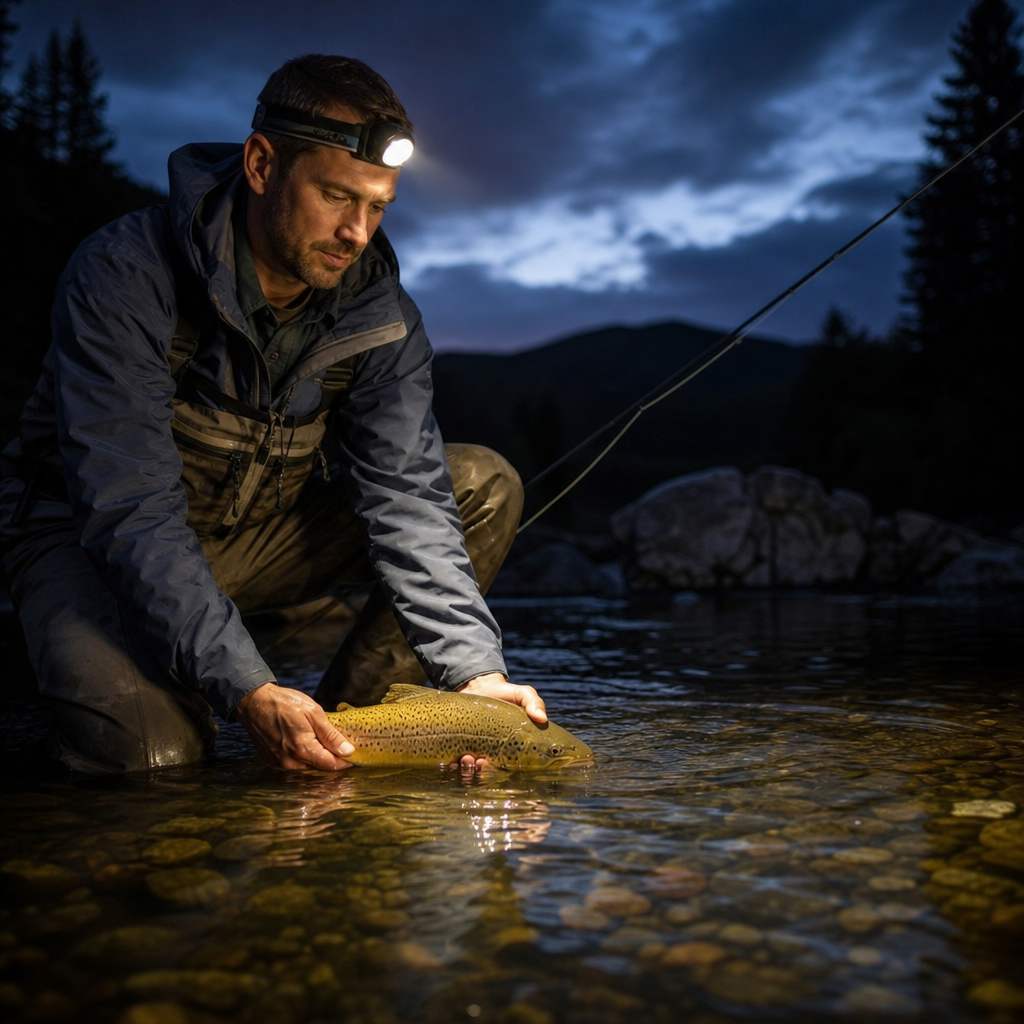
Best fly fishing headlamps for night fishing balance three demands at once: enough light to tie knots and track water, enough control to preserve night vision, and enough weather resistance to survive hard use on rivers, beaches, and stillwaters. In practical terms, a fly fishing headlamp is a hands-free lighting tool worn on the head or hat that combines beam power, runtime, beam pattern, and sealing against water. Night fishing pushes every one of those traits harder than a short walk from camp because anglers move over uneven banks, manage line in current, identify insects, and handle fish with wet hands. That is why choosing the best fly fishing headlamp for night fishing matters more than picking the brightest model on the shelf.
I have tested headlamps on trout rivers, carp flats after sunset, and striper beaches where spray, wind, and cold expose weak switches, poor battery doors, and beams that look impressive in marketing copy but fail in real conditions. The best models are not simply high-lumen units. They are systems built around usable red light, regulated output, lockout modes, glove-friendly controls, and battery options that fit the trip. For anglers building a dependable night setup, the right headlamp improves safety, efficiency, and fishability in ways that a bargain light rarely does.
What makes a headlamp good for fly fishing at night
A good fly fishing headlamp starts with beam control. Flood light helps with knot tying, fly changes, and digging through a sling pack. Spot light helps with trail approaches, reading current seams, and scanning exits on the walk back. The best headlamps combine both in a balanced beam or offer separate emitters. For fishing, I usually prefer moderate output in the 150 to 400 lumen range for most tasks, with a higher setting available for emergencies. Excessive maximum brightness can be counterproductive because reflected light off water, tippet, or light-colored jackets destroys dark adaptation fast.
Color mode matters just as much as brightness. Red light remains the most useful night fishing option because it preserves more night vision than white light and is less disruptive when working around other anglers. Green can appear brighter to the eye, but it often reflects sharply from vegetation and gear. Blue light is generally the least useful streamside because it worsens glare and can make subtle color distinctions in flies or leaders harder to judge. A headlamp with direct access to red mode is a major advantage. If an angler has to cycle through bright white every time the lamp turns on, the feature is compromised.
Ingress protection ratings tell you whether the lamp can handle fishing conditions. IPX4 is acceptable for rain. IPX7 is better for accidental immersion, which is realistic when wading at night. Battery design also deserves close attention. Rechargeable lithium-ion packs are convenient and often powerful, but replaceable AAA or AA compatibility can still be valuable for multiday trips, winter outings, or travel where charging is uncertain. Regulated output is another overlooked feature. A regulated lamp holds steady brightness for longer instead of starting bright and fading gradually. On the water, that consistency is easier to trust.
Key technologies that separate average lights from the best fly fishing headlamps for night fishing
Modern headlamp technology has improved dramatically over the past decade. Better LEDs, more efficient drivers, and improved battery management mean today’s premium lights are brighter, lighter, and more durable than older models with similar size. The first feature I look for is a regulated driver. Brands such as Fenix, Petzl, Black Diamond, and Princeton Tec increasingly publish runtime data that reflects controlled output rather than optimistic laboratory bursts. In use, this means your lamp is not dramatically dimmer halfway through the session.
The second differentiator is user interface design. Night fishing rewards simple controls. A top-mounted button with tactile feedback is easier to use than a tiny flush switch when hands are cold. Lockout mode prevents accidental activation in a pack, which is common when a lamp rides beside forceps or fly boxes. Memory mode can help if it returns to a preferred low white or red setting, but poorly implemented memory can surprise you with maximum output at the wrong time. The best interfaces provide direct shortcuts to low mode and red mode.
Battery systems are now a strategic choice rather than a minor spec. USB-C charging is becoming the standard and is preferable to older micro-USB ports because it is stronger and faster. Some lamps use proprietary rechargeable packs, while others accept both a branded battery and standard alkaline or lithium disposables. Hybrid systems are ideal for travel and remote fishing. Weight distribution matters too. Front-heavy lamps bounce during walks and feel worse over a hat brim. Well-designed straps, low-profile housings, and rear battery packs with balanced weight can make long nights noticeably more comfortable.
| Feature | Why It Matters for Night Fishing | Best Choice |
|---|---|---|
| Beam pattern | Flood helps knots and gear; spot helps navigation and reading water | Combined flood and spot or smooth balanced beam |
| Red light access | Preserves night vision and reduces glare around partners | Dedicated red button or instant shortcut |
| Water resistance | Rain, spray, and accidental dunking are common | IPX7 or better |
| Battery type | Affects runtime, cold-weather performance, and trip planning | USB-C rechargeable with backup disposable option |
| Output regulation | Keeps usable brightness steady through the session | Digitally regulated driver |
| Controls | Need easy operation with wet or cold hands | Large tactile switch with lockout |
Best headlamp categories and who should buy them
There is no single best fly fishing headlamp for night fishing for every angler because fishing style changes lighting needs. Trout anglers on small streams usually benefit from lighter, lower-output lamps with excellent low modes and red LEDs. They spend more time tying small flies, threading tippet, and moving quietly in confined spaces. A compact lamp such as the Petzl Actik Core or Black Diamond Spot 400 works well here because it delivers enough reach for trail use without excessive bulk.
Saltwater and Great Lakes anglers often need more throw and stronger weather sealing. Walking jetties, beaches, or boulder fields in wind-driven spray demands better build quality and more stable output. In that category, Fenix models such as the HM50R V2.0 or HM65R-T have earned strong reputations for aluminum construction, strong sealing, and practical controls. They are slightly more technical in feel, but that durability pays off when equipment gets rinsed with salt mist for hours.
Guides and anglers who fish long sessions should prioritize runtime and battery flexibility. Princeton Tec has long served professional users because many of its lamps are rugged, straightforward, and battery efficient. Nitecore also deserves attention for lightweight, high-output designs, though some ultralight models are better for runners than anglers because exposed cords or minimalist straps can be less durable around hooks and brush. If your fishing regularly extends past midnight, choose the lamp that is easiest to trust after four wet hours, not the one with the highest headline lumen number.
Top product recommendations in the technology review hub
For most anglers, the best overall choice is a versatile midweight rechargeable lamp with red light, reliable sealing, and true low settings. The Petzl Actik Core remains a strong all-around recommendation because it is comfortable, widely available, easy to recharge, and simple to operate. It is not the toughest lamp in the category, but for river anglers who want balanced performance, it consistently does the job. The Black Diamond Spot 400-R is another leading option, especially for anglers who value compact size and familiar outdoor-retail support. Its feature set suits general night fishing well.
If durability is the priority, Fenix stands out. The HM50R V2.0 is compact enough for technical wading yet built more like a tool than a casual camping light. Its metal body, USB-C charging, and strong waterproofing make it one of the best fly fishing headlamps for night fishing in bad weather. For anglers who want more runtime and a dual-beam feel, the HM65R series offers a stronger platform, though it is more expensive and somewhat bulkier over a cap.
Budget buyers should still avoid the cheapest unbranded lights sold on marketplace listings with inflated lumen claims. In testing, these often fail in switch reliability, water sealing, and runtime honesty. Better value comes from established entry models from Coast, Black Diamond, or Princeton Tec. Spending a little more usually buys better regulation, safer charging, and a beam pattern that is actually useful on the water. For a hub page covering technology reviews, that is the central lesson: brand engineering matters more than marketing exaggeration.
How to match brightness, runtime, and beam color to your fishing style
Brightness should be selected by task, not ego. For knot tying, 5 to 50 lumens is often enough if the beam is wide and even. For general bank movement, 100 to 200 lumens usually covers the job. For route finding, boat ramps, or emergency scanning, 300 lumens and above can help, but only briefly. Many anglers overuse high mode and then complain about poor runtime. In reality, low and medium settings do most of the work. Premium lamps publish burn times for each level; study those rather than focusing on max output.
Runtime estimates also need context. ANSI FL1 standards allow brands to measure runtime until output drops to 10 percent of initial brightness, which can make numbers appear generous. A lamp advertised at ten hours may only provide strong, consistent light for a fraction of that period unless it is well regulated. That is why field reviews and brand reputation matter. I trust lamps more when the medium setting remains stable through an evening session without obvious sag.
Beam color should support fishability. Red is best for preserving adaptation and minimizing disturbance. Warm white is often more comfortable than cool white because it reduces harsh reflections and can make natural colors easier to interpret when sorting flies. Extremely cool LEDs can feel glaring around water and fog. Some newer headlamps offer high color rendering or warmer emitters, features photographers appreciate and anglers should not ignore. When you are checking dubbing shades, blood knots, or the edge of a drop-off, visual comfort becomes practical performance.
Maintenance, safety, and buying mistakes to avoid
A quality headlamp lasts longer when maintained like any other fishing tool. Rinse salt spray off the housing, dry the strap, and inspect charging ports for grit. Recharge lithium-ion batteries before long storage to around half charge if the lamp will sit for months. Replace worn elastic straps before they fail streamside. Keep the lens clean, because water spots and sunscreen residue scatter light and worsen glare. I also recommend carrying a backup micro light in a pack or wader pocket. Even the best primary lamp can be lost, flooded, or left switched on by mistake.
Safety is where headlamp selection becomes more than convenience. Night anglers need reliable footing, accurate depth perception, and enough reserve light to deal with injuries, changing weather, or late exits. A lamp with a strobe mode is less important than one with dependable low output and a battery gauge you can trust. I would also rather have strong waterproofing than a turbo mode I use for thirty seconds a night. Real safety comes from consistency.
The biggest buying mistakes are choosing by lumen count alone, ignoring red mode access, underestimating water resistance, and assuming all rechargeable systems are equal. For this technology review hub, the clearest recommendation is to buy a headlamp built by an established outdoor or professional lighting brand, with regulated output, direct-access red light, and enough runtime for your longest normal outing. Then test it before the trip that matters. Walk a local trail, tie flies in the dark, and learn the controls by feel. The best fly fishing headlamps for night fishing are the ones you can operate confidently when the river is loud, your hands are cold, and the only light you have is the one on your head.
The right headlamp makes night fishing safer, quieter, and far more efficient. It helps you preserve night vision, manage gear without fumbling, and move through difficult water with better judgment. Across this product reviews and recommendations hub, the strongest pattern is clear: useful beam control, honest runtime, rugged sealing, and intuitive controls matter more than flashy specs. Choose a proven model from brands such as Petzl, Black Diamond, Fenix, or Princeton Tec, and match it to the way you actually fish. If you are upgrading your night setup, start with the headlamp first, because every cast, knot, and walk back to the truck depends on it.
Frequently Asked Questions
What features matter most in a fly fishing headlamp for night fishing?
The best fly fishing headlamps for night fishing are the ones that balance visibility, control, comfort, and durability rather than simply chasing the highest lumen number. For anglers, the most important feature is usable light: enough output to tie knots, change flies, read water, and safely move along banks or through shallow current without blowing out your night vision. That usually means a headlamp with multiple brightness levels, a low mode that is genuinely low, and easy switching between white and red light. Red light is especially valuable because it helps preserve dark adaptation, reduces glare on the water, and is less likely to spook fish or irritate fishing partners.
Beam pattern is just as important as brightness. A wide flood beam is better for close tasks like rigging, knot tying, and sorting gear, while a more focused spot beam helps with scanning shorelines, spotting structure, or navigating a trail back to the truck. Many strong headlamps combine both patterns, which makes them much more practical on the water. Runtime is another major consideration. Night fishing sessions often last longer than expected, and cold weather can shorten battery performance, so a headlamp that can maintain useful output for several hours on medium or low settings is usually more valuable than one that briefly hits a very bright turbo mode.
Water resistance also matters more in fishing than in general camping use. A fly fishing headlamp should be able to handle rain, splashes, wet hands, and occasional dunking without failing. Look for a model with dependable sealing and a housing that feels solid rather than flimsy. Finally, pay attention to fit and controls. A headlamp that bounces, pinches, or requires complicated button presses is frustrating in the dark. For serious night anglers, the ideal choice is a simple, weather-resistant, comfortable headlamp with low-output control, red light, and enough runtime to last through a full outing.
How many lumens do you really need for night fly fishing?
For most night fly fishing situations, you do not need the maximum lumen output advertised on the package nearly as often as you might think. In practice, low and medium settings do most of the work. For close-range tasks such as tying knots, threading tippet, checking fly boxes, and unhooking fish, a modest amount of controlled light is usually better than a very bright beam. Too much brightness can create harsh reflections, ruin your night vision, and make it harder to see beyond the immediate hot spot. A headlamp with adjustable output is far more useful than one that is simply very bright.
Higher lumen levels are still useful in certain moments. If you are hiking into a remote access point, picking your way over slick rocks, launching a boat, or trying to identify current seams and obstacles along a dark bank, a stronger beam can add a real margin of safety. The key is having that power available when needed without being forced to use it all the time. Many anglers find that a headlamp with a practical range from very low output up to a solid high mode gives them everything they need, especially if the beam can be dimmed gradually or stepped down easily.
It is also worth remembering that manufacturer lumen claims do not tell the whole story. Beam shape, lens quality, color temperature, and runtime regulation all affect how useful a headlamp feels on the water. A well-designed lamp with moderate output and a smooth beam pattern can outperform a cheaper lamp that claims bigger numbers but has poor controls or a harsh, uneven beam. For night fishing, useful lumens are more important than maximum lumens. The best headlamp is one that lets you see what you need to see, exactly when you need to see it, without turning the riverbank into a spotlighted stage.
Is red light actually better for preserving night vision while fishing?
Red light can be very helpful for preserving night vision, but its value depends on how and when you use it. One of the biggest challenges in night fishing is maintaining dark adaptation so your eyes can continue to pick up subtle movement, current seams, shoreline contours, and the general shape of the water. Bright white light resets that adaptation quickly, especially if you shine it directly into your own face, onto reflective gear, or across the water. Red light is gentler in that respect and is often preferred for basic tasks around camp, in a boat, or on a riverbank because it allows you to work with less disruption to your eyes.
For anglers, red light is particularly useful when changing flies, checking packs, managing line, and moving around in close quarters with others. It is also less intrusive to fishing partners and generally creates less glare off wet surfaces. That said, red light is not automatically better for every task. When you need fine detail, such as tying a tiny knot, inspecting a hook point, or reading subtle texture on rough terrain, white light is often clearer and more effective. The best headlamps for night fishing give you both options so you can switch between preserving vision and maximizing detail as conditions change.
There is also a practical side to using red light well: keep it dim and directional. Even red light can be too bright if the output is excessive or if it is aimed carelessly. The most useful setup is a headlamp with a dedicated red mode that turns on directly without cycling through bright white first. That prevents accidental blasts of light that can wipe out your night vision and disturb the water around you. In short, red light is not a gimmick. It is a genuinely valuable feature for night anglers, especially when paired with a well-controlled white mode for tasks that require more precise visibility.
What level of water resistance should a headlamp have for fly fishing?
Night fishing is hard on gear, and headlamps are no exception. Between rain, spray, condensation, wet hands, and the occasional slip at the water’s edge, a fly fishing headlamp needs stronger weather protection than a casual around-the-house light. A good fishing headlamp should be able to handle repeated exposure to moisture without flickering, fogging, or failing. This is where water-resistance ratings become useful. In general, anglers should look for a headlamp with enough sealing to manage rainstorms, splashes, and brief accidental submersion rather than a model designed only for dry trail use.
Durability is about more than the published rating, though. The quality of the battery compartment seal, button design, hinge construction, and charging port cover all affect long-term performance. Rechargeable headlamps with exposed ports can be excellent, but the port closure needs to be secure and trustworthy. Models that feel loose, have thin rubber covers, or show weak points around seams may not hold up after repeated wet trips. Saltwater anglers should be even more careful because salt exposure adds corrosion risk, especially around charging contacts and metal hardware.
Beyond sealing, think about real-world fishing abuse. A dependable night fishing headlamp should survive being stuffed into a sling pack, dropped onto gravel, worn in cold weather, and used with damp fingers while handling line and fish. It should also maintain predictable performance when conditions deteriorate. If you regularly fish rivers, beaches, estuaries, or stillwaters after dark, it is worth choosing a headlamp built for sustained outdoor use rather than the cheapest bright option available. Water resistance is one of those features that may not seem exciting at first, but on a wet night far from the truck, it quickly becomes one of the most important specs you paid for.
Should you choose a rechargeable or battery-powered headlamp for night fly fishing?
Both rechargeable and battery-powered headlamps can work well for night fly fishing, and the better choice depends on how, where, and how often you fish. Rechargeable headlamps are popular because they are convenient, cost-effective over time, and often deliver strong performance with modern LED systems. If you fish close to home, can reliably charge gear before trips, and prefer not to keep buying disposable batteries, a rechargeable model makes a lot of sense. Many anglers also like the consistent beam quality and compact design that rechargeable units offer.
The tradeoff is planning. A rechargeable headlamp is only as good as your charging routine, and a dead internal battery at midnight is a real problem if you are far from backup power. That is why many serious night anglers either carry a small power bank or choose a rechargeable headlamp with a lockout mode, battery indicator, and dependable runtime on lower settings. Being able to monitor charge status before leaving the house is a major advantage, especially if you know your typical trip length and use patterns.
Battery-powered headlamps, especially those using replaceable cells, offer a different kind of reliability. They are often favored for remote trips, travel, cold conditions, or long outings where swapping fresh batteries is easier than recharging. If you fish deep into the night, make multi-day trips, or simply want the security of carrying spare power in your vest, replaceable batteries are still very practical. Some of the most versatile headlamps now offer hybrid systems, allowing either rechargeable packs or standard batteries, which gives anglers the best of both worlds.
In the end, neither power source is universally superior. The right answer depends on your fishing style. If convenience and frequent local use are your priorities, rechargeable is hard to beat. If backup security, remote reliability, and quick