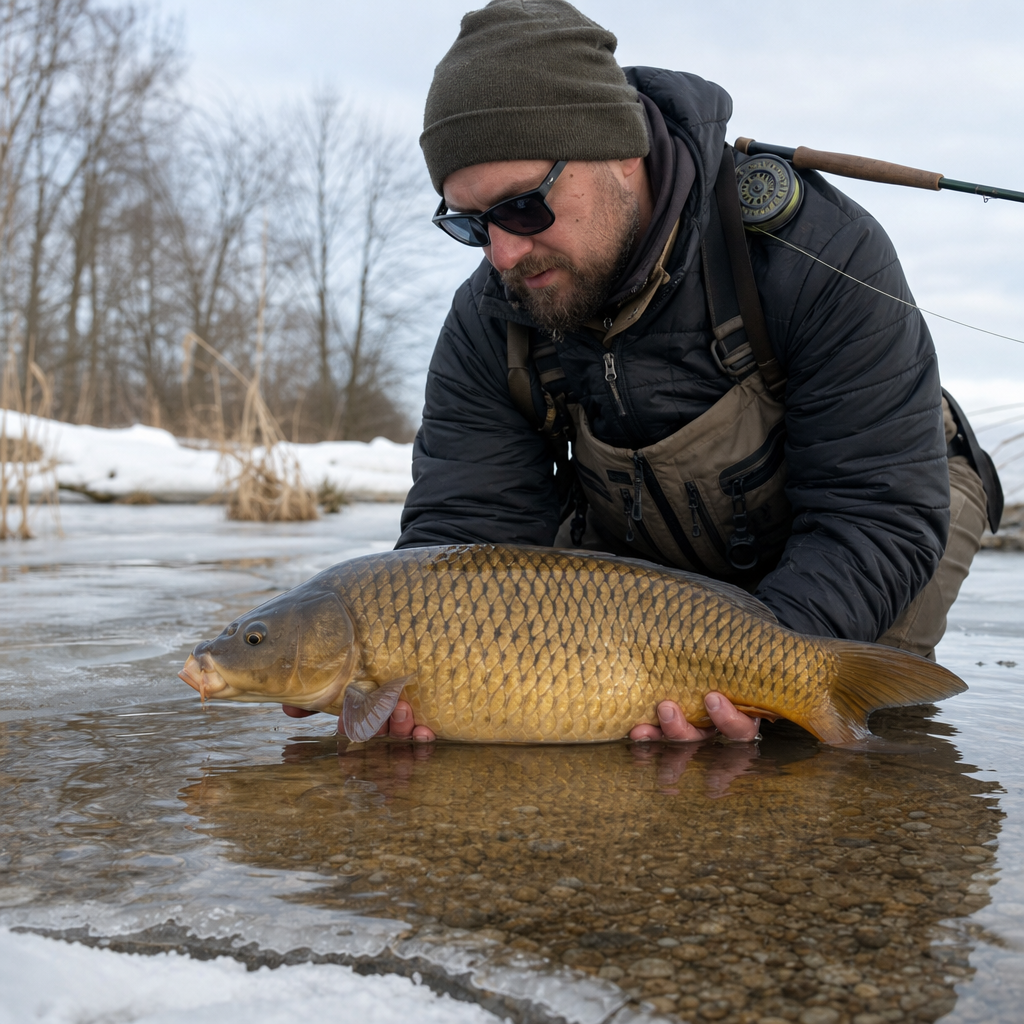
Winter fly fishing for carp rewards anglers who understand how cold water changes fish behavior, feeding windows, and fly presentation. In this season, carp do not disappear; they slow down, shift location, and become far less willing to chase. That simple change forces a more precise approach than summer sight fishing, but it also creates some of the most technical and satisfying days of the year. A winter carp session may involve only a handful of shots, yet each opportunity can be high quality because fish are concentrated, less pressured by conventional anglers, and often easier to pattern once you find the right depth, temperature, and pace.
Winter fly fishing, in practical terms, means targeting carp when water temperatures are low enough to suppress metabolism, usually from late fall through early spring depending on region. In much of the United States, that means water in the upper 30s to upper 40s Fahrenheit. Carp remain active in that range, but they feed selectively and conserve energy. They prefer stable water, soft bottom areas that hold warmth, and slow presentations that look effortless to eat. If you have spent time chasing carp in every month of the year, the difference is obvious: in July, a fish might move four feet to intercept a damselfly nymph; in January, the same fish may ignore a fly that lands a foot off line or sinks too quickly into mud.
That is why winter carp tactics matter. Success depends on reading microclimates, tracking short feeding periods, and choosing patterns that match how carp feed in cold conditions. The best winter fly fishing for carp is not about constant action. It is about stacking small advantages: a protected bay with one degree warmer water, a dark bottom that absorbs sunlight, a fly tied with sparse materials, a leader long enough for clear water, and a retrieve slow enough that the fly seems alive without looking urgent. Those details turn blank days into repeatable results.
As a hub article under seasons and conditions, this guide covers the core framework for winter fly fishing. It explains where carp hold, what weather improves the bite, how to present flies in cold water, and which winter carp fly patterns consistently produce. It also gives a practical system for planning a session, so you can connect this page to deeper articles on water temperature, lake versus river strategy, leader construction, and specialized winter patterns. If you want a concise definition, here it is: winter carp fly fishing is the practice of finding stable, slightly warmer water and presenting small, natural-looking flies with extreme precision to slow-moving fish. Everything in this article supports that idea.
How Cold Water Changes Carp Behavior
Carp are ectothermic, so their activity level is directly tied to water temperature. As water cools, digestion slows, movement becomes more economical, and feeding windows narrow. In winter, carp usually avoid long chases because chasing burns energy they are reluctant to spend. They still eat bloodworms, small nymphs, freshwater shrimp, snails, and other bottom-oriented food items, but they do so on tighter margins. That is why winter eats are often subtle. Instead of a clear charge, you may see a slight tip, a soft pectoral flare, or a barely noticeable opening of the mouth near bottom.
Location shifts are equally important. In lakes and ponds, carp commonly slide toward deeper basins for stability, then move onto adjacent flats or sun-warmed margins during the warmest part of the day. In rivers, they seek soft current, wintering holes, back eddies, canals, marinas, or slack water below structures where energy demand is low. I have found the most reliable winter fish in places with two traits: protection from current or wind and a consistent food source. Wastewater outflows, power plant discharges where legal, urban ponds with dark sediment, and sheltered coves can all become seasonal hotspots because they create slight but meaningful temperature advantages.
Clarity often improves in winter, which helps sight fishing but also makes carp more cautious. Clear water magnifies leader flash, poor casting angles, and heavy flies that plow bottom. Because fish move slowly, they also give you more time to study body language. A winter carp that is neutral will drift or hold with little head movement. A feeding fish may nose down, pulse the pectorals, and tilt just enough to expose a pale mouth. Learning to separate resting fish from catchable fish is one of the most valuable winter skills. Not every visible carp is worth presenting to.
Where to Find Winter Carp on Lakes, Ponds, and Rivers
The best winter fly fishing spots are rarely random. Start with temperature stability, then add food, cover, and light exposure. In stillwaters, prioritize north-shore coves in the northern hemisphere because they often receive longer direct sunlight. Dark mud bottoms absorb heat better than pale sand. Channels leading from deep water to shallow flats matter because carp use them as travel routes. If a flat tops out in two to four feet next to six to ten feet of security water, it deserves repeated checks between late morning and midafternoon. On calm days, this transition zone can hold the only active fish in the system.
In rivers, winter carp prefer areas where they can rest without fighting current. Think inside bends, marinas, side channels, dredged basins, slow glides, and pools below dams where legal access exists. Tailwaters can be excellent because water temperatures remain more stable than freestone rivers. Urban environments deserve special attention. Retention ponds, golf course lakes where access is permitted, and industrial canals often retain warmth better than rural waters exposed to full wind. Many of my most consistent winter carp came from unglamorous places with stained water and black muck, not postcard flats.
| Water Type | Best Winter Holding Areas | Why Carp Use Them | Best Time to Check |
|---|---|---|---|
| Natural lake | Sun-warmed coves, dark-bottom flats near depth, channel edges | Stable temperature, soft forage, quick access to deeper water | Late morning to midafternoon |
| Pond | Leeward banks, inflow corners, basin edges, muddy shelves | Wind protection, concentrated food, slight warming | Noon to warmest part of day |
| River | Back eddies, wintering holes, marinas, soft inside bends | Reduced current, energy savings, food collecting in slack water | Stable weather windows |
| Canal or urban water | Concrete edges with sun, discharge zones, silt pockets | Artificial warmth, predictable depth, year-round forage | Any warming trend |
Wind direction matters more than many anglers realize. In summer, wind can push food and oxygen and improve carp activity. In winter, a hard wind often cools skinny water and muddies visibility, but a protected leeward pocket can become a refuge where fish settle and feed. If you only remember one location rule, remember this: in cold water, carp value comfort before opportunity. Find the place that costs them the least energy, then look for the nearby place where they can feed with minimal movement.
Best Weather, Timing, and Water Conditions for Winter Fly Fishing
The most productive winter carp days usually follow stable weather rather than dramatic fronts. A string of mild days can be better than one unusually warm day after a freeze because stability lets fish acclimate and slide into repeatable routines. Bright sun often helps in lakes and ponds by warming shallow dark-bottom areas, while overcast conditions can be better on rivers where visibility is less important than current refuge and pressure. Air temperature alone is not enough; watch water temperature trend, overnight lows, barometric stability, and wind exposure. A pond that reaches 44 degrees at 2 p.m. after three calm sunny days can fish far better than one that touches 46 briefly during a chaotic front.
Timing is narrower than in warmer seasons. Early mornings are usually poor unless you are fishing a warmwater discharge or a system with stable tailwater temperatures. The prime window is commonly late morning through midafternoon, with the warmest hour often producing the most visible movement. I plan winter sessions around sunlight, not sunrise. That means arriving with enough time to scout before the window opens, then fishing methodically through the period when carp shift from dormant to neutral or lightly active. In many fisheries, that window lasts only two to four hours.
Water conditions should guide technique. Clear water favors longer leaders, smaller flies, and slower strips. Stained water allows heavier tippet and stronger visual triggers, but fish still want a modest pace. If water is muddy after runoff, sight fishing may collapse completely. In that case, blind casting can work around known wintering areas, but only if you control depth and retrieve with discipline. Most anglers fish too fast in cold water. If you think you are moving slowly enough, slow down again.
Winter Fly Patterns for Carp That Consistently Produce
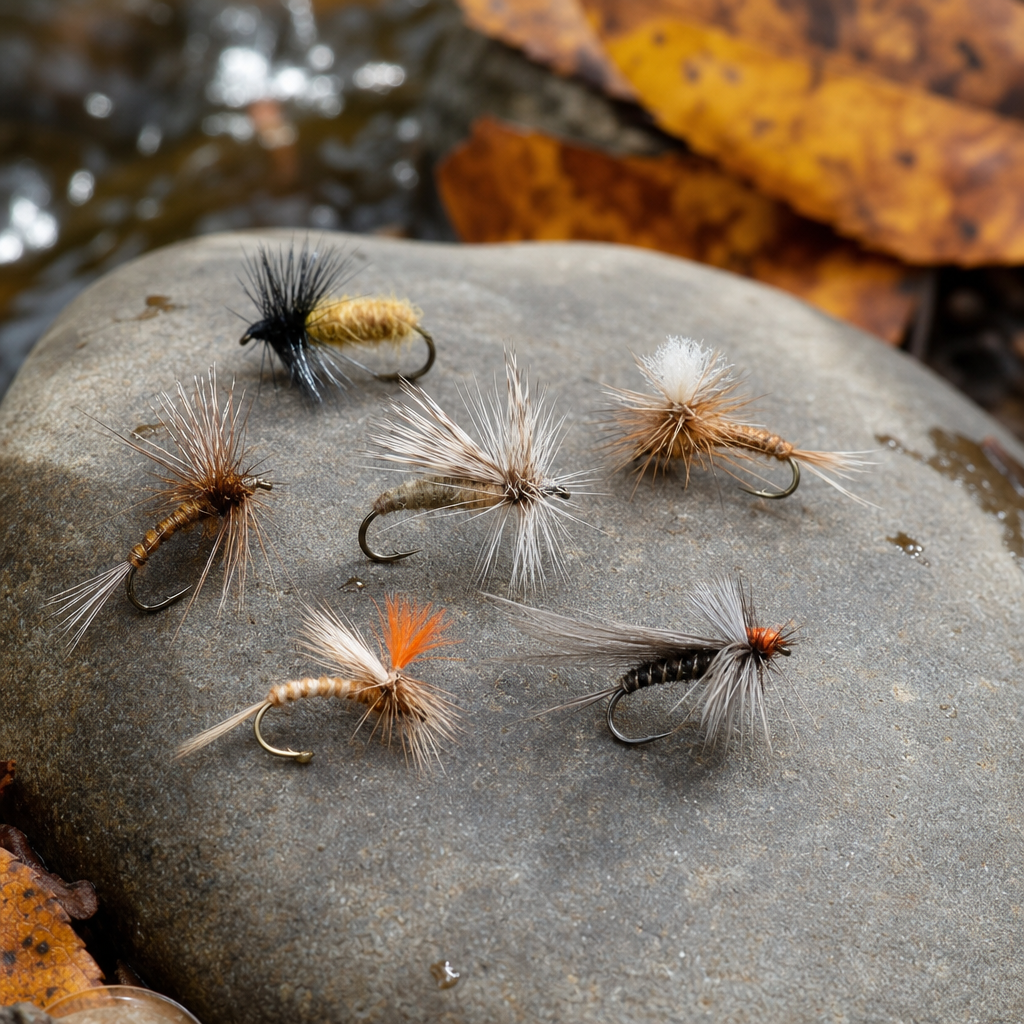
The best winter carp flies are small, sparse, and easy to eat. They should suggest natural bottom food without excessive motion or buoyancy. My core box starts with bloodworm imitations, small hare’s ear variations, freshwater shrimp or scud patterns, black and olive micro leeches, simple nymphs tied on size 8 to 12 hooks, and lightly weighted hybrids that land softly and settle without crashing. In especially clear water, a drab fly with subtle flash outperforms loud materials. The fish are not looking for spectacle; they are evaluating whether an easy meal is worth the effort.
Bloodworm patterns are winter staples because chironomid larvae remain available in soft sediments year-round. A slim red pattern tied with thread, wire rib, and a small tungsten or brass bead can be deadly when fish are nosing mud. Scuds and shrimp matter in lakes, canals, and weedy ponds where carp feed on crustaceans through cold periods. Small woolly bugger-style flies also produce, but only when tied sparsely and retrieved with tiny pulses rather than classic strips. If a bugger looks too lively, it often gets refused. Many winter carp takes come on flies that barely move at all after settling.
Weight selection is critical. Heavily weighted flies can work in wind or deeper channels, but in shallow mud they often bury or create a puff that alarms fish. Bead-chain eyes, small tungsten beads, lead-free wraps under the thorax, or jig hooks with compact slotted beads each have a place. The goal is controlled descent, not maximum sink rate. A winter carp fly should arrive in the feeding lane and remain there naturally. I carry the same pattern in multiple weights because depth control matters more than minor color differences on most days.
Presentation, Tackle, and Hooking Strategy in Cold Water
Presentation is the real pattern. In winter, the best fly can fail if it lands six inches too close, sinks below the fish’s line of sight, or moves before the carp notices it. Lead the fish more than you would in summer because cold carp seldom accelerate to intercept. For a slow cruiser in two to three feet of water, place the fly one to two feet ahead on the line of travel, let it settle, then use tiny strips or a gentle hand twist only when the fish is close enough to register the movement. If a fish is tailing or nosing down, cast beyond it, draw the fly into the zone, and stop. Stillness often triggers the eat.
A 6- or 7-weight rod is ideal for most winter carp fishing because it protects lighter tippet yet turns over longer leaders in wind. Floating lines cover the majority of scenarios. Leaders from 10 to 12 feet are standard in clear, calm conditions, usually tapered to 2X through 4X depending on fly size, bottom clutter, and fish size. Fluorocarbon tippet can help with abrasion resistance and sink rate, though nylon remains useful when you need softer turnover. Polarized glasses are as important as any fly in your box. In winter, the game is often won by spotting one fish others walk past.
Strip-sets matter because winter takes are soft and traditional trout lifts pull flies away from downward-facing mouths. When you see the mouth open, the gill plate flare, or the fish tip on the fly, make a short, firm strip-set and then raise the rod smoothly. Do not hit too hard on light tippet. Once hooked, winter carp may start slowly, then surge hard near the bank or net. Because cold water can reduce immediate power, some anglers underestimate the fish and rush the fight. Keep side pressure steady, clear the line cleanly, and expect a late run.
A Practical Winter Carp Game Plan
A reliable winter carp plan starts before you make a cast. Check recent weather, identify protected water with stable depth, and build your route around the warmest hours. Arrive ready to scout. I often spend the first thirty to forty minutes simply watching edges, mud flats, and transitions with the sun at my back. If I see no fish, I move quickly. If I find one active carp, I slow down because winter fish frequently group by comfort zone. The first fish is not just a target; it is a clue about depth, bottom, light, and water temperature.
Rotate through three presentation modes. First, sight cast to active fish with a small weighted nymph or bloodworm. Second, prospect known travel lanes with slow, bottom-oriented retrieves. Third, dead-drift or static-present flies in marinas, canals, and wintering pools where fish hold almost motionless. Keep notes on water temperature, time of first sighting, and exact fly weight. Over a season, patterns become obvious. In my logs, the difference between an empty day and a productive one is often less than two degrees of water temperature and one fly weight increment.
Winter also requires realistic expectations. Some days offer only three legitimate shots. That does not mean the strategy failed. It means every shot must be executed cleanly. This is the season that sharpens line control, fish reading, and restraint. If you want to improve at carp year-round, winter is the best teacher because it punishes sloppy casts and rewards observation.
Winter fly fishing for carp is a game of precision, patience, and confidence in small details. Cold water slows the fish, narrows feeding windows, and makes presentation more important than in any other season. The anglers who succeed consistently are the ones who stop searching for aggressive summer behavior and start matching winter reality: stable water, soft forage, controlled sink rates, and near-motionless flies presented exactly where a carp can eat without effort.
The key takeaways are simple. Find warmth relative to the surrounding water, even if it is only a degree or two. Focus on protected areas near depth, especially dark-bottom flats, channels, marinas, and slack current. Fish from late morning through midafternoon when conditions are most stable. Use small, sparse patterns such as bloodworms, scuds, and lightly weighted nymphs. Present them slowly, watch body language closely, and strip-set on subtle takes. When conditions are tough, let location and timing do more of the work.
As the central hub for winter fly fishing within seasons and conditions, this page gives you the framework to make better decisions on any cold-water carp venue. Use it as your starting point, then apply the same structure to local waters: observe temperature trends, map winter holding zones, test fly weights, and record what changes during warming periods. The reward is not just more fish in winter. It is a deeper understanding of carp behavior that improves your fishing in every season. Pick a stable day, tie on a sparse winter pattern, and go find the warmest water in your system.
Frequently Asked Questions
Can you really catch carp on the fly in winter, or do they stop feeding altogether?
Yes, you can absolutely catch carp on the fly in winter. Carp do not simply shut down when water temperatures drop, but their behavior changes dramatically. In cold water, their metabolism slows, which means they feed less often, move less, and become much less willing to chase a fly over any distance. That is why winter success is rarely about covering water quickly or taking dozens of shots. Instead, it is about recognizing short feeding windows, locating fish that are actually catchable, and presenting a fly with extreme precision.
Winter carp often slide into slower, more stable areas where they can conserve energy. You may find them in deeper basins, soft-bottom bays, channels with slightly warmer water, or sun-warmed flats during the warmest part of the day. Not every fish you see is in a feeding mood, and that is one of the biggest lessons winter teaches. A group of inactive carp resting near the bottom can look promising, but if they are locked down and unresponsive, they are usually not worth forcing. The better targets are fish that are slowly cruising, tipping, nosing the bottom, or showing subtle signs of interest in food.
The key takeaway is that winter fly fishing for carp becomes a game of quality over quantity. You may only get a few realistic opportunities in a day, but those shots can be incredibly rewarding because they demand accurate observation, delicate presentation, and patience. If you adjust your expectations and fish the conditions rather than the calendar, winter can be one of the most technical and satisfying times to target carp on fly.
Where should you look for carp in winter, and what kinds of water hold the most fish?
Finding winter carp starts with understanding that cold water pushes fish toward comfort, stability, and efficiency. In many fisheries, that means deeper water with less temperature fluctuation, areas protected from heavy current, and sections with soft bottom where natural food remains available. Channels, marinas, deeper ponds, sheltered coves, and slow river edges can all hold fish during winter. On bright, calm days, shallow flats that receive direct sunlight can also become productive, especially in the afternoon after they have had time to warm slightly.
One of the most overlooked details is how even a very small temperature difference can matter. A dark-bottom flat, a bank protected from wind, inflow from slightly warmer water, or a sunny corner of a lake can all create a marginally better environment for carp. In winter, those small edges can be enough to concentrate fish or trigger limited feeding activity. That is why successful anglers often spend a lot of time scouting before they ever make a cast. Polarized glasses, elevation, and patience are especially valuable because winter fish are often subtle and difficult to spot.
Water clarity also plays a major role. Clear water lets you sight fish effectively, which is ideal because winter presentations need to be exact. In stained water, it becomes more important to focus on predictable holding structure and move slowly so you do not spook fish in close quarters. If you are fishing rivers, look for softer seams, wintering holes, and inside bends where carp can rest without spending much energy. In stillwaters, concentrate on transition zones between deeper basins and nearby flats, since fish may shift slightly during the day as conditions improve.
Ultimately, the best winter carp water is not always the most visually exciting. It is often the calm, overlooked area that offers security, stable temperature, and easy access to food. The anglers who consistently find winter fish are usually the ones who slow down, observe carefully, and let the carp reveal where they want to be.
What are the best fly patterns for winter carp, and how should they differ from summer flies?
The best winter carp flies are usually smaller, lighter, and more subtle than the patterns many anglers rely on in warmer months. Because cold-water carp are less willing to chase and often inspect a fly closely, winter patterns should land softly, sink naturally, and suggest an easy meal that does not require much effort to eat. Effective choices often include small nymphs, midge larva imitations, damsel nymphs, scuds, simple worm patterns, and lightly weighted carp bugs tied with sparse materials. Hook sizes are commonly scaled down compared to summer, and flies with too much bulk or flash can sometimes turn fish off in clear, cold conditions.
Weight is one of the most important design elements. In winter, you generally want a fly that gets down without crashing into the water or plowing into the bottom unnaturally. Bead chain eyes, small tungsten beads, or lightly weighted underbodies often work better than heavily weighted flies, depending on depth and bottom type. The goal is to place the fly in the feeding zone while still allowing it to behave naturally when you give it tiny movements or let it sit still. On soft mud or silt, a fly that settles gently and remains visible without burying itself can be especially effective.
Color selection should remain natural most of the time. Olive, tan, rust, brown, black, and muted pink can all produce. In clear winter water, realistic tones often outperform bright attractor patterns, though there are always exceptions. If fish are showing but not committing, changing size or sink rate is often more important than changing color. A fly that is just a little smaller or lands just a little softer can make a big difference with cold, cautious carp.
Compared with summer, winter flies should reflect reduced aggression and lower feeding intensity. Summer carp may react to a stronger trigger, a larger meal, or a more active retrieve. Winter carp typically want the opposite: a compact pattern, a clean silhouette, and an easy presentation right in front of them. If your winter fly looks edible without looking demanding, you are usually on the right track.
How should you present a fly to winter carp when they are moving slowly and refusing to chase?
Presentation is everything in winter carp fishing. Since cold-water fish rarely want to move far to eat, the fly must be placed very close to the fish’s line of travel or directly in its feeding zone without startling it. Leading the fish by too much often means it never notices the fly. Dropping it too close can spook the fish. The sweet spot depends on water depth, visibility, and how the fish is behaving, but in general you want the fly to arrive calmly, settle naturally, and be available with minimal movement from the fish.
Once the fly is in position, less is usually more. Winter carp often respond best to tiny strips, subtle twitches, or even a complete dead-stick presentation. The biggest mistake many anglers make is overworking the fly. In summer, an active fish may track and eat with confidence. In winter, extra motion can make the fly seem unnatural or simply ask the fish to spend more energy than it wants to. If a carp tips slightly, slows down, flares its pectorals, or drops its head toward the fly, that is often enough reason to stay calm and let the fish decide.
Line control matters just as much as fly movement. Slack must be managed carefully so you can detect a take and come tight without ripping the fly away. At the same time, too much tension can drag the fly unnaturally. This balance is one of the hardest parts of winter sight fishing. A longer leader, a thoughtful casting angle, and repositioning your body before the shot can all help you maintain a better connection while still keeping the presentation soft.
Hook sets also need discipline. Winter takes are frequently subtle. Instead of a dramatic eat, you may only see the fish’s mouth open, the fish pause, the gill plate move, or the line twitch slightly. When in doubt, a controlled strip-set is usually the right response. Avoid lifting the rod too quickly as if you were trout fishing, because that often pulls the fly out or fails to drive the hook home. In winter, the best presentations look uneventful from the outside, but they are built on careful timing and a lot of restraint.
What conditions, timing, and tackle give you the best chance of success during a winter carp session?
The best winter carp conditions are usually the ones that create the most stability and the least stress for the fish. Sunny afternoons, light wind, and gradual warming trends are often more productive than cold mornings after a hard freeze or days with sudden weather swings. In many waters, the prime window begins later in the day, once the sun has had time to warm shallow areas slightly and stimulate a bit more fish movement. That does not mean every winter bite happens in skinny water, but it does mean timing matters more than many anglers realize.
Stable weather often beats dramatic change. A string of mild days can be far better than a single bright day following an abrupt temperature crash. Wind can either help or hurt depending on the fishery, but excessive chop usually makes sight fishing and delicate presentations much harder. Clear skies can improve visibility for the angler, while light cloud cover sometimes encourages fish to move more confidently. The point is not to chase perfect conditions, but to understand which combinations make winter carp easier to locate and more likely to feed.
As for tackle, most anglers do well with a 6- to 8-weight rod capable of making accurate presentations and handling strong fish in cold conditions.