Respecting local regulations and laws in fly fishing is not a bureaucratic side note; it is one of the clearest expressions of ethical fishing practices. In practical terms, regulations are the operating rules that protect fish populations, habitat quality, angler access, and public trust. Laws set minimum standards, but ethical fishing goes further by asking what a careful, informed angler should do even when nobody is watching. After years of fishing trout streams, warmwater rivers, tailwaters, and small stillwaters in different jurisdictions, I have learned that the anglers who consistently protect fisheries are the ones who treat regulations as part of the craft, not as obstacles between them and a day on the water.
Local regulations govern seasons, licensing, access rights, species identification, creel limits, tackle restrictions, bait rules, invasive species prevention, and watercraft use. They can differ dramatically between neighboring waters. One river reach may be catch-and-release with single barbless hooks, while a downstream section allows harvest within a protected slot limit. A mountain stream may close during spawning, while a stocked pond remains open year-round. In fly fishing, where presentation, fish handling, and selective methods matter so much, understanding these details is central to ethical fishing practices because each rule usually reflects a biological or social reason.
This article serves as a hub for ethical fishing practices by connecting regulations to the broader responsibilities of anglers. If you want to fish responsibly, start by knowing what applies where you stand, why those rules exist, and how to adapt your tactics accordingly. That means checking state or provincial agency updates before every trip, reading special regulation maps carefully, respecting private property boundaries, and recognizing that legal behavior can still be irresponsible if fish are stressed by heat, low flows, or spawning activity. The goal is simple: protect the resource, preserve access, and make choices that keep fisheries healthy for everyone who comes after you.
Why local regulations exist and what they protect
Fishery regulations are designed to balance biological sustainability, fair use, and public safety. Agencies use creel surveys, electrofishing data, redd counts, stocking records, water temperature trends, and angler effort estimates to set rules that fit a specific waterbody. A wild brown trout river with limited natural recruitment requires different management than a put-and-take stocked stream. Protective regulations often target spawning success, age structure, and mortality rates. For example, catch-and-release zones on productive trout water are commonly used to maintain larger fish and more natural size distribution, while seasonal closures prevent pressure on fish when they are concentrated and vulnerable.
Regulations also protect the fishing experience itself. Tackle restrictions such as artificial flies and lures only, no felt soles, or single-hook requirements reduce injury to fish and limit transport of aquatic invasive species. Access rules reduce conflicts between anglers, boaters, landowners, and wildlife users. On many western tailwaters and salmonid rivers, emergency hoot owl closures now restrict afternoon fishing when water temperatures rise beyond safe thresholds, often around the upper 60s Fahrenheit depending on species and local guidance. These rules are not arbitrary. Warm water lowers dissolved oxygen and increases post-release mortality, especially after prolonged fights or poor handling.
When anglers understand the purpose behind a rule, compliance improves. I have seen this repeatedly on heavily used rivers: fishers who know why a reach is closed during spawning are far less likely to pressure visible fish on redds. Ethical fishing practices begin with that mindset. Regulations define the baseline, but the best anglers read them as management signals. If a river has strict hook, season, or retention rules, that usually means the fishery is either ecologically sensitive, intensely used, or both. Treat that information as guidance for how carefully you should fish, move, land fish, and decide whether to fish at all.
Core legal areas every fly angler must check before fishing
Before entering any water, verify the license requirement, season status, species rules, harvest limits, tackle restrictions, and access conditions for that exact location. Do not assume the statewide summary tells the whole story. Many agencies publish separate special-regulation booklets, watershed maps, and emergency closures online. In the United States, state wildlife agencies typically manage inland waters, while federal rules may apply on national parks, wildlife refuges, tribal lands, or designated wilderness areas. In Canada and Europe, province, region, or country-specific structures vary, but the principle is the same: the local rulebook governs.
Species identification matters more than many anglers realize. On mixed fisheries, confusing a bull trout with a brook trout, or a wild steelhead with a hatchery fish, can turn an honest mistake into a violation with conservation consequences. Slot limits are another common stumbling block. A protected slot might require release of medium-sized fish because those are prime breeding adults, while harvest is permitted only below or above that size class. Measuring devices, current regulation summaries, and saved digital licenses are basic equipment, not optional extras.
| Regulatory area | What to verify | Why it matters |
|---|---|---|
| License and stamps | Freshwater license, trout stamp, salmon permit, invasive species decal | Funds management and confirms legal participation |
| Season and hours | Open dates, night restrictions, emergency closures, temperature-based limits | Protects spawning fish and reduces stress during unsafe conditions |
| Species and limits | Creel, possession, slot, protected species, hatchery marks | Prevents overharvest and supports population structure |
| Tackle rules | Barbless hooks, fly-only waters, no bait, hook-point limits | Reduces injury, mortality, and illegal methods |
| Access and watercraft | Private property, walk-in boundaries, boat ramps, wading closures | Protects rights, safety, and future public access |
Checking conditions should become habitual. My own routine is simple: review the agency page the night before, screenshot the relevant regulation section, confirm map boundaries, and recheck for emergency orders on the morning of the trip. On rivers with multiple management zones, I mark bridges, tributary mouths, and county lines on a phone map because regulation boundaries are often tied to those landmarks. This level of preparation prevents accidental violations and reflects the practical side of ethical fishing practices.
Ethical fishing practices beyond the letter of the law
Legal does not always mean ethical. Many waters remain technically open during periods when fish are unusually vulnerable, especially during drought, heat waves, low dissolved oxygen events, or concentrated spawning runs. Ethical fishing practices require anglers to read the water and the conditions, then decide whether continuing to fish serves the resource. On several summer trout rivers I fish, I stop entirely when afternoon temperatures climb into stressful ranges, even if no mandatory closure has been issued. A thermometer is one of the most important conservation tools in a vest or pack.
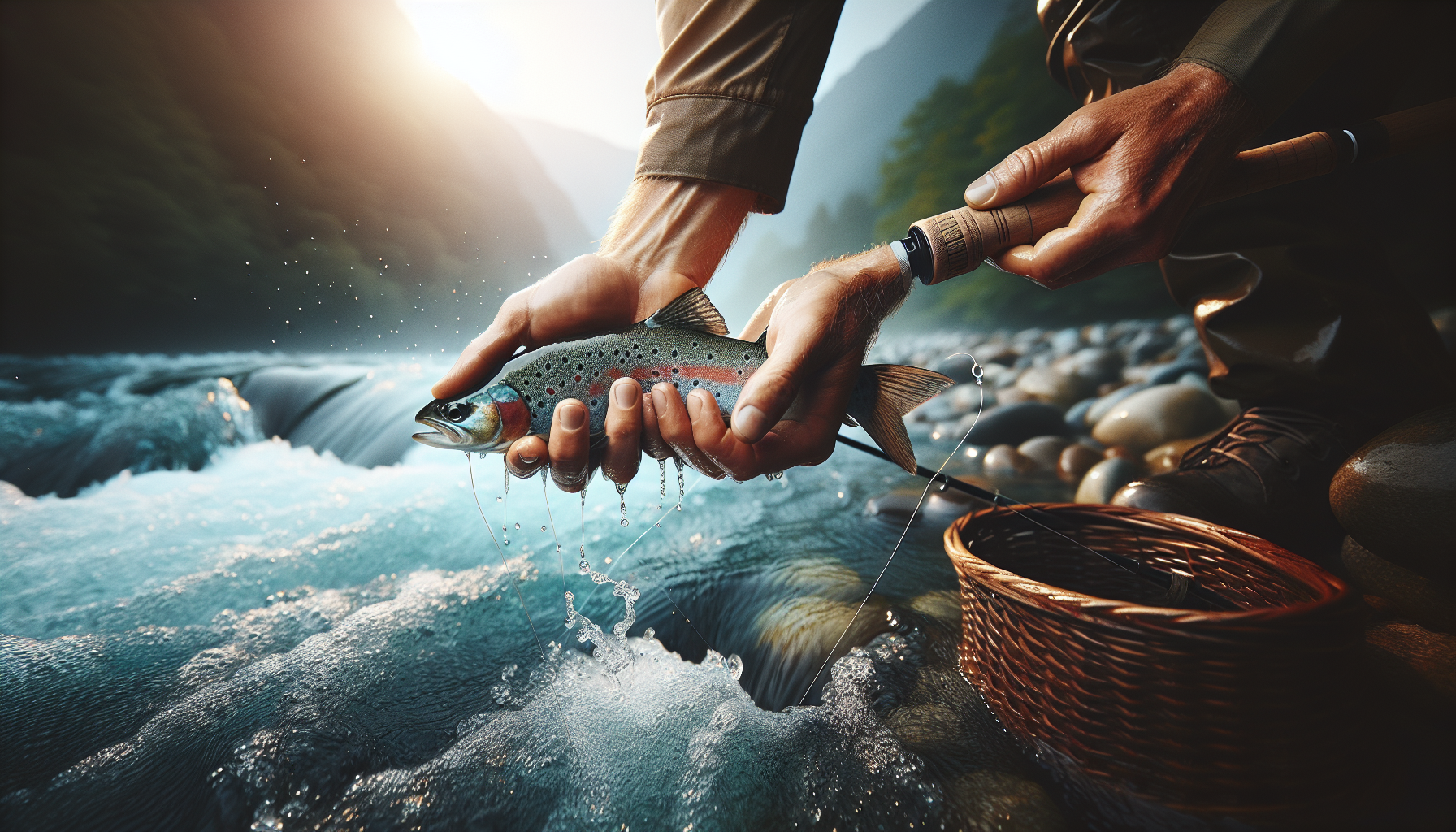
Handling standards matter just as much. Wet hands before touching fish, keep them in the water as much as possible, use hemostats for quick hook removal, and avoid squeezing the abdomen or gills. Rubberized landing nets reduce scale loss and fin abrasion compared with old knotted nylon nets. Fight fish firmly on appropriately strong tippet to shorten exhaustion time, especially in warm water. Photographs should be brief and secondary to recovery. If a fish cannot maintain equilibrium quickly, it has already paid too high a price for the encounter. Those choices are not always written into law, but they are central to responsible fly fishing.
Another ethical line concerns fish on redds and concentrated staging fish. Spawning trout and salmon can often be seen clearly in shallow gravel. Targeting them may be legal in some places, but it undermines recruitment and disrupts reproduction. The better choice is to avoid wading through spawning habitat, leave paired fish alone, and watch for clean gravel beds where eggs may be buried downstream of active spawners. Similarly, repeatedly casting to exhausted fish trapped below barriers or in shrinking pools may be lawful yet plainly harmful. Ethical fishing practices ask the angler to exercise restraint before enforcement becomes necessary.
Access laws, private property, and respectful conduct on the water
Some of the most serious conflicts in fly fishing have little to do with fish and everything to do with access. Stream access law varies widely. In one state, the public may legally wade below the ordinary high-water mark on navigable streams; in another, touching the streambed through private land can be trespass. Western states, eastern riparian systems, and internationally managed waters all handle this differently, and assumptions are risky. Always verify whether access is governed by navigability, ownership of the bed, posted easements, or designated public rights-of-way.
Respectful conduct protects access better than any argument. Close gates, stay on marked trails, do not block farm lanes or boat ramps, pack out tippet and leader clippings, and keep noise low near homes and livestock. If a landowner raises a concern, remain calm and leave if necessary, then clarify the rule with the managing agency later. I have gained more long-term access by being courteous than by insisting on technical rights at the water’s edge. Local fly shops and conservation groups are often the best sources for practical guidance because they know where conflict points, boundary changes, and seasonal sensitivities exist.
Shared-water etiquette also belongs in this discussion. Crowding another angler, stepping into a run someone is working, low-holing a swing, or anchoring carelessly through a drift may not break a statute, but it damages trust and increases pressure on fish. On popular trout rivers, ethical fishing practices include spacing generously, communicating clearly at launches and pullouts, and rotating through runs when local custom expects it. Fisheries endure when anglers behave like stewards and neighbors, not just permit holders.
Staying compliant in changing conditions and different jurisdictions
Modern fisheries management changes quickly, so static knowledge is not enough. Emergency closures for wildfire impacts, toxic algae, flood damage, low flow, fish disease, or invasive species can be issued with little notice. Felt-sole bans have spread in some places to reduce transmission of organisms such as didymo and whirling disease vectors. Boat inspection requirements, decontamination stations, and clean-drain-dry rules are now common on lakes and reservoirs. If you travel to fish, expect your home-water habits to be inadequate until you confirm the local standard.
Cross-border anglers need extra care. A fly fisher moving between U.S. states, Canadian provinces, or European countries may face different definitions of legal gear, retention, and access. Some waters permit weighted flies but prohibit added split shot in certain reaches. Others differentiate between single-point and treble hooks, artificial fly design, or the number of flies allowed on a leader. On Atlantic salmon rivers, mandatory catch reporting and tag systems are often enforced because managers need accurate harvest and encounter data. Failure to report can harm management even if no fish are kept.
The most reliable compliance system is procedural. Build a pre-trip checklist, keep licenses accessible, carry a thermometer and measuring tool, clean gear between waters, and log any fish retained or reported species immediately. Join a local watershed group, Trout Unlimited chapter, or equivalent regional conservation organization to stay current on rule changes and habitat concerns. This hub on ethical fishing practices points to a larger truth: good anglers do not merely avoid tickets. They align their methods with conservation goals, local norms, and the biological reality of the water in front of them.
Respecting local regulations and laws in fly fishing is the foundation of ethical fishing practices because it turns good intentions into consistent action. The essentials are straightforward: know the exact rules for the specific water, understand the conservation purpose behind them, handle fish in ways that minimize stress, respect access boundaries, and adapt when heat, low flows, spawning activity, or emergency closures make fishing a poor choice. Regulations are the minimum standard, but ethical anglers recognize when the resource needs more caution than the rulebook can practically prescribe.
As the hub for ethical fishing practices, this topic connects every responsible decision an angler makes. Tackle choice, release methods, invasive species prevention, streamside behavior, and landowner relations all depend on the same principle: the fishery is shared, finite, and worth protecting. In my experience, anglers who fish this way catch plenty, earn trust locally, and help keep waters productive over the long term. They also become better observers, because paying attention to rules teaches them to pay attention to fish, habitat, and seasonality.
Before your next trip, review the current regulations for your destination, save the relevant pages to your phone, and commit to fishing only under conditions that support fish survival. Then keep building your understanding of ethical fishing practices across handling, habitat protection, and angler etiquette. Responsible fly fishing starts with compliance, but it matures into stewardship. That shift benefits fish, fellow anglers, and every river, creek, lake, and estuary you hope to fish in the years ahead.
Frequently Asked Questions
Why are local fly fishing regulations so important if I already practice catch and release?
Catch and release is a strong ethical starting point, but it does not replace the need to follow local regulations. Rules are usually written to address specific biological and environmental conditions in a particular fishery, and those conditions can vary dramatically from one river, lake, tailwater, or tributary to the next. A stream may have seasonal closures to protect spawning fish, gear restrictions to reduce injury rates, bait bans to limit deep hooking, or special harvest rules designed to balance angling opportunity with population recovery. Even if you intend to release every fish, fishing in a closed area, using prohibited tackle, or handling fish during a thermal stress period can still cause measurable harm.
Local regulations also protect more than fish numbers. They help preserve habitat, reduce crowding-related conflicts, maintain access agreements with private landowners, and support public confidence that anglers are using shared resources responsibly. In many places, regulations reflect years of input from fisheries biologists, conservation officers, watershed groups, and local communities. Respecting them is not merely about avoiding a citation; it is about participating in a system that keeps fisheries healthy and access open over the long term.
From an ethical standpoint, responsible anglers do not ask only, “Can I release this fish?” They also ask, “Should I be fishing here, in this season, under these conditions, with this setup?” Regulations provide the baseline answer. Ethical fly fishers then build on that baseline by staying informed, adapting to changing conditions, and choosing the least harmful approach even when enforcement is unlikely.
What kinds of local laws and regulations should fly anglers check before fishing?
Before you step into the water, you should verify several categories of rules rather than assuming a valid license is enough. Start with the basics: license requirements, permits, stamps, and any species-specific endorsements. Then confirm season dates, daily bag limits, size restrictions, and whether the water you plan to fish is managed under general statewide regulations or a special-regulation section. Many productive trout streams, warmwater rivers, and tailwaters operate under exceptions that are easy to miss if you only skim the summary pages.
Gear rules are especially important in fly fishing. Some waters are limited to artificial flies and lures only, while others require single barbless hooks, prohibit added weight in certain areas, or define “fly fishing only” in ways that affect what tackle is legal. In some jurisdictions, indicators, split shot, multiple fly rigs, or certain hook styles may be restricted. It is also wise to check whether there are bait bans, motor restrictions, wading closures, boat access rules, and invasive-species requirements such as drain-dry protocols or decontamination procedures for waders and watercraft.
Access laws deserve just as much attention as fish rules. You need to know where public access begins and ends, whether streambeds are publicly navigable, whether crossing private land is allowed, and where parking is legal. Trespassing violations can damage landowner relationships and result in the loss of access for everyone. Finally, look for temporary emergency orders, such as low-flow closures, hoot-owl restrictions during hot weather, wildfire-related access limits, and construction or restoration closures. The best practice is to read the current regulations directly from the state or provincial agency, check for in-season updates online, and contact a local biologist, ranger, or fly shop if anything is unclear.
How can I make sure I stay compliant when regulations vary from one water to another?
The most reliable approach is to treat every new destination as a separate fishery with its own rules, even if it is only a short drive from water you already know. Many anglers get into trouble not because they intend to break the law, but because they assume nearby rivers share the same regulations. In reality, neighboring stretches may differ by season, species protections, harvest allowances, hook requirements, and access rights. Tailwaters below dams, tributaries feeding spawning habitat, and delayed-harvest sections often have highly specific rules that change at bridge crossings, county lines, or posted management boundaries.
A practical system helps. Before a trip, identify the exact water you plan to fish and pull up the current agency regulation page or official booklet. Save screenshots or download the PDF to your phone in case you lose signal. Cross-reference the location with agency maps and public access maps so you know where special sections begin and end. If the language is technical, do not guess. Call the agency, a conservation officer, or a reputable local fly shop and ask direct questions. It is better to spend five minutes confirming whether two flies are legal than to spend the day fishing under the wrong assumptions.
On the water, stay alert to signage, posted closures, and changing conditions. If flows are dangerously low, temperatures are high, or fish are visibly stressed, the ethical move may be to stop fishing even if no formal closure exists. Carry simple tools that support compliance, such as forceps, a thermometer, and a copy of local rules. Most importantly, build a habit of humility. Regulations are not static, and skilled anglers know that staying informed is part of the craft. The more experienced you become, the less acceptable “I didn’t know” becomes as an excuse.
What are the consequences of ignoring fly fishing laws and local regulations?
The immediate consequence can be legal: fines, confiscation of gear, loss of fishing privileges, mandatory court appearances, or points against your license depending on the jurisdiction and the severity of the violation. Some offenses are treated more seriously than anglers expect, especially those involving protected species, closed areas, trespassing, illegal harvest, or repeated noncompliance. Conservation agencies use these penalties to deter behavior that can degrade a fishery quickly, particularly in popular waters that already face heavy pressure.
But the long-term consequences often matter even more. When anglers ignore regulations, fish populations can suffer through increased mortality, disrupted spawning, illegal harvest, and additional stress during vulnerable periods. Habitat restoration efforts can be undermined. Landowners may close informal access routes after repeated trespass or parking abuse. Public perception of anglers can shift from stewards to exploiters, making it harder to defend access, funding, and conservation priorities. In that sense, one person’s “small” violation can contribute to a much larger erosion of trust.
There is also a personal consequence tied to ethics and credibility. Fly fishing often presents itself as a conservation-minded pursuit rooted in restraint, observation, and respect for wild places. Ignoring local laws contradicts those values. An angler who talks about stewardship but dismisses closures, access boundaries, or handling rules is not practicing ethical fishing in any meaningful sense. Respect for regulations is one of the clearest ways to show that the fish, the water, and the broader angling community matter more than a single day’s convenience or success.
How does respecting regulations fit into ethical fly fishing beyond simply following the law?
Following the law is the floor, not the ceiling. Ethical fly fishing begins with compliance, but it goes further by recognizing that not every harmful action is specifically prohibited and not every legal action is automatically responsible. For example, fishing during extreme heat may be legal in some areas, yet still place released trout under severe stress. Crowding into spawning zones, repeatedly targeting exhausted fish, or posting fragile access locations to large audiences may not violate a written rule, but each can damage the resource or the experience for others. Ethics asks anglers to use judgment where regulations leave room for discretion.
In practical terms, this means learning enough about fish behavior, seasonal vulnerability, water temperature, and habitat sensitivity to make sound decisions without needing constant enforcement. It means pinching barbs where appropriate, minimizing air exposure during releases, avoiding redds, respecting private property even when boundaries seem informal, and backing off when conditions suggest fish need a break. It also means helping newer anglers understand that regulations are not obstacles to enjoyment; they are tools that support the future of the fishery.
Experienced fly fishers often discover that the most satisfying days on the water are shaped by restraint as much as by success. Respecting local regulations reinforces a mindset of stewardship, patience, and accountability. It acknowledges that healthy fisheries do not exist by accident and that access can disappear when anglers act carelessly. In that way, obeying the law is not a bureaucratic burden but a visible commitment to the long-term well-being of fish, habitat, and the communities that depend on both.