Fly fishing on private property can offer uncrowded water, healthier habitat, and memorable days on the river, but access comes with obligations that go far beyond catching fish. Ethical fishing practices on private property mean understanding landowner rights, respecting boundaries, protecting fisheries, and leaving every gate, bank, and conversation better than you found it. As someone who has spent years asking for access, guiding guests, and helping landowners manage stream corridors, I have learned that respectful behavior is not a courtesy added after the trip; it is the foundation that makes the trip possible. This hub article explains how to fly fish respectfully on private property, what rules matter most, how to communicate with landowners, how to minimize ecological impact, and how to handle fish, livestock, roads, fences, and other people responsibly. If you care about ethical fishing practices, private water is one of the clearest places to put those principles into action because every choice is visible, personal, and consequential. Get it right, and you may earn long-term access while supporting conservation. Get it wrong, and you can damage habitat, relationships, and the reputation of anglers generally.
Private property in this context includes deeded streambanks, ranches with spring creeks, timber company holdings, club leases, agricultural land crossed by trout streams, and parcels where access roads, parking pullouts, or footpaths are privately owned even if a waterway itself is legally navigable. The legal details vary sharply by state and country, so ethical fishing practices begin with a simple rule: know the law, then behave better than the law minimally requires. On some waters, touching the streambed below the high-water mark may be lawful; on others, it may be trespass. Some landowners welcome catch-and-release anglers but prohibit wading near irrigation structures, livestock pastures, or spawning channels. Respectful fly fishing means clarifying permission, asking where you may park, learning whether guests are allowed, following seasonal closures, and accepting that “no” is a complete answer. Because this page serves as a hub for conservation and ethics, it also connects the big ideas: access etiquette, low-impact movement, fish handling, gear choices, invasive species prevention, conflict avoidance, and stewardship. Together, these practices protect fish populations and strengthen the social license anglers depend on.
Know access rights, boundaries, and permission terms before you fish
The first step in respectful fly fishing on private property is confirming exactly where you can be and under what conditions. Do not rely on hearsay from a tackle shop, a social media pin, or a friend who “fished it once.” Use current county parcel maps, onX Hunt, Basemap, Gaia GPS, or state GIS layers to verify ownership and access corridors. Then contact the landowner, manager, lease holder, or club representative directly. When I arrange access, I ask specific questions: Which gate should I use? Where should I park? Can I walk both banks or only one? Is wading allowed? Are there livestock, irrigation ditches, or restoration areas to avoid? May I bring a friend? Is there a preferred start and end time? These details prevent accidental trespass and signal professionalism.
Permission should be explicit, not assumed from silence or from a previous season. Private property changes hands, rules change, and conditions on working farms and ranches can shift weekly. During haying, calving, hunting season, prescribed burns, or flood repairs, access that was once fine may be disruptive or unsafe. If the owner sets conditions, treat them as nonnegotiable. Do not negotiate from the bank after arriving. If you were told to fish a half-mile reach, do not “just explore” around the bend. If vehicles are prohibited on wet roads, park where instructed even if it means a longer walk. Respectful anglers understand that the inconvenience is trivial compared with the owner’s risk, liability concerns, and management priorities.
| Access issue | Respectful practice | Why it matters |
|---|---|---|
| Parking | Park only where directed, without blocking gates or equipment | Farm and emergency access must stay open |
| Boundaries | Use GPS maps and visible landmarks to stay within approved areas | Prevents trespass and disputes |
| Guests | Ask before bringing anyone else | Permission is personal, not transferable |
| Timing | Arrive and leave within the agreed window | Respects work schedules, hunting, and livestock movement |
| Special restrictions | Honor closures around spawning beds, irrigation works, and restoration sites | Protects habitat and reduces liability |
Communicate like a good guest, not a customer
One of the biggest mistakes anglers make on private property is acting as though payment, friendship, or past access turns a favor into an entitlement. Even on fee water, respect matters because you are entering someone else’s land and operating within someone else’s management system. Ask permission well in advance when possible. Be concise, polite, and transparent about your plan. Mention your target species, party size, dates, and whether you will keep or release fish. If the answer is no, thank them and move on. Pressuring landowners, arguing about navigability, or citing what neighboring ranches allow is the fastest way to close doors.
Good communication also continues during and after the trip. If a gate is unexpectedly locked, call rather than climbing around it. If you notice a broken fence, sick animal, wildfire smoke, poaching, dumping, or a stranded calf, notify the owner promptly. I have preserved access more than once by reporting issues quickly and accurately. After fishing, send a thank-you note or text, especially if conditions were difficult and the owner accommodated you anyway. Offer useful feedback such as insect activity, water temperature concerns, or trash found on the reach, but do not lecture the owner about management unless invited. Small gestures matter: showing up on time, introducing everyone in your party, and remembering names builds trust over seasons.
Gifts can be appropriate, but they should never feel like a bribe. A handwritten card, a photo from the property, or an offer to help with stream cleanup is often better than expensive gear or alcohol. If you pay for access through a lodge, guide, or club, still treat the owner or caretaker respectfully. Close the loop with the person who granted permission. In many communities, your reputation travels faster than your casts.
Protect habitat while moving through the property
Ethical fishing practices on private property are inseparable from habitat protection. Banks on private water are often better vegetated because owners invest in fencing, grazing rotation, weed control, and restoration. That work is easy to undo with repeated trampling. Enter and exit where instructed. Use established paths, avoid cutting switchbacks, and stay off saturated banks that slump underfoot. In spring creeks and meadow streams, one careless shortcut can open bare soil that erodes for months. In tailwaters, walking around every bush instead of through designated access points creates spiderweb trails and damages riparian cover used by birds, amphibians, and juvenile fish.
Wading deserves particular care. Felt soles are banned in some places because they can move invasive organisms; rubber soles with studs are now standard and, in my experience, less damaging when anglers avoid shuffling. Step on clean cobble, not spawning redds, aquatic vegetation beds, or undercut banks. Trout redds appear as lighter, cleaned patches of gravel, usually in shallow tailouts and riffle margins. Avoid them entirely, even if the law does not specifically prohibit wading there. During warm periods, limit time on the water if temperatures approach stressful levels. For trout, 68 degrees Fahrenheit is a common caution threshold, and many careful anglers stop sooner, especially on low flows or spring creeks holding large fish. Carry a thermometer and use it.
Private property often includes features anglers overlook: headgates, pivot ruts, electric fences, hay fields, cattle guards, and roads that become impassable after rain. Do not drive on muddy two-tracks unless told to do so. Deep ruts cost landowners time and money. Pack out monofilament, tippet clippings, strike indicators, cans, and food waste. If you smoke, carry a sealed butt container. Fire risk on Western properties is not theoretical; one careless act can destroy a stream corridor and a ranch operation.
Handle fish with restraint and use tackle that reduces harm
Respect for private property must extend to the fish themselves. Ethical fishing practices are measured partly by what happens after the hookup. On many private fisheries, especially spring creeks and small streams, the same trout may be caught multiple times a season. That makes low-impact handling essential. Use tackle balanced to the fish and current so fights stay short. A 5X tippet on selective trout can be appropriate, but if you are undergunned for heavy flows, large fish, or warm water, stepping up to 4X or stronger may reduce exhaustion and improve survival. Barbless hooks or pinched barbs make release faster and are required on many well-managed waters for good reason.
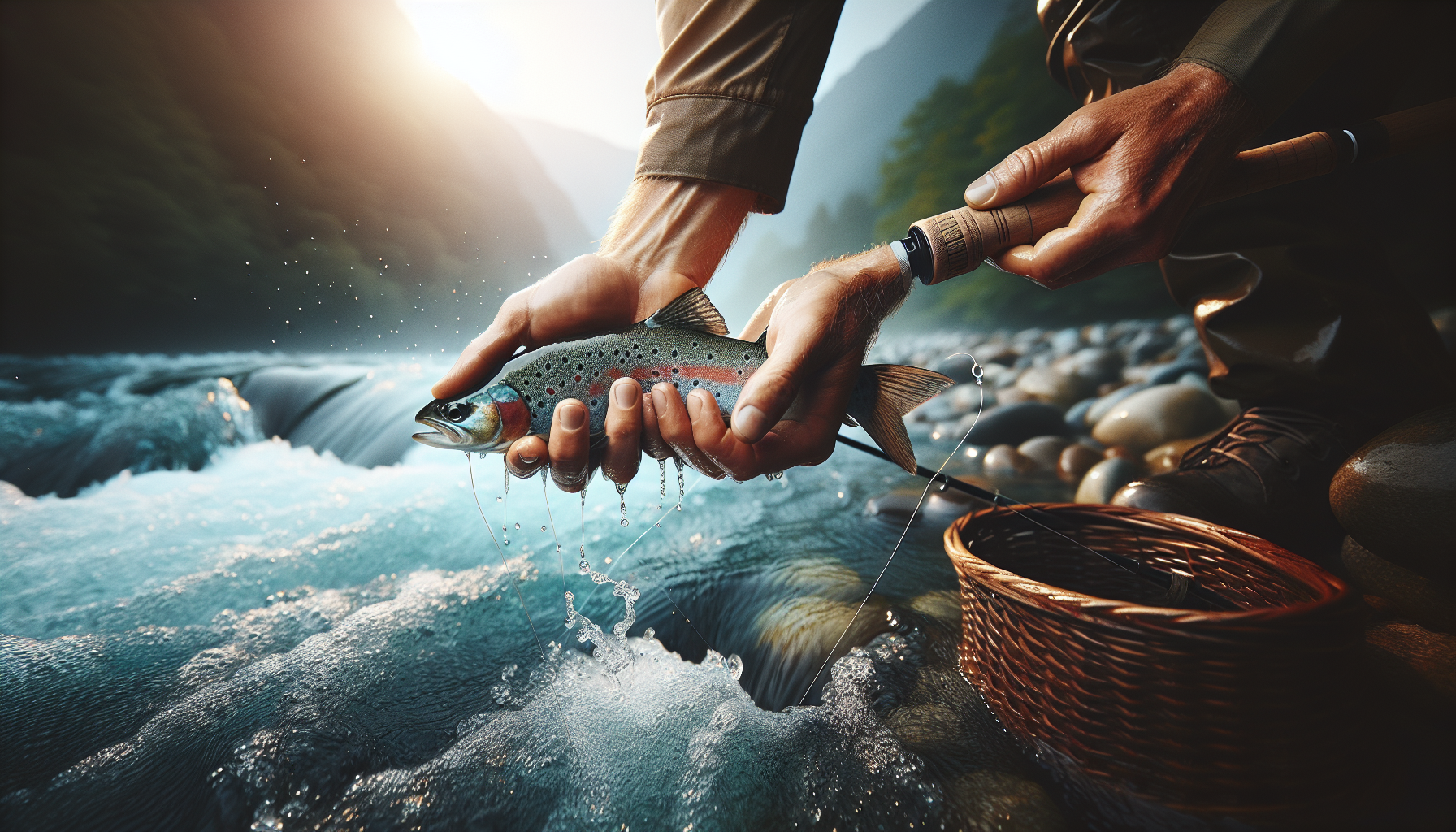
Keep fish in the water whenever possible. Wet your hands before touching them, support the body horizontally, and never squeeze the abdomen or hold a trout vertically by the jaw. Use a rubber or silicone landing net rather than abrasive knotted mesh. If you want a photo, have the camera ready first, lift the fish briefly, and return it immediately. Studies on catch-and-release mortality vary by species, temperature, hook location, and handling time, but the broad lesson is consistent: air exposure and prolonged fights sharply increase harm. If a fish is deeply hooked, cut the tippet close rather than digging aggressively. If local rules allow harvest and a fish is unlikely to survive, keeping it within legal limits can be more ethical than forcing a doomed release.
Fly choice also has ethical dimensions. Weighted rigs and multiple flies catch fish effectively but can increase foul-hooking or snagging in tight channels if used carelessly. During spawning periods, avoid repeatedly targeting fish on redds or visible paired spawners simply because they are easy to spot. Respectful anglers focus on actively feeding fish and leave reproduction undisturbed. On private trophy waters, that restraint matters enormously because recruitment and age structure are often central to the owner’s conservation goals.
Respect livestock, working lands, and the people who depend on them
Many of the best private trout streams run through working ranches, farms, and timber lands, not scenic museums. Ethical fishing practices require understanding that angling is secondary to the property’s primary purpose. Livestock stress, open gates, damaged fences, and disturbed equipment create real costs. The old rule still applies: leave a gate exactly as you found it. If it was open, leave it open. If it was closed, close it securely. Do not assume an open gate should be shut “to help.” Ranchers manage animal movement intentionally, and improvising can separate cows from calves or block rotations.
Give animals space. Walk around herds calmly and quietly, especially during calving or when bulls are present. Never cast near horses, working dogs, or stock tanks. Keep food secured and pets at home unless specifically invited. If a ranch road is active with machinery, pull over and let operators through. On leased club water, respect staff instructions even if they differ from what you have done elsewhere. Their rules often reflect insurance requirements, habitat projects, or lessons learned from past problems.
Be discreet about location sharing. Posting gate photos, recognizable bridges, or map screenshots can unintentionally send trespassers to a property. I encourage anglers to share the experience, not the coordinates. A broad regional description and a fish photo taken low over the water are usually enough. Landowners remember who protected their privacy and who treated their place like content.
Practice stewardship that earns future access and supports conservation
The highest standard for how to fly fish respectfully on private property is stewardship. That means doing more than avoiding harm. It means contributing to the health of the fishery and the relationship. Join stream cleanup days, donate to watershed groups, support riparian fencing projects, and follow disinfection protocols for boots and nets to prevent spreading whirling disease, didymo, New Zealand mudsnails, or other aquatic hitchhikers. Check, clean, dry is not a slogan; it is a practical routine that protects watersheds. If you fish multiple properties, this habit is especially important.
Stewardship also includes honest self-regulation. If fish are stressed by heat, if banks are sloughing after a storm, or if an owner seems overwhelmed during harvest season, choose not to fish even if permission technically stands. Restraint is one of the clearest signs of ethical fishing practices. The same applies to group size and frequency. A reach that handles two careful anglers may not handle six. A landowner who likes seeing you once a month may resent unannounced weekly visits. Protect the privilege by using it lightly.
This hub article is the core idea for every conversation about conservation and ethics in fly fishing: access is relational, fish are finite, and respectful behavior is practical rather than performative. Learn the law and then exceed it. Ask clearly, listen carefully, and follow every condition. Move through habitat lightly, handle fish for survival, respect working land, and keep locations private. Most important, look for ways to leave value behind, whether that is a repaired piece of litter, a timely message about a broken fence, or simply the confidence that an angler can be trusted. If you want more access, better fisheries, and stronger relationships between anglers and landowners, make respectful fly fishing your standard every time you step onto private property.
Frequently Asked Questions
Do I always need permission to fly fish on private property, even if the stream looks navigable?
In most cases, yes. If the land bordering the water is privately owned, you should never assume access is allowed just because the stream appears fishable, boatable, or lightly posted. Water law and stream access rules vary widely by state, and what is legal in one region may be trespassing in another. Some places allow public use of navigable waterways while restricting bank access, anchoring, or wading through privately owned streambeds. Other areas give landowners broader control over both the banks and the bed of the stream. The safest and most respectful approach is simple: know the law, verify ownership, and ask for permission before entering.
Respectful anglers do a little homework before ever stringing up a rod. That means checking county parcel maps, state access rules, posted signage, and any easements or walk-in agreements that may apply. If ownership is unclear, do not guess. Reach out to the landowner, property manager, ranch hand, or local conservation office and get a direct answer. When asking for access, be polite, specific, and transparent about when you want to fish, who is coming with you, where you plan to go, and how long you expect to stay. That level of clarity builds trust and shows that you understand private property is not public water with fewer crowds. It is someone’s home, livelihood, pasture, business, or carefully managed habitat, and you are a guest first and an angler second.
What is the best way to ask a landowner for permission to fish?
The best way is respectfully, clearly, and without pressure. If possible, ask well before the day you hope to fish rather than showing up at dawn and knocking on a door unexpectedly. A phone call, a brief in-person introduction at an appropriate time, or a thoughtful written message can all work, depending on the setting. Introduce yourself, explain how you learned about the property, and ask whether the owner ever allows limited access for fly fishing. Be honest about your experience level, the size of your group, whether you plan to wade or simply cast from certain areas, and whether you will be bringing a dog, vehicle, or guest. People are much more comfortable granting access when they know exactly what they are agreeing to.
It also helps to show that you understand what matters to landowners. Mention that you will close gates, avoid disturbing livestock, stay out of crops, pack out every bit of trash, respect any no-go areas, and leave immediately if asked. If they say no, thank them anyway and move on gracefully. A respectful response to a refusal matters just as much as your behavior after getting a yes. If they do grant permission, confirm the details: where to park, which route to use, what times are acceptable, whether catch-and-release is expected, and whether there are any sensitive areas to avoid. After your trip, a thank-you note, a quick follow-up message, or even a small gesture of appreciation can go a long way toward maintaining long-term access. Many of the best private water opportunities come not from one good conversation, but from years of proving that you are trustworthy.
How should I behave once I am on private property to show respect for the landowner and the fishery?
Think of your conduct on private property as an extension of your permission. Getting access is not the finish line; it is the beginning of your responsibility. Park only where you were told to park. Use only the roads, paths, gates, and stream reaches you were authorized to use. Do not explore side fields, barns, outbuildings, cabins, irrigation structures, or neighboring water just because it is nearby. Leave every gate exactly as you found it, because a gate left open or closed at the wrong time can create real problems with livestock management. Keep noise down, especially near homes, equipment yards, and animals. If you brought a dog and did not get explicit approval, that is a mistake. Pets, drones, campfires, target shooting, and extra guests should never be assumed to be acceptable.
On the water, respectful behavior means protecting the resource as much as respecting the property. Avoid trampling soft banks, spawning redds, and fragile streamside vegetation. Enter and exit the water at durable access points whenever possible. Practice careful fish handling by using barbless hooks if appropriate, keeping fish wet, minimizing air exposure, and ending the fight quickly enough to avoid excessive stress. Do not leave leaders, tippet clippings, beverage cans, cigarette butts, food wrappers, or any other trace behind. If you find trash, picking up a little extra is often appreciated. Most importantly, follow every condition the landowner gave you, even if it seems minor. Rules about hours, sections of stream, weather conditions, muddy roads, or seasonal closures usually exist for a reason. Landowners remember the anglers who make their lives easier, and they also remember the ones who do not.
What are the biggest mistakes anglers make on private property?
The biggest mistake is assuming access instead of earning and honoring it. That can take several forms: crossing a fence because “it’s just for a minute,” entering through an unposted corner, parking on a road shoulder that blocks equipment, inviting a friend without asking, or continuing downstream beyond the agreed boundary. Many anglers do not think of these as serious violations, but landowners often do, and for good reason. Small acts of entitlement are exactly how access gets revoked not only for one person, but for everyone who hopes to fish there in the future. Another common mistake is treating permission as permanent. A landowner who allowed access last fall may not want visitors during calving season, during a family event, or after heavy rain has made roads vulnerable. Always ask again unless you have been clearly told otherwise.
Other damaging mistakes involve carelessness around habitat and operations. Walking through crops, spooking cattle, driving on wet two-tracks, littering, cutting fences, or leaving gates wrong can create financial and logistical headaches that far outweigh any fish you caught. Anglers also get into trouble by posting photos with recognizable landmarks, naming the property online, or sharing “secret” access details with others. Even well-meant publicity can result in a flood of unwanted visitors for the owner. Finally, some anglers fail at basic stream ethics by overplaying fish in warm water, handling trout roughly for photos, or ignoring seasonal closures and spawning activity. On private water, your behavior reflects on every other angler who may seek permission later. One irresponsible afternoon can undo years of trust-building.
Is it okay to share the location of private water or invite others after I’ve been given access?
Not unless the landowner has clearly said that is acceptable. Permission to fish private property is usually personal, limited, and based on trust. It does not automatically include your friends, clients, family members, social media followers, or anyone who hears about the spot at the fly shop parking lot. Even if a landowner seems relaxed, it is still important to ask before bringing another person or sharing any details that could identify the property. Many owners are willing to accommodate a guest if they are asked in advance, but they are understandably frustrated when people multiply access on their behalf without consent.
Location sharing is especially sensitive today because a single photo, pinned map, or enthusiastic online post can expose a private stretch of river to far more attention than the owner ever agreed to. A good rule is to keep property names, landmarks, access routes, and recognizable background features off the internet unless you have explicit permission to mention them. The same goes for boasting about the quality of fishing in a way that invites others to track the place down. If someone asks where you were, a respectful answer can stay general. Protecting a landowner’s privacy is part of respecting the invitation. In many cases, the most ethical thing you can do after a great day on private water is say thank you, keep the details quiet, and make sure your actions help preserve that opportunity rather than putting it at risk.