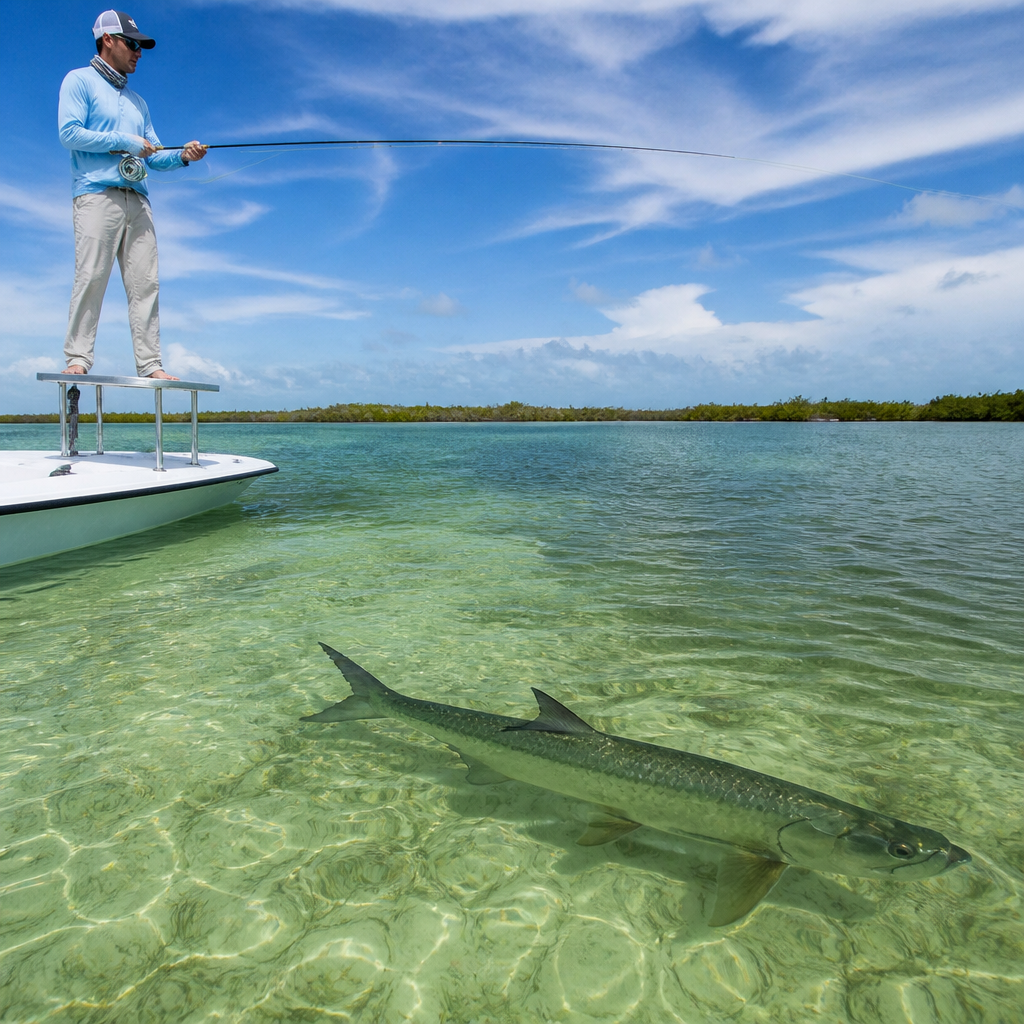
Sight fishing for tarpon is one of the most visual, technical, and rewarding forms of saltwater angling. Instead of blind casting to likely water, anglers actively locate fish, interpret their movement, and present a fly or lure only when angle, distance, light, and current align. Tarpon are uniquely suited to this method because they are large, surface-oriented, and often visible as rolling, laid-up, or cruising fish in shallow water. Yet the same traits that make them easy to spot also make them hard to fool. A hundred-pound fish can materialize in clear water, inspect a perfect cast, and refuse without touching the bait. That tension is why sight fishing for tarpon matters: success depends on observation, boat handling, tackle balance, and precise presentations rather than luck alone.
In practical terms, sight fishing means casting to a fish you can actually see, or to a clearly identified path the fish is taking. For tarpon, that usually happens on ocean beaches, backcountry basins, channels, mangrove edges, or shallow flats from late spring through summer, though the exact timing varies by region. In Florida, migratory fish commonly show along the Gulf Coast and Atlantic beaches, while resident juveniles inhabit creeks, lagoons, and canals year-round. In Mexico, Belize, and Costa Rica, anglers often target laid-up adults in protected bays or intercept rolling fish in backwater systems. Across these destinations, the fundamentals stay consistent: find fish before they detect you, get in range without changing their behavior, and deliver a presentation that matches speed, depth, and direction.
I have spent enough days poling clear flats and idling beach edges to know that most failures happen before the cast. People focus on rods, flies, and leader formulas, but tarpon sight fishing begins with reading water and controlling position. If the sun angle is poor, if the boat drifts too fast, if the guide and angler are not communicating in the same clock-face language, the opportunity is gone. This hub article covers the complete system behind sight fishing for tarpon, from identifying fish behavior to choosing rods, reels, line systems, leaders, lures, flies, and release practices. It is designed as a central reference for the broader sight fishing topic, giving you the framework needed before you drill deeper into specific environments, presentations, or seasonal patterns.
How Tarpon Behave in Sight Fishing Situations
To catch more visible tarpon, start by classifying what the fish is doing. Rolling tarpon are surfacing to gulp air, a normal behavior tied to their modified swim bladder, but a roll alone does not always create a castable shot. A fish that rolls once and sounds may be impossible to intercept, while a string of fish rolling steadily along a shoreline gives away a travel lane. Cruising tarpon move with purpose, often along beaches, channels, or edges; these fish can be excellent targets because their line of travel is predictable. Laid-up tarpon rest high in the water, commonly in calm basins or lee shorelines, and they are famous for extreme sensitivity to push poles, hull slap, false casts, and heavy fly lines. Migratory strings offshore or on the beach may look catchable, but boat traffic, swell, and sun glare can make those fish difficult despite their numbers.
Reading body language is the skill that separates random shots from deliberate ones. A tarpon tracking comfortably will hold its depth, maintain cadence, and avoid sharp directional changes. A nervous fish may tip, sink, accelerate, or “burn” away before the cast lands. The head matters most: if the fish is pointed slightly away, you usually need a lead cast that crosses into its field of view without landing on top of it. If it is quartering toward you, strip timing becomes critical because the fish closes distance faster than most anglers expect. Tides and current also shape behavior. Incoming water often floods edges and brings bait shallow; outgoing water concentrates prey at drains and cuts. Wind can help by breaking up glare, but too much wind reduces your ability to lead fish accurately and manage slack.
Finding Tarpon and Setting Up the Shot
The best sight fishing anglers are excellent hunters before they are casters. Polarized glasses with high-contrast lenses are nonnegotiable, and lens color should match conditions: copper or amber often excels in low-angle light and variable clouds, while gray performs well under harsh sun on bright beaches. Stand high when possible. From a skiff platform or elevated bow, look for shadows, backs, tails, pushes, flashes, and the subtle black-green shape of a fish moving over pale bottom. On beaches, use wave troughs and color seams to your advantage. In backcountry water, watch potholes, current tongues, and down-sun shorelines where fish silhouette cleanly.
Boat position determines whether the cast is easy, awkward, or impossible. The ideal setup puts the fish inside comfortable casting range with enough lead distance for the fly or lure to settle before the tarpon arrives. For many anglers, that means thirty to sixty feet, not seventy to ninety. Guides often use a clock system to call fish: “eleven o’clock, fifty feet, moving left to right.” The angler then confirms visual contact before lifting the rod. One of the most common mistakes I see is casting at the guide’s words rather than at the fish. Another is failing to account for drift; by the time the cast lands, the skiff and fish have both moved. Quiet corrections with a push pole, trolling motor, or strategic use of wind are far more effective than last-second power moves with the outboard.
| Tarpon scenario | Best boat position | Typical lead | Primary risk |
|---|---|---|---|
| Laid-up fish on calm flat | Downwind or crosswind, long quiet drift | 6 to 12 feet | Hull noise or line splash spooking fish |
| Cruising beach fish | Parallel track outside travel lane | 8 to 15 feet | Overleading and pulling fly away too soon |
| Rolling fish in channel | Intercept ahead of repeated rolls | Cast to path, not the last roll | Chasing each rise and arriving late |
| Mangrove edge juvenile tarpon | Tight angle along shade line | 2 to 6 feet | Landing lure too deep in cover |
Casting, Presentation, and Hooking Technique
Good tarpon presentations are deliberate and economical. The cast should land far enough ahead of the fish to avoid alarm but close enough to be noticed without excessive stripping. On fly tackle, that often means one or two false casts at most, then delivery with tight loops under control. A fly that lands softly and sinks or tracks naturally is better than a heroic seventy-foot cast that piles slack. Fly choice depends on depth, speed, and forage. Cockroach patterns, Black Death variants, toad-style flies, bunny patterns, and baitfish profiles all have their place, usually tied from 1/0 to 3/0 for many adult fisheries, larger where regulations and local practice allow. Color matters less than contrast and profile; black and purple, tan and white, chartreuse, and natural mullet tones remain staples because they read clearly under changing light.
With conventional tackle, accurate lure placement matters just as much. Soft plastics rigged on swimbait hooks, suspending twitchbaits, shallow swimmers, and small jerkbaits can all work when presented ahead of moving fish. In some beach and pass situations, live mullet, pinfish, crabs, or threadfin herring outperform artificials, especially when fish are pressured or feeding selectively. However, sight fishing still demands controlled placement. You are not soaking a bait and waiting. You are dropping it into a lane, managing tension, and letting the tarpon discover it without seeing the boat first.
The strip set is a defining tarpon skill. Trout-style lifting with the rod tip pulls the fly away and rarely buries the hook. Keep the rod low, point at the fish, and drive the hook with one or more hard strips until pressure is solid. Then bow on the jump by feeding just enough slack or dropping the rod toward the fish as it goes airborne, reducing leverage that can throw the hook. Circle hooks are standard and often required with natural bait because they set in the corner of the jaw and reduce deep hooking, but they still require discipline: come tight smoothly instead of swinging hard.
Gear for Sight Fishing for Tarpon
Tarpon tackle must balance casting efficiency, fish-fighting power, and leader abrasion resistance. For adult fish on fly, the modern standard is a 10-, 11-, or 12-weight rod, with the exact choice based on fly size, wind, and fish size. A 10-weight is pleasant and capable for laid-up fish, smaller adults, and calm conditions, while an 11-weight is the all-around workhorse in many Florida and Caribbean fisheries. A 12-weight earns its place when wind rises, currents are strong, or flies are large and weighted. Fast-action rods from makers such as Sage, Orvis, Scott, G. Loomis, and Thomas & Thomas dominate because they generate line speed and lift heavy heads cleanly off the water. Reels need strong sealed drags, high backing capacity, and corrosion resistance; trusted models from Hatch, Tibor, Nautilus, Abel, and Shimano have proven themselves over thousands of fish.
Fly line selection is more technical than many anglers realize. Clear intermediate lines are favored by many beach and laid-up fish specialists because they land relatively softly and keep the fly tracking just below the surface. Floating lines excel when fish are extremely shallow, when mangrove edges demand immediate pickup, or when a buoyant pattern is part of the plan. Sink rates that are too aggressive often sabotage the shot by forcing rushed strips or hanging the fly below the fish’s line of sight. Leaders commonly run 9 to 12 feet and usually follow class-tippet rules where applicable. In IGFA-style setups, the class tippet may be 16 or 20 pounds depending on goals, followed by heavier shock tippet of 60 to 100-plus pounds to withstand the tarpon’s abrasive mouth. For general recreational fishing outside record considerations, many guides simplify formulas but still insist on substantial shock.
Conventional gear varies by fish size and habitat. For juveniles in creeks and canals, a 4000 to 5000 size spinning reel on a medium-heavy fast rod with 20- to 30-pound braid and 40- to 60-pound leader is common. For adult migratory fish, anglers step up to 6000 to 10000 size reels, heavier rods, and 50- to 80-pound braid paired with 60- to 100-pound fluorocarbon or monofilament leaders. Drag should be smooth rather than extreme. Tarpon are usually fought off rod angle, pressure changes, and boat handling more than locked-down drag. Essential accessories include quality pliers, hook files, line cutters, a stripping basket for beach scenarios in surf, and sun-protective clothing that helps anglers stay sharp through long periods of scanning.
Fighting, Landing, and Releasing Tarpon Responsibly
Once hooked, tarpon reward calm mechanics and punish panic. Keep steady side pressure, change angles to disrupt the fish’s balance, and clear loose line instantly to the reel on fly gear. During jumps, bow without throwing total slack. When the fish settles, use the butt section of the rod rather than high sticking with the tip. From a skiff, the guide may pole or motor to keep the line clear of the hull, channel markers, bridge pilings, or mangroves. On beaches, walking with the fish can be more effective than brute force. The goal is a shorter, controlled fight that limits exhaustion, especially in warm water where post-release stress rises.
Responsible handling is not optional with tarpon, particularly large adults. Many jurisdictions prohibit removing fish over a certain size from the water except under tightly regulated harvest or record conditions. Keep the tarpon in the water during dehooking and photos whenever possible. Support it upright boatside, avoid gripping the jaw in ways that torque the spine, and revive only as long as needed to regain strong balance and tail kick. Shark predation is a growing issue in several fisheries, so if sharks are present, break off a deeply exhausted fish only as a last resort and otherwise apply maximum lawful pressure to land and release it quickly. The most successful sight fishing anglers are not simply effective catchers; they protect the fishery by making choices that keep big breeders alive.
Sight fishing for tarpon rewards the angler who can blend vision, patience, and exact execution. The method is simple to describe and difficult to master: find the fish, predict its path, present naturally, set hard, and fight efficiently. Every variable matters, from sun position and drift speed to fly sink rate, hook style, and the discipline to wait for a better angle instead of forcing a low-percentage cast. That complexity is exactly what makes the pursuit so compelling. A single clean shot at a laid-up giant can validate hours of scanning empty water because the entire process is built on judgment rather than chance.
As the central hub for sight fishing within broader tarpon techniques and strategies, this guide should frame how you approach every related topic, whether you are studying beach migration patterns, juvenile backcountry tactics, leader construction, fly selection, or skiff positioning. Start by improving the steps that happen before the cast: fish spotting, communication, and boat control. Then refine presentation and gear choices for your home water. If you want to become consistently better at sight fishing for tarpon, pick one environment, keep notes on light, tide, and fish behavior, and practice until reading the shot becomes instinctive.
Frequently Asked Questions
What makes sight fishing for tarpon different from blind casting or other saltwater fishing styles?
Sight fishing for tarpon is built around visual decision-making rather than covering water at random. Instead of casting repeatedly into promising structure, channels, or bait-rich areas and hoping a fish moves through, the angler first locates the tarpon, studies its behavior, and then times a presentation to intersect the fish naturally. That means every part of the process matters: sun angle, water clarity, wind direction, current speed, boat position, casting angle, and how the tarpon is traveling. In practical terms, you are not simply fishing the water; you are fishing a specific fish.
Tarpon are especially well suited to sight fishing because they are large, reflective, and often easy to identify in shallow water. Anglers may see them rolling on the surface, laid up and barely moving in calm basins, or cruising shorelines, beaches, flats, and channel edges. But visibility does not make them easy. Tarpon are famous for rejecting poor presentations, flaring from line splash, and ignoring flies or lures that track unnaturally. A fish that is plainly visible can still be effectively uncatchable if the approach is wrong.
That is what makes the technique so technical and rewarding. Success comes from reading body language and making adjustments in real time. A laid-up fish often requires a soft, precise presentation well ahead of its nose. A moving fish may need a lead cast that accounts for both current and boat drift. A fish rolling on a migration path might only offer a brief window to put the fly or lure in the right lane. Compared with many other forms of saltwater angling, sight fishing for tarpon demands more restraint, more observation, and more precision. When it comes together, the eat is visual, immediate, and unforgettable.
How do you properly spot and read tarpon before making a cast?
Finding tarpon is only the first step; correctly interpreting what they are doing is what creates high-quality shots. Skilled anglers look for several common signs. Rolling fish are often the easiest to identify because they break the surface to gulp air, exposing a back, head, or silver flash. Laid-up fish tend to appear as dark shapes or subtle shadows suspended over a flat or in protected backcountry water, especially on calm mornings with strong light. Cruising fish usually travel with purpose and may leave a visible push, wake, or intermittent flash as they move through shallow water. The better you become at distinguishing these behaviors, the better your casting decisions become.
Body language tells you whether a fish is catchable. Relaxed tarpon move steadily, track predictably, and often respond to a properly placed fly or lure. Nervous fish may change direction abruptly, sink, speed up, or tilt away from the boat. Fish traveling fast in a straight line can be difficult because the lead must be exact and the retrieve must engage immediately. Rolling fish can be deceptive as well; what you see at the surface may only mark where the fish was, not where it will be by the time your cast lands. That is why experienced anglers cast to the path, not the last roll.
Environmental conditions also shape what you can see and how accurately you can read it. Sun at your back generally improves visibility, while glare, chop, and cloud cover reduce contrast. Tidal flow can push fish onto edges, into troughs, or along shorelines where they become easier to predict. Polarized glasses are essential, but they are only part of the system. Elevated boat position, clean windshield lines if you are polling from a skiff, and disciplined communication between guide and angler all help turn a fleeting visual opportunity into an effective shot. In sight fishing for tarpon, seeing the fish is important, but understanding the fish is what matters most.
What are the best casting and presentation techniques for sight fishing tarpon?
The best presentation is the one that puts the fly or lure where the tarpon can see it without alarming the fish. In most cases, that means leading the fish rather than casting directly at it. The exact distance depends on how fast the fish is moving, how deep it is, and whether current is pushing the offering toward or away from the fish. A common mistake is placing the cast too close, which can create a splash, cross the fish’s line of travel unnaturally, or force an immediate retrieve that looks panicked. Another common mistake is leading too far, giving the fish no reason to notice the fly or lure before it drifts out of the feeding window.
With cruising fish, accuracy and timing are usually more important than distance. A well-placed cast 40 feet away is often far better than a sloppy cast at 70 feet. Once the offering lands, the retrieve should match the fish’s mood. Some tarpon respond best to a smooth, moderate strip that keeps the fly moving naturally across their field of vision. Others need a quicker trigger to provoke a reaction. Lure anglers face the same principle: the bait must enter the zone cleanly and then move with intent, not wobble aimlessly or crash into the fish. If the tarpon tips, tracks, or follows, keep the cadence steady unless the fish clearly needs a change to commit.
Hook-setting technique is another major factor. Tarpon should generally be set with a strip strike, not an aggressive overhead trout-style hook set. Lifting the rod too early often pulls the fly away or results in a weak hookup. After the fish eats, keep stripping until the line comes tight, then raise the rod gradually. Once hooked, be ready for explosive jumps and immediate direction changes. “Bow to the king,” or dropping the rod tip toward a jumping tarpon, can help reduce thrown hooks by lowering tension during the jump. In short, effective tarpon presentation is a chain of events: correct lead, soft landing, believable retrieve, disciplined hook set, and calm reaction after the eat.
What gear is best for sight fishing for tarpon with flies or lures?
The ideal tarpon setup balances casting control, fish-fighting power, and reliability in harsh saltwater conditions. For fly anglers, 11- or 12-weight rods are standard for adult tarpon because they handle large flies, heavy wind, and powerful fish without folding under pressure. The rod should be paired with a saltwater-grade large arbor reel featuring a strong, smooth drag and enough backing for long runs. Tropical fly lines are preferred in warm climates because they resist softening and help maintain casting accuracy. Leaders are typically long and strong, often with a class tippet and a shock tippet heavy enough to withstand a tarpon’s abrasive mouth. Fly selection usually centers on proven baitfish and crustacean profiles in colors matched to water clarity, light level, and forage base.
For conventional tackle, medium-heavy to heavy spinning or baitcasting gear is common, depending on the size of fish and the environment. Fast, powerful rods help deliver long, accurate casts and maintain control during the fight. Reels should have corrosion-resistant construction, dependable drags, and enough line capacity for long runs. Braided main line is widely used because it offers casting distance, sensitivity, and solid hook penetration, usually paired with a fluorocarbon or heavy mono leader for abrasion resistance. Popular lures include soft plastics rigged to swim naturally, suspending or slow-sinking twitch baits, swimbaits, and other streamlined offerings that land reasonably quietly and track cleanly in shallow water.
Beyond the rod and reel, several pieces of supporting gear matter more than many anglers realize. High-quality polarized sunglasses are essential for locating fish and reading behavior. Neutral-colored technical clothing reduces glare and helps anglers stay comfortable in intense sun. Good footwear, a stripping basket or line management strategy for fly anglers, and a deck free of clutter all improve performance when a shot develops quickly. Since sight fishing opportunities can appear and disappear in seconds, tackle should be organized so the angler can cast immediately. Tarpon are not a species that reward fumbling. The best gear is ultimately the gear that helps you make fast, accurate presentations and then survive the chaos after the hookup.
What are the biggest mistakes anglers make when sight fishing for tarpon, and how can they improve?
The most common mistake is rushing the shot. Tarpon often give anglers just enough time to panic, and panic leads to false casts, poor alignment, overpowered presentations, and casts that land on top of the fish. Many anglers become so focused on the excitement of seeing a big tarpon that they stop processing the basics: where the fish is going, how fast it is moving, how the current will carry the fly or lure, and whether the boat is drifting into a bad angle. Slowing down mentally, even in a fast-moving situation, is one of the biggest separators between missed opportunities and clean eats.
Another major mistake is misunderstanding fish behavior. Not every visible tarpon is in a receptive mood. Fish that are nervous, highly pressured, or moving too fast may be poor targets compared with a relaxed fish traveling on a predictable line. Anglers also often retrieve too soon, too late, or too erratically. In fly fishing especially, line management errors are costly. Loose loops around feet, gear, or deck hardware can prevent a clean strip strike or break the rhythm of the presentation at exactly the wrong moment. Lure anglers commonly make the equivalent error