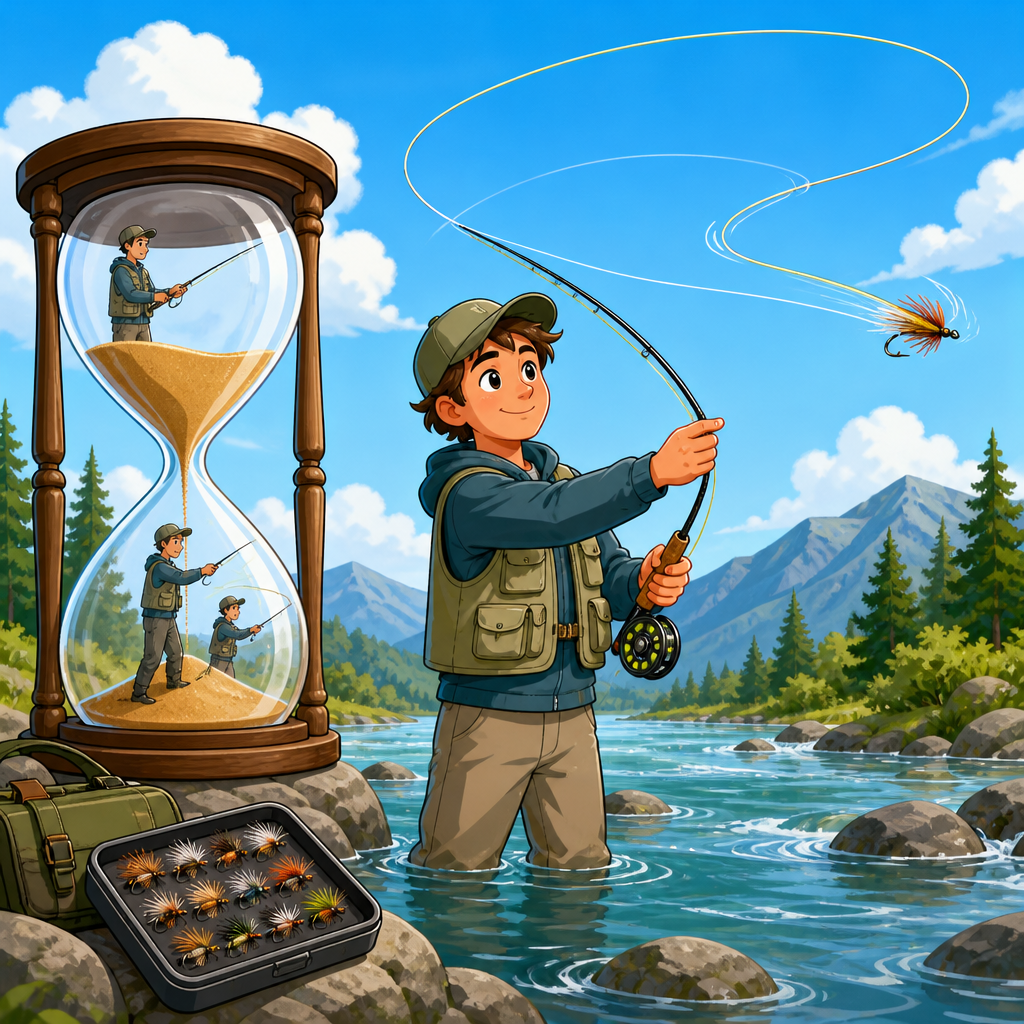
Learning to fly cast usually takes a few hours to grasp, a few weeks to perform with reasonable control, and several months to do well under real fishing conditions. That answer is simple, but the real timeline depends on what “learn” means in practice. For a complete beginner, fly casting is the foundational skill that connects every part of fly fishing basics: tackle setup, line control, presentation, accuracy, and eventually fish landing. If you cannot move line efficiently, even the best rod, flies, and water reading skills will not produce consistent results. I have coached new anglers on ponds, trout streams, and practice fields, and the pattern is remarkably consistent: students who focus on mechanics and short sessions improve quickly, while those who chase distance too early usually plateau.
Fly casting is the controlled acceleration and stop of a fly rod to form loops in the line that carry a nearly weightless fly. Unlike spin casting, where the lure provides casting mass, fly fishing uses the fly line’s weight to load the rod. Key terms matter from the start. Rod loading is the bend created by line tension during acceleration. A casting loop is the U-shaped line path traveling through the air. Timing is the relationship between acceleration, stop, and the pause that allows line to straighten. Presentation is how the fly lands and drifts, which is often more important than raw distance. Understanding these terms shortens the learning curve because they explain why a cast works or fails.
This topic matters because beginners often underestimate how teachable fly casting really is. It looks elegant, even mysterious, but it is a measurable motor skill, not a talent reserved for experts. Most anglers can build a fishable cast faster than they expect if they practice the right way. For a sub-pillar on introduction to fly fishing, fly casting is also the natural hub skill. It links directly to choosing beginner gear, matching rod weights to species, learning knots, understanding fly line types, improving accuracy, reading water, and handling wind. Once an angler can cast twenty to thirty feet with control, the rest of fly fishing opens up in a practical way.
So how long does it take to learn to fly cast? For most adults using suitable beginner equipment, one focused lesson of sixty to ninety minutes is enough to learn grip, stance, pickup and laydown cast, and basic false casting. After two to five practice sessions, many beginners can deliver line thirty feet with inconsistent but usable accuracy. Reaching the point where you can fish confidently on small water often takes ten to twenty hours of deliberate practice. Becoming consistently good in wind, around brush, or with longer casts takes much longer. The encouraging truth is that you do not need expert-level skill to start catching fish on a fly rod.
What beginners usually mean by “learn to fly cast”
When people ask how long it takes to learn to fly cast, they usually mean one of three milestones. The first is making the line go forward without tangling. The second is casting far enough and straight enough to fish effectively. The third is casting under pressure on the water, with current, wind, uneven footing, and a fish rising near a bank. These are very different standards. In lessons, I tell students that a reliable twenty-five-foot cast on target is a more useful benchmark than a flashy sixty-foot cast on a lawn.
For most trout, panfish, and bass situations, you do not need heroic distance. According to common instructional benchmarks used by organizations such as Fly Fishers International, beginners should first aim for line control, loop shape, and accuracy at short to moderate range. In real conditions, many fish are hooked inside thirty feet. That is why the early goal is not “master fly casting.” It is “become fishable.” Fishable means you can pick up line, make one or two false casts, change direction slightly, and present the fly with enough control to begin a natural drift or retrieve.
A second source of confusion is that fly casting includes multiple casts. The overhead cast is the foundation, but roll casts, reach casts, mends, and sidearm deliveries are what make anglers effective on water. You can learn the basic overhead cast quickly, yet still feel lost once trees crowd the bank or wind blows upstream. That does not mean you failed to learn. It means your skill is progressing from isolated technique to applied fishing. Every serious beginner should expect that transition to take longer than the first breakthrough on a practice field.
Typical timeline from first lesson to fishable skill
The fastest progress usually happens in stages. In the first hour, most beginners can learn to strip line, hold the rod correctly, keep the elbow relatively stable, accelerate smoothly, and stop high on the back cast and forward cast. During hours two through five, students begin to understand the pause. They feel when the line straightens behind them and learn that many tailing loops come from rushing the stroke. By ten hours, a dedicated beginner often develops repeatability: cleaner loops, fewer cracks of the fly, and better control of thirty feet of line.
By twenty hours of intentional practice, many anglers can fish small streams and ponds comfortably if they also understand leader setup and basic fly selection. Around the thirty- to fifty-hour mark, improvement shifts from simply making casts to solving problems: dealing with wind, varying casting plane, shooting line efficiently, and presenting slack when needed. That is where instruction remains valuable. I have seen anglers spend a year repeating the same mechanical fault because no one corrected their tracking or rod tip path early enough.
| Stage | Typical Practice Time | What Most Beginners Can Do |
|---|---|---|
| First exposure | 1 to 2 hours | Grip the rod correctly, make basic back and forward casts, understand the pause |
| Early control | 3 to 5 hours | False cast short line, deliver 20 to 30 feet, reduce major tangles |
| Fishable skill | 10 to 20 hours | Cast accurately at common fishing distances, change direction modestly, fish simple water |
| Practical competence | 30 to 50 hours | Handle light wind, roll cast, mend line, adapt stroke to obstacles and presentations |
| Advanced consistency | 50+ hours | Control loops, distance, trajectory, and presentation under varied real-world conditions |
These ranges are realistic, not rigid. Athletic background helps some people, especially those who already understand rhythm and sequencing from sports like tennis or golf. Still, fly casting is different enough that prior habits can also interfere. The student who improves fastest is usually the one who accepts short, specific feedback and practices regularly instead of muscling the rod.
What makes the learning curve shorter or longer
Equipment choices matter more than many beginners realize. A medium-action 9-foot 5-weight rod paired with a quality weight-forward floating line is still the easiest all-around setup for learning freshwater fly fishing. Cheap line is a hidden obstacle because poor coatings and inaccurate grain weights make rod loading less obvious. Instructors often say, correctly, that beginners blame themselves for what is really a line problem. A balanced setup from brands such as Scientific Anglers, Rio, Orvis, or Cortland can noticeably accelerate learning because the rod communicates timing better.
Instruction quality is another major factor. One qualified lesson often saves weeks of frustration. The best teachers use concise cues: smooth acceleration, crisp stop, wait for the line to straighten, then go. They avoid overloading students with advanced theory before the basic stroke becomes repeatable. If you can take a lesson from a certified instructor, especially one familiar with Fly Fishers International teaching standards, you will usually progress faster than by relying on random online tips alone. Video can help, but it does not replace immediate correction.
Practice structure may be the biggest variable of all. Two twenty-minute sessions per week beat a single two-hour grind. Motor learning research consistently shows that distributed practice improves retention and reduces fatigue-related errors. On a field, use targets at twenty, thirty, and forty feet. Practice pickup and laydown, then one false cast and delivery, then change direction. Stop when mechanics slip. In my experience, beginners who end sessions early while still casting well improve faster than those who practice through frustration.
Physical factors count too. Wind exposes flaws immediately. Tight shoulders limit smooth acceleration. Poor eyewear makes tracking the loop harder. Even footwear matters on uneven banks. Learning on grass is easier than learning knee-deep in current, so the environment should become progressively harder. Starting simple is not a shortcut; it is efficient skill building.
The core fly casting skills every beginner should build first
The first skill is line management. Before discussing beautiful loops, a beginner needs to strip line cleanly, avoid stepping on it, and understand how much line is outside the rod tip. The second is straight-line rod tip travel. In plain terms, the rod should move mostly back and forth on a consistent path rather than making large circular motions. Circular strokes create wide loops, wasted energy, and poor accuracy. The third is the stop. A decisive stop transfers energy into the line and forms the loop. Without it, the cast collapses.
Next comes timing the pause. On short casts, the pause is brief. As more line extends, the pause lengthens because the loop needs time to unroll. This is where beginners often rush. They start the forward cast while the back cast is still traveling, which causes tailing loops, snapping flies, or the line dropping behind them. Watching the back cast occasionally during practice helps build awareness, though on the water you should not constantly turn your head. The goal is to feel the line straighten.
After that, beginners should learn the roll cast early, not late. Roll casting teaches tension, anchor placement, and smooth acceleration while solving real fishing problems such as limited back-cast room. It is one of the most practical skills in fly fishing basics. Add a basic mend soon after. Even a clean cast fails if the line drags the fly unnaturally across current. Casting and drift control are inseparable in actual fly fishing.
Common mistakes that slow progress
The most common mistake is overpowering the cast. Beginners see line fail to travel and instinctively hit harder, but fly casting rewards smooth acceleration more than force. Another frequent issue is dropping the rod tip too far on the back cast, which widens loops and wastes energy. Bad tracking is also common. If the rod hand swings across the body, the line travels in curves instead of straight paths. Many students do not realize this until they watch themselves on video.
A different class of errors comes from unrealistic expectations. Social media highlights distance casting and dramatic loop shapes, but beginners need accuracy, control, and safe mechanics. Trying to carry too much line too soon makes timing harder. So does using flies with weighted beads or indicators before the basic stroke is stable. There is also a safety issue: sunglasses and a hat are mandatory, because flies and split shot can rebound dangerously.
Finally, many anglers practice only casting and neglect the rest of introduction to fly fishing. They do not learn knots, leader formulas, fly selection, or how current affects drag. Then they wonder why field skill does not transfer to fish. Fly casting is the hub skill, but it works best when connected to the full beginner system.
How to learn faster and connect casting to real fly fishing
If your goal is to shorten the timeline, start with a lesson, use balanced beginner gear, and practice short sessions with clear objectives. Film ten casts from the side and from behind. Compare what you feel with what actually happens. Use simple drills: pick up and lay down twenty-five feet, then hit paper plates at different angles, then practice roll casts with no back-cast room. Measurable drills create feedback, and feedback speeds learning.
Just as important, move from field practice to fishing scenarios early. Cast from kneeling positions. Practice with a light breeze. Learn to cast sidearm under branches. Add one skill at a time. This is how fly casting becomes useful instead of performative. In fly fishing basics, everything connects: casting supports presentation, presentation supports drag-free drift, and drift supports strikes.
In the end, learning to fly cast does not take as long as most beginners fear. You can understand the fundamentals in a day, become fishable in ten to twenty hours, and keep improving for years as conditions and techniques expand. The main benefit is not just distance. It is control: the ability to place a fly where fish will eat it and manage the line once it lands. If you are starting your introduction to fly fishing, make casting your first priority, then build outward into gear, knots, reading water, and presentation. Book a lesson, practice deliberately, and aim for a clean twenty-five-foot cast. That milestone will open the door to the rest of fly fishing.
Frequently Asked Questions
How long does it usually take to learn to fly cast?
For most people, learning to fly cast happens in stages rather than all at once. A complete beginner can usually understand the basic motion in a few hours, especially with a lesson or some focused practice. Within a few practice sessions, many anglers can make short, usable casts on grass or calm water. After a few weeks of regular practice, it is common to develop reasonable control over line direction, basic timing, and short-to-medium casting distance.
That said, doing it well under real fishing conditions takes longer. Wind, moving water, uneven footing, trees behind you, and the pressure of presenting to an actual fish all expose weaknesses in timing and line control. That is why many anglers feel they “learned” to cast quickly but still spend several months improving consistency, accuracy, and presentation. In practical terms, a few hours gets you introduced, a few weeks gets you functional, and a few months gets you capable in the situations that matter most on the water.
What does it really mean to “learn” fly casting?
That depends entirely on the standard you are using. If “learn” means making the fly line go forward and landing the fly somewhere in front of you, that can happen very quickly. If it means consistently making controlled casts with proper timing, managing line efficiently, and presenting the fly accurately at fishing distance, that is a higher level of skill. And if “learn” means adapting to current, wind, changing distances, and different casting angles while actually trying to catch fish, that is a much deeper benchmark.
Fly casting is not an isolated trick; it is the mechanical foundation of fly fishing. It connects rod loading, line control, loop shape, accuracy, presentation, mending, and eventually even your ability to fight and land fish efficiently. Someone may be able to false cast on a lawn after one afternoon, but still struggle to place a fly under overhanging branches or deliver a drag-free drift on a stream. So when people ask how long it takes, the best answer is that basic motion comes fast, useful skill comes with repetition, and dependable on-the-water performance develops through practice and experience.
Can you learn to fly cast on your own, or do you need lessons?
Yes, you can learn on your own, and many anglers do. With modern videos, practice drills, and a little patience, a motivated beginner can pick up the fundamentals independently. Short practice sessions on grass can help you understand the casting stroke, line path, and timing without the distractions of moving water. Self-teaching often works best for people who are willing to go slowly, focus on clean fundamentals, and correct problems early rather than simply casting harder when something goes wrong.
However, a good instructor can dramatically shorten the learning curve. One lesson can save weeks of frustration by fixing common beginner mistakes such as overpowering the rod, starting the forward cast too early, using too much wrist, or trying to force distance before developing control. Lessons are especially valuable because fly casting errors are often hard to feel accurately on your own. What seems like a strength problem is usually a timing or tracking problem. If your goal is to become competent as efficiently as possible, professional instruction is one of the fastest ways to improve.
What factors make some people learn fly casting faster than others?
Several factors affect how quickly someone progresses. Frequency of practice is one of the biggest. Ten short, focused sessions usually produce better results than one long, exhausting day. Athletic background can help, especially if someone already understands timing, hand-eye coordination, or smooth acceleration from sports like tennis, golf, or paddling. Quality instruction also matters, because good habits formed early are much easier to build on than bad habits corrected later.
Equipment setup plays a role as well. A balanced rod, matching line, and a simple leader and fly are much easier for a beginner to manage than overly technical gear. Conditions matter too. Learning on an open field with room behind you is very different from learning on a brushy creek with wind in your face. Perhaps most importantly, mindset influences progress. Anglers who accept that fly casting is a skill built through repetition usually improve faster than those who expect instant distance. Smooth mechanics, clean loops, and control come before power, and the people who respect that sequence tend to learn faster and retain the skill better.
How can a beginner learn to fly cast faster and avoid common mistakes?
The fastest way to improve is to focus on fundamentals before worrying about distance. Start with short casts and learn to form tight, controlled loops. Keep your stroke compact, pause long enough on the back cast, and let the rod do the work instead of trying to muscle the line through the air. Many beginners rush the cast, apply too much force, or move the rod in a wide arc, all of which make the line collapse or tail. Practicing at short range makes errors easier to spot and correct.
It also helps to practice with a purpose. Rather than casting aimlessly, pick targets at different distances and work on landing the fly line accurately and softly. Watch the line unroll and pay attention to whether it straightens cleanly. If possible, get feedback early from an experienced caster or instructor. A few corrections at the beginning can prevent months of reinforcing inefficient habits. Most importantly, be patient with the process. Fly casting rewards relaxed repetition and clean mechanics. If you build control first, distance and confidence will come much more naturally over time.