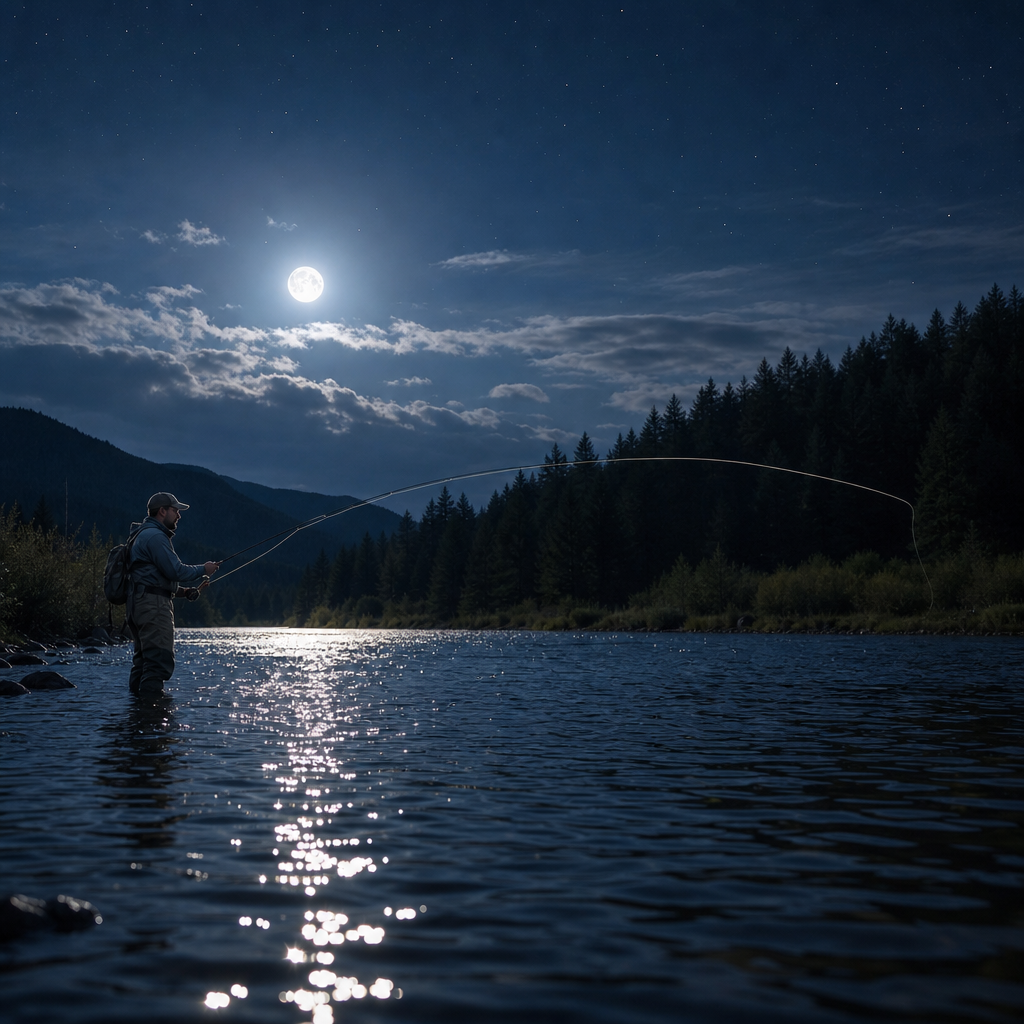
Fly fishing during midnight demands a different mindset than daytime angling because visibility drops, insect activity shifts, fish behavior changes, and every decision about safety, tackle, and presentation carries more weight. In practical terms, midnight fly fishing means targeting fish during the darkest central hours of the night, usually between roughly 11 p.m. and 2 a.m., when low light, cooler water, and reduced human pressure can trigger feeding windows that simply do not happen under the sun. As a time-of-day strategy within the broader seasons and conditions category, it matters because many rivers, lakes, and tailwaters fish best after dark in summer, during bright moon phases, or when large predatory trout and bass become less cautious. I have planned and fished enough night sessions to know that success rarely comes from luck; it comes from preparation, disciplined casting angles, and understanding how fish use current seams, structure, and sound when they cannot rely on full daylight vision.
Midnight conditions affect both predator and prey. Aquatic insects such as caddis, midges, and hex mayflies often emerge late, while baitfish, mice, crayfish, and sculpins move in ways that draw aggressive strikes from larger fish. Trout commonly slide from daytime holding lies into softer feeding lanes, bass cruise weed edges and shallow flats, and carp in some waters tail confidently under low pressure. Night fishing also changes how anglers evaluate water. During the day, people often read the surface first; at midnight, experienced anglers rely more on prior scouting, bank markers, depth memory, current feel, and the audible cues of riffles, drop-offs, and shoreline cover. That is why this guide works as a hub for time-of-day fly fishing: the principles here connect to dawn, dusk, overcast afternoons, bright bluebird days, and seasonal windows, but midnight requires the highest level of planning and the cleanest execution.
The biggest advantage of fly fishing at midnight is access to fish that are larger, less pressured, and more willing to move for a fly. The biggest risk is that mistakes multiply quickly. A poor wading choice, a sloppy knot, a weak headlamp, or an unfamiliar run can turn a promising session into a dangerous one. Good midnight strategy balances opportunity with caution. It starts before dark, continues through fly selection and line control, and ends with fish handling and the walk back to the truck. If you understand why fish feed at night, where they reposition, and how to present flies they can locate by silhouette, vibration, and displacement, midnight can become one of the most productive periods in your fishing calendar.
Why fish feed at midnight
Fish feed at midnight for three main reasons: reduced light makes them feel secure, water temperatures often improve, and prey becomes more concentrated or vulnerable. In summer, large brown trout on many freestone rivers avoid bright afternoons and begin hunting once water cools and bankside shadows merge into full darkness. In lakes, bass and trout use darkness to ambush bait over points, shoals, and weed lines. In tailwaters, stable flows and dense insect hatches can create repeatable feeding windows long after sunset. Predatory fish do not stop feeding because they cannot see perfectly; they adapt by using lateral line detection, contrast, and short-range visual tracking against the night sky.
Moon phase influences feeding, but not in a simplistic good-moon bad-moon way. Bright moonlight can improve visibility for both fish and angler, especially on open water, and it often helps streamer and mouse anglers by creating stronger silhouettes. New moon periods can be excellent too, particularly on waters where fish leave cover only under near-total darkness. Cloud cover can deepen darkness and compress fish into shallower lies. Wind matters because surface chop can hide your presence and push bait, but too much wind makes line management and safe boat control much harder. Water clarity is equally important. Slight stain often favors night fishing because fish feel protected, while very clear skinny water may demand softer presentations and slower wades even after midnight.
Species respond differently. Brown trout are the classic midnight target because large fish often become territorial and predatory after dark. Rainbow trout may feed well on nocturnal insects but are usually less structure-oriented than browns at night. Smallmouth bass are outstanding midnight fly rod fish, especially around boulder fields and current breaks. Largemouth bass patrol edges, docks, and pads. Striped bass in tidal rivers and estuaries commonly feed hardest at night around bridges and current seams. Understanding the target species determines everything else, from leader length to whether you should fish a deer-hair diver, a sparse sculpin, or a size 6 soft hackle.
Preparation before the sun goes down
The best midnight anglers do most of their work in daylight. Scout access points, wading routes, hazards, and likely holding water before sunset. I mark entry trails mentally, note back-cast obstructions, and identify shoreline reference points such as split boulders, root wads, dock posts, or seams entering a pool. On moving water, I pay close attention to depth transitions because a knee-deep glide at 7 p.m. can become a confusing black sheet at midnight. On lakes, I locate weed edges, drop-offs, and safe casting lanes ahead of time. This daylight reconnaissance is nonnegotiable; if you have not seen the water, fish simpler banks or postpone the session.
Your gear must be streamlined. Carry fewer fly boxes, fewer spools, and only the tools you will actually use. Every extra item becomes noise in darkness. A dependable headlamp with red and white modes is essential, and a backup light belongs in your pack or wader pocket. Many experienced anglers prefer red light for knot tying and walking because it preserves night vision better than white light. Bring hemostats, nippers on retractors, a wading staff if current is involved, and a net that can be reached one-handed. Check boot traction closely. Felt, studs, and modern sticky-rubber soles all have strengths, but midnight is not the time to gamble on marginal footing.
Clothing deserves more attention than many anglers give it. Night temperatures can drop sharply even after hot days, especially near tailwaters and mountain rivers. Layer for the coldest hour, not the parking-lot temperature. Avoid noisy fabrics that scrape during casting. In mosquito-heavy regions, treat outer layers with permethrin and carry a simple face covering. Hydration matters at night too; fatigue and dehydration reduce judgment. If you are fishing from a boat, navigation lights, a charged phone, and a float plan are basic safety standards, not optional extras.
Midnight fly selection and tackle choices
At midnight, fly selection is less about matching exact color shades and more about creating a profile fish can detect quickly. For trout, the core night box usually includes mouse patterns, rabbit-strip leeches, Woolly Buggers, sculpins, articulated streamers, and larger dry flies tied to skate or wake. During major hatches, large caddis, drakes, and hex imitations belong in the rotation. For bass, deer-hair divers, Gurglers, baitfish streamers, and crayfish patterns consistently produce. Dark flies such as black, purple, and deep olive often outperform bright patterns because they silhouette strongly against the surface or moonlit background. That said, white streamers can excel in some lakes and estuaries where fish key on baitfish flash.
Tackle should simplify turnover, contact, and hook-setting. A 5- or 6-weight covers many trout situations, but larger rivers and streamer work often justify a 6- or 7-weight. Bass and stripers fit comfortably on 7- to 9-weights depending on fly size and wind. Floating lines are the starting point for mice, waking flies, divers, and shallow streamers. Sink-tip lines help keep baitfish patterns tracking near structure without forcing a long leader that is difficult to manage in darkness. Leaders are generally shorter and stouter than daytime dry-fly setups. For trout streamers, 7.5 feet tapered to 0X or 1X is common. For mice, many anglers go even shorter. Strong tippet reduces break-offs and shortens fights, which matters when landing and releasing fish in the dark.
| Situation | Recommended Fly | Line Type | Leader Setup |
|---|---|---|---|
| Summer brown trout in riffle-to-pool water | Mouse or articulated sculpin | Floating or short sink-tip | 6 to 7.5 ft, 0X to 1X |
| Hex hatch on a lake edge | Large hex dun or emerger | Floating | 9 ft, 3X to 4X |
| Smallmouth around boulders | Black deer-hair diver | Floating | 7.5 ft, 0X to 2X |
| Largemouth on weed lines | Gurgler or baitfish streamer | Floating | 7.5 ft, 12 to 16 lb |
| Tidal striped bass near bridges | Sparse baitfish streamer | Intermediate or sink-tip | 6 to 7.5 ft, 16 to 20 lb |
Keep fly changes limited and intentional. If fish are present but not committing, adjust speed, angle, or depth before changing patterns repeatedly. Night fish often respond more to where and how a fly moves than to fine visual detail. That principle saves time and keeps you fishing rather than fumbling through boxes.
Presentation, positioning, and hook-setting after dark
Accurate presentation at midnight starts with shorter, higher-percentage casts. Most successful night takes happen well within comfortable distance. Fish close, target banks, seams, and structure methodically, and resist the temptation to bomb long blind casts. On trout rivers, I prefer quartering casts that let a mouse or streamer swim across likely lies with tension I can manage. With a waking fly, maintain a steady V-shaped push and avoid over-manipulating it. With streamers, use controlled strips or a broadside swing that keeps the fly in the lane longer. For bass, work edges and pockets slowly enough that fish can track the displacement.
Positioning matters more than many anglers realize. Approach from downstream on trout water when possible, using current noise to cover your movement. On stillwaters, keep the boat or float tube outside the strike zone and cast across the edge rather than directly over it. In estuaries, line up with current seams, shadow lines, and bridge-light transitions. Fish regularly pin prey where dark water meets lit water, especially around artificial illumination. If a spot looks perfect, cover it from multiple angles before moving. Large fish often need repeated presentations to commit.
Night strikes feel different. Some are violent surface detonations; others are just weight. Do not trout-set blindly at every splash. With mice and divers, wait until you feel the fish or the line comes tight, then strip-set firmly before lifting the rod. With streamers, a strip-set is standard because it drives hooks home without pulling the fly away prematurely. Keep rod angles low during the first seconds to maintain pressure and reduce slack. Many missed fish at midnight come from reacting to noise instead of actual contact.
Safety, ethics, and building a full time-of-day strategy
Safety is the foundation of midnight fly fishing. Tell someone where you will be, set a return time, and avoid solo wading in strong current unless you know the water intimately. Use a wading belt, move one foot at a time, and never assume a familiar riverbed is unchanged after rain or dam releases. Check generation schedules on tailwaters through official dam operators such as the U.S. Army Corps of Engineers or TVA where relevant, and verify local regulations because some fisheries restrict night access, seasonal hours, or boat lighting requirements. Keep your light off while fishing whenever possible, but use it immediately when safety or fish handling demands it.
Ethics matter more after dark because fish are harder to land, unhook, and photograph responsibly. Use barbless hooks where practical, keep fish wet, and skip hero shots that require prolonged handling in poor visibility. If water temperatures are already stressful, especially for trout above recommended thermal thresholds, the better decision may be to fish warmwater species at night instead. A productive time-of-day plan should connect midnight to surrounding windows. Scout in the afternoon, note insect activity at dusk, fish the core midnight period with confidence, and stay flexible into the pre-dawn hour if conditions warrant. That broader framework makes this page a true hub: dawn often rewards subtle dry-fly work, midday favors depth and shade, evening triggers transitions, and midnight belongs to anglers prepared to fish deliberately, safely, and with conviction.
The key takeaway is simple: fly fishing during midnight is not just daytime fishing in the dark. It is a distinct approach built on prior scouting, compact gear, strong silhouettes, short accurate casts, disciplined hook-sets, and strict safety habits. When you match those tactics to species behavior, moonlight, water temperature, and structure, midnight can produce your largest and least pressured fish of the season. Review your local conditions, scout before sunset, and plan your next night session with purpose.
Frequently Asked Questions
What makes fly fishing during midnight different from fishing earlier in the evening or during the day?
Midnight fly fishing is different because the conditions, fish behavior, and angler decision-making all change once the night reaches its darkest point. Earlier in the evening, fish may still be responding to leftover surface activity, fading light, and transitional feeding patterns. By midnight, that transition is over. Fish are often either fully committed to nocturnal feeding lanes or holding in positions that let them take advantage of cover, cooler water, and reduced pressure. In many fisheries, the hours between about 11 p.m. and 2 a.m. can create a unique feeding window because water temperatures stabilize, bankside activity quiets down, and larger fish feel more secure moving into shallower lies.
From a practical standpoint, visibility is the biggest dividing line. During the day, anglers rely heavily on seeing currents, tracking drifts, watching follows, and adjusting presentations in real time. At midnight, you often cannot see your fly well, if at all, and you may not be able to read the water in the same visual way. That means success depends more on preparation, memory, line control, feel, and fishing water you already understand. Instead of covering water quickly, many experienced anglers slow down and work proven holding zones methodically.
Another major difference is insect and forage behavior. Some hatches taper off after dusk, while others continue into the night or give way to terrestrials, baitfish movement, crayfish activity, or mouse patterns that draw aggressive strikes from predatory fish. That is why midnight fishing often rewards anglers who think beyond classic daytime dry-fly scenarios. Streamers, larger silhouettes, and flies that push water can become more effective because fish are locating prey through vibration, contrast, and movement rather than perfect visual inspection.
Safety and discipline also matter much more. A poor step, a missed knot flaw, or a bad wading choice is far more serious in darkness. Midnight fly fishing is less forgiving, but for anglers who prepare properly, it can be one of the most productive and memorable periods to be on the water.
What flies and tackle work best for fly fishing during midnight?
The best flies and tackle for midnight fly fishing are the ones that help fish find your offering in low light while still giving you control and confidence. In many situations, larger-profile flies outperform small, technical patterns because they create a stronger silhouette and displace more water. Dark-colored flies are often favored at night, not because fish see every detail, but because black, deep olive, and similarly dark tones can stand out against the faint glow of the surface or sky. Depending on the species and the water, effective midnight patterns may include mouse flies, woolly buggers, sculpin imitations, leeches, baitfish streamers, or larger wet flies and nymphs fished slowly through likely holding water.
If fish are feeding near the surface, a bulky dry fly, foam pattern, or skated mouse can be highly effective. Surface takes at midnight are often explosive, but they also require patience. Many anglers strike too quickly because they hear the splash before the fish actually turns down with the fly. In subsurface situations, weighted streamers or sink-tip setups can help keep the fly in the zone longer, especially in deeper runs or along banks where bigger fish patrol under darkness.
Your rod and line setup should match the style of fishing you plan to do, but many anglers lean toward slightly heavier tackle at night for better turnover and control. A 5-weight may be fine for trout in moderate conditions, but a 6-weight or 7-weight often makes casting larger flies easier and helps you manage fish when you cannot see every move they make. Leaders are commonly shortened compared to delicate daytime dry-fly setups because turnover, accuracy, and control matter more than stealth when visibility is already limited. A shorter, stronger leader also reduces tangles and helps with landing fish efficiently.
Just as important as the fly itself is keeping your system simple. Midnight is not the time for constant rig changes, ultra-fine tippet, or complicated multi-fly setups that are hard to untangle in the dark. Choose a small number of confidence patterns, organize them before you leave home, and fish them with intent. The anglers who do best at midnight are usually the ones with streamlined tackle, dependable knots, and a presentation they can repeat consistently without needing to see every detail.
How should you approach presentation and casting when you can barely see the water?
Presentation at midnight starts long before the first cast. The smartest approach is to fish water you have already studied in daylight or at least during twilight. Knowing where the drop-offs, seams, boulders, undercut banks, and wading hazards are allows you to concentrate on fishing instead of guessing. Once darkness fully sets in, most anglers benefit from shortening their casting distance and focusing on high-percentage targets rather than trying to cover too much water. Night fishing is usually more efficient when you make controlled, deliberate casts to specific lies and repeat productive drifts instead of constantly moving.
Because visual tracking is limited, line control becomes a feel-based skill. Keep as much unnecessary slack out of the system as possible so you can maintain contact with the fly. With streamers, that may mean slow, purposeful retrieves, quartering swings, or broadside presentations that let the fly pulse through likely lanes. With nymphs or wets, it may mean shorter drifts and tighter control so subtle takes can still be detected. If you are fishing surface patterns, listen as much as you watch. Sometimes the sound of the take tells you more than your eyes can.
Casting mechanics also need to be cleaner at midnight. This is not the time for false casting excessively or carrying lots of loose line at your feet. Fewer false casts reduce tangles and keep you oriented. A compact, repeatable casting stroke is safer and more productive, especially around trees, rocks, and uneven banks. Many experienced night anglers position themselves carefully, make the same cast angle repeatedly, and use landmarks such as a dark tree line, a seam they can hear, or a bank contour they memorized earlier to maintain consistency.
One of the most overlooked presentation tips is to slow down after a strike. Night fish, especially larger trout and predatory species, often track a fly before fully committing. If you miss one, cast back to the same zone and vary the speed slightly. Midnight fish are often feeding with confidence, but their takes can still be more deliberate than anglers expect. Calm, methodical presentations almost always outperform rushed or overly aggressive fishing in the darkest hours.
What safety precautions are most important when fly fishing during midnight?
Safety is absolutely central to midnight fly fishing because the same water that feels manageable during daylight can become far more dangerous once visibility disappears. The first rule is simple: do not fish unfamiliar water in full darkness if you can avoid it. Scout access points, current speed, bottom structure, entry and exit routes, and potential obstacles beforehand. Knowing where you can safely wade, where the bank drops off, and how to get back to your vehicle is not a convenience at midnight; it is essential risk management.
A reliable headlamp with fresh batteries is one of the most important pieces of gear you can carry, but it should be used strategically rather than constantly. Preserving your natural night vision helps you fish more effectively and stay oriented. Many anglers carry both a primary light and a backup, along with spare batteries. It is also wise to keep your gear organized and minimal. Loose tools, open packs, and cluttered line can quickly turn into hazards in the dark. Forceps, nippers, fly boxes, and tippet should all be in predictable places you can access by feel.
Wading requires extra caution. Move slower than you think you need to, shuffle or probe when unsure, and avoid aggressive crossings. A wading staff can make a major difference, especially in rivers with uneven rock, soft silt, or strong current seams. Even highly experienced anglers often choose to wade less at night and instead fish from stable positions they identified earlier. Footwear with dependable traction matters, and a personal flotation device may be appropriate in larger rivers, tailwaters, or remote settings where a mistake would be difficult to recover from quickly.
Communication and planning are equally important. Tell someone where you are going, where you are parking, and when you expect to return. Bring a fully charged phone in a waterproof case, and know whether you will have signal. Weather deserves close attention too, since fog, sudden temperature drops, rising water, or nighttime storms can drastically increase risk. Midnight fly fishing can be incredibly rewarding, but the best anglers treat safety as part of the strategy, not as an afterthought.
When is the best time and place to fish at midnight for the highest chance of success?
The best midnight fly fishing usually happens where fish already have a reason to move and feed after dark. Productive water often includes shallow shelves near deeper holding zones, undercut banks, soft edges beside faster current, tailouts, pool transitions, structure-rich margins, and areas where baitfish, mice, or drifting insects naturally concentrate. Large fish in particular may leave secure daytime lies and slide into shallower water at midnight because darkness lowers their perceived risk. That is one reason nighttime fishing can offer a realistic shot at fish that are difficult to