Ethical fly fishing for rare and endangered species demands a higher standard than ordinary catch-and-release because every decision on the water can affect populations already under pressure. In practical terms, ethical fishing practices are the set of choices that reduce harm to fish, habitats, and spawning success while respecting laws, science, and local stewardship goals. Rare species are those with limited distribution, low abundance, or fragile habitat requirements; endangered species face a serious risk of extinction in all or part of their range. Fly fishing can be selective and low impact compared with many other methods, but only when anglers act with restraint, use the right tackle, and sometimes choose not to fish at all. I have seen rivers where a single season of low flows, warm water, and repeated handling pushed vulnerable trout into obvious decline, and I have also seen streams recover because anglers changed behavior before regulations forced them to. That is why this topic matters: ethical fly fishing is not about preserving access at any cost, but about keeping wild fish, wild places, and angling culture compatible over the long term.
For a hub article on ethical fishing practices, the central question is straightforward: how can anglers pursue fish responsibly when the species is uncommon, protected, or especially sensitive to stress? The answer begins with understanding that legality is only the minimum threshold. A river may remain open while water temperatures climb above safe levels; a species may be legal to target while local biologists ask anglers to avoid redds or migration bottlenecks; a photo may be allowed yet still impose unnecessary risk. Ethical fly anglers weigh season, water temperature, fish condition, equipment, fight time, handling, access routes, and social pressure before making a cast. They also recognize that conservation is not abstract. Native cutthroat trout, Atlantic salmon, taimen, steelhead, grayling, and desert fishes all occupy waters shaped by dams, development, invasive species, wildfire, drought, and warming temperatures. In this landscape, restraint is often the most important skill an angler can learn.
What ethical fishing practices mean on sensitive waters
Ethical fishing practices for rare and endangered species rest on four principles: avoid preventable mortality, protect reproduction, minimize habitat disturbance, and support management goals. Avoiding mortality means more than releasing fish; it means shortening fights, keeping fish in the water, using barbless hooks, and stopping when conditions are poor. Protecting reproduction means identifying spawning seasons, redds, nest sites, staging areas, and migration corridors, then staying clear even if fish are visible and catchable. Minimizing disturbance includes careful wading, avoiding trampling bankside vegetation, cleaning gear to prevent invasive spread, and not publicizing fragile locations in ways that increase pressure. Supporting management goals means reading emergency regulations, respecting closures, participating in creel surveys when requested, and reporting poaching or fish in distress.
On the water, these principles translate into specific habits. If water temperatures approach 68 degrees Fahrenheit for salmonids, many experienced anglers stop, because dissolved oxygen drops and post-release mortality rises. If fish are stacked in a thermal refuge at a tributary mouth, ethical anglers leave them alone even when regulations are silent. If a rare char or trout is feeding during a low-water drought, the ethical choice may be observation rather than pursuit. I have worked through these decisions stream by stream, and the pattern is consistent: the best outcomes come from anglers who plan before they fish and who accept that a successful day can mean zero fish landed.
Species vulnerability, stress, and why tackle choices matter
Rare fish are not equally vulnerable. Some species suffer most during spawning, others during warm-water periods, low flows, estuary transitions, or after long migratory runs. Anadromous fish such as Atlantic salmon and some steelhead populations expend enormous energy before entering freshwater. Native trout isolated above barriers may have tiny gene pools and little resilience after repeated handling. Even robust-looking fish can be physiologically compromised by lactic acid buildup during prolonged fights. Research across salmonids has shown that fight time, air exposure, and water temperature are major drivers of post-release stress and mortality. That is why tackle selection is an ethical issue, not a gear preference.
A properly matched rod and leader reduce fight time. Heavy enough tippet allows steady pressure and quick landing, whereas ultralight presentations can turn one fish into several minutes of exhaustive struggle. Rubberized landing nets protect slime layers better than rough knotted mesh. Single barbless hooks penetrate effectively and come out quickly, reducing tissue damage. Hook placement matters as well; fish hooked in the jaw generally fare better than fish hooked deep. In waters with endangered fish present, I advise anglers to avoid tandem-hook rigs, oversized streamers with multiple attachment points, and techniques that raise foul-hooking risk. Precision, not maximal hooking power, should guide rigging decisions.
| Ethical decision point | Preferred practice | Why it helps vulnerable fish |
|---|---|---|
| Hook style | Single barbless hook | Faster release, less tissue damage, simpler unhooking in current |
| Tippet strength | Use the heaviest appropriate diameter | Shortens fight time and reduces exhaustion |
| Net choice | Rubberized knotless net | Protects fins, scales, and slime coat |
| Water temperature | Stop targeting salmonids near or above 68°F | Lowers post-release mortality during heat stress |
| Photo handling | Keep fish submerged; skip hero shots | Reduces air exposure and recovery time |
| Spawning habitat | Avoid redds and staging fish | Protects reproduction and egg survival |
Catch, release, and the limits of catch-and-release ethics
Catch-and-release is often presented as the ethical default, but with rare and endangered species it is only ethical when it clearly lowers net harm. The phrase can hide tradeoffs. Repeated capture in a small reach can alter feeding, increase stress hormones, and reduce spawning success even when mortality appears low. Fish released from warm, shallow water may swim away and still die hours later. Mouth wounds can become significant for fish entering long migrations or preparing to spawn. For that reason, ethical fly fishing includes deciding when not to target a species at all, even if every fish would be released.
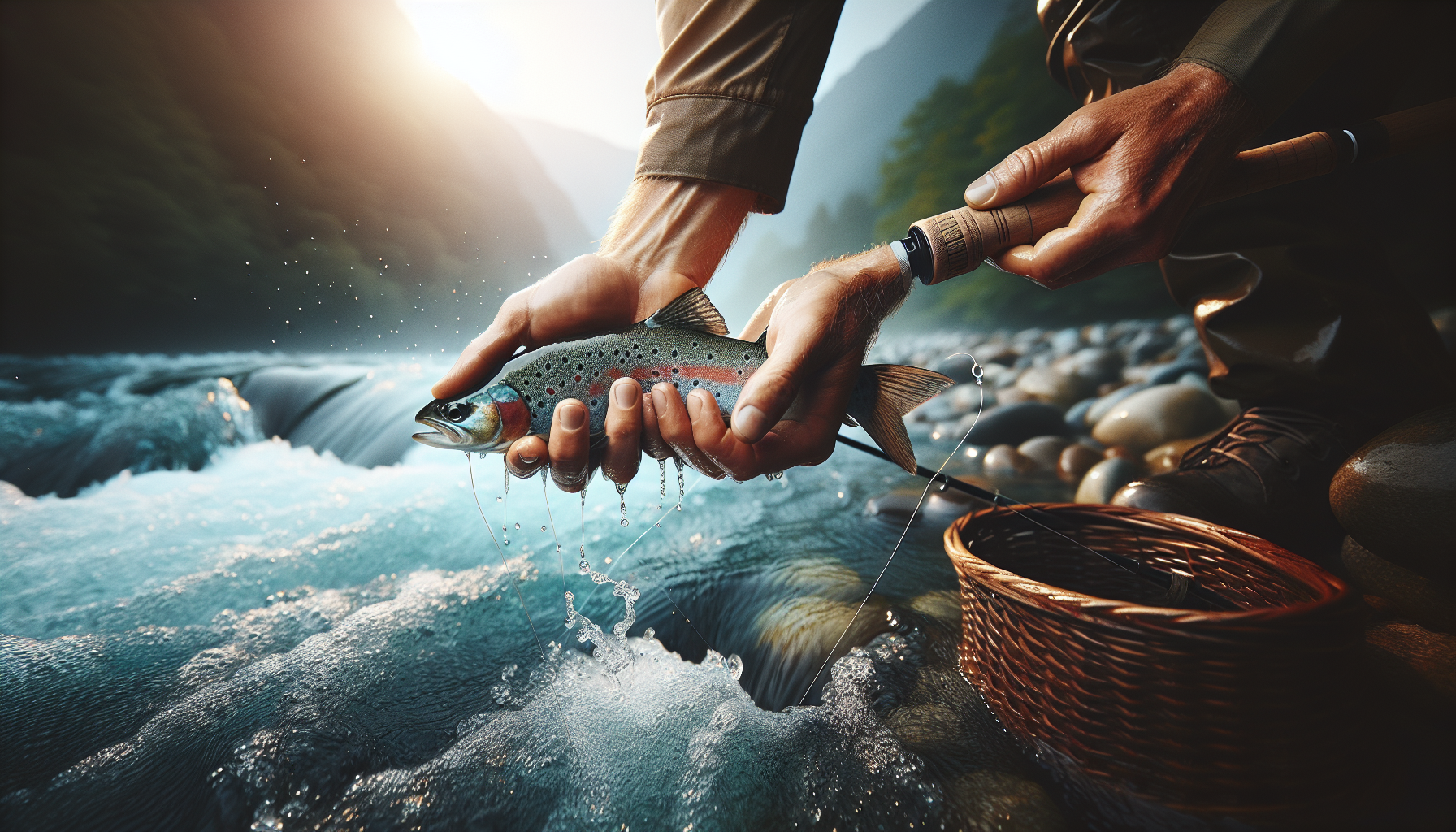
Best practice release methods are nonnegotiable. Land fish quickly, leave them in the water, and wet hands before touching them if contact is unavoidable. Do not squeeze the caudal peduncle hard enough to remove slime. Never place fish on dry rocks, boat decks, grass, or snow. Remove the hook with forceps while the fish remains supported in current. If revival is needed, hold the fish upright and allow it to regain equilibrium; avoid pumping it back and forth, which can impair gill function. If a fish is bleeding heavily or hooked in the gills, regulations may dictate what to do next, but ethically the lesson is preventive: use flies and techniques that minimize deep hookups in the first place.
Protecting habitat, spawning fish, and seasonal sanctuaries
Habitat ethics are as important as fish handling. On many trout and salmon rivers, the most serious damage an angler can cause is not to an individual fish but to spawning habitat. Redds often look like clean, lighter-colored patches of gravel in riffles and tailouts. Wading through them can crush eggs or displace developing embryos. In spring creeks and small tributaries, undercut banks, submerged vegetation, and side channels may shelter juvenile fish that are easy to overlook. The ethical approach is deliberate foot placement, limited bank trampling, and a bias toward deeper paths when crossing. If uncertain whether a patch is a redd, avoid it.
Seasonal sanctuaries deserve special respect. Many managers close reaches during spawning runs, but closures rarely cover every sensitive area. Fish congregating below barriers, at culverts, in plunge pools beneath warm reaches, or near cold inflows are functionally trapped. Catching them there may be legal and technically easy, yet it conflicts with the purpose of conservation-minded angling. The same applies to low winter flows where fish are compressed into a few deep pools. Ethical fishing practices treat vulnerability as a reason to back off, not as a tactical advantage. This standard becomes even more important on iconic waters where social media can turn one overlooked holding area into a crowded lineup within days.
Local regulations, science, and stewardship on the ground
Good ethics are informed by law, but they go beyond law through attention to current science and local context. Fisheries agencies publish emergency closures, temperature advisories, invasive species decontamination rules, and species identification guides for a reason. Native versus hatchery distinctions can matter enormously, especially where wild fish recovery depends on selective harvest or strict release protocols. On mixed-stock rivers, misidentification is one of the most common ethical failures. Every angler targeting rare fish should be able to distinguish look-alike species, juvenile life stages, and spawning color phases before they step into the water.
Stewardship also means listening to people who know the drainage intimately: biologists, tribal managers, guides with a conservation ethic, land trusts, and local watershed groups. In my experience, the best fishing communities are not the ones with the loosest rules; they are the ones where anglers voluntarily share temperature data, report fish kills, help remove trash, and support habitat restoration with time and money. Named tools such as stream thermometers, dissolved oxygen meters, and state regulation apps are simple but powerful aids. So are cleaning protocols promoted through Check, Clean, Dry campaigns to limit whirling disease, didymo, and invasive invertebrates. Ethical fly fishing is therefore both personal conduct and collective responsibility.
Photography, location sharing, and the ethics of attention
Modern angling pressure is shaped as much by phones as by flies. A single image with recognizable landmarks can direct hundreds of anglers to a fragile reach, especially when the fish is rare, unusually large, or visually distinctive. Ethical fishing practices now include digital restraint. If a species is vulnerable, crop backgrounds, delay posting, omit exact locations, and avoid content that frames sensitive fish as trophies to be collected. The goal is not secrecy for status. It is reducing sudden pressure on fish and places that cannot absorb it. This is particularly relevant for small streams with native trout, urban refuges with remnant populations, and destination rivers recovering from long declines.
Photography itself should be conservative. Keep the fish submerged whenever possible and prepare the camera before lifting, if a lift is necessary at all. One quick image is enough. Extended grip-and-grin sessions, multiple angle changes, and handing the fish between anglers for better shots all increase risk. I often tell clients that the most ethical photo of a rare fish is one taken in the net, half in the current, with enough detail to remember the moment but not enough spectacle to encourage copycat pressure. Conservation-minded storytelling can still be compelling when it emphasizes habitat, context, and restraint instead of possession.
Building a personal code for ethical fly fishing
A durable personal code makes good decisions easier under pressure. Mine starts with a simple sequence: know the species, know the conditions, know the regulations, and know when to leave. Before any trip aimed at sensitive fish, check flow levels, water temperature trends, seasonal closures, and recent management updates. Carry tackle strong enough to land fish quickly. Fish barbless. Step around redds and nursery water. Limit handling to what is strictly necessary. Do not target visibly stressed, spawning, or refuge-holding fish. Keep locations general when sharing. If conditions deteriorate, switch species, move to cooler water where regulations and biology support angling, or end the day. That framework has prevented more bad outcomes than any single piece of gear.
As the hub for ethical fishing practices, this page points to a broader truth: conservation-minded fly fishing is not a contradiction, but it requires discipline. The reward is not only healthier fish populations. It is better judgment, stronger local fisheries culture, and a style of angling that remains defensible in an era of climate stress and growing scrutiny. Rare and endangered species do not need more admiration in the abstract; they need anglers who can translate respect into action on every trip. Start by auditing your own habits this season. Replace harmful shortcuts with proven practices, support local restoration, and treat the option not to cast as one of the highest forms of skill.
Frequently Asked Questions
What does ethical fly fishing mean when targeting rare or endangered species?
Ethical fly fishing for rare or endangered species means holding yourself to a stricter standard than ordinary recreational fishing because the stakes are higher. These fish often exist in small, fragmented, or stressed populations, so even short-term handling stress, accidental injury, or repeated disturbance on spawning or refuge water can have outsized consequences. In practice, ethical fishing involves making decisions that minimize harm before, during, and after each encounter. That includes knowing the legal status of the species, understanding seasonal closures and habitat protections, avoiding vulnerable times such as spawning periods or extreme water temperatures, and using tackle and techniques that shorten fight time and reduce physical damage.
It also means recognizing that “legal” and “ethical” are not always identical. A fishery may technically be open, but conditions on the water may still make fishing irresponsible. For example, low flows, warm temperatures, crowded holding water, or visible spawning activity can all signal that it is better to walk away. Ethical anglers think beyond the individual fish and consider the cumulative effect of repeated catch-and-release on a population that may already be under pressure from habitat loss, drought, barriers, invasive species, or climate stress. The goal is not simply to avoid killing fish, but to reduce avoidable stress, preserve reproductive success, protect habitat, and support long-term recovery and stewardship.
Is catch-and-release always safe for endangered fish?
No. Catch-and-release is often better than harvest, but it is not automatically harmless, especially for rare or endangered fish. A released fish can still suffer from exhaustion, loss of protective slime, jaw or gill injury, increased vulnerability to predators, delayed mortality, or reduced spawning success. These risks become more serious when fish are played too long, handled with dry hands, lifted from the water for photos, landed on rocks or sand, or caught in warm, low-oxygen water. For species already facing population pressure, even a small amount of additional mortality or reproductive disruption matters.
The safety of catch-and-release depends on conditions, gear, technique, and timing. Using appropriately strong tackle can reduce fight time. Barbless hooks can speed release and lessen tissue damage. Keeping the fish in the water, avoiding contact with gills, and releasing it quickly all help. However, there are times when catch-and-release is still not an ethical option. If the fish are spawning, staging in concentrated pools during drought, or showing clear signs of temperature stress, the most responsible choice may be not to fish for them at all. Ethical anglers understand that successful conservation is not measured by whether a fish swims away immediately, but by whether it survives and continues to contribute to the population after the encounter.
What gear and techniques are most ethical for minimizing harm?
The most ethical setup is the one that lets you land fish quickly, handle them minimally, and release them in the best possible condition. In most cases, that means using tackle heavy enough for the size and strength of the fish rather than ultralight gear that prolongs the fight. Single barbless hooks are widely considered best practice because they penetrate effectively, are easier to remove, and usually cause less damage than barbed or multi-hook systems. Rubber or knotless landing nets are preferable to abrasive mesh because they reduce scale loss, slime damage, and fin fraying. A good pair of forceps or hemostats also helps shorten handling time.
Technique matters just as much as gear. Fight the fish efficiently, keep it in the water whenever possible, wet your hands before touching it, and support the body gently without squeezing. Never put fingers in the gills, and avoid laying the fish on dry rocks, gravel, or grass. If you want a photo, prepare the camera in advance and keep the fish submerged until the moment of a very quick shot, ideally measured in seconds, not repeated attempts. Release should be calm and controlled: hold the fish upright in current if needed, allow it to recover on its own terms, and do not push it back and forth aggressively. Ethical technique is about reducing cumulative stress at every step, from hook choice to final release.
When should anglers avoid fishing for rare or endangered species altogether?
There are several situations where the ethical answer is simply not to fish. Spawning season is one of the clearest examples. Fish on redds or in spawning aggregations are especially vulnerable, and disturbing them can reduce egg survival, interrupt courtship, or displace breeders from critical habitat. Likewise, low-water periods, heat waves, drought conditions, and warm stream temperatures can make catch-and-release much more dangerous because fish recover poorly when oxygen levels are low and physiological stress is high. If fish are concentrated in shallow pools, thermal refuges, or migration bottlenecks, repeated angling pressure can become especially harmful even if each individual encounter seems minor.
Anglers should also avoid fishing when regulations, land managers, tribal authorities, or local conservation groups advise restraint, even if the rules are not framed as outright closures. Ethical stewardship includes respecting the best available science and local knowledge. In many cases, the right decision is to redirect effort toward healthier, more resilient fisheries rather than insist on pursuing a species that cannot absorb much pressure. A strong ethical approach asks not “Can I catch this fish?” but “Should I be trying to catch it under these conditions?” That mindset is central to protecting species with limited abundance or fragile habitat needs.
How can fly anglers support conservation beyond their behavior on the water?
Responsible conduct on the water is only part of the picture. Anglers can make a meaningful difference by supporting habitat restoration, barrier removal, water-quality improvement, and science-based management. Many rare and endangered fish are threatened less by anglers alone than by larger pressures such as degraded habitat, altered flows, development, pollution, invasive species, and climate-related warming. Donating to credible conservation organizations, volunteering for stream restoration projects, participating in watershed groups, and supporting public policies that protect cold water, spawning habitat, and migration corridors all contribute to long-term recovery.
Anglers can also help by improving the quality of information shared within the community. That means avoiding spot-burning sensitive locations online, being cautious with geotagged photos, reporting poaching or habitat damage, and helping newer anglers learn low-impact practices. In some fisheries, submitting catch observations or participating in citizen science programs can aid researchers and managers, provided that data collection is done carefully and according to local guidance. Ethical fly fishing ultimately involves stewardship, humility, and restraint. The best anglers are not just skilled at catching fish; they are committed to protecting the conditions that allow vulnerable species to persist and recover.