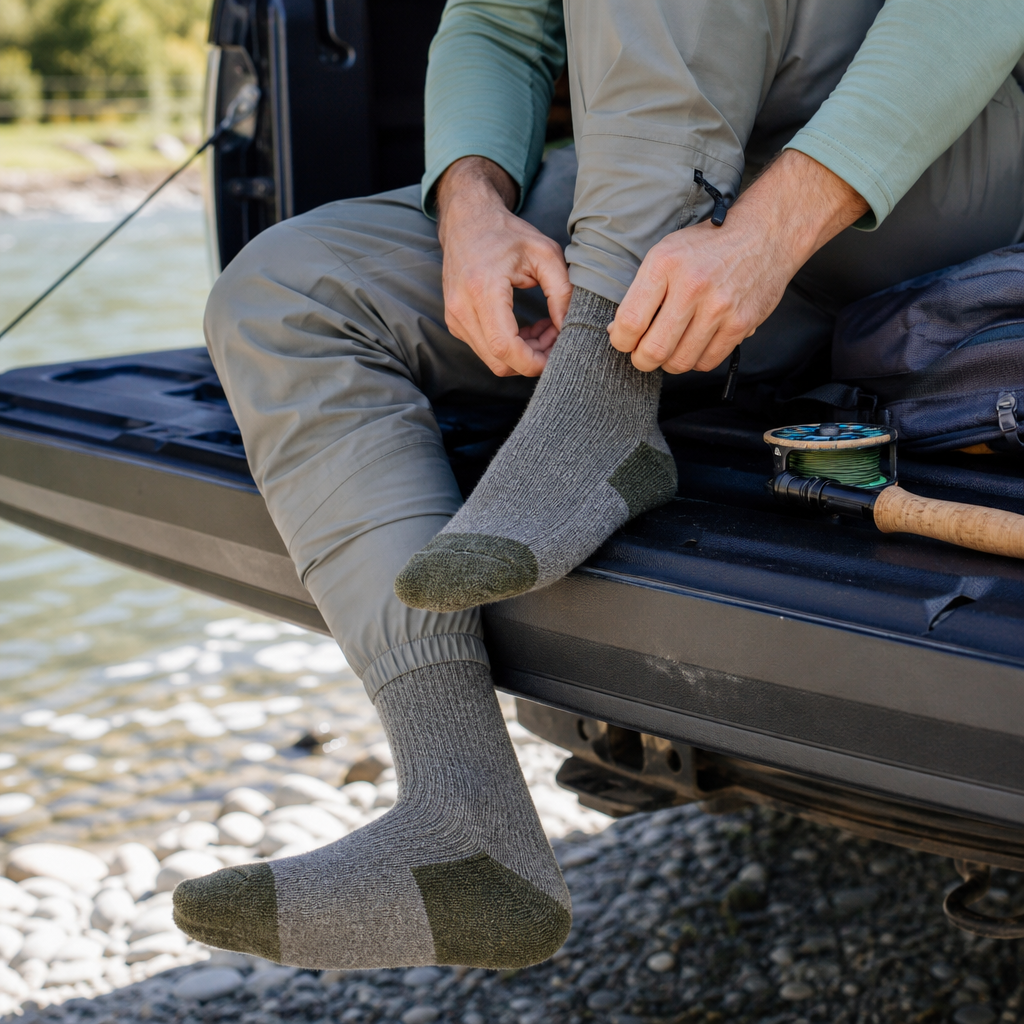
Best fly fishing socks for long days on the water are not just a comfort upgrade; they are part of your wading system, affecting warmth, blister prevention, boot fit, and how long you can fish before fatigue sets in. In clothing reviews, socks are often treated like an afterthought, yet they sit at the exact point where moisture, pressure, friction, and temperature meet. After years of testing waders, boots, layering systems, and sock combinations on freestone rivers, tailwaters, and stillwater trips, I have learned that the wrong pair can ruin a day faster than a leaky seam. The best pair keeps feet dry from sweat, cushions repetitive walking, insulates when submerged, and stays in place inside gravel-guarded boots. For anglers building a complete clothing system, this guide serves as the central reference for fly fishing socks, explaining materials, fit, thickness, seasonal use, and product categories that consistently perform well for long, demanding days.
Fly fishing socks are purpose-built performance socks designed to work inside wading boots and breathable or neoprene waders. They differ from ordinary hiking or casual socks because they must manage a unique environment: your feet sweat inside a waterproof barrier, then face cold water outside that barrier for hours. That combination means a good sock needs moisture transport, thermal efficiency, strategic cushioning, flat seams, and enough durability to handle abrasive boot interiors. Key terms matter here. Merino wool regulates temperature and resists odor. Synthetic blends, usually nylon, polyester, and elastane, add structure, faster drying, and abrasion resistance. Cushioning refers to extra knit density under the heel, toe, and sometimes shin. Compression means controlled tightness that can reduce bunching and improve support, though too much can limit comfort over a full day. Understanding those basics helps anglers choose socks that match conditions instead of buying whatever feels thickest on a store shelf.
This clothing reviews hub matters because sock choice is connected to every other apparel decision. If your wading boots fit tightly, bulky socks can reduce circulation and make feet colder, not warmer. If your layering system traps too much heat, even premium socks cannot overcome sweat saturation. If you hike into remote water, heavy cushion may feel great while standing but overheat during the walk. Anglers usually notice these problems only after they have invested in boots and waders, which is why socks deserve separate, comprehensive coverage. The goal is simple: help you choose the best fly fishing socks for the type of water you fish, the weather you face, and the rest of your gear.
What makes a fly fishing sock actually good
The best fly fishing socks solve four problems at once: moisture, temperature, friction, and fit. In my testing, moisture management matters most because wet skin softens, then blisters under pressure. Merino wool remains the benchmark because it absorbs vapor, still insulates when damp, and does not get clammy the way cheap cotton does. Cotton is the material to avoid. Once soaked with sweat, it stays wet, loses loft, and creates friction points at the heel and toe. A strong fly fishing sock usually blends merino with nylon for durability and elastane for shape retention. A pure wool sock sounds premium, but it often wears out faster inside stiff wading boots.
Temperature control is more nuanced than simply buying the thickest sock available. Warmth comes from trapped air, dry skin, and proper circulation. If a sock is so bulky that it compresses inside the boot, it can make your feet colder. Thin and midweight merino socks often outperform heavy expedition socks in moderate conditions because they preserve fit and blood flow. For winter steelhead or tailwater trout fishing, heavyweight socks make sense only if boots were sized with that system in mind. Good fly fishing socks also have anatomical shaping, seamless toes, reinforced heel and toe boxes, and a cuff that stays up without cutting into the calf.
Durability separates premium models from bargain pairs. Wading boots are abrasive, especially around the heel cup and forefoot flex point. Reputable brands reinforce high-wear areas with denser nylon content and tighter knitting. I look for socks that remain smooth after repeated wash cycles, because pilling and internal roughness translate directly into hot spots during long days. Another overlooked detail is height. Over-calf designs work best with waders because they prevent slippage and protect the lower leg from rubbing. Crew socks can work in summer wet wading, but for bootfoot or stockingfoot waders, taller is usually better.
Best materials and thickness for different fishing conditions
Material choice should follow water temperature, air temperature, and activity level. For most trout anglers using breathable waders from spring through fall, a midweight merino blend is the safest default. It balances insulation, sweat control, and boot volume. On technical rivers where you hike a mile or more before fishing, lightweight merino or merino-synthetic blends are often better because they breathe more efficiently during the approach. During cold-weather fishing, especially when standing in current for long periods, heavyweight merino socks can help, but only if your boots leave enough room around the forefoot and instep. Tight boots negate the benefit.
Neoprene-blend socks have a narrow role. They add warmth and water resistance, making them useful for wet wading in cold shoulder seasons or as specialized liners, but they are usually too clammy for full-day use inside breathable waders. Pure synthetic socks dry fast and resist abrasion, yet they often hold odor and can feel less forgiving over twelve-hour sessions. That is why the most dependable options remain merino-forward blends, typically in the 40 to 70 percent merino range, supported by nylon and a small amount of elastane. Brands such as Darn Tough, Smartwool, Simms, Orvis, and Patagonia have each proven that formula across multiple fishing-specific or mountaineering-derived models.
Thickness also changes with boot style. A roomy, supportive boot like the Simms G3 Guide can accommodate a midweight or heavyweight sock more easily than a low-volume boot built for nimble hiking. Anglers using insulated bootfoot waders can usually step down in sock thickness because the boot already supplies thermal mass. For summer wet wading, many anglers do well with a lighter merino sock under gravel guards or inside wet-wading boots, where the objective shifts from insulation to blister control and sand management.
| Condition | Best Sock Weight | Preferred Material | Why It Works |
|---|---|---|---|
| Spring and fall trout fishing | Midweight | Merino-nylon blend | Balances warmth, moisture control, and boot fit |
| Summer wet wading | Lightweight | Merino-synthetic blend | Reduces friction and dries faster during hikes |
| Winter tailwaters or steelhead | Heavyweight | High-merino blend | Adds insulation for long periods of standing in cold water |
| Bootfoot waders | Lightweight to midweight | Merino blend | Avoids overpacking the insulated boot interior |
Top sock categories and reliable product picks
Instead of claiming there is one perfect sock for every angler, it is more accurate to identify the categories that consistently perform. For all-around use, the standout class is the midweight over-the-calf merino blend. Darn Tough’s over-the-calf ski and hunting socks have become a quiet favorite among serious anglers because they are densely knit, exceptionally durable, and backed by a lifetime guarantee. They are not marketed exclusively as fly fishing socks, but in practice they work extremely well inside stockingfoot waders. Smartwool’s full-cushion over-the-calf models are another dependable choice, especially for anglers who prioritize warmth and a softer feel.
For anglers who fish hard in cold water, Simms and Orvis offer fishing-oriented socks designed around wader use. Simms’ heavyweight and guide-focused merino models typically emphasize shin coverage, strategic cushion placement, and compatibility with wading boots. Orvis has produced merino performance socks that lean slightly more versatile, useful both for fishing and travel. Patagonia, while less focused on sock specialization, has offered merino technical socks that appeal to anglers already invested in a broader layering system from the brand. The key point is that the best product often comes from outdoor categories adjacent to fishing, including skiing, hunting, and mountaineering, because those segments share the same demands for insulation, friction management, and durability.
If you want a short list of proven options, start with Darn Tough for longevity, Smartwool for comfort and broad availability, and Simms for fishing-specific integration with waders and boots. For lightweight summer use, look at thinner merino hiking or running hybrids from premium brands, but avoid ultra-minimal race socks that lack heel and toe reinforcement. In field use, I have seen anglers spend hundreds on premium boots only to pair them with discount multipack socks, then blame the boots for heel lift or numb toes. In many cases, switching to a better sock fixes the problem immediately.
How to match socks with waders, boots, and layering systems
Fly fishing socks cannot be reviewed in isolation because they interact directly with boot sizing and the entire lower-body layering system. The most common mistake is buying socks after the boots, without testing the exact combination. When you try on wading boots, wear the socks you actually plan to fish in, along with your waders if possible. Your toes should have room to move, the heel should stay seated when climbing an incline, and the forefoot should not feel compressed after ten minutes of standing. A snug performance fit is good; pressure points are not. Cold feet often come from compression, not lack of insulation.
Layering also matters. In very cold conditions, some anglers stack a thin liner sock under a midweight merino outer sock. This can work, especially for reducing friction, but only when boot volume allows it. Double-layer systems can backfire if they cause bunching or tighten the fit. In most situations, one high-quality merino blend sock performs better than two mediocre layers. Breathable waders pair best with socks that move sweat away from the skin, while neoprene waders are less forgiving and usually demand more careful moisture management. If your feet run hot, choose a lighter sock and adjust outer layers instead of defaulting to maximum cushioning.
Another practical issue is drying and trip planning. On multi-day fishing travel, bring enough pairs to rotate daily. Even the best merino sock loses comfort when worn repeatedly without drying. Turn socks inside out after each day, air them fully, and wash them according to brand guidance, usually cool water and low heat or air drying. High heat shortens elastic life and can shrink wool fibers, changing fit. Proper care extends performance more than most anglers realize.
Common mistakes, buying advice, and what this clothing hub covers next
The biggest mistakes are choosing cotton, oversizing thickness, ignoring boot volume, and buying for the label instead of the knit. Price alone does not guarantee performance, but very cheap socks usually compromise on fiber quality, reinforcement, or seam construction. Read the material breakdown. Look for enough merino to regulate temperature, enough nylon to survive abrasion, and just enough elastane to hold shape. Inspect the toe seam, heel contour, and cuff height. If a sock slides down in a fitting room, it will slide down even faster inside wet gear.
For buying decisions, start with your most common conditions. If you fish three seasons in breathable waders, buy two or three pairs of midweight over-the-calf merino blends first. Add one heavyweight pair only if you regularly fish below about 45 degrees Fahrenheit in prolonged cold water exposure. If you wet wade all summer, add lightweight merino pairs that fit securely in wet-wading boots. This approach covers nearly every scenario without overcomplicating your kit. It also aligns with how experienced anglers actually build clothing systems: one dependable core setup, then targeted pieces for extremes.
As the hub for clothing reviews within product reviews and recommendations, this page connects naturally to deeper guides on wading jackets, rain shells, base layers, sun hoodies, gloves, hats, and the best wading boots for different riverbeds. Socks are the foundation because foot comfort determines mobility, safety, and endurance. Choose a merino-forward sock with the right height, cushioning, and boot compatibility, and you will fish longer with fewer distractions. Review your current setup before your next trip, replace any worn or cotton pairs, and build your clothing system from the feet up for better days on the water.
Frequently Asked Questions
What makes a good fly fishing sock different from a regular hiking or everyday sock?
A good fly fishing sock is built for a very specific environment: long hours inside wading boots, constant exposure to water and temperature shifts, and repeated friction under load. That combination puts far more demand on a sock than casual wear or even standard day hiking. The best fly fishing socks manage moisture effectively, cushion high-pressure areas without becoming bulky, and help regulate temperature whether you are standing in cold current or hiking between access points. They also need to hold their shape over time, because a sock that bunches, sags, or compresses too quickly can create hot spots and make your boots fit poorly.
Material is one of the biggest differences. Merino wool blends are often the top choice because they insulate when damp, wick moisture well, resist odor, and stay comfortable across a wide range of temperatures. Synthetic blends can also perform well, especially when durability and quick drying are priorities, but they may not offer the same temperature regulation or odor resistance as merino. Construction matters just as much. Look for features like reinforced heel and toe zones, smooth or seamless toe closures, arch support, and targeted cushioning along the shin, footbed, and Achilles. In fly fishing, these details are not minor. They directly affect how your feet feel after six or eight hours in boots and whether you finish the day comfortable or counting the minutes until you can get back to the truck.
How thick should fly fishing socks be for long days on the water?
The right thickness depends on water temperature, weather, how your boots fit, and how much walking you do, but the safest general advice is to avoid automatically choosing the thickest sock available. Thicker is not always warmer or better. If a sock is so bulky that it makes your boots tight, circulation can suffer, and your feet may actually get colder. Tight boots also increase pressure and friction, which can lead to fatigue, numbness, and blisters. For long days on the water, the best sock is usually the one that matches your boot volume properly while still providing enough cushioning and insulation for the conditions.
Lightweight to midweight socks work well in mild weather, for anglers who cover a lot of ground, or for use as part of a layering system. Midweight to heavyweight socks are often better for cold water, late fall, winter, and anglers who spend extended periods standing rather than moving. In very cold conditions, many experienced anglers use a thin liner sock under a heavier outer sock, but this only works if the overall fit inside the boot remains comfortable and unrestricted. A smart approach is to think in terms of system fit, not just sock warmth. Your sock, stockingfoot wader, and wading boot all interact. The best thickness is the one that preserves circulation, reduces friction, and supports your foot for a full day without crowding the boot.
Are merino wool socks really the best option for fly fishing?
For most anglers, yes, merino wool blends are the best overall option because they balance warmth, breathability, moisture management, and comfort better than most alternatives. Merino performs especially well in fly fishing because feet often get damp from sweat even when waders stay dry, and dampness is where lesser socks begin to fail. Merino continues to insulate when wet, helps move moisture away from the skin, and feels less clammy over long hours than many basic synthetic or cotton socks. It also resists odor remarkably well, which matters more than people like to admit on multi-day trips or repeated back-to-back outings.
That said, pure merino is rarely the full story. Many of the best fly fishing socks use merino blended with nylon, polyester, and a small amount of elastane or Lycra. Those added fibers improve durability, stretch, and shape retention, especially in high-wear zones like the heel and toe. This is important because fly fishing is hard on socks. Wading boots, gravel guards, and repeated boot entry and exit create wear patterns that can destroy low-quality socks quickly. While synthetics can be a solid choice in warm weather or for anglers who prioritize fast drying and abrasion resistance, merino blends remain the most versatile and forgiving option across different seasons and fishing styles. The key is choosing a performance-oriented merino blend sock rather than a generic wool sock that happens to be thick.
Can the wrong socks cause blisters, cold feet, or foot fatigue while wading?
Absolutely. Socks play a central role in all three problems, and they are often overlooked because anglers tend to blame boots first. Blisters usually start with friction, pressure, and moisture. If a sock slides around inside the boot, bunches under the foot, or traps sweat against the skin, friction increases quickly. Add in miles of walking on uneven banks or constant micro-adjustments while wading, and small fit issues become painful by midday. Cold feet can also be caused by poor sock choice, but not just because a sock is too thin. A sock that is too thick can compress the foot inside the boot, reduce circulation, and make your feet colder than a slightly thinner, better-fitting option would.
Foot fatigue is another major issue on long days. Good socks add more than softness; they provide strategic cushioning and support in the areas that take repeated pressure, including the ball of the foot, heel, and shin. In wading boots, where support is important but movement is less natural than in trail shoes, sock design can influence how stable and comfortable your feet feel after hours of standing in current. If you regularly finish a day with sore arches, rubbing at the heel, toe pressure, or numb forefeet, your sock system deserves a close look. Often the fix is not dramatic. Switching to a better material, better fit, or more appropriate thickness can noticeably improve comfort and endurance on the water.
How should I choose the best fly fishing socks for different seasons and fishing conditions?
Start by matching socks to water temperature, air temperature, and how active you expect to be. In spring and fall, when water is cold but air temperatures can vary, a midweight merino blend sock is often the most versatile choice. It offers enough insulation for cold wading while still breathing well during walks or changing weather. In summer, many anglers are better served by a lighter or midweight sock that controls moisture and friction without overheating the foot. For winter fishing, especially on tailwaters or icy freestones, a heavier merino blend sock or a well-designed liner-plus-outer-sock combination can make a major difference, as long as your boots still fit correctly and circulation remains open.
You should also think about fishing style. If you mostly hike into streams, cover a lot of water, and climb banks frequently, prioritize fit, moisture management, and anti-friction performance over sheer bulk. If you spend long stretches standing in cold water with limited movement, insulation becomes more important. Boot fit should always guide the final decision. Try socks on with your waders and boots, not in isolation. A sock that feels great at home may feel completely different once compressed inside a wading setup. It is also wise to own more than one sock weight rather than forcing a single pair to handle every season. The best fly fishing socks are not just “good socks”; they are the right socks for your specific wading system, local conditions, and the kind of days you actually spend on the water.