Fly fishing landing gloves solve a specific problem that every serious angler eventually faces: how to control fish safely, protect hands from line burns and cold water, and reduce handling stress during landing and release. In the accessory category, gloves are often treated as an afterthought behind rods, reels, waders, and boots, yet they influence fish care, grip security, and comfort on nearly every outing. I have tested landing gloves on trout rivers, saltwater flats, and steelhead runs, and the differences between materials, coatings, cuff design, and dexterity are much larger than product listings suggest. The best fly fishing landing gloves are not simply “waterproof” or “grippy.” They balance wet traction, tactile sensitivity, quick drying, odor control, and compatibility with nets, forceps, cameras, and knot tying. For anglers building a reliable accessory system, this topic matters because gloves sit at the intersection of performance, fish handling ethics, and durability.
This hub article covers accessory reviews with landing gloves as the center point, while also connecting the buying logic that applies across related gear. A landing glove is any glove used during the final stage of fighting, netting, controlling, unhooking, and releasing a fish. Some are full-finger neoprene models designed for cold water. Others are half-finger sun gloves with textured palms for warm-weather trout and flats fishing. A few use rubberized coatings similar to commercial fish-handling gloves, but scaled for anglers who still need feel. Choosing correctly depends on water temperature, target species, line class, and how often you handle fish by hand instead of solely with a rubber net. If you want one clear takeaway before diving deeper, it is this: the top fly fishing landing gloves provide secure wet grip without sacrificing enough dexterity to interfere with the rest of your fishing system.
What makes a fly fishing landing glove truly effective
An effective landing glove does four jobs at once. First, it improves grip on wet fish, net rims, stripping baskets, and boat surfaces. Second, it protects the hand from abrasion, teeth, gill plates, mono cuts, and cold exposure. Third, it preserves enough fingertip control to manage knots, tippet spools, zingers, pliers, and camera buttons. Fourth, it avoids harming the fish through abrasive fabrics, excessive squeezing, or coatings that become slick with slime. In testing, the best-performing gloves usually combine a synthetic stretch back with a textured palm made from nitrile print, polyurethane overlays, silicone patterning, or thin neoprene with embossed grip zones. Pure warmth without tactile control is not enough for fly fishing.
Fit is the most underestimated variable. A glove that shifts at the fingertips loses precision when pinching barbless hooks or tailing a fish. A glove that is too tight reduces circulation and becomes colder over time, especially in winter tailwaters. I recommend a close, anatomical fit with pre-curved fingers and low-bulk seams. Look for cuffs that stay under a rain shell or jacket without bunching. Good closure systems use stretch slip-on entries or minimal hook-and-loop tabs; oversized wrist straps catch fly line and annoy quickly. Breathability also matters more than many anglers expect. Warm-weather gloves that trap sweat become slippery inside, making them feel unstable even when the exterior grip is strong.
Material choice should reflect fishery conditions. Neoprene is unmatched for insulation in cold conditions, but thicker versions reduce feel. Sun gloves built from polyester-spandex blends excel in UV protection and quick drying, though they need palm reinforcement to perform during actual landings. Nitrile-dipped gloves offer superb wet grip and value, but many industrial models lack the refined fit and fish-friendly finish anglers need. Merino blends are comfortable and odor resistant, yet generally require leather or synthetic overlays to survive repeated fish handling. Across accessory reviews, this same pattern repeats: the best product is rarely the most specialized on a single claim; it is the one that performs consistently across the full workflow of casting, landing, releasing, and moving to the next fish.
Top fly fishing landing gloves by use case
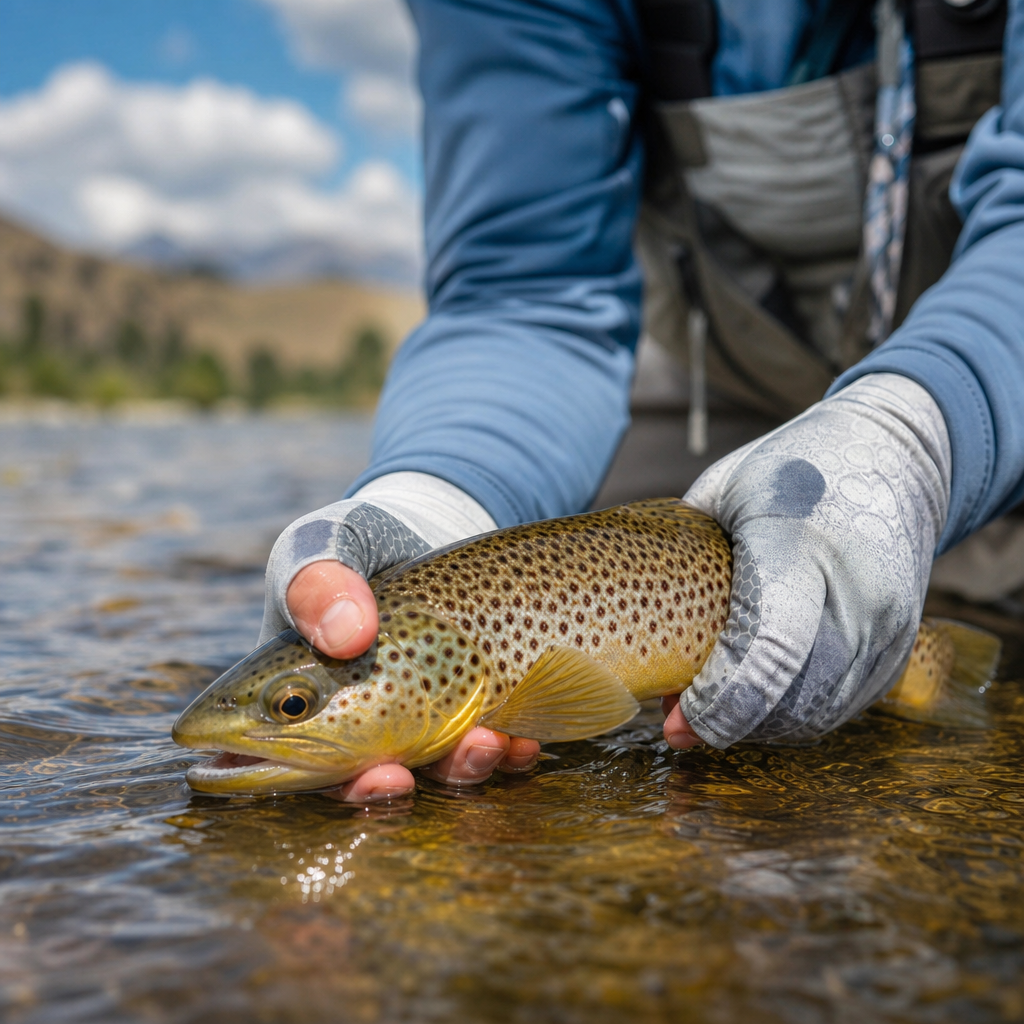
The right recommendation changes with conditions, so the best way to evaluate top fly fishing landing gloves is by scenario rather than brand hype. For cold-water trout, steelhead, and winter river fishing, a thin neoprene glove with a textured palm is usually the strongest choice. Models in the 1.5 mm to 2 mm range preserve enough dexterity for line control while still insulating during repeated hand immersion. For spring creeks, summer freestones, and drift boat trout fishing, fingerless or half-finger synthetic gloves with silicone or PU palm zones usually outperform bulkier cold-weather options. On saltwater flats, sun protection becomes part of landing performance because gloves stay on all day; UPF-rated, fast-drying fabrics with reinforced thumb and forefinger panels are ideal.
Below is a practical breakdown that mirrors how I categorize gloves during accessory reviews and field testing.
| Use case | Best glove style | Key features | Main tradeoff |
|---|---|---|---|
| Winter trout and steelhead | Thin neoprene full-finger | Insulation, wind resistance, textured palm, snug cuff | Reduced knot-tying dexterity |
| General trout fishing | Half-finger synthetic landing glove | Grip, tactile control, quick drying, low bulk | Less warmth in cold water |
| Saltwater flats | UPF sun glove with reinforced palm | Sun protection, abrasion resistance, casting comfort | Minimal insulation |
| Boat fishing for bass or pike | Rubberized fish-handling glove | Strong wet grip, puncture resistance, secure control | Can be too abrasive or bulky for trout |
| Budget backup pair | Light nitrile-coated work glove | Low cost, excellent grip, easy replacement | Fit, seams, and fish safety vary widely |
Among widely recognized brands, Simms, Fishpond, Glacier Glove, Gill, and Buff consistently appear in serious angler rotations because they understand fishing-specific movement. Simms sun gloves are often strong in warm-weather comfort and casting feel. Glacier Glove has long been a cold-weather reference point because its neoprene patterns prioritize utility over fashion. Fishpond accessories tend to integrate well with conservation-minded trout systems, especially when anglers use rubber nets and barbless hooks. Gill, though known strongly in sailing, produces waterproof and thermal handwear that some cold-condition fly anglers adapt successfully. The point is not that one brand wins universally, but that proven fishing brands usually design around wet dexterity better than generic outdoor gloves.
How landing gloves fit into a complete accessory reviews strategy
Because this page serves as a hub for accessory reviews, it helps to place landing gloves in the larger gear ecosystem. Gloves interact directly with landing nets, forceps, nippers, retractors, sling packs, waterproof packs, wading jackets, and even eyewear. If your glove catches on net mesh, it slows release. If it is too slick to open hemostats, the fish stays out of the water longer. If fingertips are too bulky to strip line cleanly, hook-set timing suffers before the landing phase even begins. When I review accessories, I test them as a system, not in isolation, because anglers experience gear as one chain of motions rather than separate product pages.
For trout anglers, the most relevant adjacent accessory is the rubber landing net. A fish-friendly net reduces the need for firm manual control, which means your glove can prioritize dexterity over brute grip. For streamer anglers and warmwater fly fishers targeting bass or pike, pliers and jaw-control techniques change what matters in a glove; abrasion resistance becomes more important. For saltwater anglers, sun gloves pair closely with stripping guards and long-sleeve technical shirts. In each case, gloves should support the larger setup rather than duplicate another accessory’s role. That is why a comprehensive product recommendation approach evaluates combinations: glove plus net, glove plus forceps, glove plus pack access, and glove plus climate protection.
There is also a maintenance dimension that many reviews ignore. Gloves live in a hard environment of fish slime, sunscreen, insect repellent, salt, mud, and constant wet-dry cycling. Saltwater gloves should be rinsed after every trip because salt crystallization stiffens seams and degrades coatings. Neoprene gloves last longer when dried inside out first, then fully aired, rather than left crumpled in a boat compartment. Sun gloves with synthetic fabrics can hold odor if stored wet, though enzyme-free sport washes help. These practical habits matter because accessory value is measured over seasons, not a single weekend.
Key buying factors: grip, fish safety, weather protection, and durability
If you are comparing top fly fishing landing gloves, start with palm texture. Smooth palms become unreliable once covered with water and fish slime. The best grip patterns are slightly raised and distributed across the zones that contact the net handle, fish tail wrist, and rod cork. Silicone dot patterns work well for light-duty trout use. Polyurethane overlays often last longer under repeated abrasion. Nitrile coatings provide exceptional traction, especially in cold wet conditions, but the coating should be flexible enough not to crack. Leather can work in mixed dry-wet use, yet once saturated it dries slowly and can stiffen unless carefully maintained.
Fish safety deserves explicit attention. Gloves should never encourage squeezing or rough fish handling. For trout, salmon, and char, soft and flexible surfaces are preferable to aggressive industrial textures. Wetting your glove before touching the fish helps reduce friction on the fish’s protective slime coat. If a glove has rough seams, exposed stitching, or rigid coatings, use the net as the main control point and minimize direct contact. This is especially important with wild trout in catch-and-release fisheries, where post-release survival depends on low handling stress. Ethical fish handling is not separate from product performance; it is one of the primary standards by which landing gloves should be judged.
Weather protection comes next. In cold environments, gloves should cut wind, retain warmth when damp, and avoid evaporative chill. Fold-back finger designs can be useful, but many create seam pressure points and snag line. In hot weather, ventilation and UPF ratings matter more than insulation. Dark gloves can become uncomfortably hot on open flats, while pale synthetic blends remain wearable all day. Durability is usually about reinforcements at the thumb crotch, index finger, and palm heel. Those are the zones that fail first from stripping line, rowing, handling net frames, and contact with boat decks or rocks. Double stitching, bonded overlays, and quality elastic recovery all separate premium gloves from disposable ones.
Best practices for testing and choosing the right pair
My testing process for landing gloves is simple and repeatable. I first evaluate dry fit and seam placement. Then I wet the gloves fully and check grip on a cork rod handle, aluminum net frame, and smooth forceps handles. Next comes dexterity: tying a clinch knot, opening a tippet spool, using a phone camera, and removing a barbless hook from a practice pad. Finally, I assess comfort after a few hours of actual fishing, because hotspots and cuff irritation rarely show up in five-minute trials. This sequence reveals weaknesses faster than marketing claims ever will. A glove that feels impressive in the shop can fail quickly once saturated and exposed to repetitive hand motions.
For buyers, the safest path is to choose one primary pair matched to your most common fishery and one backup pair for temperature swings. A Western trout angler might pair lightweight half-finger gloves for summer with thin neoprene for shoulder seasons. A Great Lakes steelhead angler may want insulated neoprene as the primary choice and a lighter synthetic pair for milder days. Saltwater anglers should prioritize sun protection, then add a more protective handling glove only if target species or boat conditions demand it. If you fish across many conditions, trying to force one glove to cover every scenario usually leads to compromise in the moments that matter most.
The final recommendation is practical: treat landing gloves as essential accessories, not optional extras. They improve grip, protect your hands, support faster releases, and make the rest of your gear work better. The top fly fishing landing gloves are the ones that match your water temperature, target species, and handling style while remaining comfortable enough to wear when the fish finally shows at the net. Use this hub as your starting point for accessory reviews, compare gloves by real conditions rather than slogans, and upgrade the pair you trust on the water before your next trip.
Frequently Asked Questions
What are fly fishing landing gloves, and do you really need them?
Fly fishing landing gloves are purpose-built gloves designed to help anglers control fish more safely during the landing and release process while also protecting their own hands. Unlike general cold-weather gloves or work gloves, good landing gloves focus on wet grip, dexterity, fish-safe materials, and comfort in cold or abrasive conditions. They are especially useful when handling energetic trout, steelhead, salmon, bass, or saltwater species that can twist, surge, or rub against your hands at the net.
Do you absolutely need them on every trip? Not always. But for many serious anglers, they quickly become one of those accessories that feels optional until you use a good pair consistently. Landing gloves help reduce line burns when fish make sudden runs, improve grip on wet nets and slippery fish, and make repeated releases easier on your hands in cold water. They can also help prevent small cuts, abrasion from gill plates or rough jaws, and the general wear that comes from landing multiple fish in a day. If you spend a lot of time wading cold rivers, fishing saltwater flats, or targeting hard-fighting fish, landing gloves can make a noticeable difference in both comfort and fish handling control.
The best reason to consider them is that they serve both angler and fish. When your hands are protected and your grip is more secure, you are less likely to fumble the landing, over-handle the fish, or squeeze harder than necessary. In that sense, landing gloves are not just a comfort accessory. They are part of an overall fish-care system that includes a good net, barbless hooks, efficient release practices, and minimizing time out of the water.
What features should you look for in the best fly fishing landing gloves?
The best fly fishing landing gloves balance grip, dexterity, comfort, and fish safety. Grip is usually the first priority. A landing glove should remain tacky and reliable when soaked, slimy, or exposed to cold conditions. This matters not only when you grab a fish or cradle the tail wrist, but also when you handle the net, manage fly line, or steady yourself in current. Materials such as textured synthetic palms, rubberized grip panels, and water-ready fabrics tend to perform much better than traditional knit or fleece-only gloves.
Dexterity is just as important. Fly anglers still need to strip line, tie knots, pinch barbs, unhook flies, and operate zippers or tools without feeling clumsy. That is why many of the best options use fingerless designs, half-finger cuts, or lightweight full-finger construction that preserves hand feel. If a glove is too bulky, you will probably stop wearing it when fishing gets technical. A good landing glove should disappear while casting and become useful the moment the fish is near the net.
Fit is another major factor that buyers often underestimate. A glove that is too loose can bunch up, reduce control, and slip when wet. A glove that is too tight can fatigue your hands and limit circulation in cold conditions. Look for a snug but flexible fit, reinforced seams, and materials that stretch without becoming baggy after repeated use. Wrist closure can also matter, especially in saltwater or colder environments where you want the glove to stay secure and avoid constant adjustment.
You should also pay attention to material choice from a fish-care perspective. Gloves that are overly abrasive, stiff, or rough can potentially remove protective slime or create unnecessary friction on a fish’s body. The safest landing gloves generally use smoother, fish-friendly contact surfaces while still maintaining control. Finally, think about where you fish most. For trout streams, you may prioritize dexterity and slim construction. For steelhead and salmon, durability and cold-weather protection may matter more. For saltwater flats, quick drying, sun protection, and corrosion-resistant construction become much more important.
Are landing gloves safe for trout and other catch-and-release fish?
They can be, but the answer depends entirely on the glove design and on how the angler uses them. Fish safety should always come first in catch-and-release fly fishing, and that means minimizing handling time, avoiding excessive pressure, and protecting the fish’s slime coat. A poorly chosen glove made from rough, absorbent, or abrasive material can create more risk than benefit. On the other hand, a well-designed landing glove used with wet hands, gentle handling, and quick release practices can help stabilize the fish without unnecessary fumbling or dropping.
For trout and other delicate species, the safest approach is to keep the fish in the water as much as possible, use a rubberized landing net, and touch the fish only when necessary. Gloves should be wet before contact, and they should be clean and free of sunscreen residue, insect repellent, or salt buildup. If the fish is small and easily controlled in the net, there may be no need to grip it directly at all. For larger fish or fish that need support during hook removal, a fish-friendly glove can help you maintain a light, controlled hold without chasing the fish around the net basket.
It is also important to understand that gloves are not a license to handle fish more aggressively. Even the best pair cannot compensate for poor release technique. Avoid squeezing the midsection, avoid lifting fish vertically unless species and size allow it safely, and limit time out of the water to only a few seconds when needed for a quick photo. For anglers who release most of what they catch, the ideal glove is one that improves control while encouraging faster, calmer, and more careful handling. In practical terms, that means smooth wettable materials, reliable grip, and enough dexterity to remove the fly quickly and let the fish recover.
Should you choose fingerless or full-finger fly fishing landing gloves?
The right choice depends on your fishing style, climate, and the species you target. Fingerless landing gloves are extremely popular in fly fishing because they preserve tactile feel for knot tying, fly changes, and line control. On technical trout water or during warm-weather fishing, fingerless models often provide the best overall balance. You get palm protection, better grip on wet fish and net handles, and some warmth, while your fingertips remain free for delicate tasks. Many anglers find they wear fingerless gloves all day because they interfere less with normal casting and rigging routines.
Full-finger gloves make more sense when conditions are colder, rougher, or more demanding on the hands. If you fish steelhead rivers in winter, spend long hours in cold drift boats, or handle species with abrasive mouths or hard runs, full-finger coverage can be a real advantage. They provide more complete protection from cold water, line friction, sun exposure, and repetitive abrasion. The tradeoff is that some full-finger models reduce sensitivity enough to make fine fly-fishing tasks frustrating, especially if they are bulky or poorly cut.
A lot of anglers solve this by choosing a lightweight full-finger glove with high dexterity, or by carrying both styles depending on the season. Fingerless gloves are often ideal for spring, summer, and early fall trout fishing, while full-finger models come into their own in cold weather and saltwater environments. If you only plan to buy one pair, think honestly about where discomfort affects your fishing most. If you hate cold hands and fish in shoulder seasons, lean toward full-finger. If you value touch and precision above everything, fingerless is usually the better all-around option.
How do you care for fly fishing landing gloves so they last longer and stay fish-friendly?
Proper care matters more than many anglers realize because landing gloves are constantly exposed to water, fish slime, mud, UV, sand, and salt. If you want them to remain effective and safe, rinse them after every trip, especially after saltwater use. Salt crystals can stiffen fabrics, degrade stitching, and reduce grip performance over time. A simple freshwater rinse followed by air drying in a shaded, ventilated area goes a long way toward preserving materials and preventing odor buildup.
It is also smart to wash them periodically with mild soap, particularly if they have picked up fish residue, algae, sunscreen, bug spray, or boat grime. Harsh detergents and high heat can break down synthetic grip surfaces and elastic fibers, so skip the dryer unless the manufacturer specifically says otherwise. Make sure the gloves dry fully before storing them, because damp storage encourages mildew, bad odors, and premature wear. If you fish frequently, rotating between two pairs can extend the life of both and ensure you always have a dry set available.
From a fish-care standpoint, keeping gloves clean is non-negotiable. Anything on the glove surface can potentially contact the fish, so avoid handling fuel, strong chemicals, or oily substances while wearing them. Inspect the palms and seams regularly for cracking, peeling, or rough spots that could become abrasive. Once a glove loses its smooth fish-contact qualities or its grip becomes unreliable, it is time to replace it. Well-maintained landing gloves can last a long time, but only if they are treated like technical fishing gear rather than tossed in a wet pile at the end of every outing.