Identifying caddis hatches is one of the most useful skills in fly fishing because it connects insect behavior, trout feeding patterns, and fly selection into a single practical system. In simple terms, a hatch is the period when aquatic insects become active and vulnerable, while match the hatch means choosing a fly that imitates the size, stage, color, and behavior trout are eating at that moment. Caddisflies matter because they are present on many trout streams for long stretches of the season, often emerging in heavy numbers and triggering aggressive feeding. I have found that anglers who can read a caddis event consistently catch fish even when exact pattern names change from region to region.
Caddis belong to the order Trichoptera, and unlike mayflies, they pass through egg, larva, pupa, and adult stages without a dun or spinner phase. That difference shapes how trout feed. During mayfly hatches, fish may lock onto delicate insects drifting on the surface. During caddis activity, trout often key on rising pupae, skittering adults, egg-laying females, or dislodged larvae tumbling near the bottom. If you only look for surface rises, you will miss much of the action. Learning to identify caddis hatches means watching the water column, streamside vegetation, current seams, and timing of emergence rather than relying on one visual clue.
This topic matters far beyond selecting a single dry fly. It sits at the center of any serious match the hatch approach because caddis force anglers to think in stages and behaviors. A pale olive pupa in a riffle may be more important than a tan adult in the air. A trout slashing at dusk may want an elk hair caddis twitched across the film, while fish hugging the bottom at noon may prefer a green rockworm or a soft hackle pupa. As a hub for techniques and strategies, this article explains how to identify the main signs of caddis hatches, how to distinguish life stages, what patterns solve common situations, and how to make fast streamside decisions that lead to better presentations.
What a caddis hatch looks like on the water
A caddis hatch usually announces itself through movement rather than elegance. Adults flutter low over riffles, bounce off the surface, gather on streamside rocks, or cluster in bankside vegetation. Trout often feed with sharp, splashy rises instead of slow sips because caddis adults are active and pupae ascend quickly. You may also see brief boils, porpoising just under the film, or fish swinging into current seams to intercept emergers. On many freestone rivers, the strongest clue is not airborne insects at all but shucks drifting in eddies and pupal cases collecting along foam lines.
Time of day helps narrow identification. Many species emerge in late morning through afternoon when water temperatures climb, but some of the most important adult activity happens near dusk, especially when females return to lay eggs. On tailwaters with stable temperatures, caddis can hatch more predictably and for longer durations. On snowmelt rivers, the hatch may compress into shorter windows after flows drop. Wind, cloud cover, and water release schedules also matter. I have seen strong emergence continue under overcast skies while bright midday sun pushed the best feeding into shaded banks and broken pocket water.
Look at where trout are positioned. Fish holding just below riffles often target ascending pupae because current concentrates insects before they break through the surface. Trout stationed tight to overhanging grasses may be taking adults that fell in during egg laying. Fish in softer edge water may be intercepting spent adults trapped in the film. Reading location is often more informative than counting bugs. If rises are random and violent across fast water, think emergers or skittering adults. If fish repeatedly nose through a foam seam, suspect trapped adults or dead egg layers.
Understanding caddis life stages for match the hatch success
The larval stage is common year round and should not be ignored. Free-living larvae such as green rockworms are bright olive to chartreuse and drift when current dislodges them. Case-building species live in protective homes made from gravel, sticks, or plant material, and they become important when high water or wading pressure loosens them from the bottom. Larval imitations work best dead drifted near the substrate with enough weight to stay in the feeding lane. They are not glamorous flies, but in many streams they provide the baseline food item before any visible hatch begins.
Pupae are usually the key stage during a hatch. As they prepare to emerge, caddis pupae develop gas bubbles under the shuck that help them rise quickly. This trapped gas creates a bright, flashy look, which is why pupa patterns often include pearl, antron, or sparse dubbing that suggests translucence. Trout recognize that upward movement. A dead drift with a lift at the end of the swing often outperforms a static presentation because it imitates the natural ascent. If fish are bulging just below the film and refusing dries, the pupa is almost always the missing piece.
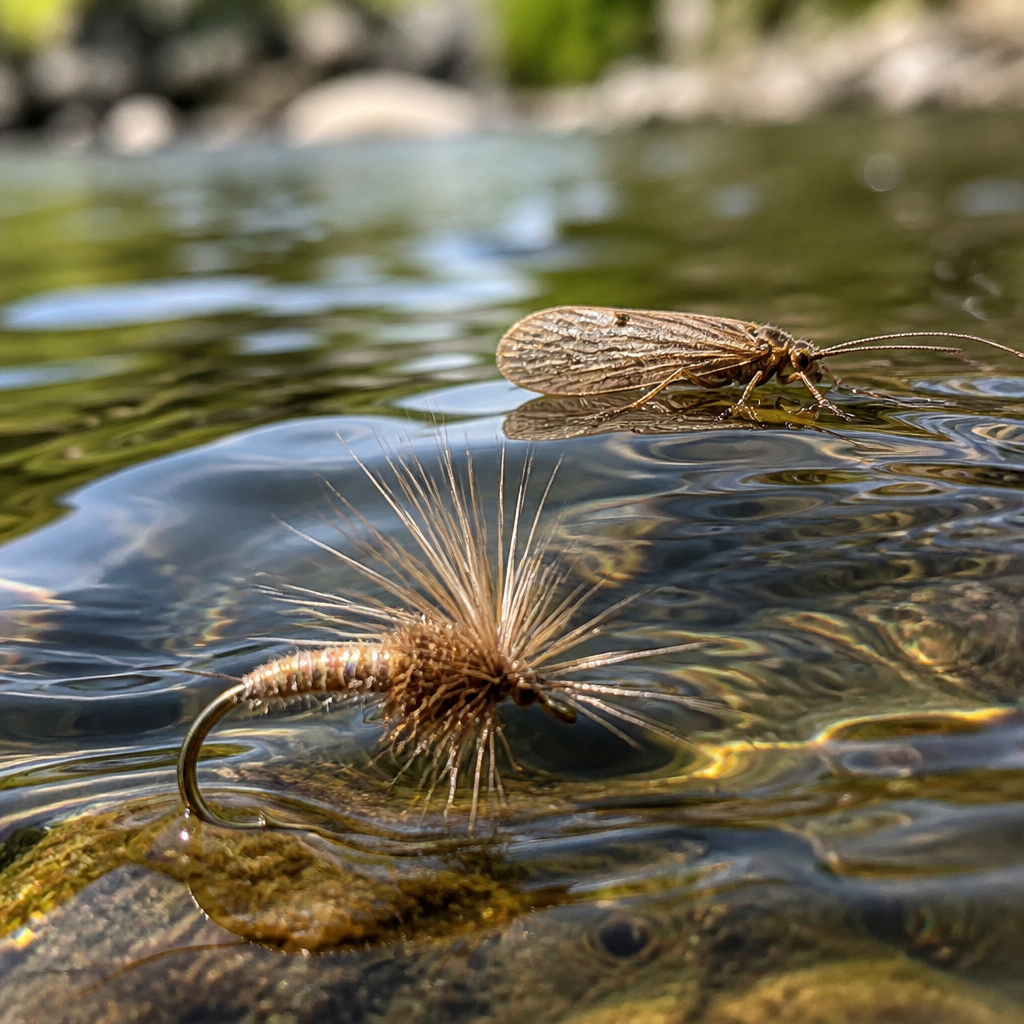
Adults are what most anglers notice first, but matching adults requires more than choosing tan or olive. Profile, wing tent shape, body size, and behavior all matter. Sedges commonly range from black and dark brown to cinnamon, gray, olive, and cream depending on species and region. Some adults skate and flutter rapidly, while others sit low and drift helplessly when trapped. Egg-laying behavior can be dramatic: females may dive, crawl under the surface, or repeatedly touch down to deposit eggs. These actions justify patterns fished dry, swung wet, or even stripped back under tension.
How to identify species, size, and color without overcomplicating it
You do not need an entomology lab to identify caddis hatches, but you do need a method. Start with size because trout are often more selective about size than exact shade. Carry a small streamside box with common caddis in sizes 12 through 20, plus a seine or aquarium net to sample drift in the margin. Check rocks for shucks, sweep streamside branches for adults, and compare what you see to your flies under natural light. When anglers say they cannot tell species apart, the real problem is often that they are not narrowing the field by water type, season, and body length.
Color should be grouped into useful families: olive or green, tan or amber, brown, black, and cream. This is more practical than chasing every Latin name. For example, Hydropsyche species often produce tan to olive adults and pale pupae that emerge in riffled water, while Brachycentrus, commonly called grannoms, can create dense spring hatches with dark adults and bright green larvae. In the West, October caddis stand apart because they are unusually large and orange. In limestone creeks, small dark caddis may dominate. The point is to connect recurring categories to local hatch calendars and stream character.
| Clue | What it usually means | Best starting pattern |
|---|---|---|
| Bright green insects in drift seine | Larvae or pre-emergent pupae are active | Green larva or soft hackle pupa |
| Splashy rises in riffles | Ascending pupae or skittering adults | Sparkle pupa, then elk hair caddis |
| Adults bouncing at dusk near banks | Egg-laying flight | Low-floating caddis twitched near cover |
| Shucks collecting in foam lines | Recent or ongoing emergence | Emergent pupa in film |
| Large orange adults in fall | October caddis presence | Oversized orange stimulator or pupa |
Reading trout feeding behavior during a caddis event
Trout tell you the stage if you watch carefully. Splashing, chasing, and missed strikes usually indicate active insects, especially adults skittering or pupae rocketing upward. Subtle bulges that leave only a push in the film often mean fish are taking emergers just below the surface. Repeated head-and-tail rises in one lane can point to trapped adults. Deep flashes without surface disturbance often reveal subsurface feeding on larvae or pupae. I routinely spend the first five minutes of a hatch watching one productive seam before I tie on anything, because the fish often solve the puzzle for you.
Current speed changes how selective trout become. In broken pocket water, fish have little time to inspect a fly, so a correct size and lively presentation can beat perfect color. In smooth spring creek glides, the opposite is often true. Trout may reject a high-floating caddis if naturals are trapped flush in the film. Position also matters. During emergence, the best fish frequently sit where fast water spills into a softer cushion, using current to deliver pupae. During egg laying, they may move shallow under alders or to side channels where adults gather. The hatch is not static, and your target water should not be either.
Another common mistake is staying with one pattern after trout behavior changes. Early in the window, a beadless pupa swung upward may draw strikes. Mid-hatch, a soft hackle in the film may be ideal. Near dark, an adult pattern skated across the current can become the top producer. Strong anglers treat caddis hatches as sequences. They rotate from subsurface to surface and back again as evidence changes. That approach mirrors what trout see: larvae drifting occasionally, pupae rising in bursts, adults escaping, and females returning later to deposit eggs.
Effective caddis patterns and when to fish them
The elk hair caddis remains a standard because it is buoyant, visible, and suggestive rather than exact. Its swept wing and hackled body imitate many adults well enough on freestones, and it can be dead drifted, twitched, or skated. For lower-riding imitations, patterns like the X-Caddis or CDC caddis excel when trout are taking adults flush in the film. If fish are slashing but missing your dry, clip the hackle underside or switch to a spent or cripple style. Many refusals happen because a pattern rides too high compared with battered naturals.
For subsurface work, a simple caddis pupa with a slim dubbed body, sparse flash, and soft hackle is hard to beat. LaFontaine-inspired sparkle pupae remain influential because they imitate the gaseous sheen of emerging insects. Swinging soft hackles across riffles is especially effective during active emergence, while euro-style anglers often tight-line pupa patterns through seams where trout hold below the hatch. Larval patterns should be slim, curved, and appropriately weighted. Bright green caddis larvae, pepper caddis, and case larva imitations all have places depending on local species and flow conditions.
Large seasonal events justify specialized flies. During a grannom hatch, dark adults and vivid green pupa patterns can be essential, particularly in Eastern rivers where trout key tightly on the timing. During October caddis activity, standard size 16 dries are simply too small; use size 8 to 10 patterns with orange or cinnamon tones. On technical spring creeks, tiny black caddis may call for sparse CDC adults and fine-tippet presentations. The lesson is practical: build your caddis box around the hatch calendar of your watershed, not around random fly shop variety.
Presentation techniques that make caddis imitations believable
Presentation usually decides whether a good caddis pattern actually works. Dead drift is important, but caddis often demand controlled movement. A pupa should rise at the end of the drift, either by tightening line on the swing or by adding a gentle hand-twist retrieve. Adults can be twitched in place, skated across a seam, or allowed to bounce under overhanging cover during egg laying. These are not gimmicks. They reflect real behavior that trout expect. If your imitation never moves during a caddis hatch, you are ignoring one of the insects most distinctive traits.
Leader design supports that behavior. For dry flies, a 9-foot leader tapered to 4X or 5X covers most rivers, though tiny technical caddis may need 6X. For swinging pupae, slightly shorter leaders improve control. Grease only the butt and midsection when you want a pupa to fish in or below the film. Mending should preserve a natural lane first and animation second. The best drifts combine stealth, line control, and timing. In riffled water, quartering downstream and letting the fly rise naturally can be more convincing than casting straight upstream every time.
Two-fly systems are also effective when identification is uncertain. A buoyant adult can suspend a pupa dropper in the upper column, showing whether trout prefer the surface or just below it. In deeper runs, pair a weighted larva with an unweighted pupa to cover both baseline and hatch behavior. Watch your takes closely. If fish boil near the dry but eat the dropper, they are not fully committed to adults. If they slash at the dry after refusing the pupa, the hatch has advanced. Rigging this way shortens the learning curve on unfamiliar water.
Common mistakes and a reliable streamside decision process
The biggest mistake is assuming every visible caddis means fish want a dry fly. Often the strongest feeding happens on pupae before adults become obvious. Another error is matching color while ignoring size and stage. Anglers also fish one lane too long, overlook bankside egg laying, or fail to inspect naturals directly. I have watched fishermen cast at random rises for half an hour when a quick look at a seam would have revealed olive pupae popping under the film. Observation is faster than guesswork and usually more productive than changing flies blindly.
A reliable decision process is simple. First, confirm caddis presence by seeing adults, shucks, or sampled insects. Second, identify the likely stage from trout behavior and where fish are feeding. Third, choose one fly that matches the stage and one presentation that reflects natural movement. Fourth, give that setup a fair test in the right water, not just any water. Fifth, adjust only one variable at a time: stage, size, depth, or movement. This prevents the common spiral of changing everything at once and learning nothing.
Match the hatch becomes practical when you treat caddis as a sequence of clues instead of a single bug name. Learn the life cycle, watch trout position, sample the water, and carry patterns that cover larva, pupa, adult, and egg-laying behavior. The reward is not just more fish, but faster, calmer decisions on the river. As you build out your techniques and strategies, use this caddis framework as the foundation for reading any hatch. The next time trout start slashing in a riffle, pause, identify the stage, and fish the pattern that matches what is happening now.
Frequently Asked Questions
What does it mean to identify a caddis hatch, and why is it so important in fly fishing?
Identifying a caddis hatch means recognizing when caddisflies are becoming active, which life stage trout are focused on, and how that activity affects feeding behavior. In practical fly fishing terms, it is not just about seeing insects in the air. It is about understanding the full sequence: larvae drifting or rising, pupae ascending toward the surface, adults emerging, adults skittering, and sometimes females returning to the water to lay eggs. Each of those moments can trigger very different feeding responses from trout, and each one often calls for a different fly pattern and presentation.
This skill matters because caddisflies are among the most important aquatic insects on many trout streams. They can hatch over broad portions of the season, appear in strong numbers, and create dependable feeding windows. When anglers say “match the hatch,” they are talking about selecting a fly that matches the size, color, stage, and behavior of what trout are actually eating. With caddis, that often means the fish may ignore a generic dry fly if they are keyed in on rising pupae just below the surface, or they may refuse a dead-drifted imitation if they are chasing skittering adults. In other words, identifying the hatch helps you move beyond guesswork and into a more systematic approach that connects insect activity directly to trout behavior.
The biggest advantage is efficiency. Instead of cycling through random patterns, you can observe what is happening, narrow down the likely stage, and fish more confidently. That saves time, improves your presentations, and usually increases hookups. For beginners, this creates a practical framework for reading the water. For experienced anglers, it becomes a way to fine-tune choices when trout are selective. Either way, identifying caddis hatches is one of the clearest paths to making smarter decisions on the stream.
How can I tell whether trout are feeding on caddis larvae, pupae, or adults?
The easiest way to tell is to combine direct observation of the insects with close attention to the trout’s feeding rhythm and location in the water column. If trout are holding near the bottom or in deeper seams and you are not seeing much surface activity, they may be taking larvae or early-stage pupae drifting naturally. Caddis larvae are usually available throughout the season and can become especially important when current dislodges them. In that situation, trout often feed steadily but without obvious rises, and subsurface patterns fished near the streambed are usually the best choice.
If fish are making quick, splashy, or slashing rises just under or through the film, there is a strong chance they are targeting ascending pupae or emerging adults. Caddis pupae are one of the most vulnerable stages because they actively rise toward the surface before emergence. Trout often respond aggressively to that movement. During this window, anglers may see fish break the surface erratically or flash beneath it. A pupa pattern swung, lifted, or drifted just under the film often outperforms a standard dry fly because it imitates the real behavior more closely.
When adults are the focus, the clues become more visible. You may see fluttering insects above the water, adults drifting in the surface film, or egg-laying females returning low to the water and skittering across it. Trout feeding on adults may rise more confidently in riffles, seams, and tailouts, especially late in the day. If they are calmly sipping, a dead-drift adult imitation may work well. If they are chasing and exploding on top, an elk hair style caddis or a skittered adult pattern may be the better match. The key is to avoid assuming all rises mean the same thing. The more you match trout behavior to insect stage, the more accurately you can choose your fly and presentation.
What are the most useful signs of a caddis hatch on the water?
Several signs can point to a caddis hatch, and the best anglers learn to watch for a combination rather than relying on a single clue. The most obvious sign is visible adult activity. If you see small, tent-winged insects fluttering above riffles, collecting in streamside vegetation, or bouncing along the surface, caddis are likely involved. Their flight is often quick, erratic, and moth-like, which helps distinguish them from mayflies. You may also notice adults returning to the water in the evening to lay eggs, sometimes skittering or dipping onto the surface repeatedly. That behavior can create brief but intense feeding windows.
Another major sign is trout rise form. Caddis feeders often produce splashier takes than fish sipping delicate mayflies, especially when trout are intercepting emerging pupae or chasing adults. Watch where the rises occur. Fast riffles, broken pocket water, and current seams are classic caddis water because those areas suit both insect activity and confident trout feeding. Surface dimples, flashes just under the film, or fish porpoising in transition water can all signal that caddis pupae are ascending.
Physical evidence is just as valuable. Turn over a few streamside rocks and look for caddis larvae cases or free-living larvae, depending on the species in the stream. Use a small seine, aquarium net, or even a close visual scan of the waterline to look for shucks, emergers, and adults. Pay attention to size and color, not just presence. Two caddis hatches can overlap, and being even one size off can matter when trout are selective. Finally, notice timing. Many caddis species become especially active in low light, late afternoon, or evening, though some hatch earlier. If you begin to connect time of day, water type, insect appearance, and rise behavior, you will start to recognize caddis hatches much faster and with much more confidence.
Which fly patterns and presentations work best when matching a caddis hatch?
The best patterns depend on the life stage trout are feeding on, which is why identifying the hatch comes first. For larvae, a simple caddis larva imitation in olive, green, tan, or cream can be extremely effective. Fish it near the bottom with a natural dead drift through riffles, seams, and runs where trout are holding. If the fish are not rising and you suspect subsurface feeding, this is often the most logical place to start. A lightly weighted larva or a two-fly rig under an indicator can help keep the fly in the zone long enough for trout to notice it.
For pupae, many anglers see the biggest jump in success. An emerger or pupa pattern, especially in the right size and silhouette, can be deadly when trout are focused on ascending insects. These flies work well on a dead drift, but they often become even more convincing when allowed to rise at the end of the drift or swing across the current. That upward motion mimics the natural behavior of caddis pupae heading to the surface. Fish that ignore a dry fly will often take a pupa presented just under the film because that is the exact stage they are targeting.
For adults, classic patterns like elk hair caddis styles remain popular because they float well, suggest the correct profile, and can be fished in more than one way. If trout are taking spent or drifting adults, present the fly dead drift. If they are reacting to active egg-layers, add subtle motion by twitching or skittering the fly across the surface. Soft hackles and wet flies can also be excellent crossover choices during caddis activity because they suggest movement so naturally. The most important point is that fly selection and presentation should support each other. A perfect-looking imitation fished the wrong way is often less effective than a slightly less exact pattern moved in a way that matches the real insect.
How do size, color, and behavior affect success when trying to match a caddis hatch?
Size, color, and behavior are the three details that most consistently determine whether your imitation looks believable to trout. Size usually comes first. Even when fish are feeding aggressively, trout often key in on a narrow size range during a hatch. If natural caddis are small and your fly is noticeably larger, refusals can happen quickly. A close match in length and profile gives you a much better starting point than relying on a general “caddis-looking” fly. Carrying multiple sizes of your most trusted larva, pupa, and adult patterns is one of the simplest ways to stay adaptable.
Color matters too, but not always in the way anglers assume. You generally do not need an exact paint-chart match, but you should stay within the right family. Caddis can range through tan, olive, gray, brown, cream, and even brighter shades depending on species and stage. Pupae often appear more vivid than adults, and wet insects can look darker than dry ones. Looking at naturals in your hand or against the water can help you judge color more accurately than observing them in flight. If trout are inspecting your fly and refusing it, adjusting color by one step lighter or darker can make a difference.
Behavior is often the deciding factor. Trout do not just eat what an insect looks like; they respond to how it moves and where it appears in the water. A caddis pupa that rises