Choosing the best fly fishing portable batteries is no longer a niche gear decision; it is a practical power-management choice that affects safety, efficiency, and time on the water. In the last few seasons, I have tested portable batteries on drift boats, rafts, skiffs, and bank-fishing setups, and the pattern is clear: anglers now rely on electronics that demand clean, dependable power. Fish finders, smartphone mapping apps, action cameras, USB lights, electric pumps, and small trolling motors all compete for runtime. A poor battery choice means dead screens, slow charging, added weight, and avoidable frustration in remote conditions.
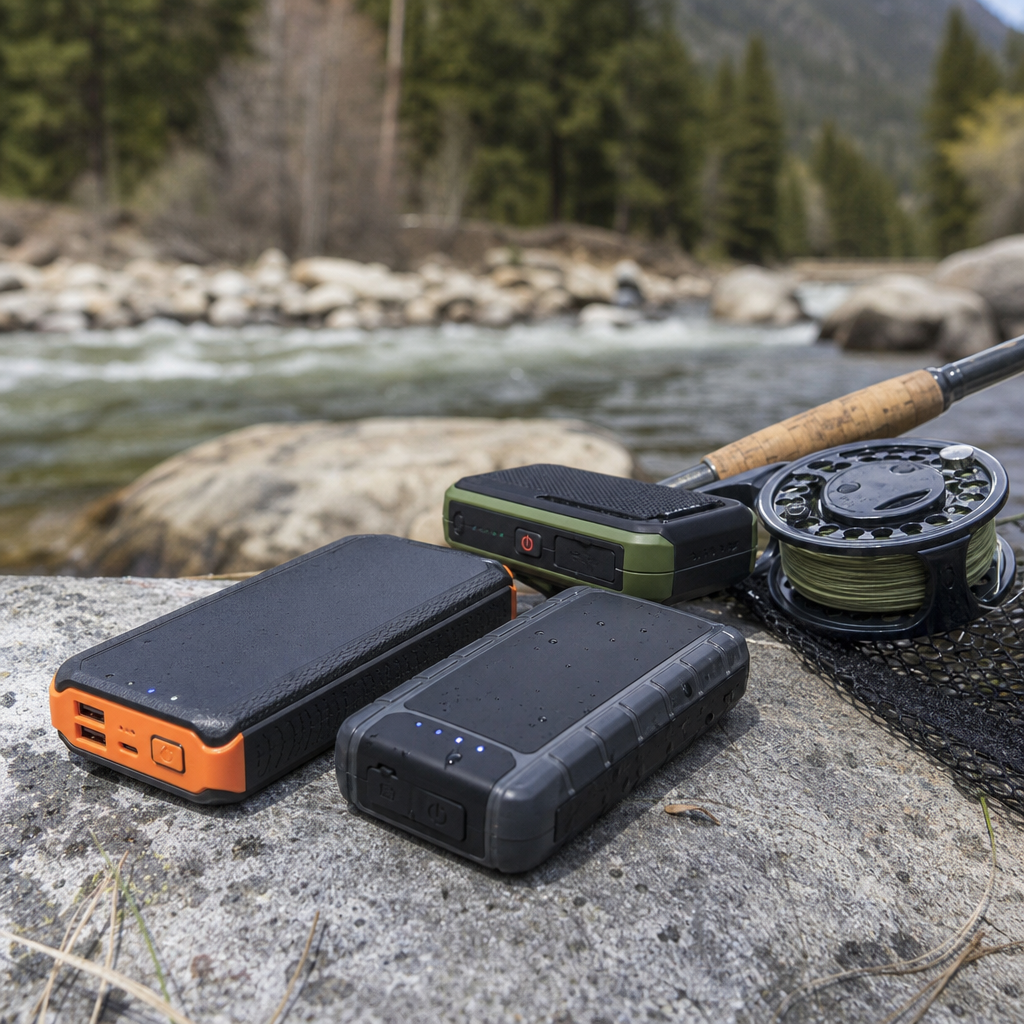
Portable batteries for fly fishing generally fall into three categories: compact USB power banks, mid-capacity lithium power stations, and dedicated 12-volt lithium batteries. Each category solves a different problem. A power bank keeps a phone and headlamp alive during a long wade. A power station can run a sonar unit, charge camera batteries, and support camp lighting for a weekend. A 12-volt lithium battery is usually the best answer for anglers running fish finders or electric inflatables that need stable DC output. Understanding those distinctions matters more than chasing the highest advertised capacity.
The term “portable battery” is also used loosely in product marketing, which is why many buyers end up with the wrong unit. Capacity is usually listed in milliamp-hours for small power banks and watt-hours or amp-hours for larger systems. Those numbers are not interchangeable without conversion. Output matters just as much as capacity. A battery with plenty of stored energy may still fail if it cannot deliver the required voltage, current, or connector type for your electronics. Weather resistance, charging speed, battery chemistry, and battery management systems are equally important in fly fishing, where wet hands, temperature swings, and long distances from shore power are normal conditions.
This hub article reviews the best fly fishing portable batteries by use case, not by hype. It covers what to buy for day trips, rafts, travel kits, and camp-supported river missions, while also explaining the technical details that actually influence performance. If you are building a reliable technology setup under the broader product reviews and recommendations category, this is the page that helps you compare options, avoid common mistakes, and choose a battery that fits how you fish.
What Makes a Portable Battery Good for Fly Fishing
The best fly fishing portable battery is one that delivers the right power, in the right form factor, with enough durability for wet, mobile use. In practice, five criteria separate worthwhile products from generic electronics accessories. First is usable capacity. Manufacturers often advertise idealized capacity numbers measured at internal cell voltage, but real usable output is lower after conversion losses. As a rule, a 10,000 mAh USB power bank will not fully deliver 10,000 mAh at 5 volts to your device. Expect roughly 60 to 75 percent usable energy depending on conversion efficiency, cable quality, and temperature.
Second is output flexibility. A fly angler carrying a phone, a Garmin inReach Mini, a GoPro, and a modern fish finder needs more than one port. USB-A still matters for older cables, but USB-C Power Delivery is now the most important standard because it supports fast charging and wider device compatibility. For sonar units and pumps, regulated 12-volt DC output is often essential. Third is durability. Water resistance ratings such as IPX4 or IP67 are useful shorthand, but they do not replace good port covers, corrosion-resistant terminals, and robust casing. I trust real-world sealing and drop resistance more than glossy claims.
Fourth is weight-to-runtime efficiency. Ounce for ounce, lithium iron phosphate and lithium-ion batteries outperform sealed lead-acid batteries for portable fishing use. Lead-acid remains inexpensive, but it is heavier, slower to recharge, and suffers more when repeatedly deep-cycled. Fifth is charging logistics. If a battery takes ten hours to recharge from a weak wall charger, it becomes less practical for multi-day travel. Fast USB-C input, solar compatibility, and standard AC charging all add useful flexibility depending on trip style.
When anglers ask what size battery they need, the answer begins with their electronics list. A phone may need 10 to 15 watt-hours per full charge, a compact sonar may draw 5 to 15 watts continuously, and an action camera battery charger may consume 8 to 20 watts depending on model. Add those loads honestly, then build in reserve. On the water, a margin of safety is not a luxury; it is part of the system.
Best Battery Categories and Who Should Buy Them
Not every angler needs a power station, and not every raft angler should rely on a pocket power bank. Matching battery class to fishing style is the fastest route to a good purchase decision. For minimalist walk-and-wade anglers, the best portable battery is usually a rugged USB-C power bank between 10,000 and 20,000 mAh. Models from Nitecore, Anker, and BioLite routinely perform well because they balance compact size, dependable circuitry, and realistic charging speed. This category is ideal for keeping a phone, satellite communicator, and headlamp charged during full-day trips or overnight outings.
For raft anglers using fish finders, camera gear, and inflator pumps, the best choice is often a dedicated 12-volt lithium battery in the 10Ah to 30Ah range. Dakota Lithium, Amped Outdoors, and Norsk Lithium are widely used in small-boat fishing because they offer stable voltage, built-in battery management systems, and large cycle-life advantages over lead-acid alternatives. In my experience, a 12Ah or 14Ah lithium battery is enough for many sonar-only day trips, while 23Ah or more provides comfortable reserve for longer floats or additional accessories.
For anglers who combine fishing with vehicle-based camping, photography, or multi-device charging, compact power stations from Jackery, EcoFlow, Goal Zero, and Bluetti make the most sense. These units are bulkier, but they simplify camp power by combining AC outlets, USB-C ports, 12-volt outputs, display screens, and advanced charging controls in one housing. They are particularly useful on destination trips where batteries must support phones, drones, lights, camera chargers, and navigation devices over several days.
| Battery type | Best use | Typical capacity | Main advantage | Main limitation |
|---|---|---|---|---|
| USB-C power bank | Wade fishing, travel, emergency charging | 10,000 to 27,000 mAh | Lightweight and pocketable | Limited 12V support for sonar |
| 12V lithium battery | Rafts, fish finders, pumps | 10Ah to 30Ah | Stable DC power and long cycle life | Requires separate charger in some kits |
| Portable power station | Basecamp, vehicle trips, multi-device charging | 150Wh to 500Wh | Multiple outputs in one unit | Heavier and more expensive |
If you want one simple rule, use a power bank for personal electronics, a 12-volt lithium battery for boat electronics, and a power station for camp systems. That framework prevents most bad purchases.
Top Portable Battery Recommendations by Use Case
For ultralight fly fishing, I consistently recommend the Nitecore NB10000 Gen 3 or a comparable premium power bank. It is popular among backpackers for a reason: low weight, efficient USB-C charging, and a carbon-fiber-reinforced shell that stands up well to hard travel. For anglers who prioritize more capacity over absolute weight savings, the Anker 737 Power Bank is a stronger technology play. It supports high-watt USB-C output, charges modern phones and tablets quickly, and gives better visibility into charge status. It is not tiny, but for travel and day-long fishing with navigation and camera use, it is one of the better all-around options.
For sonar-driven raft fishing, a Dakota Lithium 12V 10Ah or 12Ah battery is a proven baseline. These batteries are widely trusted because lithium iron phosphate chemistry offers excellent cycle life, flat discharge behavior, and lower weight than sealed lead-acid. A Garmin STRIKER or Humminbird HELIX unit generally benefits from that steady power delivery. Amped Outdoors also earns strong marks, especially among anglers who want robust connectors and practical marine integration. The best value often appears in this middle class, where the battery is small enough to carry but powerful enough for serious electronics use.
For camp-based trips, the EcoFlow River 2 and Jackery Explorer 300 class deserve attention. The River 2 stands out for fast recharging and lithium iron phosphate longevity, while Jackery has built a reputation for straightforward operation and dependable customer support. Goal Zero still matters because of its ecosystem approach, especially if you want compatible solar panels, lights, and cables in one family of products. Bluetti’s compact units often offer favorable watt-hour value, though you should verify dimensions and output layout before buying because not every model is equally packable.
The “best” model changes with your fishing style, but the strongest products all share a few traits: honest capacity, reliable output regulation, clear displays or indicators, and connectors that do not feel like an afterthought. Those details affect satisfaction more than branding.
How to Calculate Runtime and Avoid Common Buying Mistakes
The most common battery mistake in fly fishing is buying by advertised capacity alone. Runtime should be estimated in watt-hours because watt-hours allow direct comparison across devices. The formula is simple: watt-hours equal volts multiplied by amp-hours. A 12V 10Ah battery stores about 120Wh. If your fish finder draws 8 watts on average, ideal runtime is around 15 hours. Real runtime will be somewhat lower because of conversion losses, screen brightness, temperature, and reserve cutoff from the battery management system.
For USB gear, use the same logic. If your phone battery is roughly 4,500 mAh at about 3.85 volts, that is roughly 17Wh. A 20,000 mAh power bank may sound huge, but at nominal cell voltage it might store around 74Wh before losses. After conversion, you may get around three to four full phone charges, not five or six. This is normal, not a defect.
Another buying mistake is ignoring voltage requirements. Some fish finders are sensitive to voltage drop, especially when backlight and GPS are active. A cheap power bank with a weak 12V trigger cable can cause shutdowns or erratic behavior. Dedicated 12V lithium batteries usually solve that problem better than improvised adapters. Connector quality is another overlooked issue. SAE plugs, alligator clips, ring terminals, and barrel connectors all have tradeoffs. For wet boats, I prefer secure, strain-relieved connections with minimal exposed metal.
Temperature also matters. Lithium batteries generally perform better than lead-acid in discharge efficiency, but charging some lithium chemistries below freezing can be problematic unless the battery includes low-temperature protection or internal heating. If you fish tailwaters in winter or travel into shoulder-season mountain conditions, verify the charging temperature specification before you buy.
Durability, Charging, and Long-Term Value
Portable batteries live hard lives in fishing. They get stepped on in rafts, bounced in truck beds, sprayed with river water, and stored in cold garages. That is why long-term value depends on more than purchase price. Battery chemistry is central here. Lithium iron phosphate batteries usually provide far more charge cycles than sealed lead-acid and many standard lithium-ion packs. Over years of frequent use, that difference often makes the higher initial cost worthwhile. It also means more stable voltage under load, which sensitive electronics appreciate.
Charging speed and charger quality deserve equal attention. Fast input charging is a real advantage before early departures or between float days. EcoFlow’s fast AC charging has set a strong standard in compact power stations, while USB-C PD charging has improved premium power banks dramatically. For dedicated 12V batteries, use chargers recommended by the manufacturer, especially with LiFePO4 chemistry. Mismatched chargers can reduce battery life or fail to top-balance cells correctly.
Maintenance is simple but important. Store batteries partially charged if they will sit for months, inspect terminals for corrosion, avoid prolonged high heat in parked vehicles, and protect ports from grit and moisture. I also recommend labeling cables and keeping one waterproof pouch strictly for power gear. Most “battery failures” I see on fishing trips are really cable failures, bad adapters, or wet connection points.
If you are building a dependable technology setup for fly fishing, invest first in power reliability, then in extra accessories. A modest but well-matched battery will outperform a bigger, poorly integrated one every time.
How This Hub Fits the Broader Technology Reviews Category
This page serves as the central guide for battery buying within a broader technology reviews and recommendations library. Portable batteries connect directly to other fishing tech decisions, including fish finder selection, GPS and satellite communication tools, camp lighting, camera systems, and charging accessories. If you review or compare those products separately, use this hub as the reference point for understanding power demand, connector compatibility, expected runtime, and field durability.
The key takeaway is straightforward. Buy the battery for the load, not for the marketing. Choose a rugged USB-C power bank for personal devices, a dedicated 12V lithium battery for sonar and small-boat electronics, and a compact power station for camp-centered multi-device use. Prioritize real watt-hours, output standards, weather resistance, and recharge speed. Those factors determine success on the water far more than inflated capacity claims.
Reliable portable power keeps maps available, safety devices charged, sonar running, and cameras ready when the fishing turns memorable. If you are upgrading your fly fishing technology kit, start by auditing your actual devices and power draw, then select the smallest battery that covers them with reserve. That approach saves weight, prevents dead electronics, and gives you a system you can trust trip after trip.
Frequently Asked Questions
What should I look for when choosing the best portable battery for fly fishing?
The best portable battery for fly fishing should match the way you actually fish, not just the biggest capacity number on the label. Start with your power needs. If you only need to keep a phone, headlamp, or small USB light charged, a compact power bank may be enough. If you are running a fish finder, electric pump, action camera, or a small trolling motor, you need to think in terms of battery chemistry, voltage, amp-hour capacity, port options, recharge speed, and overall durability. In practical use, the biggest mistake anglers make is buying a battery that is either underpowered for their electronics or unnecessarily heavy for the type of water access they use.
Battery chemistry matters a lot. Lithium iron phosphate, often called LiFePO4, has become a top choice for many anglers because it is lighter than traditional sealed lead-acid batteries, offers more usable capacity, charges faster, and generally lasts for far more charge cycles. That makes a real difference when you are carrying gear to a remote bank spot or trying to keep weight under control in a raft or drift boat. Sealed lead-acid batteries can still work, especially for anglers on a tight budget, but they are heavier and less efficient in repeated use.
You should also pay close attention to output options. Many fly fishing setups now depend on a mix of devices, so having USB-A, USB-C, 12V DC, or even AC output can be useful depending on your equipment. Waterproofing or at least strong water resistance is another major factor. Fly fishing environments are wet by nature, and gear gets splashed, dropped, and exposed to changing weather. A battery with a rugged case, secure port covers, and reliable build quality is worth paying for. Finally, consider portability in realistic terms. A battery that is easy to carry, easy to secure in the boat, and simple to recharge between trips is usually a better long-term choice than an oversized unit that becomes a hassle every time you head to the water.
How much battery capacity do I need for a typical fly fishing trip?
The right battery capacity depends on the devices you run, how long you are on the water, and whether you need emergency reserve power. A short evening session from the bank may only require enough capacity to top off a phone and power a small light. A full-day float with a fish finder, regular phone GPS use, camera charging, and an electric pump requires much more reserve. In general, it helps to think about your setup by total daily power draw rather than buying based on generic marketing terms like “all-day power.”
For lighter use, a small portable battery in the 10,000mAh to 20,000mAh range may handle phones, cameras, and USB accessories well. Once you move into boat electronics, especially 12V devices like fish finders and pumps, you should start looking at amp-hour ratings and actual watt-hour capacity. A 12V 10Ah lithium battery, for example, can be adequate for a compact fish finder over a moderate outing, while a larger 20Ah or 30Ah unit offers more peace of mind for all-day trips or multiple devices. If a small trolling motor enters the equation, capacity demands rise quickly, and you need to size the battery specifically to the motor’s draw and your expected run time.
A smart approach is to calculate your expected load, then add margin. If your electronics should theoretically consume a certain amount of power over eight hours, do not buy a battery that only just meets that number on paper. Real-world conditions reduce efficiency, and cold weather, older devices, screen brightness, constant sonar use, and repeated charging cycles all affect performance. For fly anglers, reserve power is not just about convenience. It can be a safety issue if your phone handles navigation, communication, or weather updates. Choosing slightly more capacity than you think you need is usually the better decision, as long as the added size and weight still fit your style of fishing.
Are lithium portable batteries better than lead-acid batteries for fly fishing use?
For most anglers, yes, lithium batteries are the better option for fly fishing, especially if portability, efficiency, and long-term value matter. Lithium batteries, particularly LiFePO4 models, have several advantages that become obvious on the water. They are significantly lighter for the same usable power, they maintain voltage more consistently during discharge, and they usually recharge much faster than lead-acid alternatives. Those benefits are especially important when you are loading and unloading a drift boat, packing into walk-in access spots, or trying to keep a raft setup streamlined and balanced.
Another major advantage is usable capacity. With many lead-acid batteries, draining too deeply can shorten lifespan, so you often cannot safely use the full rated capacity. Lithium batteries generally allow a much deeper discharge without the same level of long-term damage, which means more of the battery’s stated power is practically available. Over time, lithium also tends to offer better cycle life, so frequent anglers often get more years of dependable use. For anyone regularly powering sonar units, maps, lights, cameras, or pumps, that reliability is a real asset rather than a spec-sheet talking point.
That said, lead-acid batteries are not useless. They can still be a workable choice for anglers who fish close to home, do not move gear very far, and want a lower upfront cost. Some larger boat setups also continue to use them successfully. The tradeoff is weight, bulk, and lower efficiency. For a fly fishing article focused on the best portable batteries, lithium usually wins because portability is part of the core requirement. If you want cleaner power delivery, less carrying burden, and a battery that better matches modern electronic demands, lithium is generally the stronger choice.
Can a portable battery safely power fish finders, phones, cameras, pumps, and small trolling motors?
Yes, a well-matched portable battery can safely power all of those devices, but only if the battery is properly sized and the outputs are compatible with the electronics you plan to use. Fish finders, smartphones, action cameras, USB lights, and small electric pumps are all common loads for modern fly anglers, and many portable battery systems are built specifically for this kind of mixed use. The key is understanding that “can power” and “can power well” are not always the same thing. A battery may technically connect to a device, but if the voltage is wrong, the current output is limited, or the capacity is too low, performance can suffer.
For small electronics like phones and cameras, quality USB outputs are usually enough. For fish finders and pumps, 12V output is often essential, and a stable, regulated supply helps equipment run more reliably. Trolling motors are where you need to be especially careful. Even a small trolling motor can draw far more power than phones or sonar units, and not every portable battery is designed for that kind of sustained load. Before connecting one, check the motor’s voltage requirements, peak and continuous current draw, and the battery’s discharge rating. A battery that works beautifully for electronics may not be suitable for propulsion.
Safety also depends on construction quality. Look for portable batteries with built-in battery management systems, short-circuit protection, overcharge protection, over-discharge protection, and temperature safeguards. Good cable management matters too. Wet environments make clean, secure connections even more important. If you use adapters, extension leads, or accessory plugs, make sure they are marine-appropriate and firmly connected. In real fishing conditions, the safest portable battery setup is the one that has enough capacity, the right ports, the proper protection features, and a simple layout that does not become a mess once the weather shifts or the deck gets wet.
How do I protect and maintain a portable battery for long-term reliability on the water?
Portable battery maintenance is simpler than many anglers think, but it matters a lot if you want dependable performance season after season. The first rule is to protect the battery from unnecessary water exposure, even if it is marketed as weather-resistant. Splash resistance is not the same as complete waterproofing. Keep the battery in a secure, elevated position when possible, and consider using a dry bag, hard case, or protected battery box for transport and storage. In boats and rafts, secure mounting is important because repeated impact, shifting gear, and vibration can shorten the life of both the battery and its connections.
Charging habits also affect lifespan. Use the charger recommended by the manufacturer and avoid leaving the battery fully drained for extended periods. Lithium batteries generally prefer more controlled charging and storage conditions than anglers sometimes realize. If you are putting the battery away for weeks or months, store it in a cool, dry place and follow the maker’s guidance on ideal storage charge level. Extreme heat inside vehicles or garages can degrade battery health over time, while freezing conditions may reduce charging performance or create problems depending on the battery type. A few basic habits between trips can make a noticeable difference in how well the battery performs during peak season.
It is also smart to inspect the battery and cables regularly. Check for corrosion, damaged connectors, loose terminals, cracked housings, or worn port covers. Clean connections help deliver stable power to sensitive electronics like fish finders and charging devices. If your battery has a display or app-based monitoring system, use it. Monitoring charge level, voltage, and output behavior can