Fly fishing rewards attention to detail, and the best fly fishing smartwatch extends that discipline to your wrist. In this category, a smartwatch is not just a timekeeper or fitness tracker. It is a compact outdoor instrument that can map a river approach, log barometric pressure changes, mark productive runs with GPS, monitor weather shifts, and help an angler fish safely and efficiently without digging through a pack. For anglers comparing technology reviews, this topic matters because the wrong watch adds distraction, while the right one quietly supports better decisions on the water.
I have tested outdoor watches on freestone rivers, tailwaters, lakes, and salt flats, and fly anglers consistently care about the same practical questions. Can the screen be read in bright sun through polarized lenses? Will buttons work with wet hands or gloves? Does the watch survive repeated immersion, shock, mud, and boat rash? Can it provide reliable navigation when a phone loses signal? Battery life, mapping quality, tide data, weather alerts, heart rate tracking, and compatibility with apps such as Garmin Connect, Apple Health, Strava, and onX Backcountry all affect real usability. A fly fishing smartwatch also needs comfort for all-day casting. A bulky case can interfere with wrist rotation, while poor strap materials trap grit and salt.
This hub article covers the full technology reviews landscape for fly fishing smartwatches, from premium expedition models to practical midrange options and everyday wearables that still earn a place on the river. The goal is simple: help you choose a watch based on how you actually fish. Backcountry trout anglers need maps, waypointing, and long battery performance. Skiff anglers may prioritize tides, storm awareness, and corrosion resistance. Guides often need dependable tracking, sunrise and sunset data, and durable controls they can trust daily. If you are building out a broader kit, this page also connects naturally with fish finder reviews, GPS communicator comparisons, polarized eyewear guides, and wader durability content inside a product reviews and recommendations section.
The strongest models come from brands already proven in outdoor navigation and multisport wearables. Garmin dominates the category because its Instinct, Fenix, Epix, and Quatix lines combine rugged construction, mature mapping, and excellent battery management. Apple Watch Ultra competes through a refined display, broad app ecosystem, dual-frequency GPS, and strong safety features, though it remains more dependent on charging discipline. COROS appeals to anglers who value efficient battery life and clean training metrics, while Suunto retains fans for route management and durable outdoor design. The watch you buy should match your waters, not marketing claims.
What Makes a Smartwatch Good for Fly Fishing
A fly fishing smartwatch should solve five real problems: navigation, weather awareness, safety, logging, and convenience. Navigation means breadcrumb routes, back-to-start guidance, waypoint marking, and ideally topo or offline maps. Weather awareness means barometer trends, storm alerts, temperature context, and sunrise or sunset timing. Safety includes emergency calling or messaging through a paired phone or satellite device, plus location sharing when appropriate. Logging covers trip tracking, elevation, distance walked, and notes tied to places you want to fish again. Convenience includes alarms, timers, tide data, calendar reminders, music control, and the ability to check information without pulling out a phone with wet hands.
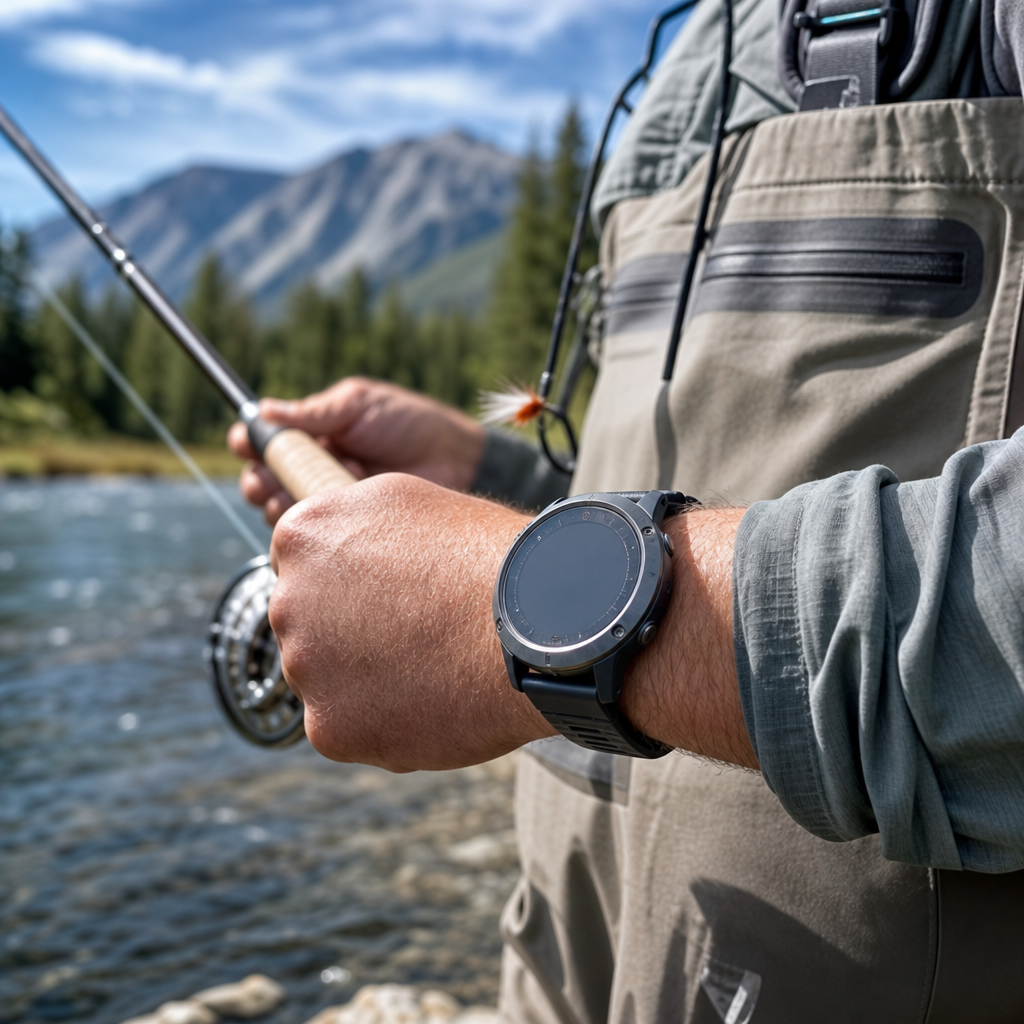
Durability standards matter. For fly fishing, look for at least 10 ATM water resistance on rugged outdoor models, sapphire or strengthened glass on higher-end units, and case materials that resist impact. A watch rated only for casual splashes may survive, but it is not the right tool for repeated dunking, rain, and seasonal abuse. Physical buttons are usually better than touch-only controls because they remain usable when wet. High-end GPS chipsets also matter more than many buyers realize. Multi-band or dual-frequency GPS generally improves tracking around canyon walls, dense tree cover, and steep drainages, where standard signals bounce and drift.
Display technology is a tradeoff. AMOLED screens, found on devices like Garmin Epix or Apple Watch Ultra, look excellent and are easy to read for maps and notifications. They also draw more power. Memory-in-pixel screens, common in Garmin Fenix Solar and Instinct lines, are less flashy but exceptionally efficient outdoors. I have found that anglers who take multi-day trips usually appreciate battery life more than visual polish, while anglers fishing day trips close to charging tend to prefer the brighter displays.
Best Smartwatch Categories for Fly Anglers
The best overall fly fishing smartwatch for most serious anglers is usually a Garmin Fenix or Epix model because these lines balance maps, sensors, durability, and software maturity better than rivals. Fenix suits battery-focused users, especially solar versions, while Epix suits anglers who want a brilliant display for map reading. Both support waypoint marking, TracBack routing, storm alerts, pulse oximetry on many versions, and broad accessory integration. They are expensive, but they are complete tools.
The best rugged value option is often Garmin Instinct 2 or Instinct 2X. These watches drop detailed onboard cartography in many configurations, but they retain excellent battery life, strong GPS performance, and practical outdoor functions. For anglers who mostly need coordinates, route tracking, sunrise data, moon phase, and weather trend context, Instinct offers outstanding utility without premium pricing. The 2X in particular stands out for endurance and readability.
Apple Watch Ultra is the best pick for anglers who want one device for daily life, fitness, communication, and occasional river navigation. Its bright display, cellular options, Backtrack feature, siren, and third-party apps are genuine strengths. However, it is not the best remote-trip watch. Battery life remains its limiting factor, and serious backcountry anglers should assess charging plans carefully. COROS Vertix models are compelling for battery-first users, especially on expedition-style trips. Suunto Vertical also deserves attention for offline mapping and strong outdoor credentials.
| Model | Best For | Main Strength | Main Limitation |
|---|---|---|---|
| Garmin Fenix | All-around serious anglers | Balanced maps, sensors, battery | High price |
| Garmin Epix | Map clarity and premium display | AMOLED readability | Shorter battery than Fenix |
| Garmin Instinct 2/2X | Rugged value buyers | Excellent endurance | Less map detail |
| Apple Watch Ultra | Daily wear and smart features | Display and app ecosystem | Battery management |
| COROS Vertix | Long remote trips | Outstanding battery life | Weaker app ecosystem |
| Suunto Vertical | Route-focused outdoor users | Offline maps | Smaller accessory ecosystem |
Features That Actually Help on the Water
GPS waypoint marking is one of the most useful overlooked functions in fly fishing. It lets you save the exact location of a productive seam, a safe put-in, a parking turnout, or a trail split in low light. On western rivers with multiple side channels, this can save substantial time on return hikes. Topographic maps help identify contour lines, feeder creeks, road access points, and elevation changes between runs. In saltwater, tide apps and moon data matter more. A striper or redfish angler often benefits from tide stage information every bit as much as from route tracking.
Barometric trend data is more useful than many weather widgets because pressure changes can signal approaching instability before rain arrives. On mountain streams, I pay close attention when a watch begins showing a falling trend alongside cloud build-up. It is not a replacement for a full forecast, but it is a practical warning. Altimeters are similarly helpful when approaching alpine lakes or gauging how much climbing remains before dusk. Compasses are useful, but calibration quality matters. Cheap digital compass behavior can be erratic after impacts or temperature swings.
Health and training metrics may seem secondary, yet they have real value. Guides, hike-in anglers, and older fishers benefit from heart rate trends, recovery metrics, sleep data, and exertion tracking across long days. These features should not drive a purchase, but they add meaningful context if the watch already meets outdoor needs. Notification handling is another quality-of-life feature. Quiet vibration for texts or weather alerts can be helpful during travel or while coordinating shuttle logistics, provided you disable distractions once fishing begins.
How to Choose Based on Fishing Style and Budget
Start with where and how you fish. If most of your trips are day outings on familiar trout water, you probably do not need a thousand-dollar flagship. A Garmin Instinct 2, Instinct 2X, or a discounted older Fenix can cover the essentials better than a general-purpose fashion wearable. If you routinely bushwhack into remote water, fish multi-day backcountry routes, or guide in changing mountain weather, invest in strong battery life, dependable buttons, offline navigation, and robust construction. Those are not luxury features in remote fishing; they are risk-management tools.
Budget also affects replacement expectations. Premium watches can last years, but batteries eventually degrade, straps wear, and software support evolves. Buyers should weigh total ownership, not just launch price. A prior-generation Garmin Fenix often represents better value than a newer mainstream smartwatch because it remains purpose-built for outdoor use. Refurbished units from reputable sellers can be sensible if battery health and water resistance are verified. Avoid choosing on marketing categories alone. “Adventure” branding means little without practical details like GPS accuracy, map storage, and button reliability when wet.
Comfort is the final filter. A watch that is too heavy or too large for your wrist may interfere with casting mechanics or simply get left at home. Nylon hook-and-loop straps, silicone bands with secure keepers, and corrosion-resistant hardware all improve long-term use. Try to match case size to your wrist and clothing system. Thick cuffs, rain jackets, and layering can make oversized cases frustrating.
Common Mistakes and Final Recommendations
The most common mistake is overvaluing generic smartwatch features and undervaluing outdoor fundamentals. A river watch needs endurance, visibility, controls, and reliable navigation first. Fancy app variety matters less if the battery is low by late afternoon or the screen becomes awkward in rain. Another mistake is assuming water resistance ratings make every watch equally suitable for fishing. They do not. Construction quality, gasket durability, and long-term sealing are what matter in repeated real use.
For most readers shopping top fly fishing smartwatches, the safest recommendation is Garmin. Choose Fenix if you want proven all-around performance, Epix if display quality leads your list, and Instinct 2X if value and battery life matter most. Choose Apple Watch Ultra if you want a highly capable everyday smartwatch that can fish well, especially on shorter or better-supported trips. Choose COROS Vertix or Suunto Vertical if endurance and route management are your top priorities and you accept a different software ecosystem.
The best watch is the one that supports your fishing style without demanding attention. Prioritize navigation, battery life, weather tools, and durability, then compare comfort and software. From there, read deeper model-specific reviews, check current pricing, and match the watch to the waters you fish most. Done well, this purchase will improve safety, simplify logistics, and help you spend more time focused on currents, casts, and fish.
Frequently Asked Questions
What features matter most in the best fly fishing smartwatch?
The most important features in a fly fishing smartwatch are the ones that solve real on-the-water problems, not just the ones that look impressive on a spec sheet. For most anglers, GPS and navigation are at the top of the list. A good watch should let you mark access points, productive runs, launch sites, camps, and safe return routes. This is especially useful when you are exploring unfamiliar water, hiking into remote streams, or navigating back after changing light or weather conditions.
Weather tools are also extremely valuable. A built-in barometer, storm alerts, altitude tracking, and temperature trends can help you anticipate changing conditions before they become obvious on the river. Since trout behavior and insect activity are often influenced by weather shifts, these readings can also help you make better tactical decisions. Water-resistant construction is non-negotiable, and not just for splash protection. Fly fishing involves repeated immersion, rain exposure, wet hands, and accidental submersion, so the watch should be designed for legitimate outdoor use.
Battery life is another major consideration. A smartwatch that dies halfway through a long float trip or backcountry day is far less useful than one built for extended GPS sessions. Anglers should also look for screen visibility in bright sunlight, easy button-based controls for use with wet fingers or gloves, and compatibility with smartphone apps for route planning and trip review. In practical terms, the best fly fishing smartwatch is one that combines dependable navigation, weather awareness, rugged durability, and enough battery life to last through demanding days on the water.
How can a smartwatch actually help while fly fishing, beyond telling time?
A smartwatch can be surprisingly useful during a fly fishing trip because it serves as a compact field tool rather than just a wearable gadget. One of its biggest advantages is reducing the need to constantly pull out a phone or dig through a pack. If you are wading, drifting, or hiking between runs, quick access to navigation, weather data, elevation, and location marking can make your day smoother and safer. Instead of trying to remember where you found active fish, you can drop a GPS marker and return to the same seam, pool, or side channel later.
It also helps with decision-making. Watching pressure changes, incoming weather fronts, or the time remaining until sunset can influence how you fish a stretch of river. For example, if a smartwatch shows a falling barometric trend and an approaching storm, you may decide to leave open water earlier or move closer to an exit point. If you are on a larger river system, a smartwatch can help you stay oriented around access points and avoid taking a wrong turn back through brush, side channels, or steep banks.
Many anglers also use smartwatches for trip logging and performance tracking. You can record distance covered on foot, total time on the water, elevation gain on backcountry approaches, and in some ecosystems even correlate fish activity with conditions over time. That kind of data can be useful if you fish the same waters throughout a season and want to notice patterns. In short, a smartwatch helps organize information that anglers already pay attention to, but it keeps that information instantly available on the wrist where it is easiest to use.
Are fly fishing smartwatches accurate enough for navigation and weather tracking?
In most cases, yes, high-quality outdoor smartwatches are accurate enough to be genuinely useful for fly fishing navigation and weather awareness. GPS accuracy on modern devices is generally strong enough to mark access points, note productive holding water, track hiking routes, and guide you back to a vehicle or camp. Premium models often improve location precision further by using multiple satellite systems and advanced positioning modes, which can be especially helpful in canyons, dense tree cover, or mountain terrain where signal conditions are more challenging.
That said, anglers should understand the limits of wrist-based tools. A smartwatch is excellent for practical field navigation, but it is not a replacement for common sense, local knowledge, or backup planning in remote country. If you are deep in backcountry terrain, a dedicated map, offline navigation plan, or additional emergency communication device may still be wise. GPS performance can also vary based on satellite visibility, update frequency, and battery-saving settings, so accuracy depends partly on how the watch is configured.
Weather tracking works similarly. Built-in barometric sensors and storm trend alerts can be very useful for detecting changes in pressure and identifying deteriorating conditions, but they do not replace a full forecast or local river report. They are best used as immediate, situational indicators. For fly anglers, that can still be extremely valuable. Knowing that pressure is dropping, weather is shifting, or elevation and temperature are changing gives you actionable information right where you need it. The key is to treat a smartwatch as a reliable field aid, not a flawless standalone forecasting system.
What should anglers look for in battery life, durability, and water resistance?
Battery life, durability, and water resistance are some of the most important buying factors because fly fishing often puts gear into harsh, wet, and unpredictable environments. A watch may look advanced in a product listing, but if the battery drains quickly during GPS use or the case cannot handle repeated exposure to water and impact, it will not be a strong choice for serious anglers. Ideally, a fly fishing smartwatch should provide enough battery for a full day of active tracking at minimum, with longer endurance preferred for float trips, travel, and backcountry outings.
Durability matters because watches get scraped against rocks, brushed against trees, soaked in rain, and bumped while handling rods, nets, and packs. Materials like reinforced polymer housings, stainless steel or titanium bezels, and scratch-resistant glass can make a significant difference over time. Button controls are often more dependable than touch-only systems when the screen is wet or your hands are cold. A readable display in direct sun is also important, since many fishing days involve open water and bright conditions where lower-quality screens become difficult to see.
As for water resistance, anglers should not settle for vague splash-proof language. Look for a device designed for real outdoor and aquatic use, with a rating appropriate for immersion and repeated exposure. Even if you are not swimming with it, fly fishing regularly means wet wrists, submersion while landing fish, rainstorms, and accidental drops into current. A dependable smartwatch for fishing should be built with the assumption that water exposure is routine, not occasional. In practical terms, long battery life, rugged construction, and true water resistance are what make a smartwatch trustworthy on the river.
Is a fly fishing smartwatch worth it for casual anglers, or is it mainly for serious enthusiasts?
A fly fishing smartwatch can be worth it for both casual anglers and dedicated enthusiasts, but the value depends on how you fish and which features you will actually use. For a serious angler who regularly explores new water, hikes into remote areas, tracks conditions closely, and spends full days outside, the benefits are easy to justify. Navigation tools, weather awareness, route marking, activity tracking, and durable all-day wear become part of the fishing system, not just an optional extra. In that context, a smartwatch can save time, improve safety, and make each outing more efficient.
Casual anglers can benefit too, especially if they want straightforward convenience. Even if you do not analyze pressure trends or build detailed trip logs, it is still useful to have quick access to time, sunset information, incoming weather, basic maps, and GPS location marking. That can make local trips easier and reduce reliance on a phone near water. For someone who fishes a few times a season, camps occasionally, or wants one wearable for fishing, hiking, and general outdoor use, a well-chosen smartwatch can offer plenty of practical utility.
The real question is whether you are paying for features you will use. If you mostly fish close to home, stay on familiar water, and do not care about navigation or weather metrics, then a premium fishing-oriented smartwatch may be more than you need. But if you value convenience, safety, and better situational awareness, it can be a smart investment even for recreational use. The best approach is to match the watch to your fishing style rather than assuming the most expensive model is automatically the right one.