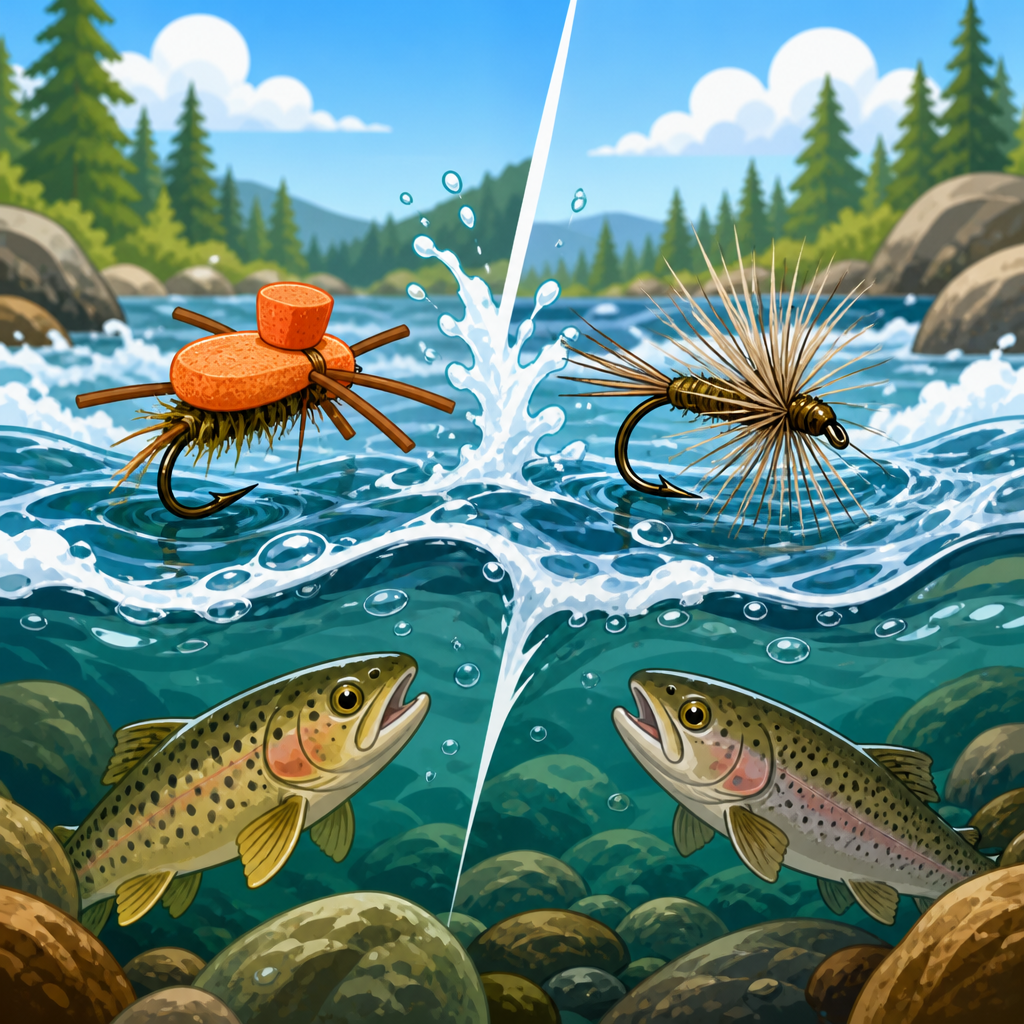
Foam dry flies and hackled dry flies solve the same problem in fast water, but they do it with different materials, different mechanics, and different strengths on the stream. In fly fishing, a dry fly is any pattern designed to float and imitate an insect or other food item on the surface film. Foam refers to closed-cell synthetic material that traps air and resists saturation, while hackle refers to stiff rooster feathers wound around the hook to support the fly on many contact points. Fast water means pocket water, riffles, chutes, broken seams, and turbulent runs where current speed, surface tension, and drag all work against a natural drift. Choosing between foam dry flies vs. hackled dry flies in fast water matters because buoyancy, visibility, durability, profile, and presentation all change with water speed.
I have fished both styles extensively on freestone rivers, tailwater riffles, and small mountain streams, and the difference is not academic. In heavy chop, a fly that rides high enough to track visually can turn refusals into takes simply because it stays in the feeding lane longer. In calmer slots within fast runs, though, too much bulk or too rigid a footprint can look wrong, especially when trout key on mayflies, caddis, or terrestrials of a specific size. Anglers looking for the best dry fly for fast water usually need a practical answer: which style floats better, lands more naturally, and hooks fish more consistently under real conditions. This guide answers that question while also serving as a hub for the wider types of flies conversation, because understanding dry flies becomes easier when you place them beside nymphs, emergers, wet flies, streamers, terrestrials, and attractor patterns.
At the broadest level, types of flies are categories built around where the pattern fishes and what behavior it imitates. Dry flies ride on top. Emergers sit in or just below the film. Nymphs drift subsurface as immature insects. Wet flies and soft hackles suggest ascending insects or drowned adults. Streamers imitate baitfish, leeches, or large prey. Terrestrials imitate land-based insects such as ants, beetles, and hoppers. Within the dry fly category, foam and hackled designs represent two major schools of construction. The question is not which one is universally better. The useful question is which one is better for a specific current type, hatch stage, trout mood, and visibility problem. Once you think that way, fly selection becomes more precise and much less frustrating.
How fast water changes dry fly performance
Fast water amplifies every weakness in a dry fly. Broken surfaces pull water over the hook bend, micro-eddies twist leaders, and conflicting currents drown patterns that would fish fine on a spring creek. Trout in these places often have less time to inspect a fly, but they still reject patterns that skid, drown, or drift unnaturally across current tongues. In practical terms, a good fast-water dry fly must do four things: float through turbulence, remain visible to the angler, land with enough softness to avoid spooking fish in short pockets, and recover after repeated drifts without constant drying.
Foam excels because it provides inherent buoyancy independent of delicate surface support. A Chubby Chernobyl, Club Sandwich, or foam beetle can take on rough treatment and still ride high after multiple fish. Hackled flies rely more on the geometry of stiff fibers, clean dressing, and floatant maintenance. A well-tied Royal Wulff, Elk Hair Caddis, or heavily hackled Adams can be superb in riffles, but if slimed, chewed, or overdressed with water, performance drops faster than a foam pattern. That difference matters most when you are covering many short pockets and need the fly to stay fishable for dozens of quick presentations.
Not all fast water is the same, however. In plunge pools and foam lines, trout often react to general shape, movement, and timing. In slick cushions beside boulders, they may have a cleaner window and a better angle. There, the lower, more insect-like footprint of a hackled dry fly can outfish a big foam pattern. Fast water rewards buoyancy, but selectivity still exists. The best anglers treat current complexity as a map of micro-habitats, then match fly style to each target rather than fishing one answer everywhere.
Foam dry flies: buoyancy, visibility, and modern fast-water utility
Foam dry flies are built to stay afloat under stress. Closed-cell foam does not absorb water like natural hair, dubbing, or feather fibers, so the pattern retains lift after repeated drifts and fish eats. In fast water, that translates into less false drying, less powder desiccant use, and more time with the fly actually fishing. Modern guide favorites such as the Chubby Chernobyl, Morrish Hopper, and various foam stonefly patterns became popular for a reason: they support heavy droppers, remain visible in glare, and survive dozens of trout.
Another strength is strike detection. In turbulent runs, visual tracking is often harder than drag-free drifting. A foam post, wing, or overbody gives the angler a clear target. That improves hook timing, especially at distance or in late-day shadow. Foam also allows high-floating attractor design. A large foam stonefly in sizes 6 to 12 can suggest salmonflies, golden stones, cicadas, or simply a substantial surface meal, and trout in pocket water frequently attack that silhouette without demanding exact imitation.
The tradeoff is realism. Foam can create extra thickness, shine, and angular shape. On rivers where trout are feeding narrowly on pale morning duns, blue-winged olives, or smaller caddis, a generic foam fly may ride too high or look too coarse. I have also found that some foam patterns twist leaders if tied with bulky wing stacks or uneven bodies, especially on light tippet in gusty canyon currents. Foam is not a magic material; it is a buoyancy tool. It works best when flotation, suspension, and visibility are the primary problems to solve.
Hackled dry flies: tradition, footprint, and hatch precision
Hackled dry flies remain essential because they match many natural insects better than foam can. Genetic dry-fly hackle from lines developed by breeders such as Whiting Farms produces stiff, uniform fibers that support the hook while allowing a slimmer body and more refined silhouette. Classic patterns like the Adams, Comparadun variations with hackle components, Royal Wulff, Humpy, and Elk Hair Caddis cover a vast range of mayfly and caddis situations. In fast water, hackled flies can ride surprisingly well if proportions are correct and hackle quality is high.
The biggest advantage is a convincing surface footprint. Trout do not only see the top of a fly. They see the underside, the body segmentation, and the way the pattern sits in the film. Hackled flies often offer a more insect-like contact profile than foam blocks do. During caddis activity, for example, an Elk Hair Caddis skittered or dead-drifted through riffles can look alive in a way many foam flies do not. During a mayfly hatch in broken current, a parachute Adams or high-floating attractor with proper hackle can split the difference between buoyancy and realism very effectively.
The weakness is maintenance. Hackled patterns fish best when hackle fibers remain clean, splayed, and dry. Fish slime, false casts, and rough landings can collapse them. CDC-enhanced or low-riding hackled patterns are especially vulnerable in heavy chop. I routinely carry amadou, silica powder, and gel floatant because a hackled fly that is not maintained becomes an emerger by accident. Sometimes that helps. Often in fast water it simply makes the fly hard to see and less able to support itself through the drift.
When to choose one over the other
The decision becomes clearer when you break it into river situations, insect signals, and rigging needs.
| Situation | Best choice | Why |
|---|---|---|
| Heavy pocket water with short drifts | Foam dry fly | Maximum buoyancy, visibility, and durability |
| Fast riffle with active caddis | Hackled dry fly | Better insect profile and lively footprint |
| Dry-dropper with weighted nymph | Foam dry fly | Supports extra weight without drowning |
| Selective trout in fast slick seams | Hackled dry fly | Cleaner silhouette and subtler presentation |
| Windy terrestrial season | Foam dry fly | Floats after splashy casts and remains visible |
| Technical mayfly hatch in broken water | Hackled dry fly | Closer match in size, posture, and body shape |
If I am prospecting unfamiliar water, I usually start with foam because it eliminates variables. A buoyant attractor lets me cover water, suspend a dropper if needed, and detect fish quickly. Once I find feeding lanes or notice refusals, I may switch to a hackled pattern that matches the insects more faithfully. This progression is efficient and mirrors what many guides do on Western freestones. Search first, refine second.
Fly size also matters. In larger sizes, foam often dominates because the extra bulk looks plausible on hoppers, stoneflies, beetles, and attractors. In smaller sizes, especially 14 through 20, hackled dries generally offer cleaner proportions. Tiny foam flies exist, but many become fiddly to tie and less elegant in profile than a conventional dry. Hook style matters too. Wide-gap dry fly hooks improve hookups on some foam patterns, while standard dry fly hooks preserve the slender look of many hackled designs.
Where these patterns fit within the broader types of flies
As a hub for types of flies, this comparison makes more sense when placed in the full fly selection framework. Dry flies are surface tools used when trout are willing to rise or when you want to suspend another fly. Emergers bridge the gap between dry and subsurface presentations and are often deadly when trout refuse high floaters. Nymphs are usually the most consistent producers because many aquatic insects spend most of their life underwater. Wet flies and soft hackles shine when insects ascend or when trout feed just under the film. Streamers target predatory behavior, not hatch matching. Terrestrials become important from late spring through fall, especially along grassy banks. Attractor patterns, including many foam dries, trigger reaction strikes even when no obvious hatch is present.
Understanding these categories prevents a common mistake: forcing a dry fly answer when the fish are not truly feeding on top. In fast water, rises can be splashy and misleading. Trout may be intercepting emergers inches below the surface. If a foam or hackled dry is drawing looks but no eats, the better move may be an emerger dropper, a soft hackle swung through the lane, or a lightly weighted nymph under a buoyant dry. The best anglers move fluidly among fly types instead of treating categories as rigid camps.
For anglers building a compact box, a practical types-of-flies system works well. Carry a few foam attractors, a few hackled caddis and mayflies, slim emergers, beadhead nymphs in proven shapes, one or two soft hackles, and a handful of streamers. That spread covers the feeding column. As a hub topic, types of flies is not about memorizing hundreds of patterns. It is about knowing what each class is meant to do, then selecting the one that solves the fish’s current feeding problem.
Tying considerations, materials, and common mistakes
If you tie your own flies, material choice explains much of the foam dry flies vs. hackled dry flies debate. Foam thickness controls buoyancy and shape; 2 millimeter and 3 millimeter sheets are common for terrestrials and stoneflies. Too much foam creates a cork that lands hard and spins the tippet. Too little foam defeats the purpose. For hackled flies, hackle density, barb stiffness, and body taper are critical. Oversized hackle can prop the fly up unrealistically, while undersized hackle causes sinking in fast current. A useful rule is to match hackle length to about one and a half hook gaps for many general-purpose dries, then adjust by pattern style.
Thread control matters more than many tyers realize. Compressing foam too tightly can cut it or distort the body. Crowding the eye with stacked materials ruins tippet threading on stream. With hackled flies, uneven wraps and trapped fibers create listing, poor balance, and weak flotation. I also see anglers overdress both styles with floatant. Gel on foam can add shine and collect scum. Too much paste on hackle mats fibers together. Powder desiccant is often a better recovery tool after the fly has been fished.
Durability differs in specific ways. Foam bodies resist saturation, but thread cuts, UV damage, and tooth tears eventually split them. Hackled flies may fail at the tie-in points, hackle stem, or tail fibers. In my boxes, foam patterns last longer through repeated fish, while hackled flies maintain a more refined appearance when new. If you fish hard, that tradeoff is worth noting. Patterns are tools, not ornaments. Tying for function usually catches more trout than tying for display.
Practical recommendations for anglers
If your main question is which style to buy first for fast water, start with both, but assign them clear jobs. Use foam for pocket water, dry-dropper rigs, windy days, terrestrial season, and low-light visibility. Use hackled dries for caddis riffles, mayfly-driven feeding, flatter cushions inside fast currents, and any situation where trout inspect the fly slightly longer. On many rivers, the smartest approach is not foam versus hackle but foam first, hackle when needed.
Three patterns in each camp will cover most situations. For foam, carry a Chubby Chernobyl, a foam beetle or ant, and a dedicated foam stonefly. For hackled dries, carry an Elk Hair Caddis, a Parachute Adams, and a high-floating attractor such as a Royal Wulff or Humpy. Vary sizes before colors. Trout usually care more about drift, size, and posture than tiny color differences in fast water. Keep floatant simple, dry your flies regularly, and watch the drift path more than the fly itself. Good line control makes both styles better.
Ultimately, foam dry flies vs. hackled dry flies in fast water is a matter of function, not ideology. Foam gives you flotation, toughness, and visibility. Hackle gives you finesse, a natural footprint, and stronger hatch matching. Learn where each belongs within the broader types of flies, and your fly selection will become faster, more confident, and more productive. If you want to improve your topwater results, build a small box around both styles, fish them side by side on your next fast-water trip, and let the trout show you when each answer is right.
Frequently Asked Questions
What is the main difference between foam dry flies and hackled dry flies in fast water?
The main difference is how each style stays afloat and maintains visibility in broken current. Foam dry flies rely on closed-cell synthetic foam, which naturally traps air and resists water absorption. That gives them strong inherent buoyancy, even after repeated drifts, strikes, or rough treatment in turbulent runs and pocket water. Hackled dry flies float differently. Instead of a buoyant body material doing most of the work, they use stiff rooster hackle fibers wound around the hook to create many tiny contact points on the water’s surface. Those fibers spread the fly’s weight and help it ride high on the surface film.
In practical terms, foam flies are usually more forgiving in heavy, fast, choppy water because they keep floating with less maintenance. They are often easier to see, harder to sink, and better suited to rough currents where fish have very little time to inspect a fly. Hackled dry flies, by contrast, often offer a more delicate, traditional silhouette and can match many natural insects more precisely. They can be excellent in fast water too, especially when tied with quality hackle and fished on appropriate tippet, but they typically require more attention to drying and floatant over the course of a day. So while both patterns are designed to solve the same challenge—keeping a fly on top where trout can find it in fast current—they do it through entirely different mechanics, and those mechanics shape when each fly performs best.
Which type of dry fly floats better in fast water?
If the question is strictly about raw buoyancy and durability on the surface, foam dry flies usually have the advantage in fast water. Foam is naturally water-resistant and remains buoyant without depending entirely on delicate surface tension. In broken riffles, plunge pools, pocket water, and turbulent seams, that matters a lot. A foam pattern can be battered by repeated casts, dragged through rough chop, or eaten and released multiple times, and it will often continue riding high with minimal fuss. That makes foam especially valuable when fishing fast currents where constant false casting and fly drying would otherwise interrupt the rhythm of presentation.
That said, “floats better” does not always mean “fishes better” in every situation. A well-tied hackled dry fly with good genetic hackle can float impressively well and often lands lighter than a bulkier foam pattern. In certain currents, especially when fish are keyed on mayflies, caddis, or attractors with a more natural profile, a hackled fly may drift in a way that looks more convincing. It may sit in the film with a subtler footprint, and that can matter when trout are feeding selectively, even in relatively swift water. So the best answer is this: foam generally wins on pure flotation and staying power, while hackled flies can still be extremely effective when presentation, profile, and imitation matter as much as buoyancy.
When should I choose a foam dry fly over a hackled dry fly in fast-moving streams?
Choose a foam dry fly when you need maximum flotation, easy tracking, and minimal maintenance. Fast-moving streams often create conflicting currents, turbulent pockets, and short drift windows, and foam shines in exactly those conditions. If you are fishing pocket water, high-gradient freestone streams, boulder gardens, or riffled banks where the fly gets knocked around by the current, foam gives you a margin of error. It is also an excellent choice when using a dry-dropper rig, because the added buoyancy helps support the weight of a nymph below. In many real-world fast-water situations, that practical advantage alone makes foam the better tool.
Foam is also the better choice when fish are opportunistic rather than selective. In rough current, trout often have only a second or two to react. They may be looking for a clear, visible target rather than studying exact proportions. High-floating foam terrestrials, hoppers, beetles, chubby-style attractors, and foam-bodied stimulators can all draw aggressive takes in these conditions. Another reason to favor foam is visibility for the angler. In fast water, being able to track your fly instantly can improve hooksets and reduce missed eats. If the water is rough, the light is bad, or you are guiding a less experienced angler, foam often makes the entire system easier to fish effectively. In short, choose foam when toughness, floatation, and fishability are the top priorities.
When are hackled dry flies the better option in fast water?
Hackled dry flies are often the better option when you want a more refined insect profile, a lighter presentation, or a drift that more closely matches a specific hatch. Fast water does not automatically mean fish stop caring about silhouette or proportion. On many rivers, trout feeding in riffles and runs still key in on mayflies, caddis, stoneflies, and emergers with surprising precision. A classic hackled fly can suggest legs, body shape, and wing posture in a way that many foam patterns do not. If fish are rising consistently but refusing larger, more buoyant attractors, switching to a hackled dry can be the move that turns inspection into commitment.
Hackled flies also excel when you want the fly to land softly and behave with a little more subtlety on the surface. Some foam flies, especially larger ones, create more disturbance on landing and can sit unnaturally high in the water compared with the insects trout are actually eating. A properly tied hackled pattern can ride beautifully, maintain a more classic dry-fly footprint, and still hold up in moderate to fast current if treated with quality floatant and kept reasonably dry. They are especially valuable during hatches where trout are tuned to familiar shapes such as Elk Hair Caddis, parachute-style mayflies, Royal Wulffs, Adams variants, or other high-floating traditional patterns. In these moments, hackle is not just a flotation system; it is part of the imitation itself.
Can foam and hackled dry flies be used together or combined in one pattern for fast water?
Yes, and in many cases that combination gives you the best of both worlds. Some of the most effective fast-water dry flies blend foam and hackle specifically because the two materials complement each other so well. Foam provides dependable buoyancy and helps the fly remain visible and unsinkable in rough current. Hackle adds movement, a more insect-like footprint, and additional support across the surface film. This hybrid design can create a fly that is durable, easy to track, and still convincing enough to fool trout that are feeding aggressively but not blindly.
Many modern attractor and searching patterns for fast water use exactly this formula. A fly might have a foam back, foam post, or foam body for flotation, combined with palmered hackle or a parachute hackle arrangement to stabilize the drift and improve appearance. These flies are especially useful when you want a pattern that can handle repeated drifts through pocket water, support a dropper, and remain visible at distance. They are also a smart compromise for anglers who appreciate the fishability of foam but do not want to give up the traditional dry-fly qualities that hackle provides. In other words, foam versus hackle is not always an either-or choice. On many rivers, especially in fast water, the most practical answer is a thoughtfully balanced mix of both.